
Overview of Russian Cherry Varieties
1. General Statistics from the State Register of Breeding Achievements (2024)

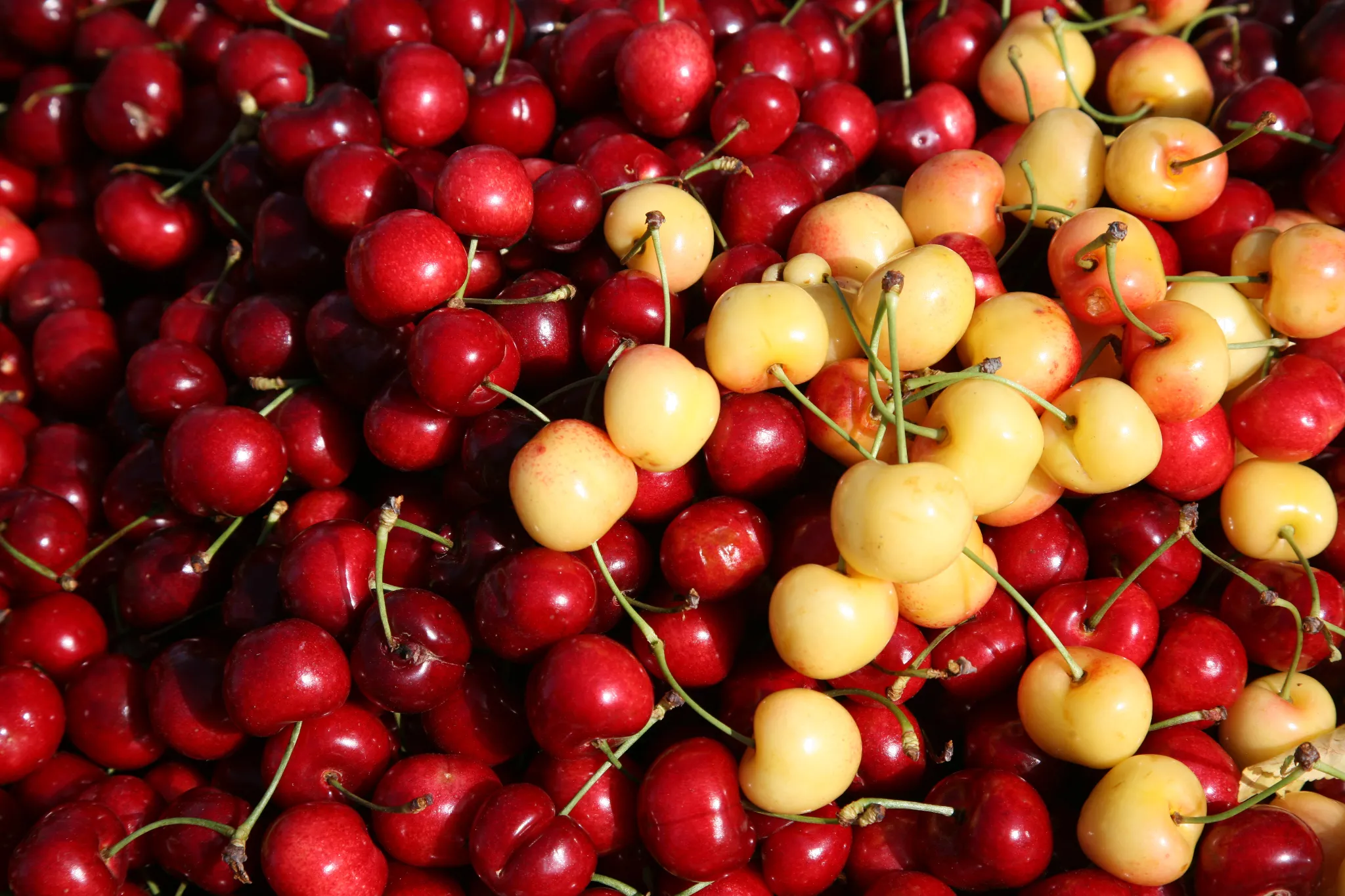
Assortment of different sweet cherry varieties at a farmers market
The photograph contrastingly presents both dark red varieties and light (yellow with pink blush) berries. The image illustrates the seasonal diversity of sweet cherries presented on a farmers market stall (the original description mentions that four different varieties were presented at the "Temps Des Cerises" stand).
If you have decided to plant cherries, the first thing to figure out is choosing a variety. In Russia, more than one and a half hundred varieties of this crop are officially approved for use. All of them are included in the State Register of Breeding Achievements, which is updated annually and serves as the main reference for gardeners, farmers, and nurseries.
As of 2024, the situation is as follows:
- Common cherry (Cerasus vulgaris) — 99 varieties. This is the most numerous and familiar group for the middle belt. These are the fruits we most often see in markets and on country plots.
- Felt cherry (Cerasus tomentosa) — 17 varieties. Distinguished by pubescent leaves and shoots, a compact bush, and very sweet, tender fruits.
- Sand cherry (Cerasus pumila) — 6 varieties. So far a small group, but it is rapidly gaining popularity due to its high drought and winter hardiness.
- Steppe cherry (Cerasus fruticosa) — 30 varieties. Low-growing, frost-resistant shrubs that are well‑suited for harsh continental regions.


Photograph of branches of sour cherry (Prunus cerasus) with numerous ripe bright red fruits (drupes) and green leaves


Photograph of a Nanking cherry bush (Prunus tomentosa) with numerous small bright red fruits (Saratov, Russia)


Fruiting of sand cherry (Prunus pumila) on a rocky coast
The plant has elongated green leaves and dark purple (almost black) ripe fruits. The shrub grows in a natural environment on rocky/gravelly soil, which is characteristic of this species. Location: South St. Marys Island, city of Sault Ste. Marie, Ontario, Canada.

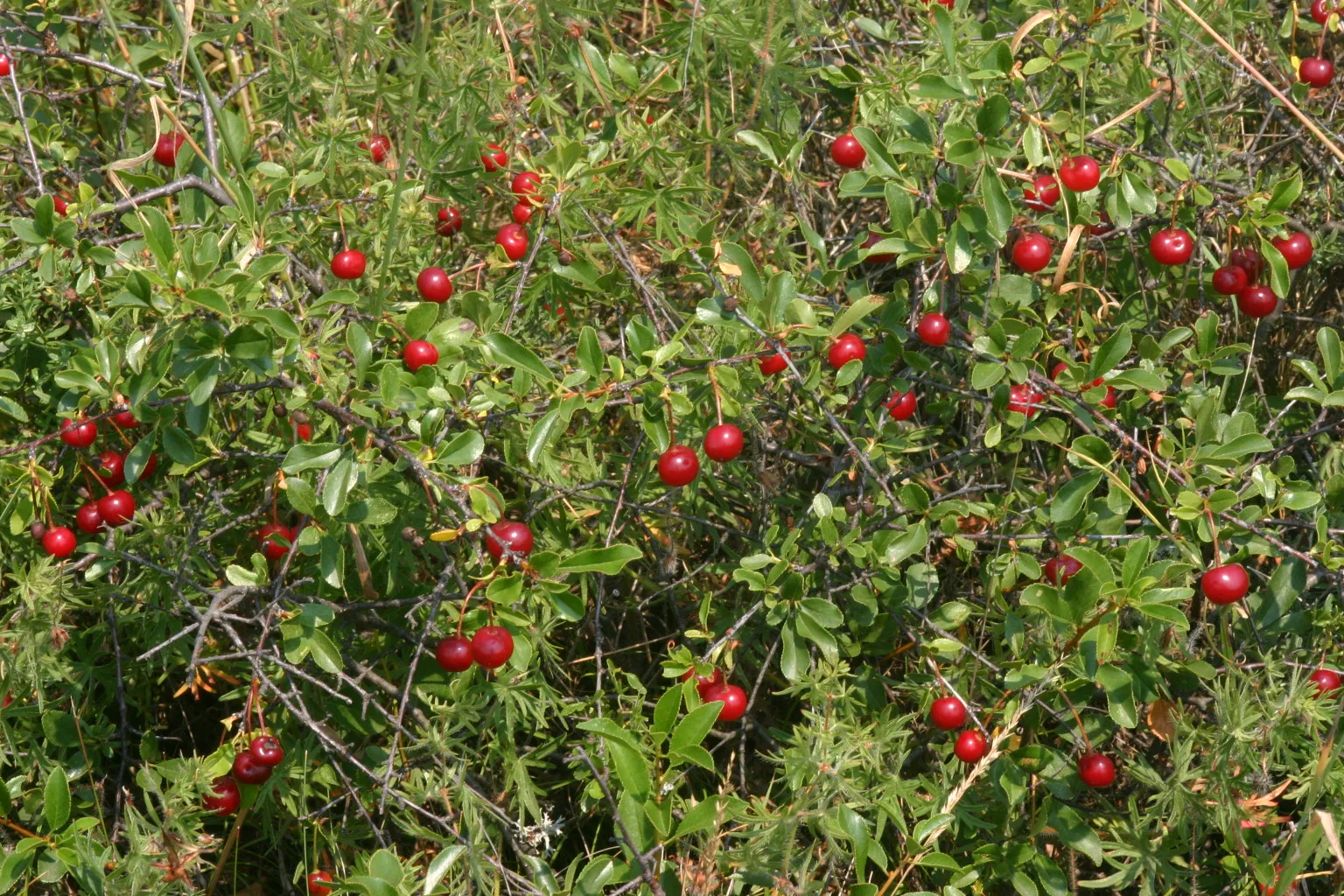
Fruits of the dwarf cherry (Prunus fruticosa)
The species is a low-growing shrub often used in breeding as a winter-hardy and drought-resistant rootstock for cultivated cherry varieties.
The Oldest Varieties: “Long‑livers” of the Register
Among modern novelties, the register still contains varieties that were included as early as the mid‑20th century. They have stood the test of time and remain in demand—primarily due to their reliability and adaptability to local conditions.
Here are a few striking examples (with the year of inclusion):
Common cherry:
- Vladimirskaya (1947) — a classic variety of the middle belt. A bush‑like tree with small but very tasty dark red fruits. It still remains a standard for many regions.
- Lyubskaya (1947) — a late‑ripening technical variety. Low‑growing, highly self‑fertile, produces stable yields of dark, almost black berries with a sour taste—ideal for processing.
- Shubinka (1959) — an old Moscow variety with small, sourish fruits. Valued for its high winter hardiness of wood and unpretentiousness.
- Griot Moskovsky (1959) — the result of selection from an ancient clone. It features abundant and annual fruiting, although it is severely affected by coccomycosis.
Steppe cherry:
- Uralskaya rubinovaya (1959) — a low‑growing shrub with dark red berries. Bred for the harsh conditions of the Urals and Western Siberia. Winter hardiness is very high, and resistance to damping‑off is good.
- Shchedraya (1959) — another “veteran” from the same series. The fruits ripen unevenly, but the yield is stable. Used mainly for technical processing.
Felt cherry:
- Leto (1965) — one of the first officially registered varieties of this group. Fruits are large, light pink, with dense flesh. It has been under trial since 1958 and is still recommended for the Far East.
These old varieties are living history of domestic breeding. They do not always produce the largest or sweetest fruits, but their main advantage is proven adaptability. For an amateur gardener who does not want to take risks, they remain a reliable backbone. However, modern varieties generally surpass them in fruit size, disease resistance, and taste—we will discuss this in detail in the following chapters.
2. Overview of the Largest Originators, and Foreign Originators
When you choose a variety, it is important to understand who created it and for what conditions. Behind each name lies years of work by breeders who purposefully selected plants for winter hardiness, yield, disease resistance, and taste. In Russia, there is a whole network of research centres, and each one “specialises” in its own climatic zones.
According to the State Register, the vast majority of cherry varieties are of domestic breeding. Foreign originators are represented by isolated cases, but they are also worth mentioning.
Key Breeding Centres of Russia
1. Federal Horticultural Research Centre (FHRC, Moscow)
The oldest and one of the most authoritative centres. It has bred such “star” varieties as Vladimirskaya, Lyubskaya, Molodyozhnaya, Pamyat YEnikeeva, Bryunetka, Volochaevka, and many others. The centre specialises in varieties for the Central region, with emphasis on winter hardiness and resistance to coccomycosis.
2. All‑Russian Research Institute of Fruit Crop Breeding (VNIISPK, Oryol Oblast)
Oryol breeders created varieties widely grown in the Black Earth region and the Centre. Among them are Antratsitovaya, Banketnaya, Businka, Novella, Stoykaya, Shokoladnitsa (famous for its almost black colour). Here, special attention is paid to large fruit size and dessert taste.
3. North Caucasus Federal Horticultural, Viticulture, and Winemaking Research Centre (Krasnodar)
The main “supplier” of varieties for southern regions. The climate here is milder, so breeders focus on large fruit size, high sugar content, and early ripening. Examples: Aleksa, Kazachka, Krasnodarskaya sladkaya, Shakhrazada (with fruits up to 6 g).
4. Ural Federal Agrarian Research Centre (UrFANTS, Yekaterinburg)
The main “forge” of varieties for the harsh Ural climate. Here, not only steppe but also common cherries with outstanding frost resistance (down to –40°C) have been developed. The most famous: Gradskaya, Izobilnaya, Mechta Zauralya, Ozherelye, as well as steppe Uralskaya rubinovaya and Shchedraya.
5. Far Eastern Experimental Station of VIR (Vladivostok)
This centre is the birthplace of almost all regionalised varieties of felt cherry. It is here that Alisa, Vostochnaya, Detskaya, Krasavitsa, Natali, Tsarevna and others were created. Many common cherry varieties for the Far East also come from here.
6. Federal Altai Research Centre for Agrobiotechnology (Barnaul)
The leader in breeding steppe cherry. Varieties such as Altayskaya lastochka, Altayskaya rannyaya, Zhelannaya, Maksimovskaya, Seliverstovskaya, Shadrinskaya were obtained here. All of them are distinguished by exceptional winter hardiness and resistance to damping‑off—the main scourge in snowy Siberian winters.
7. Kazan Research Centre of RAS (Republic of Tatarstan)
This centre specialises in varieties for the Middle Volga region. Notable developments: Volzhskaya, Zarya Tatarii, Krasa Tatarii, Pamyat Sakharova, Tveritinovskaya, Shakirovskaya. Many of them combine winter hardiness with good resistance to fungal diseases.
8. Federal Research Centre named after I.V. Michurin (Tambov Oblast)
The Michurin centre is one of the oldest in Russia. Varieties for the Central Black Earth region have been created here: Vechernyaya zarya, Desertnaya Morozovoy, Zherdevskaya krasavitsa, Romantika, Tamaris, Kharitonovskaya. They are distinguished by large fruits and excellent taste.
“Lone” Originators and Private Breeders
The register includes varieties whose authors are not only institutes but also individual enthusiasts. The most striking example is Vera Petrovna Tsarenko (Vladivostok), who, together with the Far Eastern Station, bred a whole series of felt cherries: Vostorg, Skazka, Smuglyanka vostochnaya, TRIANA, Yubileynaya and others. Such cases show that breeding is accessible not only to large centres.
Foreign Originators
In the State Register, the absolute majority of varieties are Russian. However, there are also “foreigners”. For example:
- Institute of Fruit Growing (Belarus) — variety Zhyvitsa (common cherry). This medium‑early ripening variety is winter‑hardy and disease‑resistant, and has performed well in the Central region.
- Also included in the register are varieties that were imported from Europe long ago and have already become “ours”—for example, Lotovaya (of German origin) and Podbelskaya (considered an old European variety). However, their originators in the register are already Russian institutions, since the varieties underwent long‑term adaptation and trials in the USSR and Russia.
Thus, the modern Russian assortment of cherries is the result of work by dozens of breeders across the country, from the Far East to Krasnodar. When choosing a variety, always pay attention to the originator: if the centre is in your region or in a similar climatic zone, the variety is very likely to thrive there. In the next chapter, we will examine what characteristics the State Register provides and what they mean for the gardener.


LCD 4-in-1 Soil Tester
Check essential growing conditions with one compact tool. Measure soil pH, moisture, temperature and light intensity — ideal for gardens, potted plants and greenhouses.
- 4-in-1 measurement
- Easy-to-read LCD display
- Portable design
Affiliate link · For indicative measurements only.
3. Characteristics Used in the State Register
To enable you to choose a variety knowledgeably, it is important to understand the language of the State Register. Each variety description contains a standard set of parameters. Behind the outwardly dry wording lie practical properties that directly affect how the cherry will grow and bear fruit on your plot. Let us go through them in order.
Ripening Time (Maturity Group)
This is one of the first characteristics to look at. It indicates approximately when you can harvest. The State Register uses a clear gradation:
- Very early — fruits ripen in late June – early July. Examples: Afrodita, Krasnodarskaya sladkaya, Chereshnevaya.
- Early (early‑ripening) — ripening in the first–second decade of July. Examples: Vostorg, Detskaya, Pamyat YEnikeeva.
- Medium‑early — transitional group between early and medium‑ripening. Examples: Bagryanaya, Zherdevskaya krasavitsa, Feya.
- Medium (mid‑season) — the bulk of varieties, ripening in the second half of July. Examples: Vladimirskaya, Bryunetka, Natali.
- Medium‑late — late July – early August. Examples: Antratsitovaya, Mtsenskaya, Orlitsa.
- Late (late‑ripening) — ripening in August. Examples: Alisa (felt), Lyubskaya, Shubinka.
- Very late — isolated varieties, ripening in late August. Example: Morel Bryanskaya.
For the gardener, choosing the ripening time allows you to stretch the fresh berry season over 2–2.5 months, and also to match the variety to the climate: in cold regions, late varieties may simply not have time to ripen.
Purpose of the Variety
The State Register divides all varieties into groups according to their primary use:
- Dessert (table) — fruits are good for fresh consumption, with high taste qualities. Example: Pamyat YEnikeeva.
- Technical — berries are mainly used for processing (jam, juices, compotes, freezing). The taste may be mediocre, but the yield is stable. Example: Lyubskaya.
- Universal — combines suitability for both fresh consumption and processing. Most modern varieties fall into this category. Example: Volochaevka.
In practice, any variety can be used in any way, but the register's indication helps to understand what the breeder focused on.
Self‑fertility
One of the most important characteristics for a small garden.
- Self‑fertile — the variety sets fruit from its own pollen, even if no other cherries are nearby. This is ideal for single plantings. Examples: Assol, Bryunetka, Lyubskaya.
- Partially self‑fertile — some flowers are pollinated by own pollen, but yield will be higher with a pollinator neighbour. Examples: Antratsitovaya, Turgenevka, Kharitonovskaya.
- Self‑sterile — without cross‑pollination it produces virtually no crop. For such varieties, it is necessary to plant other varieties of the same flowering period nearby. Examples: Vladimirskaya, Molodyozhnaya, Natali (felt).
For an amateur gardener, self‑fertility is a huge advantage, but do not be afraid of self‑sterile varieties: by planting 2–3 different varieties the problem is solved.
Winter Hardiness
The State Register describes this characteristic in general phrases: “winter‑hardy”, “relatively winter‑hardy”, “above average”, but for some varieties the minimum temperature that the wood can withstand is indicated (e.g., “down to –32°C” or “down to –40°C”). It is important to distinguish between winter hardiness of wood and of flower buds — in many varieties the wood withstands frost, but the buds may freeze during spring return frosts. This is sometimes specified in the description.
For harsh regions (Urals, Siberia), choose steppe cherry varieties or specially bred winter‑hardy forms. For the south, this criterion is less critical.
Disease Resistance (Coccomycosis, Moniliosis, Clusterosporiosis)
The main enemies of cherries are fungal diseases. The State Register often indicates the degree of susceptibility:
- “relatively resistant”
- “moderately resistant”
- “weakly affected”
- “susceptible”
Varieties resistant to coccomycosis — a disease that in wet years can defoliate and weaken the tree — are especially valued. Examples of resistant varieties: Bryunetka, Volochaevka, Shokoladnitsa, Novella, Pamyat Sakharova. For regions with humid climates, this criterion should be a priority.
Fruit Weight
Indicated in grams, usually average. The range is very wide:
- Small — up to 2.5 g (steppe varieties like Altayskaya rannyaya)
- Medium — from 2.5 to 4 g (most old varieties, e.g. Vladimirskaya)
- Large — 4–5 g (Natali, Turgenevka)
- Very large — more than 5 g (Lava, Shakhrazada, Prichuda)
Large‑fruitedness usually attracts more attention, but small‑fruited varieties often prove more winter‑hardy and undemanding.
Tasting Score
Taste rating of fresh fruits on a 5‑point scale. A value of 4.0 and above is considered good, 4.5 and above excellent. For example, Afrodita — 4.8, Pamyat YEnikeeva — 4.8, Lyubskaya — about 3.5. However, remember that taste is subjective and is influenced by growing conditions: in the sun berries are sweeter than in the shade.
Sugar, Acid, Vitamin C Content
These figures give an idea of the biochemical composition. For example, sugar above 10% means a sweet variety, above 12% — very sweet. Acid above 1.5% gives tartness. Vitamin C (ascorbic acid) can reach 80 mg% in sand cherries — much higher than in common cherries. But for the average gardener, these indicators are only an additional guide; the main thing is the tasting score.
Region(s) of Admission
In the State Register, each variety is assigned to one or more of the 12 regions of Russia (from Northern to Far Eastern). This means that the variety has passed trials and is recommended for those territories. However, as a rule, varieties admitted in many regions (e.g., all 12) are more adaptable and can be grown in a wide range of climates. Old varieties often have a wide admission, modern ones may be narrowly localised.
Date of Inclusion in the Register
The year when the variety was officially registered. Varieties with a date of 1947–1960 are old and proven; from the 1990s — more modern; after 2010 — novelties that may have improved properties but are still little studied in amateur gardening.
Now that we have deciphered the “language” of the State Register, in the next chapter we will compile a rating of the most popular varieties that gardeners most often choose based on reviews and practice.
4. Top Most Popular Varieties
What do gardeners most often look for when they think about planting cherries? We analysed search queries over the past month — and we got a rating that says a lot about real preferences. The top 15 includes both legendary “veterans” and modern hits, as well as a few names that are not in the State Register but are firmly on the minds of summer residents.
Below is a detailed breakdown of each position. Note: the presence of a variety in the State Register is a sign of quality and official recommendation. Absence does not always mean the variety is bad, but it indicates that it either did not undergo trials, or is a hybrid or a species in general.
Top 5 Undisputed Leaders
1. Shokoladnitsa
An official variety included in the register for the Central region. Medium ripening, universal purpose. The main “feature” is almost black, dark‑burgundy fruits with dense flesh, very sweet (tasting score 4.6). The tree is medium‑sized, partially self‑fertile, with relative resistance to coccomycosis. Why is it in the top? The unusual colour and excellent taste attract both amateurs and farmers.
2. Molodyozhnaya
Another official variety (in the register — “Molodezhnaya”). Medium‑late, universal. A low‑growing bush‑type tree — convenient for harvesting and winter covering. Fruits are large (up to 4.5 g), dark burgundy, juicy, sweet‑sour. The main advantage is self‑fertility and high winter hardiness. Relatively resistant to coccomycosis. Popular among central‑belt summer residents for its compactness and stable yield.
3. Vladimirskaya
A classic that needs no introduction. In the register since 1947 — one of the oldest varieties. Medium ripening, self‑sterile, requires pollinators. Fruits are small (2.5–3 g), but very aromatic, sweet‑sour, with a slight tartness. The tree is bush‑like, moderately winter‑hardy. It is valued for its unique flavour and suitability for all types of processing. Despite its small size, it remains in the top thanks to tradition and nostalgia.
4. Lyubskaya
A technical variety known since 1947. Late, highly self‑fertile, very productive. Fruits are large (4–5 g), dark red, but sourish — tasting score about 3.5. The main value is stability: it yields even in unfavourable years. Ideal for jam, compotes and freezing. Popular with those who value practicality rather than dessert taste.
5. Turgenevka
An official variety included in the register for the Central, Central Black Earth and North Caucasus regions. Medium ripening, partially self‑fertile. Fruits are large (up to 4.5 g), dark burgundy, with a semi‑dry detachment. Winter hardiness is good, resistance to coccomycosis is medium. Popular for its balanced taste and reliability.
Popular Varieties Not in the Provided Register
6. Zhukovskaya
This variety is not in the register list, but it is well known to gardeners. Bred in Michurinsk, medium ripening, self‑sterile. Fruits are large (up to 6–7 g), dark red, dessert taste. Yield reaches 30 kg per tree. Relatively resistant to coccomycosis. Many consider it one of the best‑tasting old varieties.
7. Chudo‑vishnya
This is not even a variety in the usual sense, but a hybrid (duke) of cherry and sweet cherry. Bred in Ukraine, not listed in the Russian State Register. It is distinguished by very large fruits (up to 9 g), sweet, with a cherry aroma. Self‑sterile, requires a sweet cherry or cherry pollinator. Disease resistance is increased. It attracts gardeners with its size and taste — a true “cherry dream”.
8. Duke (as a group)
Gardeners often search not for a specific variety, but for the whole group of cherry‑sweet cherry hybrids. In the register, individual dukes exist (e.g., Nochka, Ivanovna). In general, dukes are valued for large fruit, sweetness and disease resistance, but require careful selection of pollinators.
9. Morozovka
Absent from the register. It is likely a folk name or synonym for the variety “Desertnaya Morozova” (which is in the register). Sometimes mentioned as a pollinator for “Molodyozhnaya”. In any case, if you are looking for “Morozovka”, pay attention to the official variety “Desertnaya Morozovoy” — it has similar characteristics.
10. Besseja
This is not a variety, but a separate botanical species — western sand cherry (Cerasus besseyi). There are no varieties of this species in the register, but the plant is widely used as a dwarf rootstock, as well as for decorative purposes and for obtaining small sweet fruits. It is distinguished by high drought and frost resistance. Gardeners look for information about it as a promising crop for harsh conditions.
Official Varieties Also in the Top 15
11. Desertnaya Morozova (in the register — “Desertnaya Morozovoy”) — early, dessert, with very sweet fruits (sugar up to 14%). Resistant to coccomycosis.
12. Kharitonovskaya — medium ripening, partially self‑fertile, large‑fruited (up to 5 g), with orange flesh and excellent taste (4.7 points). Resistant to coccomycosis.
13. Shpanka Bryanskaya — early variety, self‑fertile, with delicate light‑red fruits and creamy flesh. Resistant to fungal diseases.
14. Tamaris — low‑growing, winter‑hardy, resistant to coccomycosis. Fruits are medium, dark red, good taste.
15. Felt (group) — there is no variety as such with that name, but the register contains many felt cherries (Natali, Alisa, Tsarevna and others). Gardeners look for information about the species as a whole, which attracts with its compactness, early fruiting and sweet, fuzzy berries.
What Does This Mean for You?
- If a variety is in the State Register — you can safely buy it, it has passed state trials and is recommended for your region. This guarantees its winter hardiness, yield and disease resistance (within the stated limits).
- If a variety is not in the register, it is not a death sentence. “Zhukovskaya”, “Chudo‑vishnya” and “Besseja” are real plants, but growing them may be riskier: they may tolerate local winters worse or be more susceptible to diseases. However, with proper care, they can please you just as well as official varieties.
When choosing from the top, remember the main thing: consider your region's climate and your goals (fresh consumption, processing, or universality). For example, if you have a small plot — pay attention to “Molodyozhnaya” or “Tamaris” (low‑growing). If you want sweet berries — “Shokoladnitsa”, “Desertnaya Morozova” or dukes. If you need a stable harvest without hassle — “Lyubskaya” or “Vladimirskaya” (but with a pollinator).

Solar Automatic Drip Irrigation Kit for Gardens
Automate watering for pots, gardens and small greenhouses. This solar-powered system features a timer to help schedule water delivery to your plants.
- Solar-powered
- 15 m irrigation hose
- Programmable watering
Affiliate link · Check included accessories.
5. Overview of Common Cherry Varieties by Main Characteristics
Common cherry (Cerasus vulgaris) is the cherry we are used to seeing in middle‑belt gardens. It is among its 99 varieties presented in the State Register that the greatest diversity is observed: from old proven “Vladimirskaya” and “Lyubskaya” to modern large‑fruited and disease‑resistant forms. In this chapter, we will analyse the key groups so that you can easily navigate this diversity and choose an option for your purposes and conditions.
1. By Ripening Time: How to Stretch the Fresh Berry Season
Ripening time determines not only the harvest period but also the suitability of the variety for your climate: in cold regions, late varieties may not ripen. The gradation according to the State Register includes seven groups — from very early to very late. Here are the best representatives of each.
| Group | Examples of Varieties | Features |
|---|---|---|
| Very early | Afrodita, Krasnodarskaya sladkaya, Dubovskaya krupnoplodnaya, Chereshnevaya | Ripen in late June – early July. Yield before mass disease spread. Ideal for the south, where summers are hot and dry. |
| Early | Vostorg, Detskaya, Pamyat YEnikeeva, Shpanka Bryanskaya, Griot Rossoshansky | Ripen in the first–second decade of July. Suitable for the middle belt and south. Often have good taste. |
| Medium‑early | Bagryanaya, Zherdevskaya krasavitsa, Feya, Chernaya krupnaya | Transitional group, ripening approximately from 10 to 20 July. |
| Medium | Vladimirskaya, Bryunetka, Volochaevka, Assol, Kazachka, Molodezhnaya, Turgenevka, Kharitonovskaya, Shokoladnitsa | The bulk of varieties. Ripen in the second half of July. Versatile for climate. |
| Medium‑late | Antratsitovaya, Mtsenskaya, Orlitsa, Obilnaya, Pamyat Sakharova | Late July – early August. Well suited for temperate climates. |
| Late | Lyubskaya, Zastenichivaya, Zhuravka, Igritskaya, Lotovaya, Shubinka, Shakhrazada | Ripen in August. Require a long warm season. Often technical, as they accumulate less sugar in cool weather. |
| Very late | Morel Bryanskaya | Ripens in late August. The only representative of this group in the register. Suitable only for the warmest regions. |
Advice: For the middle belt, choose varieties from early to medium‑late. Late ones in a cool summer may not develop flavour and may go into winter unprepared.
2. By Self‑fertility: Do You Need a Pollinator Neighbour?
This is one of the most practical characteristics. If you have a small garden or are planting a single tree, choose self‑fertile varieties. If space allows, you can plant 2–3 self‑sterile or partially self‑fertile varieties for cross‑pollination, which often increases yield.
| Type | Examples of Varieties | What It Gives |
|---|---|---|
| Self‑fertile | Assol, Bryunetka, Bulatnikovskaya, Lyubskaya, Molodezhnaya, Obilnaya, Pamyat YEnikeeva, Rusinka, Shpanka Bryanskaya | Set fruit from own pollen. Ideal for single plantings. Yield stable even in poor weather for pollinators. |
| Partially self‑fertile | Antratsitovaya, Bystrinka, Volzhskaya, Gradskaya, Kapelka, Livenskaya, Novella, Turgenevka, Kharitonovskaya, Shokoladnitsa | Yield even without a pollinator, but with a neighbour there will be more and larger fruit. |
| Self‑sterile | Vladimirskaya, Griot Moskovsky, Desertnaya Volzhskaya, Zhukovskaya (not in register), Malinovka, Pamyat Vorochikhinoy, Podbelskaya, Shubinka | Without a pollinator variety, they produce practically no crop. Be sure to plant at least two different varieties flowering at the same time. |
Important: For self‑sterile and partially self‑fertile varieties, choose a pollinator with the same flowering period. For example, “Shubinka” and “Lyubskaya” go well with “Vladimirskaya”. If unsure — plant “Molodyozhnaya” (self‑fertile) — it will also pollinate many neighbouring varieties.
3. By Disease Resistance: Your Main Shield Against Coccomycosis and Moniliosis
Fungal diseases are the scourge of cherry orchards. Especially dangerous are coccomycosis (causes premature leaf fall and weakening of the tree) and moniliosis (causes branch dieback and fruit rot). Fortunately, modern breeding has created many resistant varieties. Here are the best from the official register.
Highly resistant to coccomycosis (weak or moderate damage):
- Aleksa — weak damage.
- Bryunetka — resistant.
- Volochaevka — resistant.
- Gradskaya — resistant.
- Dubovskaya krupnoplodnaya — drought‑resistant and resistant.
- Zherdevskaya krasavitsa — resistant to coccomycosis.
- Kazachka — weakly affected.
- Kirina — resistant to moniliosis.
- Novella — highly resistant to coccomycosis.
- Obilnaya — resistant.
- Oksky rubin — relatively resistant.
- Pamyat Sakharova — weakly affected.
- Peskovatskaya — resistant.
- Radonezh — resistant to fungal diseases.
- Tamaris — resistant.
- Turgenevka — moderately resistant.
- Kharitonovskaya — increased resistance.
- Shokoladnitsa — relatively resistant.
Varieties susceptible to coccomycosis (require preventive treatments):
- Vladimirskaya
- Griot Moskovsky
- Malinovka
- Shubinka
- Rastunya (strongly affected)
Recommendation: If your region is humid (North‑West, Centre with frequent rains), give preference to resistant varieties — this will save time and effort on spraying.
4. By Winter Hardiness: Varieties for Cold Regions
For the Urals, Siberia and northern areas, winter hardiness is a decisive factor. The register includes varieties that withstand frosts down to –32°C, and some down to –40°C. Pay attention to the following groups.
For the Ural and West Siberian regions (high winter hardiness):
- Gradskaya — winter‑hardy, resistant to coccomycosis.
- Ozherelye — winter‑hardy, self‑fertile.
- Seyanets Lyubskoy — very early, winter‑hardy.
- Troitskaya — winter‑hardy, resistant to coccomycosis.
- Shakirovskaya — winter‑hardy.
- Mayak (not in register, but known).
- Also most steppe cherries, but more on them in the next chapter.
For the Central and North‑West regions (good winter hardiness):
- Bagryanaya — winter hardiness above average.
- Bryunetka — winter‑hardy.
- Vladimirskaya — wood winter hardiness is high, but flower buds may freeze.
- Molodezhnaya — winter‑hardy.
- Pamyat YEnikeeva — sufficiently winter‑hardy.
- Turgenevka — wood winter hardiness high, but buds medium.
- Shokoladnitsa — winter‑hardy.
For southern regions (winter hardiness less critical, but drought resistance important):
- Afrodita — very early, productive.
- Kazachka — winter‑hardy and drought‑resistant.
- Krasnodarskaya sladkaya — winter‑hardy.
- Lava — drought‑resistant.
- Podbelskaya — winter hardiness medium, but suitable for the south.
5. Large‑fruited Varieties (fruit weight more than 5 g)
Large berries always attract attention. The register includes varieties with weights up to 6 g and even more (in dukes up to 9 g, but they are not in this list). Here are the leaders among common cherries:
| Variety | Fruit weight (g) | Features |
|---|---|---|
| Afrodita | 6.0 | Very early, dessert, resistant. |
| Kazachka | 5.7 | Medium ripening, universal, disease‑resistant. |
| Lava | 6.0 | Early, very sweet (sugar 14.3%), productive. |
| Prichuda | 5.1 | Medium ripening, dessert, tasting 4.7. |
| Zherdevskaya krasavitsa | 5.0 | Medium‑early, resistant to coccomycosis. |
| Kharitonovskaya | 5.0 | Medium ripening, partially self‑fertile, tasting 4.7. |
| Vechernyaya zarya | 5.4 | Early, large, productive (up to 136 c/ha). |
| Turgenevka | 4.5–5.0 | Medium, large, semi‑dry detachment. |
If size matters to you — choose from this table. But remember that large‑fruited varieties are often more demanding of care and nutrition.
6. By Taste and Purpose: Dessert or Technical?
Dessert (table) varieties are distinguished by high taste qualities, usually scoring 4.5 and above. They are eaten fresh.
- Afrodita (4.8)
- Zastenichivaya (5.0 — maximum score in the register!)
- Pamyat YEnikeeva (4.8)
- Kharitonovskaya (4.7)
- Lava (4.6)
- Desertnaya Morozovoy (4.6)
- Shokoladnitsa (4.6)
Technical varieties have a more sour taste, but they are unpretentious, productive and excellent for processing (jam, juices, compotes, wine).
- Lyubskaya (about 3.5) — the most famous technical variety.
- Zhuravka (3.9)
- Kizilovaya (3.8)
- Mtsenskaya (4.2, but technical)
- Orlitsa (3.8)
Universal varieties occupy an intermediate position — they can be eaten fresh and processed. Most modern varieties belong to this group: Volochaevka, Bryunetka, Molodezhnaya, Shokoladnitsa, Turgenevka and others.
7. Regional Recommendations: What to Pay Attention To
The State Register assigns each variety to specific regions (1 to 12). If a variety is admitted in several regions, it is more adaptable. Particularly universal varieties recommended for all 12 regions are rare, but among common cherries, e.g., Lyubskaya (admitted in many, but not all) and Shubinka. However, most modern varieties have a narrower localisation.
- For the Central region (3): Bryunetka, Volochaevka, Molodezhnaya, Pamyat YEnikeeva, Shokoladnitsa, Radonezh, Chereshnevaya.
- For the Central Black Earth (5): Banketnaya, Businka, Vechernyaya zarya, Zherdevskaya krasavitsa, Kapelka, Novella, Kharitonovskaya, Feya.
- For the North Caucasus (6): Aleksa, Afrodita, Kazachka, Krasnodarskaya sladkaya, Lava, Podbelskaya, Shakhrazada.
- For the Middle Volga (7): Volzhskaya, Desertnaya Volzhskaya, Zarya Tatarii, Krasa Tatarii, Obilnaya, Pamyat Sakharova, Tveritinovskaya, Shakirovskaya.
- For the Ural (9): Gradskaya, Seyanets Lyubskoy, Troitskaya, Shakirovskaya.
Main advice: before buying a sapling, check for which region the variety is zoned. If your region is on the list, the variety is very likely to take root. If not — surprises are possible, both positive and negative.
Briefly About the Main Points in Choosing a Common Cherry Variety
1. Ripening time — match with climate: the farther north, the earlier the variety should be.
2. Self‑fertility — if planting one tree, take a self‑fertile one. For self‑sterile, a companion is needed.
3. Disease resistance — in wet regions, this is a salvation from chemical treatments.
4. Winter hardiness — for the Urals and Siberia choose special varieties, for the south — drought‑resistant.
5. Size and taste — decide what is more important: large berries or dessert taste (they do not always coincide).
In the next chapter, we will move on to less common but very interesting species: sand cherry, felt cherry and steppe cherry — each has its own advantages and features.
6. Overview of Sand Cherry, Felt Cherry and Steppe Cherry Varieties
If common cherry is the classic, the other three species officially recognised by the State Register are specialised solutions for specific tasks. They are less common, but in their niches they are irreplaceable. Sand cherry is the champion in drought resistance and vitamin C, felt cherry is the record holder for early fruiting and sweetness, and steppe cherry is the absolute leader in winter hardiness for the harshest regions. Let's look at each species in detail.
Sand Cherry (Cerasus pumila) — 6 varieties
This is the smallest group in the register, but all its varieties have unique properties. They were bred in the Urals (Chelyabinsk Oblast) and are permitted for cultivation in all 12 regions of Russia — a rare case for modern breeding. These are low‑growing shrubs with narrow lanceolate leaves resembling willow. Fruits are small (1.8–4.7 g), round or oval, almost black, with green flesh and colourless juice. The taste ranges from sweet‑sour to sweet, but the main value is the record content of vitamin C (up to 84.5 mg%, which is 3–4 times higher than in common cherry).
Common features of sand cherry:
- Shrub of medium size, fast‑growing, with sparse crown.
- Predominant fruiting on one‑year growth.
- High drought resistance and winter hardiness.
- Weak damage by fungal diseases.
- Yield is not high (14–30 c/ha), but stable.
- Fruits ripen in medium terms (except for variety Severyanka — early).
Key varieties of sand cherry:
| Variety | Fruit weight (g) | Ripening time | Vitamin C (mg%) | Features |
|---|---|---|---|---|
| Severyanka | 4.7 (large) | Early | 63.4 | Sweet taste, yield up to 29.7 c/ha, large fruits. |
| Cherny lebed | 3.7 | Medium | 81.0 | Sweet, tasting 4.5, very high vitamin C. |
| Estafeta | 3.4 | Medium | 84.5 | Highest vitamin C, sweet, tasting 4.5. |
| Karmen | 3.4 | Medium | 61.6 | Sweet, high tasting score 4.5, yield 25 c/ha. |
| Akvarel chernaya | 3.0 | Medium | 52.8 | Sweet‑sour, yield 14 c/ha. |
| Briz | 1.8 (small) | Medium | 58.1 | Smallest, sweet‑sour, yield 14.3 c/ha. |
Who is this cherry for? For gardeners in southern arid regions where common cherry suffers from drought. It is also interesting as a source of natural vitamin C — its fruits make very healthy juices and compotes. Due to its low growth and decorative foliage, it can be used in hedges.
Felt Cherry (Cerasus tomentosa) — 17 varieties
This species is easily recognised by the felt‑like pubescence of leaves, shoots and even fruit stalks. Bushes are compact, not tall (up to 2–3 m), come into fruiting early — already in the 3rd–4th year. Fruits in most varieties are larger than in sand cherry (1.6–4.0 g), flesh is juicy, often cartilaginous, and the taste is sweet‑sour, but in many varieties very harmonious, with high tasting scores. The main drawback is self‑sterility (almost all varieties), so pollinators are needed (at least 2–3 different varieties).
Almost all felt cherries were bred at the Far Eastern Experimental Station of VIR (Vladivostok) and are zoned for all regions, although historically they do best in the monsoon climate of the Far East. However, due to their high winter hardiness, they are successfully advancing into the middle belt.
Common features of felt cherry:
- Shrub of medium size, with spreading or oval crown.
- Pubescent shoots and leaves.
- Fruits on short stalks, often with dry or semi‑dry detachment.
- Relative resistance to coccomycosis and moniliosis (but can be affected).
- Ripening times from early to late.
- All varieties are self‑sterile (require cross‑pollination).
Outstanding varieties of felt cherry:
| Variety | Ripening time | Fruit weight (g) | Tasting | Features |
|---|---|---|---|---|
| Natali | Medium | 4.0 | 4.5 | Very large for felt, dark red, cartilaginous flesh, yield up to 110 c/ha. Winter‑hardy, disease‑resistant. |
| Detskaya | Early | 3.5 | 3.8 | Bright red, firm, cartilaginous flesh, yield 10 kg per bush, winter‑hardy. |
| Krasavitsa | Late | 3.0 | 4.0 | Dark pink, cartilaginous, high‑yielding (10 kg per bush), self‑sterile. |
| Belaya | Late | 1.6 (small) | 3.6 | Unique white fruit colour, white flesh, colourless juice. Relatively winter‑hardy, disease‑resistant. Rare exotic for collectors. |
| Alisa | Late | — | — | Included in 2009, late ripening, universal. No weight given, but known as winter‑hardy. |
| Vostorg | Early | 3.2 | 4.0 | Bright red, sweet‑sour, winter‑hardy, yield 9 kg per bush. |
| Yubileynaya | Early | 3.5 | 4.3 | Burgundy, sweet‑sour, high vitamin C (32 mg%), yield 9 kg per bush. |
Who is this cherry for? For lovers of sweet, juicy berries that can be eaten straight from the bush. Compact bushes allow planting even in small areas. They start fruiting early and are beautiful during flowering. However, they require planting several varieties for pollination. They are well suited for the middle belt and the south, as well as the Far East.
Steppe Cherry (Cerasus fruticosa) — 30 varieties
Steppe cherry is a low‑growing (often up to 1.5–2 m) shrub that grows naturally in harsh conditions from the Urals to Siberia. It is from its genes that breeders drew winter hardiness for common cherries. The register contains 30 varieties, and most of them were created at the Ural and Altai research centres. These are the most reliable cherries for regions with frosty winters and frequent thaws (damping‑off is one of the main problems). Fruits are generally small (1.5–4 g), dark red or red, with a sweet‑sour taste, often for technical or universal use. But there are also large‑fruited exceptions (e.g., Ashinskaya — 4 g, Vita — 4 g, Kristina — 4.5 g).
Common features of steppe cherry:
- Shrubby form, often multi‑stemmed.
- Height up to 2.5 m (usually less).
- Very high winter hardiness (down to –40°C), resistance to damping‑off.
- Moderate or high resistance to coccomycosis (many varieties).
- Partial or full self‑fertility (there are self‑sterile, but many self‑fertile).
- Fruits are small, but yield is stable.
Outstanding varieties of steppe cherry:
| Variety | Ripening time | Fruit weight (g) | Self‑fertility | Features |
|---|---|---|---|---|
| Uralskaya rubinovaya | Late | 3.5 | Self‑sterile | Very winter‑hardy, for the Urals and Siberia, technical purpose. Bush up to 1.5 m, fruits dark red. |
| Shchedraya | Late | 3.2 | Partially self‑fertile | Winter‑hardy, early‑bearing, table use, fruits do not drop for long. |
| Altayskaya lastochka | Medium | 2.6 | Self‑sterile | High winter hardiness, resistant to damping‑off, productive. Bush up to 1.8 m. |
| Zhelannaya | Medium‑late | 3.7 | Self‑fertile | Winter‑hardy, productive, large for steppe, good taste. Zoned for Western Siberia. |
| Maksimovskaya | Medium | 4.2 | Partially self‑fertile | Very large for steppe, winter‑hardy, disease‑resistant. |
| Vita (new 2019) | Early | 4.0 | Self‑sterile | Admitted throughout Russia, winter hardiness down to –40°C, resistant to clusterosporiosis. Fruits dark red, sweet‑sour. |
| Kristina (2004) | Medium | 4.5 | Self‑sterile | The largest among steppe varieties, oval fruits with red blush, winter‑hardy. |
| Pamyati Levandovskogo (2016) | Medium | 3.5 | Self‑sterile | Very winter‑hardy, drought‑resistant, fruits dark red with bird‑cherry aroma, tasting 4.7 — one of the best in taste. |
| Baykalskie zori (2018) | Medium | 1.9 | — | Technical, winter‑hardy, disease‑resistant, fruits small but good for processing. |
| Izobilnaya | Late | 2.5–3.0 | Self‑fertile | Very productive, winter‑hardy, for technical purposes. |
Who is this cherry for? This is the only choice for gardeners in the Urals, Siberia, and the North‑West with severe winters. It is not afraid of frosts and damping‑off, and yields berries even in the most unfavourable years. True, the taste is often mediocre, but for jams and compotes it is ideal. It can also be used as a reliable pollinator for other varieties in these regions.
Comparison Table of the Three Species
| Characteristic | Sand cherry | Felt cherry | Steppe cherry |
|---|---|---|---|
| Number of varieties in register | 6 | 17 | 30 |
| Shrub height | Medium | Medium | Low (up to 2 m) |
| Fruit size | 1.8–4.7 g | 1.6–4.0 g | 1.5–4.5 g |
| Taste | Sweet, sweet‑sour | Sweet‑sour, often harmonious | Sweet‑sour, often mediocre |
| Vitamin C | Very high (up to 84 mg%) | Medium (18–32 mg%) | Medium (10–30 mg%) |
| Winter hardiness | High | High (but lower than steppe) | Very high (down to –40°C) |
| Drought resistance | High | Medium | Medium (some high) |
| Self‑fertility | Mostly self‑sterile | All self‑sterile | Some self‑fertile and partially |
| Disease resistance | Good | Relative | Medium (many resistant) |
| Recommended regions | All (south, dry zones) | All (except extreme north) | Urals, Siberia, North‑West |
Main Takeaway
- Want to surprise neighbours with unusual white or almost black fruits, and get maximum vitamin C? Try sand cherry — it is undemanding and drought‑resistant.
- Appreciate early sweet berries, compact bush and decorative appeal? Felt cherry is your choice. Do not forget to plant 2–3 different varieties for pollination.
- Live in a region with severe winters and often lose cherries to frost or damping‑off? Plant steppe cherry without hesitation. The berries may be smaller and more sour, but the harvest will be stable every year.
In the next chapter, we will talk about the new entries in the register and varieties that, for various reasons, remain in the shadows but deserve attention.

7-in-1 Wi-Fi Weather Station
Monitor local weather conditions with a wireless outdoor sensor. Track temperature, humidity, rainfall, wind speed and direction, and atmospheric pressure. Ideal for gardens, farms and greenhouses.
- Wireless outdoor sensor
- Solar-powered
- Wi-Fi connectivity
Affiliate link · Check regional compatibility.
7. New Entries in the State Register and Varieties Unfairly Overlooked
Every year, new varieties are added to the register, often surpassing old ones in disease resistance, fruit size and taste. However, amateur gardeners do not always keep up with novelties, and some excellent varieties remain in the shadow of more promoted “stars”. In this chapter, we will briefly present both.
Fresh New Entries in the State Register (2020s)
In recent years, breeding has been actively working on improving varieties for specific regions. Here are some of the latest official inclusions:
| Variety | Species | Year included | Region | Key advantage |
|---|---|---|---|---|
| Volzhskaya | Common | 2023 | Middle Volga (7) | Winter hardiness down to –32°C, weak disease damage, tasting 4.3. |
| Shelangovskaya | Common | 2022 | Middle Volga (7) | Winter hardiness down to –35°C, early‑medium, universal, weak coccomycosis damage. |
| Aleksa | Common | 2021 | North Caucasus (6) | Medium ripening, large (5.5 g), tasting 4.3, weak disease damage, withstands –32°C. |
| Vita | Steppe | 2019 | All regions (1–12) | Early, winter‑hardy down to –40°C, large for steppe (4 g), resistant to clusterosporiosis. |
| Baykalskie zori | Steppe | 2018 | East Siberian (11) | Medium ripening, technical, very winter‑hardy, disease‑resistant. |
| Akvarel chernaya, Briz, Karmen, Severyanka, Cherny lebed, Estafeta | Sand | 2018 | All regions (1–12) | All six sand cherries — novelties of the same year. Distinguished by high vitamin C, drought resistance and admission to all regions. |
| Kazachka | Common | 2018 | North Caucasus (6) | Medium ripening, very large (5.7 g), winter‑hardy, drought‑resistant, weak disease damage. |
| Pamyati Levandovskogo | Steppe | 2016 | All regions (1–12) | Medium ripening, tasting 4.7 (one of the best tastes among steppe), very winter‑hardy and drought‑resistant. |
| Shakhrazada | Common | 2016 | North Caucasus (6) | Late, very large (6.0 g), tasting 4.5, productive. |
Note: new varieties are often created with a specific region in mind, so be sure to check whether the variety is recommended in your area. But if all 12 regions are indicated (as for sand cherries or the variety “Vita”), this means the variety is very adaptable and suitable for a wide range of conditions.
Varieties Unfairly Overlooked
Some varieties are in the register, have outstanding qualities, but for various reasons are not in the top 15 search queries. Perhaps they are simply less known, or hard to find in nurseries. However, for a gardener who wants something special, they are true “gems”.
Common cherry
- Zastenichivaya (Central region) — late, dessert, fruits up to 4.5 g and a record tasting score of 5.0 (maximum in the register!). Almost black berries, flesh tender, cartilaginous. Resistant to diseases, winter‑hardy, partially self‑fertile. Why not in the top? Apparently due to late ripening and limited availability.
- Afrodita (North Caucasus) — very early, fruits 6 g, tasting 4.8. Excellent taste, resistance. For the south — an ideal early variety.
- Prichuda (Central) — medium ripening, dessert, fruits 5.1 g, tasting 4.7. Partially self‑fertile, winter‑hardy. Little‑known, but surpasses many popular varieties in taste.
- Zherdevskaya krasavitsa (Central Black Earth) — medium‑early, fruits 5 g, tasting 4.6, resistant to coccomycosis, partially self‑fertile. An excellent choice for the Black Earth region.
- Bystrinka (Central) — medium ripening, partially self‑fertile, disease‑resistant, high frost resistance. Reliable and tasty, but rarely mentioned.
Felt cherry
- Belaya — the only variety with white fruits among all species. Unique exotic for collectors. Late, small (1.6 g), but extremely unusual. It is not in the top, but gardeners who value rarities should know about it.
- Leto — one of the oldest varieties (1965), large light‑pink fruits, winter‑hardy, but inferior to new varieties in taste. However, for the Far East it is a proven option.
Steppe cherry
- Pamyati Levandovskogo — already mentioned, but we repeat: tasting 4.7, fruits with a bird‑cherry aroma, very winter‑hardy, drought‑resistant, admitted to all regions. This is practically a “steppe Shokoladnitsa” in taste, but almost nobody knows about it.
- Kristina — medium ripening, fruits 4.5 g (maximum for steppe), winter‑hardy, self‑sterile. Rarely found in gardens, but for Siberia it is a large‑fruited option.
- Maksimovskaya — medium ripening, fruits 4.2 g, partially self‑fertile, disease‑resistant. A very reliable variety for Western Siberia.
Sand cherry
All six varieties are novelties of 2018, so they are still little known. However, they have a unique biochemical composition (very high vitamin C) and drought resistance. Among them, Cherny lebed and Estafeta stand out with very sweet taste and high tasting scores (4.5).
Why Are These Varieties in the Shadows?
There are several reasons:
- Limited regionalisation — many excellent varieties are zoned only for one region, and in other areas they simply do not appear.
- Less advertising — nurseries more often offer popular “brands” (Shokoladnitsa, Molodyozhnaya), while less known varieties are grown in smaller quantities.
- Specialised purpose — technical varieties or those for processing are less often searched for online, but they are indispensable for preserves.
- Novelty — varieties from recent years need time to earn gardeners' trust.
Advice: if you are looking not just for a popular variety but for the optimal one for your conditions, look deeper into the register. Perhaps it is “Zastenichivaya” or “Pamyati Levandovskogo” that will become your best discovery. Ask at local nurseries — they may have these “hidden gems”.
8. Brief Recommendations for Choosing a Variety Depending on Goals and Conditions
Choosing a cherry variety is always a compromise between desire and possibility. To make it easier for you, we have broken down all key tasks into shelves. Simply determine your main goal — and you get a ready list of candidate varieties.
✅ For Fresh Consumption (Dessert Taste)
If you want to eat cherries straight from the tree, getting maximum enjoyment, choose varieties with a tasting score of 4.5 and above.
| Variety | Species | Region | Tasting | Note |
|---|---|---|---|---|
| Zastenichivaya | Common | Central | 5.0 | Absolute record holder for taste. Late, fruits almost black. |
| Afrodita | Common | North Caucasus | 4.8 | Very early, large (6 g). |
| Pamyat YEnikeeva | Common | Central | 4.8 | Early, self‑fertile, large. |
| Prichuda | Common | Central | 4.7 | Medium, large (5.1 g), dessert. |
| Kharitonovskaya | Common | Central, Central Black Earth | 4.7 | Medium, partially self‑fertile, large (5 g). |
| Shokoladnitsa | Common | Central | 4.6 | Medium, almost black fruits, partially self‑fertile. |
| Desertnaya Morozovoy | Common | Central Black Earth | 4.6 | Early, very sweet (sugar 14%). |
| Lava | Common | North Caucasus | 4.6 | Early, large (6 g), very sweet. |
| Karmen, Cherny lebed, Estafeta | Sand | All regions | 4.5 | Sweet, with record vitamin C, but small. |
| Natali | Felt | All regions | 4.5 | Large for felt (4 g), medium ripening. |
| Pamyati Levandovskogo | Steppe | All regions | 4.7 | Unique taste with bird‑cherry aroma, winter‑hardy. |
🧃 For Processing and Preserves (Jam, Juices, Compotes, Freezing)
Here the main things are yield, stability, and good product output. Sour taste is not a problem because sugar is added during processing.
| Variety | Species | Region | Features |
|---|---|---|---|
| Lyubskaya | Common | Almost all regions | Technical “gold standard”. Self‑fertile, productive, fruits up to 5 g. |
| Vladimirskaya | Common | Centre, North‑West, Volga region | Classic universal, aromatic berries for jam. |
| Zhuravka | Common | Central | Late technical, fruits up to 5.2 g. |
| Kizilovaya | Common | Central | Medium technical, productive. |
| Obilnaya | Common | Middle Volga | Medium‑late, self‑fertile, disease‑resistant. |
| Rusinka | Common | Central | Late, self‑fertile, technical. |
| Baykalskie zori | Steppe | East Siberian | Technical, very winter‑hardy, for harsh conditions. |
| Shchedraya | Steppe | Urals, Western Siberia | Late, partially self‑fertile, fruits do not drop for long. |
| Uralskaya rubinovaya | Steppe | Urals, Siberia | Technical, very winter‑hardy. |
❄️ For Harsh Climates (Urals, Siberia, North‑West)
Key criteria: winter hardiness (down to –40°C), resistance to damping‑off and coccomycosis.
| Variety | Species | Region | Features |
|---|---|---|---|
| Vita | Steppe | All regions | Early, winter hardiness down to –40°C, large (4 g). |
| Pamyati Levandovskogo | Steppe | All regions | Medium, dessert (4.7), very winter‑hardy. |
| Uralskaya rubinovaya | Steppe | Urals, Siberia | Late, technical, time‑tested. |
| Shchedraya | Steppe | Urals, Siberia | Late, partially self‑fertile. |
| Altayskaya lastochka | Steppe | Urals, Western Siberia | Medium, winter‑hardy, resistant to damping‑off. |
| Zhelannaya | Steppe | Western Siberia | Medium‑late, self‑fertile, large (3.7 g). |
| Gradskaya | Common | Ural | Medium, winter‑hardy, resistant to coccomycosis. |
| Seyanets Lyubskoy | Common | Ural | Very early, winter‑hardy, partially self‑fertile. |
| Troitskaya | Common | Ural | Medium, winter‑hardy, resistant to coccomycosis. |
☀️ For Southern Regions (Drought, Heat)
Choose drought‑resistant, heat‑tolerant and large‑fruited varieties.
| Variety | Species | Region | Features |
|---|---|---|---|
| Afrodita | Common | North Caucasus | Very early, large (6 g), dessert. |
| Kazachka | Common | North Caucasus | Medium, large (5.7 g), drought‑resistant. |
| Krasnodarskaya sladkaya | Common | North Caucasus | Very early, sweet, large. |
| Lava | Common | North Caucasus | Early, very sweet, large (6 g). |
| Shakhrazada | Common | North Caucasus | Late, very large (6 g), productive. |
| Podbelskaya | Common | North Caucasus | Medium, dessert, large, old variety. |
| Sand cherries (all 6 varieties) | Sand | All regions | Ideal for drought, high vitamin C. |
🏡 For Small Gardens (Compact and Self‑fertile)
If you have little space, choose low‑growing or bush forms, as well as self‑fertile varieties to do without a pollinator.
| Variety | Species | Features |
|---|---|---|
| Molodyozhnaya | Common | Low‑growing bush, self‑fertile, productive. |
| Lyubskaya | Common | Low‑growing, self‑fertile, technical. |
| Tamaris | Common | Low‑growing (dwarf), self‑fertile, resistant. |
| Antratsitovaya | Common | Low‑growing tree, partially self‑fertile. |
| Bryunetka | Common | Medium‑sized, self‑fertile, resistant. |
| Pamyat YEnikeeva | Common | Medium‑sized, self‑fertile, early, dessert. |
| Shpanka Bryanskaya | Common | Self‑fertile, early, resistant. |
| Felt cherries (all) | Felt | Compact bushes, but all self‑sterile (need 2–3 varieties). |
| Steppe cherries (many) | Steppe | Low‑growing shrubs, some self‑fertile (e.g., Zhelannaya, Izobilnaya). |
🍒 For the Earliest Harvest
Want to enjoy cherries as early as late June – early July? Choose very early and early varieties.
| Variety | Species | Region | Timing |
|---|---|---|---|
| Afrodita | Common | North Caucasus | Very early |
| Krasnodarskaya sladkaya | Common | North Caucasus | Very early |
| Chereshnevaya | Common | Central | Very early |
| Dubovskaya krupnoplodnaya | Common | Lower Volga | Very early |
| Seyanets Lyubskoy | Common | Ural | Very early |
| Vostorg | Felt | All regions | Early |
| Detskaya | Felt | All regions | Early |
| Yubileynaya | Felt | All regions | Early |
| Severyanka | Sand | All regions | Early |
| Vita | Steppe | All regions | Early |
🌟 For Something Unusual (Exotics and Record‑holders)
If you are looking for something special — unusual colour, record size, or a vitamin bomb.
| Goal | Variety | Species | Feature |
|---|---|---|---|
| White fruits | Belaya | Felt | The only variety with white berries. |
| Black fruits | Shokoladnitsa, Antratsitovaya, Cherny lebed, Estafeta | Common, sand | Almost black berries, look spectacular. |
| Very large fruits | Shakhrazada, Lava, Afrodita (up to 6 g) | Common | Largest among common cherries. |
| Maximum vitamin C | Estafeta, Cherny lebed (up to 84.5 mg%) | Sand | 3–4 times more than in ordinary varieties. |
| Sweetest taste | Zastenichivaya (5.0 points) | Common | Record tasting score. |
| Bird‑cherry aroma | Pamyati Levandovskogo | Steppe | Unusual flavour, tasting 4.7. |
| Cherry‑sweet cherry hybrid | Chudo‑vishnya (not in register) | Duke | Large (up to 9 g) and sweet, but self‑sterile. |
Final Advice: How Not to Make a Mistake
1. Start with climate. If you live north of Voronezh — first check the winter hardiness of the variety. For the Urals and Siberia, take only steppe or specially zoned common varieties.
2. Determine the main goal. For eating — dessert varieties with a score ≥4.5. For preserves — technical or universal, they are often more productive and unpretentious.
3. Consider self‑fertility. If you have one tree — take a self‑fertile one. If you are willing to plant 2–3 varieties, you can also choose self‑sterile, which are often tastier.
4. Match the ripening time with the length of your summer. In cold regions, do not plant late varieties — they will not ripen.
5. Do not chase popularity only. “Zastenichivaya”, “Pamyati Levandovskogo”, “Prichuda” and sand cherries may be even better than the promoted “Shokoladnitsa” and “Molodyozhnaya” for your specific conditions.
Now, armed with this guide, you will be able to choose the ideal variety for your garden. And remember: even the best variety will reveal its potential only with proper planting and care. Follow our future articles — we will tell you in detail about agrotechnics for different regions.

40W Full Spectrum LED Grow Light
Support healthy plant growth with full-spectrum LED lighting. Ideal for seedlings, indoor plants and small growing spaces. A practical solution for indoor gardening and year-round cultivation.
- Full-spectrum LED
- Energy-efficient design
- Indoor plant growing
Affiliate link · Check actual power and light coverage.
References
- Министерство сельского хозяйства Российской Федерации [Ministry of Agriculture of the Russian Federation] (2024). Государственный реестр сортов и гибридов сельскохозяйственных растений, допущенных к использованию [State Register of Varieties and Hybrids of Agricultural Plants Admitted for Usage (National List)]. ФГБНУ «Росинформагротех» [FGBNU «Rosinformagrotech»]. Available at: https://gossortrf.ru/. (Accessed: August 19, 2026).
