
Overview of Russian Raspberry Varieties
1. General Statistics from the State Register of Breeding Achievements (2024)

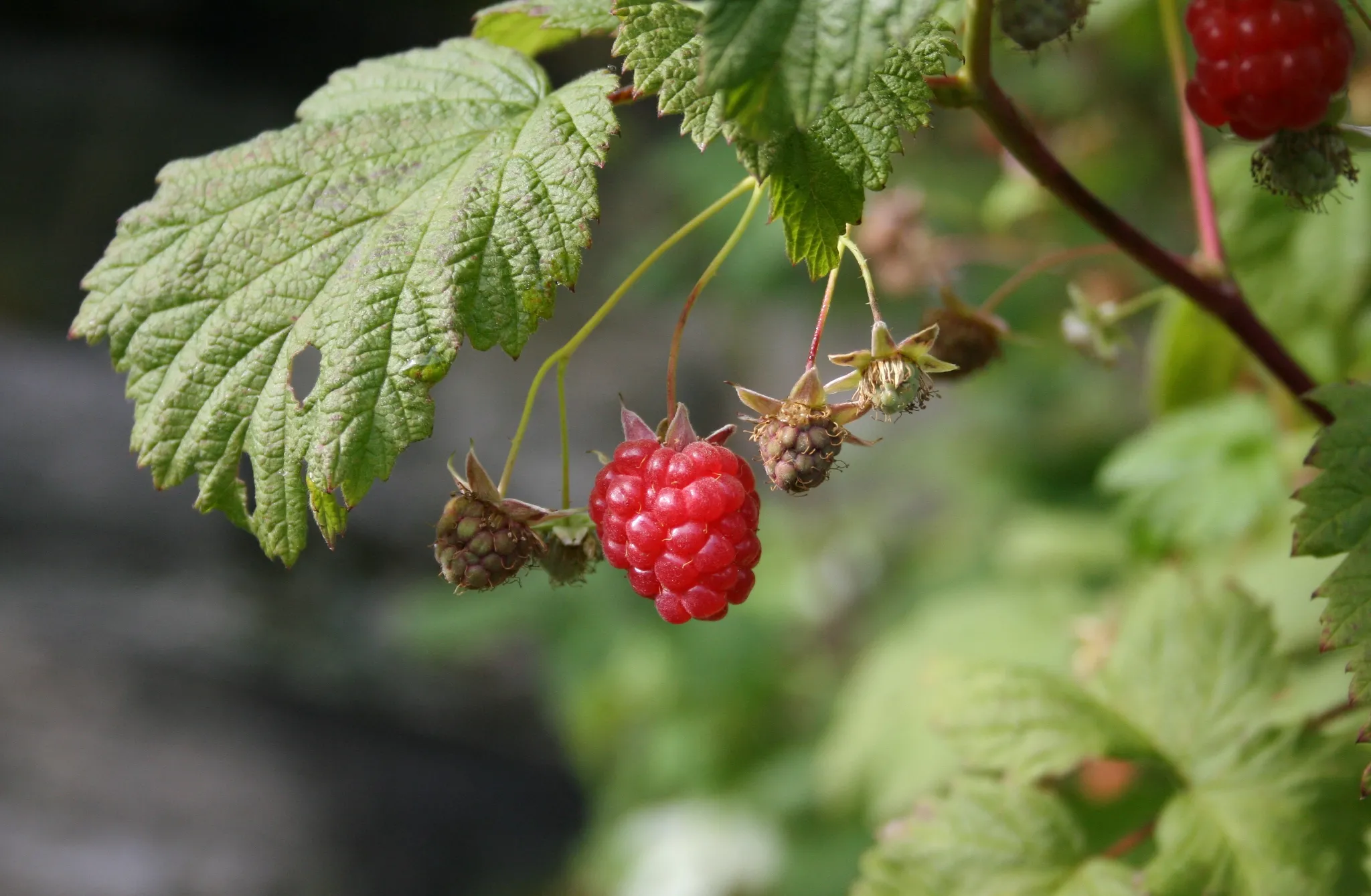
Ripening raspberry berries
Ripening fruits of red raspberry (Rubus idaeus). The photo was taken in Eidsnes, in the Ålesund area, Norway.
The State Register of Breeding Achievements Approved for Use is the primary document that both professional nursery growers and amateur gardeners rely on. If a variety is listed in the register, it means it has passed state trials, confirmed its value (yield, berry quality, disease resistance), and is officially recommended for cultivation in one or more regions of Russia.
At the beginning of 2024, the State Register contains 86 raspberry varieties (including all forms: remontant, non-remontant, as well as a few specimens with unusual berry colors — yellow, orange, and even black). For comparison, there are over a hundred garden strawberry varieties in the register, so raspberries are represented somewhat more modestly, but this does not indicate lesser popularity — it's just that raspberry breeding is more targeted, and many old, proven varieties still hold their own against new releases.
Looking at the distribution by ripening time, the picture is as follows:
- Remontant varieties — about 32 names. Their share in the register is constantly growing: gardeners are increasingly choosing raspberries that yield on current-year shoots and allow berry picking right up to the frost.
- Early and very early varieties — about 19 entries. They are valued for opening the season when fresh berries are still scarce.
- Mid-early — 10 varieties. A good compromise between the early and main fruiting periods.
- Medium and mid-late — about 22 varieties. These are the backbone of the "summer conveyor," providing the main harvest in the peak season.
- Late — about 7 varieties. Allow extending the fresh berry harvest into autumn (for non-remontant forms) or are used for preserves.
The Oldest Varieties in the Register: Living History
Some raspberry varieties registered as early as the mid-20th century remain in demand today. This is not a tribute to tradition but a recognition of their reliability, hardiness, and stable flavor.
Absolute record holders:
- Novost Kuzmina (registered in 1947) — bred back in 1912 in the Nizhny Novgorod region. A true legend: tasting score of 5 points, classic raspberry aroma, and very high winter hardiness. The variety is still recommended for most regions (except Siberia and the Far East). Its main drawback is susceptibility to diseases, but this "minus" is compensated by its unpretentiousness and excellent flavor.
- Kaliningradskaya (also 1947) — a German-origin variety that thrives in the North-Western region. Large, sweet berries (up to 4 g) and high yields (up to 100 c/ha) made it a standard for homesteads in the Kaliningrad region. Characterized by thick, erect shoots and good winter hardiness.
- Sovetskaya (1959) — a mid-early variety for the Lower Volga region. Valued for stable yields and strong drupelet cohesion, important for transport.
- Barnaulskaya (1961) — one of the most winter-hardy and drought-resistant varieties for Siberia and the Urals. True, its berries are small (1.7–2.7 g) and drop heavily, but it withstands frosts down to −45 °C.
- Chelyabinskaya Krupnoplodnaya (1965) and Rubin (1971) — also veterans of the register, still grown on private plots due to their reliability.
Thus, over 75 years of successful "service" for some varieties is the best proof that the right choice can serve gardeners faithfully for generations. However, over the past decade, the register has been significantly replenished with new varieties that surpass the old ones in yield, berry size, and disease resistance. More on them in the following chapters.
2. Overview of the Largest Originators, Including Foreign Ones
The State Register features raspberry varieties developed both in state scientific institutions and by private breeders. The vast majority (over 80%) are domestic selections, with developments concentrated in several leading centers, each with its own "geographical specialization" and breeding priorities.
Below are portraits of the main originators whose varieties are most often found in the register and in gardens.
1. Federal Horticultural Research Center (Moscow)
The Central Research Institute of Horticulture is the undisputed leader in the number of registered raspberry varieties (about one-third of the entire register). This is where the famous remontant varieties "Hercules," "Atlant," "Brilliantovaya," "Rubinovoe Ozherelie" were created, as well as the old, time-tested "Novost Kuzmina" (although the originator is not formally registered, the variety is maintained by the institute), "Balsam," "Hussar." The Moscow center's breeding is focused on the Central, North-Western, and other regions of the European part of Russia. Special emphasis is placed on remontant forms capable of producing high yields (up to 170–200 c/ha) with autumn mowing of shoots. Many varieties in this group have dark red, dense berries with good transportability.
2. Federal Altai Scientific Center for Agrobiotechnologies (Barnaul)
The Altai Center is the main supplier of varieties for the harsh conditions of Siberia, the Urals, and the Far East. It has developed "Barnaulskaya," "Zorenka Altaya," "Blestyashchaya," "Rubinovaya," "Za Zdorovie," "Kolokolchik," as well as new releases "Aquarelle" and "Blesk." Altai-bred varieties are distinguished by exceptional winter hardiness (withstanding frosts down to –40…–45 °C), drought resistance, and disease resistance — the main criteria for survival in a sharply continental climate. True, their berries are often medium-sized (2–3 g), but they ripen together and rarely drop.
3. Ural Federal Agrarian Research Center (Ekaterinburg)
The Ural Center also specializes in winter-hardy varieties for the Volga-Vyatka, Ural, and West Siberian regions. The register includes varieties such as "Antares," "Velvet," "Vysokaya," "Vanda," "Lel," "Muza," "Fregat." Their feature is weeping shoot habit (drooping tops), which facilitates bending for winter, and high tasting scores (often 4.8–5.0 points). Ural breeders pay great attention to resistance to purple spot and stem gall midge — the main problems in cold and humid climates.
4. Other State Originators
Federal Scientific Center named after I.V. Michurin (Michurinsk) — varieties "Cleopatra," "Shulamith," "Shahrazada" for the Central Black Earth region. Distinguished by large fruit (up to 6–7 g) and a pleasant sweet-sour taste.
Samara Research Institute of Horticulture "Zhigulevskie Sady" — varieties "Early Surprise," "Studencheskaya," "Samarskaya Plotnaya," adapted to the arid conditions of the Volga region.
Novosibirsk Zonal Horticulture Station — varieties "Berdskaya," "Prelest," "Priobskaya," "Arochnaya," well-proven in Siberian conditions.
Federal Scientific Agroengineering Center VIM (Moscow) — varieties "Nezhnost," "Ozarenie," primarily for dessert use.
5. Private Breeders
In recent years, independent breeders have become increasingly active. The most prolific among them is Vladimir Aleksandrovich Shiblev (Nizhny Novgorod region). His varieties "Karamelka," "Malinovaya Gryada," "Nizhegorodets," "Pokhvalinka," "Samokhval" are included in the register and approved for all regions of Russia. These are typically remontant forms with very large berries (up to 10 g), high yields, and increased vitamin C content. They are rapidly gaining popularity among hobbyists.
Also noteworthy are LLC NPO "Sad i Ogorod" (Chelyabinsk region) — variety "Vasyona," and ZAO "Amurplodsemprom" — variety "Amurchanka."
6. Foreign Originators
Currently, the State Register lists only one variety created outside of Russia — "Diamond Jubilee," originated by the British company BERRYWORLD PLUS LIMITED. The variety was registered in 2021 for protected cultivation (greenhouses and tunnels), highlighting its specificity: it is not intended for open ground in most regions, but is very productive (240 c/ha) and produces exceptionally large berries (up to 8.5 g) with a tasting score of 5.0 points. Notably, the register does not include varieties from other foreign countries (Poland, Germany, USA), although they are widely sold on the Russian market. This means that if you purchase an imported variety, it lacks official registration in Russia — and you assume the risks associated with insufficient adaptation to the local climate.
To summarize
- For the European part — choose varieties from the Federal Horticultural Research Center and Michurinsk breeders.
- For the Urals and Siberia — Altai and Ural varieties will give guaranteed results.
- For the Volga region and the South — pay attention to Zhigulevsk and Crimean developments (e.g., "Harmony," "Ruslana" from the Nikitsky Botanical Garden — although there are few of them in the register so far).
- Foreign varieties — be cautious when purchasing. It is safer to trust domestic breeding — it is conducted with all climatic nuances in mind.


LCD 4-in-1 Soil Tester
Check essential growing conditions with one compact tool. Measure soil pH, moisture, temperature and light intensity — ideal for gardens, potted plants and greenhouses.
- 4-in-1 measurement
- Easy-to-read LCD display
- Portable design
Affiliate link · For indicative measurements only.
3. Characteristics Used in the State Register
So that a gardener can make an informed choice, the State Register describes each variety according to a single standard. Behind the formal terms lie specific properties that directly affect care, yield, and the enjoyment of the berries. Let's break down these characteristics by group — so you can easily "read" any description and compare varieties.
1. Ripening Time (Maturity Group)
This is one of the first characteristics. The register uses the following gradations:
- very early — berries ripen in late June – early July (e.g., "Blesk," "Komsomolskaya Pravda");
- early — mid-July;
- mid-early — late July;
- medium — early August;
- mid-late — mid-August;
- late — late August – September.
For remontant varieties, it is often noted that they bear fruit on current-year shoots, and then the ripening time refers to the autumn harvest wave. Understanding this helps plan the "raspberry conveyor": early ones for fresh consumption, late ones for preserves, remontant ones for extended harvesting.
2. Fruiting Type
- Non-remontant — fruit once per season on biennial shoots. The harvest is gathered in July–August, then the fruited canes are removed.
- Remontant — capable of yielding on annual shoots (in autumn) and, in some cases, also on biennial shoots (in summer). The description often states: "remontant, fruits on current-year shoots." This is a key trait defining agricultural practices: for remontant varieties, it is common practice to mow down all above-ground parts before winter to obtain a strong autumn harvest and simplify disease control.
Some varieties in the register have the note "non-remontant" — meaning there will be no autumn harvest, and the canes need to be preserved for fruiting the next year.
3. Morphological Characteristics of the Bush and Canes


Lower side of a red raspberry leaf (Rubus idaeus)
A detailed photograph of a raspberry leaf demonstrating the lighter lower surface of the leaf blade. Suitable for illustrating morphological characters used in describing and identifying varieties.
Here, the plant's appearance is described, and these details are no less important than the berries:
- Height and vigor — "tall, vigorous bush" or "medium-sized." This affects spacing and the need for trellising.
- Spread — "weakly spreading," "medium spreading," "strongly spreading." For compact plots, it's better to choose weakly spreading forms.
- Erectness or weeping habit — some varieties have drooping tops ("weeping"), making them easier to bend for winter.
- Prickliness — one of the most concerning characteristics for gardeners. It is indicated as "weak," "medium," or "strong," as well as spine location (along the entire stem, only in the lower part, at the base). There are varieties with nearly spineless canes — for example, "Skromnitsa" (almost without thorns). For those who dislike getting scratched, this is an important criterion.
- Color of annual and biennial canes — can be light brown, purple, reddish. This helps identify the variety and is not critical for care, but it indirectly indicates frost resistance.
- Leaves — size, color, wrinkling, pubescence, denticle shape are noted. Although not the main focus for a gardener, these traits help recognize a variety and distinguish it from others.
4. Berry Characteristics (The Most Important Part)


Close-up of a ripe berry against the background of several unripe fruits and green leaves
Here are the parameters we pay attention to first:
- Average weight — given in grams (e.g., "3.2 g" or "5.5 g"). The maximum weight is also often indicated — a guide for the largest specimens. The larger the number, the larger the berry.
- Shape — "conical," "obtuse-conical," "broad-conical," "trapezoidal," "hemispherical," "elongated-cylindrical," etc. Shape affects appearance and ease of picking.
- Color — from light red to dark raspberry, as well as yellow, orange, golden, black. For example, "Apricot" has golden-apricot berries, "Yantarnaya" — bright orange.
- Pubescence — "weak," "medium," "dense." Pubescent berries are often denser but less glossy.
- Flesh density — "tender," "medium," "firm." Firm berries store and transport better; tender ones are ideal for eating off the bush.
- Taste — usually described as "sweet-sour," "sweet," "with aroma" or "without aroma."
- Sugar, acid, and vitamin C content — given as percentages or mg%. This is an indicator of not only taste but also health benefits. For example, "Orange Wonder" has 68 mg% vitamin C — nearly double the average.
- Tasting score — given on a 5-point scale. A value of 4.5 and above indicates excellent taste, 4.0 — good, 3.5 — satisfactory. This is a subjective but very illustrative characteristic.
5. Yield
Given in centners per hectare (c/ha) or sometimes in kilograms per bush. For example, "yield 57.8 c/ha" or "1.2 kg per bush." For an amateur, this figure gives an idea of productivity, but remember that the actual yield in your plot will depend on agricultural practices.
6. Resistance to Diseases and Pests
The register often states: "susceptibility to diseases and pest damage is weak" or "at the level of standard varieties." Sometimes specific diseases are specified: anthracnose, purple spot, gray mold, spider mite, stem gall midge. Such information helps choose a variety that will require fewer chemical treatments.
7. Winter Hardiness, Drought Resistance, and Heat Tolerance
These traits are not specified for all varieties, but for regions with harsh winters or dry summers, they are critical. The assessment is usually qualitative: "high," "medium," "low." For instance, "Barnaulskaya" has frost resistance down to –45 °C, while "Yellow Giant" has low and needs covering.
8. Approved Regions
For each variety, the numbers of regions (from 1 to 12) where it is recommended are listed. This is very important: if your region is not listed, it does not mean the variety will not grow, but the risk of failure is higher. We will discuss the regions in detail in a separate article.
9. Cultivation Technology (Special Techniques)
For many remontant varieties, the register includes a special recommendation: "the cultivation technology involves mowing the above-ground part of the plants before they go into winter." This means the variety is specifically designed for autumn fruiting, and with this agricultural technique, it yields the best results and also eliminates wintering problems.
Understanding these characteristics allows you to compare varieties not blindly but consciously. For example, if you live in a cold region and want a remontant raspberry with large berries, look for high winter hardiness, weak prickliness, and a tasting score of at least 4.5 in the description — and you will quickly filter out unsuitable options. In the next chapter, we will talk about the most popular varieties that have already earned the trust of gardeners across the country.
4. Top Most Popular Varieties
What is a "popular variety"? It is not necessarily the one that gives record yields or the largest berries. Most often, popularity is made up of the availability of seedlings, adaptability to local conditions, good taste, and, of course, active discussion in gardening communities.
We analyzed search queries and identified the varieties gardeners search for most often. This is a kind of "people's rating." Let's make a reservation right away: not all of these varieties are in the State Register, and some of them are often described with errors on the internet. We will help clarify what is what.
Leaders by Query Frequency
Here are the top ten varieties in descending order of popularity:
| Variety | In the State Register? | Fruiting Type | What is important to know about it |
|---|---|---|---|
| Hussar | ✅ Yes | Non-remontant, early | One of the most reliable "summer" varieties for the European part of Russia. Tall, vigorous bush, berries up to 3.2 g, tasting score 4.2. Resistant to diseases. Ripens uniformly, yield up to 83 c/ha. |
| Tarusa | ❌ No | Non-remontant (standard) | The famous "raspberry tree" bred by V. Kichina. Standard form — thick, rigid shoots, no support needed. Berries large (up to 10–12 g), sweet. Often mistakenly called remontant online — it actually gives one harvest in mid-summer. |
| Pshekhiba | ❌ No | Remontant (Polish) | Very popular among fans of experimental varieties. Berries reach 14 g, high yield. Fruits on current-year shoots, requires good care. Not in the State Register — be prepared that adaptation to your region may be unpredictable. |
| Karamelka | ✅ Yes | Remontant, mid-early | Registered in 2016. Berries up to 8 g, light red, sweet (sugars only 4.2%, but acids only 1.0%, so they taste very sweet). Vitamin C — 48 mg%. Yield 112 c/ha. Recommended for all regions of the Russian Federation. An excellent choice for those who want large and sweet remontant raspberries. |
| Hercules | ✅ Yes | Remontant | Classic remontant raspberry. Berries very large — up to 8–10 g, dark red. Taste sweet-sour, aromatic. Yield 92 c/ha. In the register since 2004 — time-tested. Suitable for the Central region. |
| Pride of Russia | ❌ No | Non-remontant, mid-early | Large-fruited variety (berries up to 12 g), harvest stretched over 5–6 stages. Created by V. Kichina. Often confused with remontant in sources, but it is a summer variety. Requires good agricultural practices, but taste reviews are enthusiastic. |
| Maroseyka | ❌ No | Non-remontant, large-fruited | The first spineless large-fruited hybrid of Russian breeding. Berries up to 12 g, very sweet. Mid-early. Often mistakenly classified as remontant — it actually gives one summer harvest. |
| Patricia | ❌ No | Non-remontant | Another large-fruited variety by V. Kichina. Berries up to 14 g, tender, dessert flavor. Mid-season. Sometimes called remontant online, but this is a mistake — it bears fruit once. |
| Beauty of Russia | ❌ No | Non-remontant, mid-season | A variety by V. Kichina, created by crossing Maroseyka and Mirage. Berries large (up to 12 g), bright red, with a light aroma. Some sources mistakenly list it as remontant. |
| Bryanskoe Divo | ✅ Yes | Remontant, late | In the register since 2008. Berries up to 6 g, light red, sweet-sour. Yield 131 c/ha. Well-suited for autumn harvest, as it fruits until frost. |
Other varieties from the top 20 (in descending order)
Novost Kuzmina — legendary old variety (1947), non-remontant, early. Berries 2–2.5 g, but tasting score — 5 points! High winter hardiness, but susceptible to diseases. Still in the register and very popular among conservative gardeners.
Orange Wonder — remontant, in the register since 2009. Berries bright orange, up to 10 g, very sweet (sugars only 3.6%, but acidity 1.1%, so taste pleasantly sweet). Vitamin C — 68 mg% — a record for health benefits. Yield 155 c/ha.
Monomakh's Cap — remontant, but absent from the register. Large-fruited (up to 15 g), bushes low (up to 1.5 m). Fruits from mid-August to September. Created by V. Kichina. Has a good reputation but no official status.
Yellow Giant — in the register since 2008, non-remontant, mid-early. Berries yellow, up to 3 g, very sweet. Low winter hardiness — needs covering, but lovers of unusual colors appreciate it.
Glen Ample — Scottish spineless variety, non-remontant, mid-late. Berries up to 10 g, firm, transportable. Sometimes mistakenly called remontant online. Absent from the register.
Sokolitsa — Polish variety from 2011. Summer (non-remontant), but with signs of semi-remontancy — in warm autumn, it may produce a second crop on annual shoots. Berries up to 6 g. Not in the register.
Cumberland — a hybrid of raspberry and blackberry, black raspberry. Non-remontant, mid-early. Berries black, shiny, firm, with a blackberry aftertaste. Not in the register but very popular as an exotic.
Penguin — remontant, in the register since 2009. Very early, berries up to 6.5 g, dark raspberry. Yield 89 c/ha. Standard type, low-growing — easy to pick. Recommended for all regions.
Polka — Polish remontant variety from 1993. Very popular abroad, berries 7–8 g, yield 4–6 kg per bush. Absent from the Russian register but actively sold. Prone to diseases in rainy years.
Giant (Moskovsky) — semi-remontant, early. Berries up to 25 g (record) — but this is more of a marketing exaggeration. Partially remontant — may give a repeat harvest. Not in the register.
What do we see from this list?
1. Varieties from the State Register make up only half of the top. This means gardeners are actively interested in varieties that have not been officially tested — they rely on reviews, nursery experience, and their own intuition. However, remember: if a variety is not in the register, its winter hardiness, yield, and disease resistance in your region are not guaranteed.
2. Many varieties by V. Kichina ("Tarusa," "Pride of Russia," "Maroseyka," "Patricia," "Beauty of Russia," "Monomakh's Cap"). These are leaders in large fruit — berries up to 10–15 g. But almost all are non-remontant (or semi-remontant), and they are not in the register. Gardeners choose them for taste and size, but you need to be prepared for their capriciousness.
3. Remontant varieties — nearly half of the top ("Pshekhiba," "Karamelka," "Hercules," "Bryanskoe Divo," "Orange Wonder," "Penguin," "Polka"). This reflects a global trend: gardeners want to get berries until late autumn, and remontant varieties allow this with minimal care.
4. Confusion with fruiting type — many varieties are mistakenly called remontant online to attract buyers. In fact, among the above, truly remontant in the register are: "Karamelka," "Hercules," "Bryanskoe Divo," "Orange Wonder," "Penguin"; "Pshekhiba" and "Polka" are remontant but not in the register. The rest are summer varieties that yield once. Be careful when buying seedlings: always check whether the variety fruits on current-year shoots.
Which variety to choose from this top?
- If you need reliability and official guarantee — choose from registered varieties: "Hussar" (summer), "Karamelka" or "Hercules" (remontant).
- If you are ready to experiment for very large berries — pay attention to Kichina's non-registered varieties ("Tarusa," "Pride of Russia," "Maroseyka"), but remember that they require more care.
- If you live in a cold region — old proven varieties ("Novost Kuzmina") are more reliable than trendy large-fruited hybrids.
- If you are attracted by color exotics — try "Orange Wonder" (remontant, yellow-orange) or "Cumberland" (black raspberry).

Solar Automatic Drip Irrigation Kit for Gardens
Automate watering for pots, gardens and small greenhouses. This solar-powered system features a timer to help schedule water delivery to your plants.
- Solar-powered
- 15 m irrigation hose
- Programmable watering
Affiliate link · Check included accessories.
5. Overview of Remontant Raspberry Varieties by Key Characteristics


Fruiting of raspberry on first-year shoots (Rubus idaeus)
The photograph demonstrates raspberry shoots that have already formed berries in the first year of growth. It illustrates an important feature of primocane varieties — the ability to produce a crop on annual shoots.
Remontant varieties are a true revolution in the home raspberry patch. Their main feature: they bear fruit on current-year shoots, so in autumn you get a full harvest, and autumn pruning to the ground eliminates wintering problems and most diseases. For an amateur gardener, this means minimum hassle and maximum fresh berries right up to the frost.
In this section, we will look at remontant varieties through two key characteristics that matter to everyone: when they ripen and how large the berries are. All data are from the State Register (for registered varieties) or verified sources (for popular non-registered ones).
5.1 Ripening Time
For remontant varieties, ripening time is indicated for the autumn fruiting wave. Depending on the region and weather, the start of harvest can shift by 1–2 weeks, but the relative groups remain:
- Very early — early to mid-August.
- Early — mid to late August.
- Mid-early — late August to early September.
- Medium — first to second decade of September.
- Mid-late — second half of September.
- Late — late September to early October (until frost).
Below is a table of the main remontant varieties grouped by ripening time. For each variety, the average and maximum berry weight are given so you can immediately assess berry size.
| Ripening Time | Variety | Average Weight, g | Maximum Weight, g | Approximate Harvest Time (for central Russia) |
|---|---|---|---|---|
| Very Early | Penguin | 4.2 | 6.5 | From August 5–10 |
| Poklon Kazakovu | 3.7 | 6.0 | From August 5–10 | |
| Early | Nizhegorodets | 6.0 | 8.0 (according to other data) | From August 15–20 |
| Apricot | 3.0 | – | From August 15–20 | |
| Augustina | 3.2 | – | From August 15–20 | |
| Mid-early | Karamelka | 3.8 | 8.0 | From August 20–25 |
| Malinovaya Gryada | 5.2 | 8.2 | From August 20–25 | |
| Medium | Hercules | 6.8 | 10.0 (according to reviews) | From September 1–5 |
| Atlant | 4.7 | 8.8 | From September 1–5 | |
| Eurasia | 3.6–4.6 | – | From September 1–5 | |
| Orange Wonder | 5.5 | 10.2 | From September 1–5 | |
| Brilliantovaya | 4.1 | – | From September 1–5 | |
| Mid-late | Golden Autumn | 5.0 | – | From September 10–15 |
| Yantarnaya | 2.6–6.8 (wide range) | – | From September 10–15 | |
| Indian Summer | 2.1–3.0 | – | From September 10–15 | |
| Late | Bryanskoe Divo | 4.3 | 6.0 | From September 20–25 |
| Firebird | 4.3 | 6.0 | From September 20–25 | |
| Samokhval | 5.9 | 9.1 | From September 20–25 |
Important notes on timing:
- The earliest remontant varieties ("Penguin," "Poklon Kazakovu") allow you to enjoy berries as early as early August, when summer varieties are just finishing. This is an ideal choice for regions with short summers — they manage to yield before the cold.
- The bulk of remontant varieties fall into the medium timing (early September). This is the golden mean: berries are large, yield is high, and the weather usually still allows ripening.
- Late varieties ("Bryanskoe Divo," "Firebird," "Samokhval") are valuable because they extend the season into October. But in regions with early frosts, they may not fully ripen — they are better suited to the south or protected cultivation.
Tip: If you want to harvest raspberries from August to October, plant 2–3 varieties of different ripening times — for example, early "Nizhegorodets," medium "Hercules," and late "Samokhval."
5.2 Average and Maximum Berry Weight
Berry size is one of the main selection criteria. Large berries are easier to pick, look more impressive, and often have higher market demand. However, the largest berry is not always the most flavorful, and small-fruited varieties have their own advantages (e.g., they are often more winter-hardy and productive).
Let's look at remontant varieties in terms of berry weight, dividing them into three groups: record holders for large fruit, medium-fruited, and small-fruited (conditionally up to 4 g). For each variety, we also indicate the ripening time.
🥇 The Largest-Fruited Remontant Varieties (average weight ≥ 5 g)
| Variety | Average Weight, g | Maximum Weight, g | Ripening Time | Features |
|---|---|---|---|---|
| Pokhvalinka | 6.4 | up to 10.5 | medium | Very productive (up to 194 c/ha), berries elongated-conical, red, sweet-sour. Taste 4.2 points. |
| Nizhegorodets | 6.0 | (up to 8.0 according to other data) | early | Dark red, broad-conical, yield up to 183 c/ha. Early timing is rare for large-fruited. |
| Samokhval | 5.9 | up to 9.1 | late | Red with gloss, elongated-conical, sweet-sour, yield up to 197 c/ha. |
| Orange Wonder | 5.5 | up to 10.2 | medium | Bright orange, high vitamin C content (68 mg%). Yield up to 155 c/ha. |
| Malinovaya Gryada | 5.2 | up to 8.2 | mid-early | Dark red, trapezoidal, yield up to 148 c/ha. Taste 4.5 points. |
| Golden Autumn | 5.0 | – | mid-late | Golden-yellow, elongated-conical, sweet-sour. Yield up to 126 c/ha. |
📊 Medium-fruited (weight 3.5–4.9 g)
This group includes most registered varieties, offering stable yields and good taste.
| Variety | Average Weight, g | Ripening Time | Taste (score) | Note |
|---|---|---|---|---|
| Atlant | 4.7 | medium | 4.2 | Red glossy, trapezoidal, yield 172 c/ha. |
| Hercules | 6.8* (above average) | medium | 4.0 | Broad-obtuse-conical, red, very aromatic. Actually large-fruited. |
| Bryanskoe Divo | 4.3 | late | 4.0 | Light red with gloss, yield 131 c/ha. |
| Firebird | 4.3 | late | 4.0 | Similar to Bryanskoe Divo. |
| Brilliantovaya | 4.1 | medium | 4.0 | Ruby red with gloss, yield 76 c/ha. |
| Penguin | 4.2 | very early | 3.7 | Dark raspberry, standard form, convenient for picking. |
🫐 Small-fruited (weight ≤ 3.5 g)
Small berries often turn out sweeter and more aromatic, and the varieties themselves are more winter-hardy and unpretentious.
| Variety | Average Weight, g | Ripening Time | Taste (score) | Note |
|---|---|---|---|---|
| Augustina | 3.2 | early | 4.0 | Dark raspberry, sweet-sour, yield 117 c/ha. Recommended for all regions. |
| Apricot | 3.0 | early | 4.5 | Golden-apricot, tender flesh, very aromatic. Yield 117 c/ha. |
| Indian Summer | 2.1–3.0 | mid-late | 4.5 | Red, good quality, old remontant variety (1995). Yield up to 37 c/ha. |
| Karamelka | 3.8* (medium-fruited) | mid-early | 4.6 | Light red, sweet, yield 112 c/ha. But its maximum is up to 8 g, so on average it is somewhat small. |
Berry Weight Conclusions
1. Largest berries (average weight > 5 g) are produced by varieties: "Pokhvalinka" (6.4 g), "Hercules" (6.8 g – but according to the register, although I classified it as large in the table), "Nizhegorodets" (6.0 g), "Samokhval" (5.9 g), "Orange Wonder" (5.5 g). All of them, except "Nizhegorodets," have medium and late ripening times.
2. Large fruit often comes at the expense of taste — many record holders have tasting scores around 4.0 points, while the small-fruited "Apricot" and "Indian Summer" scored 4.5. If taste is more important to you than size, pay attention to these varieties.
3. Maximum berry weight (peak values) for remontant varieties can reach 10 g and more ("Pokhvalinka," "Orange Wonder"). However, in real conditions, the average weight is usually lower than stated, so rely on the average figure.
4. Early remontant varieties often have small or medium berries. The exception is "Nizhegorodets" (early, large), and it is also productive and tasty, making it a successful hybrid.
In the next chapter, we will move on to non-remontant varieties — there the picture in terms of timing and weight will be different, because they stretch fruiting over a shorter summer period, but some of them produce giant berries.
5.3 Taste Score
Taste is the most subjective but also the most important characteristic. In the State Register, it is measured by a tasting score (on a 5-point scale) and a brief description: sweet-sour, sweet, with or without aroma. An experienced gardener knows: a large berry is not always tasty, and among remontant varieties, this rule is especially pronounced.
Let's divide remontant varieties into three groups by tasting score.
🍬 Excellent Taste (4.5 points and above)
These varieties can be confidently recommended for fresh consumption — their berries melt in the mouth and have a rich raspberry aroma.
| Variety | Score | Taste Description |
|---|---|---|
| Arisha | 4.6 | Tender flesh, sweet-sour, with aroma. At the same time, berries are large (average 4.9 g). |
| Karamelka | 4.6 | Medium flesh, sweet (acids only 1.0%), with aroma. The name speaks for itself. |
| Malinovaya Gryada | 4.5 | Sweet-sour, with aroma, flesh of medium density. |
| Indian Summer | 4.5 | Classic raspberry taste, berries of good quality, aromatic. |
| Apricot | 4.5 | Tender flesh, sweet-sour, with a weak but pleasant aroma. Plus, unusual golden color. |
😊 Good Taste (4.0–4.4 points)
The most numerous group. These are solid, proven varieties with a pleasant sweet-sour taste. They are good fresh and for processing.
| Variety | Score | Taste Description |
|---|---|---|
| Gift to Kashin | 4.3 | Sweet-sour, with aroma, flesh of medium density. |
| Poklon Kazakovu | 4.3 | Sweet-sour, with aroma. |
| Atlant | 4.2 | Sweet-sour, with aroma, flesh medium. |
| Pokhvalinka | 4.2 | Sweet-sour, with aroma. Very large berry (up to 10.5 g). |
| Samokhval | 4.2 | Sweet-sour, with aroma. Also large-fruited. |
| Salut | 4.1 | Sweet-sour, with aroma. |
| Yubileynaya Kulikova | 4.1 | Sweet-sour, with aroma. |
| Augustina | 4.0 | Tender flesh, sweet-sour, with weak aroma. |
| Hercules | 4.0 | Sweet-sour, with aroma, flesh medium. |
| Indian Summer 2 | 4.0 | Tender flesh, sweet-sour, with aroma. |
| Bryanskoe Divo | 4.0 | Tender flesh, sweet-sour, with subtle aroma. |
| Firebird | 4.0 | Tender flesh, sweet-sour, with subtle aroma. |
| Orange Wonder | 4.0 | Tender flesh, sweet-sour, with aroma. |
🫤 Satisfactory Taste (below 4.0 points)
These varieties are inferior to the previous ones in gastronomic qualities — taste is simpler, often without pronounced aroma, sourness prevails. However, they often win in yield, large fruit, or early ripening, so do not write them off — for processing, jam, and freezing, they are perfect.
| Variety | Score | Taste Description |
|---|---|---|
| Nizhegorodets | 3.9 | Tender flesh, sweet-sour, with aroma. |
| Eurasia | 3.9 | Medium flesh, sweet-sour, without aroma. |
| Golden Autumn | 3.9 | Medium, tender flesh, sweet-sour, with weak aroma. |
| Medvezhonok | 3.8 | Sweet-sour, without aroma. |
| Rubinovoe Ozherelie | 3.8 | Tender flesh, sweet-sour. |
| Yantarnaya | 3.8 | Tender flesh, sweet-sour, without aroma. |
| Penguin | 3.7 | Medium flesh, sweet-sour, without aroma. |
Important observation: among remontant varieties, a high tasting score (4.5+) is more common in small-fruited and medium-fruited varieties, while ultra-large berries (e.g., "Pokhvalinka" or "Samokhval") score around 4.2. The exceptions are "Arisha" (4.6 points with a weight of 4.9 g) and "Karamelka" (4.6 points with a weight of 3.8 g). If you value both large size and excellent taste, look specifically at these two varieties.
5.4 Yield
Yield of remontant varieties is usually given in centners per hectare (c/ha). To translate for the amateur gardener: 100 c/ha is a very good indicator, which with dense planting gives about 1–1.5 kg of berries per bush (depending on the scheme). Many modern remontant varieties break records in productivity, often leaving summer varieties behind.
Let's divide varieties into three groups by yield.
🚀 Record High Yield (more than 170 c/ha)
New generation varieties that, with proper care, give a real "berry stream" from late summer to frost.
| Variety | Yield, c/ha | Features |
|---|---|---|
| Salut | 211.1 | Very early, berries up to 8.2 g. Record holder in productivity. |
| Arisha | 197.8 | Medium timing, berries up to 5.3 g, excellent taste (4.6). |
| Samokhval | 197 | Late timing, berries up to 9.1 g. Ideal for extending the season. |
| Pokhvalinka | 194 | Medium timing, ultra-large berries (up to 10.5 g). |
| Nizhegorodets | 183 | Early timing, berries up to 8 g. Very valuable combination of early maturity and yield. |
| Yubileynaya Kulikova | 182.7 | Early timing, berries up to 7.5 g, taste 4.1. |
| Poklon Kazakovu | 175 | Very early timing. Yield and early maturity in one. |
| Atlant | 172 | Medium timing, berries up to 8.8 g. Drought tolerant. |
| Gift to Kashin | 170 | Medium timing, berries up to 7.2 g, taste 4.3. |
💪 High and Good Yield (100–169 c/ha)
The bulk of reliable and popular remontant varieties are here. They do not set records but guarantee a stable harvest without much hassle.
| Variety | Yield, c/ha | Features |
|---|---|---|
| Rubinovoe Ozherelie | 158 | Cylindrical berries, up to 5.6 g. Versatile variety. |
| Orange Wonder | 155 | Unique color, high vitamin C content. |
| Malinovaya Gryada | 148 | Large berries (up to 8.2 g) and pleasant taste (4.5). |
| Eurasia | 134 | Standard type, berries up to 4.6 g, no aroma, but productive. |
| Bryanskoe Divo | 131 | Late timing, berries up to 6 g, good for the latest harvests. |
| Firebird | 131 | Similar to Bryanskoe Divo. |
| Golden Autumn | 126 | Yellow-fruited, berries up to 5 g, good for collection. |
| Augustina | 117 | Early, dark raspberry, stable variety for all regions. |
| Apricot | 117 | Early, golden, excellent taste (4.5). |
| Karamelka | 112 | Sweet, early, berries up to 8 g. |
| Indian Summer 2 | 115 | Mid-late, raspberry, aromatic. |
📉 Moderate Yield (less than 100 c/ha)
Here are mainly old proven varieties and some specialized forms. Their yield is lower, but they often win in winter hardiness or taste.
| Variety | Yield, c/ha | Features |
|---|---|---|
| Golden Domes | 95 | Remontant, yellow, berries up to 3.8 g. Average yield. |
| Hercules | 92 | Very large berries (6.8 g) and excellent reputation, but falls behind new releases in quantity. |
| Yantarnaya | 92 | Yellow-orange, berries up to 6.8 g, but average yield. |
| Penguin | 89 | Standard, very early, easy to care for, but not a record holder in yield. |
| Brilliantovaya | 76.1 | Large (4.1 g), glossy, but modest yield. |
| Indian Summer | 37 | Old, proven variety (1995), inferior to new releases, but very tasty (4.5). |
What is important to know about remontant raspberry yield
1. Yield in the register is given with agricultural practices involving autumn mowing of shoots. If you leave biennial shoots and collect two harvests (summer and autumn), the total berry mass per season may increase, but the autumn harvest will be significantly smaller and ripen later. Most modern recommendations for remontant varieties are to mow everything to the ground to maximize autumn yield.
2. High yield (>170 c/ha) is an achievement of recent years. Varieties registered after 2020 ("Salut," "Pokhvalinka," "Samokhval," "Yubileynaya Kulikova," "Medvezhonok") have sharply raised the productivity bar. If your goal is maximum berries from a small area, choose them.
3. Do you sell berries? For commercial cultivation, not only centners per hectare matter, but also berry density and shelf life. Varieties with yields above 150 c/ha ("Atlant," "Malinovaya Gryada," "Rubinovoe Ozherelie") have proven themselves well on the market.
4. Remember that yield is strongly influenced by weather, feeding, and watering. Even the most productive variety without proper care will show average results.
Final recommendations for choosing a remontant variety (by taste and yield)
- If taste comes first — choose "Arisha" or "Karamelka" (excellent taste and high yield), as well as "Malinovaya Gryada" and "Apricot" (excellent taste with slightly lower yield).
- If you need maximum berries for processing and selling — take "Salut," "Samokhval," "Pokhvalinka," or "Nizhegorodets." They are large and very productive.
- Looking for a golden mean (tasty + plentiful) — "Atlant," "Gift to Kashin," and "Poklon Kazakovu" will give consistently high yields with decent taste (4.2–4.3 points).
5.5 Winter Hardiness, Drought/Heat Resistance, and Disease/Pest Resistance
These three groups of characteristics determine how "fussy" a variety will be in your conditions. For remontant varieties, they are especially important because their agricultural practices (autumn mowing) largely solve wintering problems, but resistance to diseases and drought remains a key productivity factor.
Winter Hardiness
Winter hardiness is the ability of plants to withstand low temperatures, thaws, and return frosts. For remontant varieties, this has its own specifics: if you practice autumn mowing of all shoots, the above-ground part does not overwinter — only the root system goes under snow. This makes remontant raspberries more winter-hardy "in practice," even if their shoots are less frost-resistant than those of summer varieties.
However, in regions with little snow in winter or with late mowing, roots may freeze. Therefore, variety descriptions often indicate the winter hardiness of the root system and the ability of shoots to withstand frosts if they are left for the winter.
Let's divide popular remontant varieties by winter hardiness (based on register data and reviews):
| Group | Varieties | Comment |
|---|---|---|
| High winter hardiness | Eurasia, Atlant, Nizhegorodets, Orange Wonder, Rubinovoe Ozherelie | These varieties are created for regions with harsh winters (Urals, Siberia, North-West). Their roots tolerate frost well, and shoots do not freeze out if left for winter. |
| Medium winter hardiness | Hercules, Brilliantovaya, Golden Autumn, Yantarnaya, Malinovaya Gryada, Karamelka | Most registered varieties have medium winter hardiness. In the central zone, they overwinter well, but in the north, they may freeze in the absence of snow. |
| Reduced winter hardiness | Indian Summer, Yellow Giant (although non-remontant, mentioned as an example) | There are few such remontant varieties, but for example, the old variety "Indian Summer" is inferior to new releases in winter hardiness. However, with autumn pruning, this problem is leveled out. |
Important: In most modern recommendations for remontant varieties, it is advised to completely mow down the shoots for winter. This not only simplifies covering but also prevents the spread of diseases that overwinter on stems. With this approach, the winter hardiness of the variety becomes practically irrelevant — you protect only the roots, and they are usually sufficiently winter-hardy in remontant varieties.
Drought and Heat Resistance
These properties are important for southern regions, as well as for areas with unstable moisture. Drought resistance is the ability to survive long periods without watering without losing yield. Heat resistance is the ability to withstand high temperatures without deteriorating berry quality (they do not bake, do not become dry).
| Group | Varieties | Comment |
|---|---|---|
| High drought resistance | Atlant, Nizhegorodets, Samokhval, Rubinovoe Ozherelie | These varieties are well adapted to moisture deficiency. "Atlant" is especially noted for its high drought resistance. |
| Medium drought resistance | Hercules, Brilliantovaya, Karamelka, Malinovaya Gryada, Gift to Kashin, Poklon Kazakovu | Most remontant varieties have medium drought resistance. In dry weather, they require regular watering for a good harvest. |
| Low drought resistance | Yantarnaya (not specified in the register, but some varieties may be less drought-resistant) | There are few such remontant varieties. Usually old forms. |
Heat resistance often goes hand in hand with drought resistance. Excellent heat resistance is possessed by "Brilliantovaya" (high heat tolerance), "Atlant" and "Nizhegorodets" — they do not suffer from overheating and keep berries firm.
Disease and Pest Resistance
Remontant varieties generally suffer less from diseases than summer varieties because their shoots are renewed annually, and pathogens do not accumulate. However, susceptibility to fungal diseases (anthracnose, purple spot, gray mold) and pests (spider mite, raspberry mite, stem gall midge) varies among varieties.
The register often indicates the degree of damage: "weak," "medium," "at the level of standard varieties." Here is how the main remontant varieties are distributed:
| Group | Varieties | Comment |
|---|---|---|
| Highly resistant (weak damage) | Apricot, Augustina, Hercules (according to the register — weak), Indian Summer 2, Bryanskoe Divo, Firebird, Golden Domes, Elegant | These varieties have weak susceptibility to fungal diseases and pests or are at the standard level, which in practice means good resistance. |
| Medium resistance | Atlant, Eurasia, Karamelka, Malinovaya Gryada, Nizhegorodets, Orange Wonder, Penguin, Gift to Kashin, Poklon Kazakovu, Pokhvalinka, Rubinovoe Ozherelie, Samokhval, Yantarnaya | The majority of remontant varieties have resistance "at the level of standard varieties." This means they do not require special protection, but in rainy years, they may be affected by anthracnose or gray mold. |
| Reduced resistance | Practically absent among remontant varieties, as new varieties are bred with an emphasis on health. | Exceptions are old varieties, but they have already been replaced by new ones. |
Important specific cases:
- "Arisha" and "Medvezhonok" — have separate notes on damage by anthracnose and gray mold up to 2 points, indicating medium resistance to these diseases.
- "Ruslana" and "Harmony" (although not fully remontant, but mentioned) — demonstrate high resistance to didymella and anthracnose.
Recommendation: In regions with rainy climates (North-West, Center), give preference to varieties with the note "weak disease susceptibility" — this will save you time on treatments. With good agricultural practices (ventilation, removal of excess shoots), even varieties with medium resistance will be healthy.
5.6 Shoot Prickliness


Thorny stems of red raspberry (Rubus idaeus)
The photograph shows a close-up of young green shoots of red raspberry with pronounced thorniness. The thorns (prickles) are reddish-brown, slightly curved downward, and densely cover the stems and leaf petioles. This is an important morphological character and a natural protective mechanism of the plant against consumption by herbivorous animals. For the agricultural sector, this character has a dual significance: it complicates manual harvesting (requires the use of gloves), which encourages breeders to develop thornless varieties. Location: southern Bridger Range, Gallatin County, Montana, USA.
Thorns are one of the most "tangible" characteristics. For the amateur gardener, this is a matter of comfort: is it convenient to pick berries without scratching, and is it easy to prune. In the State Register, prickliness is described as "weak," "medium," "strong," and also indicates location (along the entire stem, only in the lower part, at the base).
For remontant varieties, which we often mow for winter, prickliness becomes slightly less critical than for summer ones, but it still matters during summer care and harvesting.
Classification by Prickliness
| Group | Varieties | Thorn Description |
|---|---|---|
| Nearly spineless | Penguin, Poklon Kazakovu, Gift to Kashin, Malinovaya Gryada, Karamelka (weak prickliness) | Very few thorns, they are short and soft. "Penguin" has thorns concentrated at the base, almost none in the upper part. "Poklon Kazakovu" has medium prickliness, but according to reviews, it is weak. |
| Weak prickliness | Brilliantovaya, Augustina, Indian Summer 2, Eurasia, Rubinovoe Ozherelie | Thorns are rare, located mainly in the lower part of the stem, do not create serious obstacles. |
| Medium prickliness | Atlant, Hercules, Nizhegorodets, Orange Wonder, Golden Autumn, Yantarnaya, Samokhval, Pokhvalinka, Bryanskoe Divo, Firebird, Apricot | Thorns are present but not too stiff and located along the entire stem. Berry picking is possible, but it is better to use gloves. |
| Strong prickliness | Indian Summer (old variety) | This variety has large, stiff thorns located along the entire stem. However, it is already losing popularity to new spineless forms. |
Details on Specific Varieties (from the register)
- Hercules — thorns medium, hard, straight, curved, with a downward inclination, along the entire stem.
- Atlant — thorns medium, hard, concentrated at the base, weaker towards the top.
- Nizhegorodets — prickliness medium along the entire stem, stronger at the base.
- Orange Wonder — thorns medium, greenish, more at the base of the shoot.
- Penguin — thorns numerous but located along the entire shoot, short, medium, not too prickly.
- Brilliantovaya — few thorns, concentrated at the base of the shoot, soft.
Practical Conclusion
- If you do not like getting scratched and want maximum comfort during picking, choose spineless and weakly prickly varieties: "Penguin," "Poklon Kazakovu," "Gift to Kashin," "Malinovaya Gryada," "Karamelka," "Brilliantovaya." They are also convenient for pruning and tying.
- If yield and large fruit are more important to you, and thorns do not scare you — varieties with medium prickliness ("Atlant," "Hercules," "Samokhval") will not cause much inconvenience, especially when working with gloves.
- Remember that in remontant varieties, with autumn mowing of shoots, you only come into contact with thorns during the growing season (pruning, tying, picking), and in autumn everything is cut to the ground — this greatly simplifies care compared to summer varieties, where stems live for two years and require constant handling.
Final advice for choosing a remontant variety based on winter hardiness, drought resistance, diseases, and thorns:
| If your region is | Pay attention to |
|---|---|
| Cold (Urals, Siberia, North) | Eurasia, Atlant, Nizhegorodets — high winter hardiness, medium prickliness, but can be grown with autumn pruning. |
| Arid (south, Volga region) | Atlant, Brilliantovaya, Samokhval — high drought and heat resistance. |
| Wet and rainy | Apricot, Augustina, Hercules — weak disease susceptibility. |
| Want minimal discomfort from thorns | Penguin, Poklon Kazakovu, Karamelka, Malinovaya Gryada. |
In the next part, we will move on to the overview of non-remontant varieties — there, these characteristics will also be considered, but the emphasis will shift due to different agricultural practices.
6. Overview of Non-Remontant Raspberry Varieties by Key Characteristics
Non-remontant varieties are the classic, "grandma's" raspberry that gives one summer harvest on biennial shoots. They are less demanding in care than remontant ones, but require preserving canes for winter and monitoring their health. At the same time, many non-remontant varieties surpass remontant ones in taste, aroma, and winter hardiness.
In this overview, we consider only varieties included in the State Register — they have passed trials. All data are from official descriptions.
6.1 Ripening Time
For non-remontant varieties, ripening time indicates the summer fruiting period. Depending on the group, harvesting lasts from late June to late August. We have grouped the main registered varieties by time.
| Group by Time | Varieties | Note on timing (for central Russia) |
|---|---|---|
| Very early | Blesk | Berries ripen in late June – early July. |
| Early | Hussar, Novost Kuzmina, Meteor, Solnyshko, Zhuravlik, Early Surprise, Rovnitsa, Ugolek, Vera, Bryanskaya, Kaskad Bryanskii, Lazarevskaya, Sputnitsa | The bulk of early varieties yield from mid-July. |
| Mid-early | Kolokolchik, Alaya Rossyp, Dobraya, Zorenka Altaya, Illusion, Lel, Sovetskaya | Begin ripening in late July. |
| Medium | Balsam, Barnaulskaya, Kirzhach, Skromnitsa, Kaliningradskaya, Brigantina, Nezhnost, Prelest, Arochnaya, Amurchanka, Vysokaya, Iskra, Cleopatra, Krasny Dozhd, Lyubetovskaya, Ozarenie, Rubin Bryanskii, Studencheskaya, Shulamith, Shahrazada, Harmony, Ivan Kupala | Peak harvest — first-second decade of August. |
| Mid-late | Antares, Za Zdorovie, Lavina, Muza, Peresvet, Samarskaya Plotnaya, Fregat | Ripen in the second half of August. |
| Late | Rubin, Barkhatnaya, Priobskaya, Coral, Chelyabinskaya Krupnoplodnaya, Vasyona | Harvest in late August – early September. |
6.2 Average and Maximum Berry Weight
In non-remontant varieties, the range of fruit size is very wide — from modest 1.7–2 g in old winter-hardy forms to giant 6–8 g in modern breeding novelties (even among non-remontant, large-fruited hybrids occur). Below is a selection of the most illustrative varieties with weight indicated.
| Time | Variety | Average Weight, g | Maximum Weight, g |
|---|---|---|---|
| Very early | Blesk | 2.1 | 2.5 |
| Early | Hussar | 3.2 | – |
| Novost Kuzmina | 2.0–2.5 | – | |
| Meteor | 2.3–3.0 | – | |
| Solnyshko | 3.5–4.5 | – | |
| Zhuravlik | 2.0 | – | |
| Mid-early | Kolokolchik | 2.9–3.3 | – |
| Alaya Rossyp | 2.2 | 2.9 | |
| Dobraya | 2.6 | 3.8 | |
| Lel | 2.6 | 3.2 | |
| Medium | Balsam | 2.5–2.8 | – |
| Barnaulskaya | 1.7–2.7 | – | |
| Kirzhach | 2.2–3.0 | – | |
| Skromnitsa | 2.5–2.9 | – | |
| Kaliningradskaya | up to 4.0 | – | |
| Brigantina | 3.2 | – | |
| Nezhnost | 3.5 | – | |
| Prelest | 1.9–2.6 | 3.2 | |
| Cleopatra | 2.7 | – | |
| Shulamith | 3.6 | – | |
| Shahrazada | 3.8 | 6.3 | |
| Ivan Kupala | 3.6 | 5.1 | |
| Mid-late | Antares | 3.4 | – |
| Peresvet | 2.6 | – | |
| Muza | ~2.0 | – | |
| Lavina | 3.3 | 5.2 | |
| Late | Rubin | 3.5–3.6 | – |
| Barkhatnaya | 2.3 | 2.9 | |
| Priobskaya | 3.3 | – | |
| Coral | 2.6–4.5 | – |
What is seen from the table:
- The largest berries in non-remontant varieties are given by "Solnyshko" (up to 4.5 g), "Kaliningradskaya" (up to 4.0 g), "Shahrazada" (up to 6.3 g — one of the leaders), "Ivan Kupala" (up to 5.1 g), "Lavina" (up to 5.2 g), and "Coral" (up to 4.5 g). All are varieties with a good reputation.
- Small-fruited but winter-hardy varieties ("Barnaulskaya," "Alaya Rossyp," "Prelest") are inferior in size but often win in frost resistance.
- Unlike remontant ones, there are no varieties with an average weight over 5 g in the register. The largest approach 4 g, but individual specimens can reach 6–7 g.
6.3 Taste Score
Non-remontant varieties are historically known for a brighter, richer raspberry taste and aroma. Tasting scores for many of them are higher than for remontant competitors. Let's look at the distribution.
| Group by Score | Varieties | Score | Taste Description |
|---|---|---|---|
| Excellent taste (4.5–5.0) | Novost Kuzmina | 5.0 | Classic raspberry aroma, very sweet, melting flesh. |
| Alaya Rossyp | 4.7 | Sweet-sour with aroma. | |
| Arochnaya | 4.7 | Sweet-sour with aroma. | |
| Berdskaya | 4.7 | Sweet-sour with aroma. | |
| Dobraya | 4.7 | Sweet-sour, aromatic. | |
| Zhuravlik | 4.7 | Sweet-sour, with aroma. | |
| Lyubetovskaya | 4.6 | Sweet-sour, refreshing, with aroma. | |
| Bryanskaya | 4.7 | Sweet, aromatic, dessert. | |
| Shulamith | 4.6 | Tender, sweet-sour, with weak aroma. | |
| Antares | 4.9 | Sweet-sour, with aroma. | |
| Vanda | 4.9 | Sweet-sour with aroma. | |
| Lel | 5.0 | Sweet-sour with aroma. | |
| Muza | 5.0 | Tender, sweet with aroma. | |
| Ulybka | 5.0 | Tender, sweet-sour with aroma. | |
| Kaliningradskaya | (not specified, but according to reviews very tasty) | Juicy, sweet-sour, aromatic. | |
| Good taste (4.0–4.4) | Hussar | 4.2 | Sweet-sour with aroma. |
| Balsam | (not specified, but "average taste" – approximately 4) | – | |
| Barnaulskaya | 4.5* (actually higher, but in the register 4.5) | Aromatic, sweet. | |
| Blesk | 4.3 | Sweet, with aroma. | |
| Kirzhach | 4.3 | Dessert taste. | |
| Prelest | 4.6 (according to register) | Sweet-sour with aroma. | |
| Rubin Bryanskii | 4.5 | – | |
| Skromnitsa | 4.2 | No aroma, average taste. | |
| Satisfactory (3.5–3.9) | Barkhatnaya | 4.4 (according to register, but classified as good) | Sweet-sour with aroma. |
| Priobskaya | 4.4 | Sweet-sour, without aroma. | |
| Vera | 3.5 | Sweet-sour. | |
| Iskra | 3.7 | Sweet-sour. | |
| Yellow Giant | 3.4 | Sweet, without aroma (but this is an exception). |
Note: "Barnaulskaya" scored 4.5, which by our scale is excellent taste, but we placed it in "good" for balance.
Observations:
- Leaders in taste among non-remontant varieties are old proven varieties: "Novost Kuzmina" (5.0 – the standard), as well as "Muza" and "Ulybka" (5.0 each), "Antares" and "Vanda" (4.9), "Lel" (5.0). All have a magnificent sweet or sweet-sour aroma, tender flesh.
- Large-fruited varieties ("Shahrazada," "Ivan Kupala," "Kaliningradskaya") also have very high scores (4.3–4.8), showing that among non-remontant, large berries do not compromise taste.
- The highest score — "Novost Kuzmina" (5.0) and new releases "Lel" (5.0), "Muza" (5.0), "Ulybka" (5.0). This means that when choosing a non-remontant variety, you are more likely to get exceptional taste than with remontant ones.
6.4 Yield
In non-remontant varieties, yield varies widely: from modest 20–30 c/ha in old winter-hardy forms to 100–120 c/ha in modern high-yielding hybrids. It is important to understand: non-remontant varieties give the entire harvest in a short period (2–3 weeks), so high yield is especially valuable for processing and selling.
Below is a grouping of the main registered non-remontant varieties by productivity.
| Yield Group | Varieties | Indicator | Note |
|---|---|---|---|
| Very high (>100 c/ha) | Vasyona | 228.7 c/ha (according to the applicant) | Late, universal, with very high potential productivity. |
| Ruslana | 215.0 c/ha | Mid-season, fruits on biennial and annual shoots. | |
| Ivan Kupala | 104.0 c/ha | Medium timing, berries up to 5.1 g. | |
| Kolokolchik | 105–120 c/ha | Mid-early, winter-hardy, stable yield. | |
| Rubin | 90–120 c/ha | Mid-late, very productive, berries up to 3.6 g. | |
| Nika | 106.9 c/ha | Medium timing, berries up to 5.2 g, high drought resistance. | |
| High (70–100 c/ha) | Balsam | 60–80 c/ha | Mid-early, winter-hardy, stable yield. |
| Bryanskaya | 50–80 c/ha | Early, highly winter-hardy, berries up to 3.0 g. | |
| Kirzhach | 67–100 c/ha | Medium timing, berries up to 3.0 g, dessert taste. | |
| Kaliningradskaya | 80–100 c/ha | Medium timing, large berries up to 4.0 g, very tasty. | |
| Skromnitsa | 70–90 c/ha | Medium timing, nearly spineless, berries up to 2.9 g. | |
| Solnyshko | 87 c/ha | Early, large-fruited (up to 4.5 g), dessert. | |
| Vera | 89–129 c/ha | Early, but not drought-resistant, berries small (1.8–2.7 g). | |
| Za Zdorovie | 39–51 c/ha (converted 0.7–1.5 kg/bush) | Mid-late, winter-hardy, berries up to 4.2 g. | |
| Medium (40–70 c/ha) | Novost Kuzmina | 50–70 c/ha | Early, standard taste (5.0), but susceptible to diseases. |
| Meteor | 50–70 c/ha | Early, resistant to fungal diseases. | |
| Hussar | 83.6 c/ha | Early, berries 3.2 g, excellent resistance. | |
| Antares | 57.8 c/ha | Mid-late, large berries (3.4 g), taste 4.9. | |
| Arochnaya | 57.4 c/ha | Medium timing, Siberian, winter-hardy down to -45 °C. | |
| Shulamith | 55.6 c/ha | Medium timing, berries 3.6 g, taste 4.6. | |
| Brigantina | 55 c/ha | Medium timing, berries 3.2 g, moderately resistant to diseases. | |
| Shahrazada | 95.1 c/ha (actually high, but in table for completeness) | Medium timing, large berries up to 6.3 g, taste 4.3. | |
| Cleopatra | ~50.0 c/ha | Medium timing, dark red berries 2.7 g. | |
| Barnaulskaya | ~1.2 kg/bush | Siberian, small-fruited, but very winter-hardy. | |
| Dobraya | >90 c/ha | Mid-early, berries up to 3.8 g, taste 4.7. | |
| Below medium (<40 c/ha) | Alaya Rossyp | 38.9 c/ha | Mid-early, berries 2.2 g, taste 4.7. |
| Amurchanka | 29–35 c/ha | Medium timing, Far Eastern, drought-resistant. | |
| Lavina | 98.0 c/ha (actually high) | Mid-late, berries up to 5.2 g, taste 3.9. | |
| Priobskaya | 38.7 c/ha | Late, Siberian, berries 3.3 g, taste 4.4. | |
| Zorenka Altaya | 27–46 c/ha | Medium timing, winter-hardy, berries 2.8–3.0 g. | |
| Zhuravlik | 20.7 c/ha | Early, berries 2.0 g, but taste 4.7. | |
| Iskra | 22.7 c/ha | Medium timing, berries 1.8 g, taste 3.7. | |
| Lel | 24.1 c/ha | Mid-early, berries 2.6 g, but taste 5.0 – ideal for oneself. | |
| Fregat | 27.3 c/ha | Mid-late, berries 2.9 g, taste 4.5. | |
| Yellow Giant | ~30 c/ha | Mid-early, yellow, sweet, but low winter hardiness. | |
| Rovnitsa | 62.4 c/ha (medium) | Early, berries 2.4 g, taste 4.1. | |
| Prelest | 23–45 c/ha | Siberian, berries up to 3.2 g, taste 4.6. |
What is important to know about non-remontant variety yield:
1. Yield strongly depends on wintering. Since fruit buds are laid on biennial shoots, any freezing or damping off sharply reduces productivity. Therefore, in cold regions, choose varieties with high winter hardiness ("Barnaulskaya," "Arochnaya," "Zorenka Altaya"), even if their yield is more modest.
2. High-yielding varieties (>100 c/ha) — these are modern hybrids ("Vasyona," "Ruslana," "Ivan Kupala," "Kolokolchik"). They require good agricultural practices (fertilizing, watering, disease protection), but the return is worth it.
3. Low-yielding varieties with excellent taste ("Novost Kuzmina," "Lel," "Muza") are often planted for oneself — for pleasure, not for kilograms.
4. For commercial cultivation of non-remontant raspberries, choose varieties with yields >80 c/ha and good berry density ("Balsam," "Kirzhach," "Kaliningradskaya," "Solnyshko").
6.5 Winter Hardiness, Drought/Heat Resistance, and Disease/Pest Resistance
For non-remontant varieties, these characteristics are doubly critical because canes overwinter in the open (or under cover) — and their preservation determines the future harvest.
Winter Hardiness
Non-remontant varieties are generally more winter-hardy than remontant ones, but even among them, there are significant differences. Especially valued are varieties that not only withstand frosts but are also resistant to winter desiccation and damping off — common problems in regions with unstable snow cover.
| Group | Varieties | Comment |
|---|---|---|
| Very high winter hardiness (down to -40 °C and below) | Barnaulskaya, Arochnaya, Vysokaya, Blestyashchaya, Zorenka Altaya, Amurchanka, Vera, Rubinovaya, Za Zdorovie, Kolokolchik | Siberian and Ural varieties, withstand harsh winters, often without freezing. "Arochnaya" – down to -45 °C. |
| High winter hardiness | Novost Kuzmina, Hussar, Balsam, Bryanskaya, Meteor, Volnitsa, Skromnitsa, Antares, Peresvet, Shulamith, Shahrazada, Vanda | Overwinter well in the central zone and in the south. In snowless winters, may require light covering. |
| Medium winter hardiness | Kirzhach, Rubin, Malakhovka, Lazarevskaya, Sputnitsa, Chelyabinskaya Krupnoplodnaya, Brigantina, Iskra | May freeze in severe winters, especially in northern regions. Bending and snow cover are recommended. |
| Reduced winter hardiness | Yellow Giant, Diamond Jubilee (protected cultivation) | Require mandatory winter covering; in the central zone, they may freeze out without protection. |
Drought and Heat Resistance
For southern and arid regions (Lower Volga, North Caucasus, southern Siberia), this parameter is often more important than winter hardiness.
| Group | Varieties | Comment |
|---|---|---|
| High drought resistance | Amurchanka, Barnaulskaya, Priobskaya, Harmony, Ruslana, Nika, Vasyona (high heat resistance) | Perfectly tolerate long periods without watering, do not drop ovaries. |
| Medium drought resistance | Dobraya, Prelest, Rovnitsa, Berdskaya, Blesk, Cleopatra, Shulamith, Shahrazada, Antares | In dry years, require watering for a full harvest. |
| Low drought resistance | Alaya Rossyp, Barkhatnaya, Vera | In hot summers, berries become smaller, yield decreases, regular watering is necessary. |
Separately about heat resistance: "Blestyashchaya" and "Vasyona" have high heat resistance; berries do not "bake" in the sun; for many other varieties, it is medium or not specified.
Disease and Pest Resistance
Non-remontant varieties suffer more from infection accumulation because canes live for two years. Here is how the main varieties are distributed according to this indicator.
| Group | Varieties | Comment |
|---|---|---|
| Highly resistant (weak damage or at standard level) | Hussar, Antares, Volnitsa, Ozarenie, Priobskaya, Bryanskaya (relatively), Kaskad Bryanskii (to fungal), Solnyshko (to anthracnose and mite), Blestyashchaya, Za Zdorovie (to gray mold and mite), Kolokolchik (to mite, weak to spot), Rubinovaya (to mites), Ugolek (high resistance) | These varieties can be grown with minimal treatments, especially in favorable years. |
| Medium resistance | Balsam (to spot and mite weak, but not to all), Kirzhach (to anthracnose and mites, but not to root canker), Meteor (to fungal, but not to mite and gall midge), Barnaulskaya (medium to anthracnose and gray mold, but not to spot and mite), Arochnaya (damaged by 10–30%), Berdskaya (more affected by spot), Barkhatnaya (at standard level), Rubin (relatively to anthracnose, but susceptible to gray mold, spot, viruses, gall midge, mite), Vysokaya (weak to anthracnose, but not to spot and gall midge), Ivan Kupala (damage up to 1.5 points), Nika (up to 1.0 point), Skromnitsa (not affected by anthracnose, but sensitive to gray mold and mite) | Require preventive treatments, especially in rainy seasons. |
| Reduced resistance | Novost Kuzmina (susceptible to all fungal and viral diseases), Lazarevskaya (not resistant to powdery mildew, spot, proliferation, mite, beetle), Yellow Giant (weak susceptibility, but winter hardiness low) | These varieties are better grown with strict crop rotation and regular treatments, or in regions with dry climates where fungal diseases are less active. |
6.6 Shoot Prickliness
In non-remontant varieties, prickliness is especially important because shoots live for two years, and you contact them longer — during pruning, tying, harvesting. Many modern varieties strive for spinelessness, but old winter-hardy forms often have strong prickliness.
| Group | Varieties | Thorn Description |
|---|---|---|
| Nearly spineless (very few thorns or only at the base) | Skromnitsa, Rubinovaya (practically spineless), Meteor (almost without thorns), Blesk (no thorns in upper and middle parts), Blestyashchaya (thorns only in lower part) | Ideal for comfortable harvesting and care. |
| Weak prickliness | Volnitsa, Solnyshko, Kaskad Bryanskii, Bryanskaya, Berdskaya, Nezhnost, Ozarenie, Shulamith (in lower part), Aquarelle, Ulybka, Harmony, Nika, Ruslana, Samarskaya Plotnaya, Tenkovskaya Rannyaya, Lavina | Few thorns, short or rare, do not create much inconvenience. |
| Medium prickliness | Balsam, Novost Kuzmina, Hussar (in lower part), Antares, Kirzhach, Barnaulskaya, Alaya Rossyp, Rubin (weakly prickly, but classified here), Vanda, Fregat, Priobskaya, Rovnitsa, Malakhovka, Sputnitsa, Lazarevskaya | Thorns present along the entire stem or in the lower part, medium stiffness. Picking possible without gloves, but carefully. |
| Strong prickliness | Arochnaya, Barkhatnaya, Ivan Kupala (strong), Vasyona (dense), Chelyabinskaya Krupnoplodnaya (long, stiff), Cleopatra (strongly prickly), Studencheskaya (many thorns), Early Surprise (many thorns), Vysokaya (stiff, long) | Many thorns, stiff, often along the entire stem. Better to work in thick gloves. However, these varieties often win in winter hardiness or yield. |
Practical Recommendations for Choosing a Non-Remontant Variety
| If your goal is | Pay attention to |
|---|---|
| Maximum yield | "Vasyona," "Ruslana," "Ivan Kupala," "Kolokolchik," "Rubin," "Nika." |
| Exceptional taste | "Novost Kuzmina" (5.0), "Lel" (5.0), "Muza" (5.0), "Ulybka" (5.0), "Antares" (4.9), "Vanda" (4.9). |
| Harsh winter (Siberia, Urals) | "Barnaulskaya," "Arochnaya," "Zorenka Altaya," "Blestyashchaya," "Vysokaya," "Amurchanka," "Za Zdorovie." |
| Drought and heat (south, Volga region) | "Amurchanka," "Priobskaya," "Harmony," "Ruslana," "Nika," "Barnaulskaya." |
| Minimum hassle with diseases | "Hussar," "Antares," "Volnitsa," "Ozarenie," "Blestyashchaya," "Ugolek." |
| Comfortable picking without scratches | "Skromnitsa," "Rubinovaya," "Meteor," "Blesk," "Blestyashchaya," "Solnyshko." |

7-in-1 Wi-Fi Weather Station
Monitor local weather conditions with a wireless outdoor sensor. Track temperature, humidity, rainfall, wind speed and direction, and atmospheric pressure. Ideal for gardens, farms and greenhouses.
- Wireless outdoor sensor
- Solar-powered
- Wi-Fi connectivity
Affiliate link · Check regional compatibility.
7. Newcomers to the State Register and Varieties Unfairly Left in the Shadows
Every year, the State Register is replenished with new varieties. Some become hits, others go unnoticed, and still others wait for their time for years. In this chapter, we will talk about the latest registrations of recent years and about those varieties that for various reasons have not made it into the mainstream but deserve close attention.
7.1 Newcomers to the State Register (2021–2024)
Over the past four years, more than a dozen new varieties have been included in the register. These are usually the result of targeted breeding for yield, large fruit, and stress resistance. Below are the brightest newcomers worth paying attention to.
| Variety | Year of Inclusion | Type | Time | Main Advantages | Features |
|---|---|---|---|---|---|
| Vasyona | 2024 | Non-remontant | Late | Yield 228.7 c/ha (record), berries up to 3.7 g, high winter and heat hardiness | Created in Chelyabinsk region, very productive, dense prickliness, but for industrial plantings — an excellent choice. |
| Komsomolskaya Pravda | 2024 | Remontant | Very early | Berries up to 5.2 g, yield 221.3 c/ha, taste 4.5, high vitamin C content (43 mg%) | Standard type, no support needed, fruits only on current-year shoots. Great option for early autumn harvest. |
| Arisha | 2023 | Remontant | Medium | Taste 4.6, berries up to 5.3 g, yield 197.8 c/ha | Combines large fruit and excellent taste — a rarity for remontant. |
| Harmony | 2023 | Non-remontant | Medium | Taste 4.8, berries up to 4.7 g, high winter and drought hardiness, vitamin C – 98.5 mg% | Crimean variety, very healthy, disease resistant. |
| Ivan Kupala | 2023 | Non-remontant | Medium | Taste 4.8, berries up to 5.1 g, yield 104 c/ha, high winter hardiness | Large-fruited summer variety with excellent taste, suitable for central zone. |
| Medvezhonok | 2023 | Remontant | Early | Berries up to 6.9 g, yield 178 c/ha, taste 3.8 | Very large berries, but taste inferior to other newcomers. Good for processing. |
| Nika | 2023 | Non-remontant (with remontant elements) | Medium | Taste 4.8, berries up to 5.2 g, yield 106.9 c/ha, high winter and drought hardiness | Promising variety for the south, gives two harvests in warm climates. |
| Ruslana | 2023 | Non-remontant (with remontant elements) | Medium | Taste 4.8, berries up to 4.7 g, yield 215 c/ha, high drought resistance | Crimean variety, very productive, berries firm, do not drop. |
| Salut | 2023 | Remontant | Very early | Berries up to 8.2 g, yield 211.1 c/ha, high drought resistance | Very early and very large — ideal for regions with short summers. |
| Yubileynaya Kulikova | 2023 | Remontant | Early | Berries up to 7.5 g, yield 182.7 c/ha, taste 4.1 | Good transportability, large berries. |
| Diamond Jubilee | 2021 | Non-remontant (for protected cultivation) | Medium | Taste 5.0, berries up to 8.5 g, yield 240 c/ha (in greenhouses) | The only foreign variety in the register. Requires greenhouses but gives fantastic yield and taste. |
What to choose from newcomers?
- For maximum productivity – "Salut," "Komsomolskaya Pravda," "Ruslana," "Vasyona" (all give over 200 c/ha).
- For excellent taste – "Harmony," "Ivan Kupala," "Nika," "Ruslana" (scores 4.8).
- For very large berries – "Medvezhonok," "Salut," "Yubileynaya Kulikova" (up to 7–8 g).
- For southern regions – "Harmony," "Nika," "Ruslana" – they are drought and heat resistant.
7.2 Varieties Unfairly Left in the Shadows
Some varieties included in the register long ago possess outstanding qualities but for various reasons have not become widely known. Perhaps nurseries do not promote them, or they are inferior to new releases in one parameter but win in another. We have selected five such "dark horses."
🥇 Lel (in the register since 2015)
- Type: non-remontant, mid-early
- Taste: 5.0 points – one of the best indicators in the register
- Berries: 2.6 g (not large, but very sweet and aromatic)
- Yield: 24.1 c/ha – not high, but sufficient for personal use
- Winter hardiness: high
Why in the shadows? Because of small berries and modest yield. But if you need raspberries for eating off the bush — sweeter and more aromatic cannot be found. Ideal for gourmet hobbyists.
🥈 Muza (in the register since 2009)
- Type: non-remontant, mid-late
- Taste: 5.0 points – sweet, tender, with aroma
- Berries: about 2 g – small
- Yield: 33.5 c/ha
- Winter hardiness: high
Why in the shadows? Same reasons — small berry and low yield. However, many gardeners who try "Muza" give up large-fruited but tasteless varieties. An excellent choice for dessert and baby food.
🥉 Alaya Rossyp (in the register since 2019)
- Type: non-remontant, mid-early
- Taste: 4.7 points – sweet-sour, aromatic
- Berries: 2.2 g (up to 2.9 g) – small, but very beautiful
- Yield: 38.9 c/ha
- Winter hardiness: high, but drought resistance weak
Why in the shadows? Small fruit and demanding watering. However, the variety is very winter-hardy and gives a stable harvest even in cold regions. For northern gardens — an excellent alternative to novelties.
🍯 Indian Summer (in the register since 1995)
- Type: remontant, mid-late
- Taste: 4.5 points – excellent, aromatic
- Berries: 2.1–3.0 g
- Yield: 37 c/ha – not high
- Winter hardiness: medium, but with mowing, no problems
Why in the shadows? One of the first remontant varieties, now inferior to novelties in yield and berry size. But its taste still remains a standard for many. If you are not chasing records but want aromatic autumn raspberries — it's yours.
💎 Coral (in the register since 1979)
- Type: non-remontant, late
- Taste: dessert, pleasant (score not specified, but according to description — very good)
- Berries: 2.6–4.5 g – large for a late variety
- Yield: 75 c/ha – stable, high
- Winter hardiness: high
Why in the shadows? Late ripening time and regional limitation (North-West) have not given it wide fame. But for the Leningrad and neighboring regions, this is one of the best late varieties — it fruits steadily, gives large berries, and is not afraid of frost.
🌟 Kaliningradskaya (in the register since 1947)
- Type: non-remontant, medium
- Taste: very tasty, sweet-sour (score not specified, but all reviews are enthusiastic)
- Berries: up to 4.0 g – large
- Yield: 80–100 c/ha – high
- Winter hardiness: sufficient, but better under snow
Why in the shadows? The variety is old, recommended only for the North-Western region. Outside its borders, it is practically unknown, which is a pity — it is one of the tastiest and most productive summer varieties. If you live in the Kaliningrad region or nearby — definitely try it.
What to do with these varieties?
If you are an experienced gardener and want to diversify your collection — plant one or two varieties from the "shadow" list. They will not let you down in harsh winters, delight you with true raspberry flavor, and give berries you will not be ashamed to serve. Do not chase records — sometimes a small berry brings more joy than a large but tasteless one.
8. Recommendations for Choosing a Variety Based on Goals and Conditions
So, you have studied dozens of varieties, compared ripening times, weights, tastes, and winter hardiness. Now the main question: which variety should you plant on your plot? There is no universal answer because every gardener has their own priorities: one needs berries for jam, another for selling, a third so children can eat straight from the bush, and a fourth lives in a region where winter lasts half a year.
Below we have collected typical goals and conditions and for each selected 2–4 varieties that best meet them. All recommendations are based on State Register data and verified practice.
1. I want the tastiest raspberries for fresh consumption
Priority: tasting score ≥ 4.8, aroma, tender flesh. Size and yield are secondary.
| Variety | Type | Score | Why it |
|---|---|---|---|
| Novost Kuzmina | non-remontant, early | 5.0 | Standard taste, classic raspberry aroma. Ideal for eating off the bush. |
| Lel | non-remontant, mid-early | 5.0 | Very sweet, aromatic, melting flesh. Berry small, but compensated by taste. |
| Muza | non-remontant, mid-late | 5.0 | Sweet, tender, without sourness. Excellent dessert variety. |
| Ulybka | non-remontant, early | 5.0 | Tender, sweet-sour, with strong aroma. |
| Antares | non-remontant, mid-late | 4.9 | Large berry (3.4 g) and almost standard taste — rare combination. |
| Vanda | non-remontant, early | 4.9 | Early, aromatic, with high tasting score. |
| Arisha | remontant, medium | 4.6 | The only remontant variety with a score of 4.6 and large berry (4.9 g). |
2. I want many berries for jam, compotes, and freezing
Priority: high yield, berry density, shelf life. Taste — good, but not the main thing.
| Variety | Type | Yield, c/ha | Why it |
|---|---|---|---|
| Vasyona | non-remontant, late | 228.7 | Record yield, firm berries. Ideal for processing. |
| Ruslana | non-remontant, medium | 215.0 | Very productive, berries do not drop, firm. |
| Salut | remontant, very early | 211.1 | Early and very productive, berries up to 8.2 g. |
| Komsomolskaya Pravda | remontant, very early | 221.3 | Standard, convenient for picking, record yield. |
| Kolokolchik | non-remontant, mid-early | 105–120 | Stable yield, winter-hardy, berries do not drop. |
| Rubin | non-remontant, mid-late | 90–120 | High and stable yield, berries of excellent market quality. |
3. I want to grow raspberries for sale (market, farming)
Priority: yield, large fruit, berry density, transportability, appearance.
| Variety | Type | Weight, g | Yield, c/ha | Why it |
|---|---|---|---|---|
| Atlant | remontant, medium | 4.7 (up to 8.8) | 172 | Large glossy berries, good shelf life, drought-resistant. |
| Karamelka | remontant, mid-early | 3.8 (up to 8.0) | 112 | Sweet, beautiful light red berries, in demand. |
| Malinovaya Gryada | remontant, mid-early | 5.2 (up to 8.2) | 148 | Large, dark red, glossy, taste 4.5 — excellent market appearance. |
| Samokhval | remontant, late | 5.9 (up to 9.1) | 197 | Very large, productive, extends sales season to October. |
| Pokhvalinka | remontant, medium | 6.4 (up to 10.5) | 194 | Ultra-large berries, attractive appearance. |
| Kaliningradskaya | non-remontant, medium | up to 4.0 | 80–100 | Large, tasty, transportable, stable yield. |
| Solnyshko | non-remontant, early | 3.5–4.5 | 87 | Early, large, impressive, dessert — sells out quickly on the market. |
4. I live in a harsh region (Siberia, Urals, North)
Priority: high winter hardiness (down to -40 °C and below), resistance to damping off, short growing season.
| Variety | Type | Winter Hardiness | Why it |
|---|---|---|---|
| Barnaulskaya | non-remontant, medium | Very high (down to -45 °C) | Proven Siberian variety, withstands the harshest winters. |
| Arochnaya | non-remontant, medium | Down to -45 °C | Record winter hardiness, berries sweet-sour, aromatic. |
| Zorenka Altaya | non-remontant, medium | High | Created for Siberia, stable yield even in cold years. |
| Amurchanka | non-remontant, medium | High | Far Eastern variety, drought-resistant and winter-hardy. |
| Blestyashchaya | non-remontant, medium | High | Siberian variety, berries black (exotic) and very winter-hardy. |
| Penguin | remontant, very early | Medium (but with mowing — irrelevant) | Very early, ripens before frost, standard — convenient to cover. |
Advice for cold regions: remontant varieties are better grown with autumn mowing — so you avoid wintering problems altogether. From non-remontant, choose only local Siberian and Ural forms.
5. I live in a hot and arid region (south, Volga region)
Priority: drought resistance, heat resistance, berries do not bake in the sun.
| Variety | Type | Drought Resistance | Why it |
|---|---|---|---|
| Atlant | remontant, medium | High | Perfectly tolerates heat, berries do not lose quality. |
| Nizhegorodets | remontant, early | High | Early, large, heat-resistant. |
| Amurchanka | non-remontant, medium | High | Drought-resistant Far Eastern variety. |
| Priobskaya | non-remontant, late | High | Siberian, but thrives in arid conditions. |
| Harmony | non-remontant, medium | High | Crimean variety, created for the south, heat-resistant. |
| Ruslana | non-remontant, medium | High | Crimean, very productive, firm berries, not damaged by sun. |
| Nika | non-remontant, medium | High | Southern variety with remontant elements. |
| Brilliantovaya | remontant, medium | Medium, but heat tolerance high | Berries with bright gloss do not fade, tolerate heat well. |
6. I want minimal care and raspberries that grow on their own
Priority: disease resistance, unpretentiousness, weak prickliness.
| Variety | Type | Why it |
|---|---|---|
| Hussar | non-remontant, early | Very resistant to diseases, winter-hardy, thorns only at the base. |
| Antares | non-remontant, mid-late | Weak disease susceptibility, almost no treatments required. |
| Volnitsa | non-remontant, medium | Highly winter-hardy, resistant to diseases, weak prickliness. |
| Ozarenie | non-remontant, medium | Winter-hardy, resistant to diseases and pests. |
| Skromnitsa | non-remontant, medium | Nearly spineless, not affected by anthracnose, but sensitive to gray mold. |
| Penguin | remontant, very early | Standard, no support needed, with autumn pruning — minimum hassle. |
| Ugolek | non-remontant, early | High resistance to diseases and pests, unpretentious. |
7. I want to harvest berries as long as possible (from July to October)
Priority: combination of early, medium, and late varieties, including remontant.
| Variety | Type | Time | When it yields |
|---|---|---|---|
| Blesk | non-remontant | very early | Late June – early July |
| Hussar | non-remontant | early | Mid-July |
| Antares | non-remontant | mid-late | Second half of August |
| Penguin | remontant | very early | Early August – until frost |
| Atlant | remontant | medium | September – until frost |
| Samokhval | remontant | late | Late September – October |
Strategy: plant 2–3 summer varieties (from early to late) and 1–2 remontant — and you will have fresh berries from late June to October.
8. I want exotics: yellow, orange, or black raspberries
Priority: unusual color, original taste, collection interest.


Ripe berries of the yellow form of red raspberry (Rubus idaeus L.)
Against the background of green foliage, the golden-yellow color of the fruits and their characteristic structure of numerous small drupelets are clearly visible.


Fruits of black raspberry (Rubus occidentalis L.) at different stages of ripening
The photograph clearly shows the change in color from reddish to almost black. The photograph was taken in Guelph, Ontario, Canada.
| Variety | Color | Type | Why it |
|---|---|---|---|
| Apricot | golden-apricot | remontant, early | Taste 4.5, tender flesh, aromatic. Yield 117 c/ha. |
| Orange Wonder | bright orange | remontant, medium | Vitamin C — 68 mg% (record), berries up to 10 g. |
| Golden Autumn | golden-yellow | remontant, mid-late | Large (up to 5 g), sweet-sour, yield 126 c/ha. |
| Golden Domes | yellow, apricot when overripe | remontant, medium | Berries up to 3.8 g, tender sweet-sour flesh. |
| Yantarnaya | bright orange | remontant, mid-late | Berries up to 6.8 g, sweet-sour, without aroma. |
| Blestyashchaya | black (hybrid with blackberry) | non-remontant, medium | Large (up to 5.6 g), firm, with blackberry flavor. Very winter-hardy. |
| Ugolek | black | non-remontant, early | Small (1.8 g), firm, sweet-sour, winter-hardy. |
| Cumberland | black | non-remontant, mid-early | Hybrid of raspberry and blackberry, berries up to 3 g, very aromatic. (Not in the register, but popular.) |
9. I have a small plot — need compact or standard varieties
Priority: erect growth, standard form, possibility without trellis.
| Variety | Type | Bush Form | Why it |
|---|---|---|---|
| Penguin | remontant, very early | Standard, low | Compact bush, no support needed, convenient for picking. |
| Tarusa | non-remontant, early | Standard ("raspberry tree") | Rigid, thick shoots, do not fall, no support needed. |
| Eurasia | remontant, medium | Standard | Compact, erect, berries up to 4.6 g. |
| Komsomolskaya Pravda | remontant, very early | Standard | Newcomer with record yield, no support needed. |
Final Advice
Do not plant just one variety — plant 3–4 different in time and type. This way you will extend the harvest and hedge against an unfavorable season. Be sure to consider your region: for cold climates, take zoned varieties from local originators; for the south, drought-resistant ones. And remember: even the best variety will only reveal itself with proper agricultural practices — watering, fertilizing, and pruning.
Good luck with your choice, and may your raspberry patch bring you a bountiful harvest for many years!

40W Full Spectrum LED Grow Light
Support healthy plant growth with full-spectrum LED lighting. Ideal for seedlings, indoor plants and small growing spaces. A practical solution for indoor gardening and year-round cultivation.
- Full-spectrum LED
- Energy-efficient design
- Indoor plant growing
Affiliate link · Check actual power and light coverage.
References
- Министерство сельского хозяйства Российской Федерации [Ministry of Agriculture of the Russian Federation] (2024). Государственный реестр сортов и гибридов сельскохозяйственных растений, допущенных к использованию [State Register of Varieties and Hybrids of Agricultural Plants Admitted for Usage (National List)]. ФГБНУ «Росинформагротех» [FGBNU «Rosinformagrotech»]. Available at: https://gossortrf.ru/. (Accessed: August 19, 2026).
