
Hoary Alyssum (Berteroa incana)

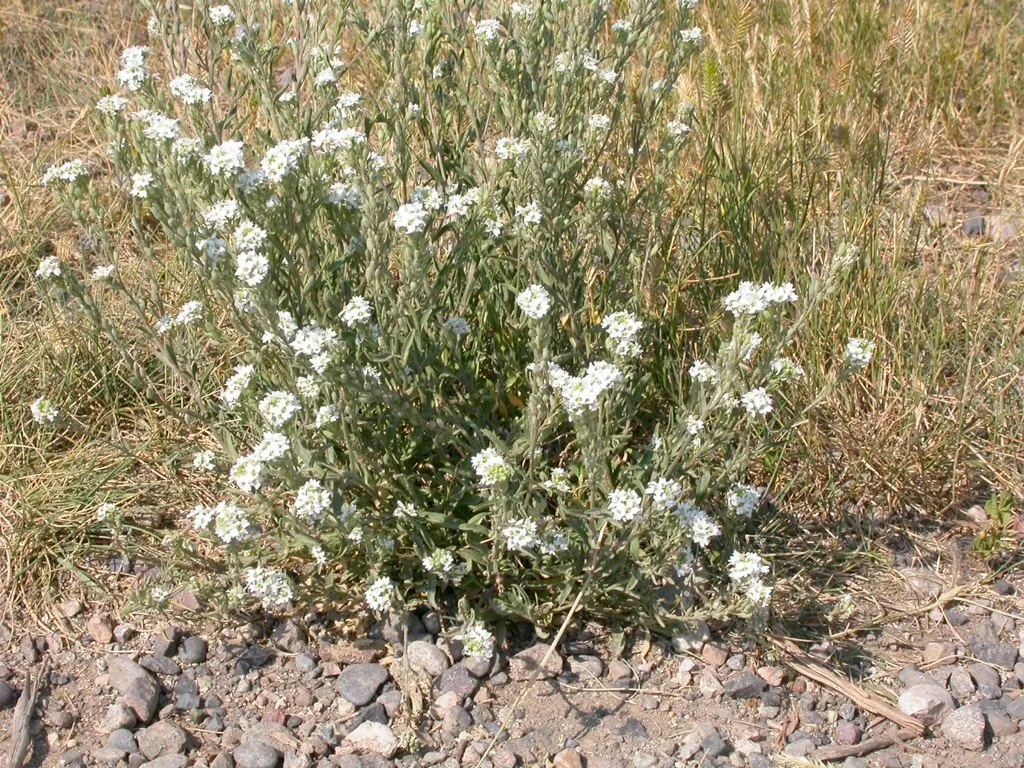
Hoary Alyssum (Berteroa incana)
Hoary Alyssum (Berteroa incana) is a non‑parasitic biennial weed of the Brassicaceae family (Brassicaceae).
Life cycle: annual, biennial, or short‑lived perennial.
Other names: hoary alyssum, grey alyssum, hoary false madwort, hoary alyssum (Eng.), false alyssum (Eng.), hoary false madwort (Eng.).
Taxonomy
Classification
Kingdom: Plants (Plantae)
Division: Flowering plants (Angiosperms) (Angiospermae)
Class: Dicotyledons (Dicotyledoneae)
Order: Brassicales (Brassicales)
Family: Brassicaceae (Brassicaceae), or Cruciferae (Cruciferae)
Genus: Berteroa (Berteroa)
Species: Hoary Alyssum (Berteroa incana (L.) DC.)
Synonyms
- Alyssum incanum L.
Similar Species
Alyssum desertorum. An introduced weedy species found on waste ground with sandy patches. It differs by having yellow flowers and round, hairless fruits about 3 mm in diameter.
Origin
Native to the Baikal region of Russia.
Photographs

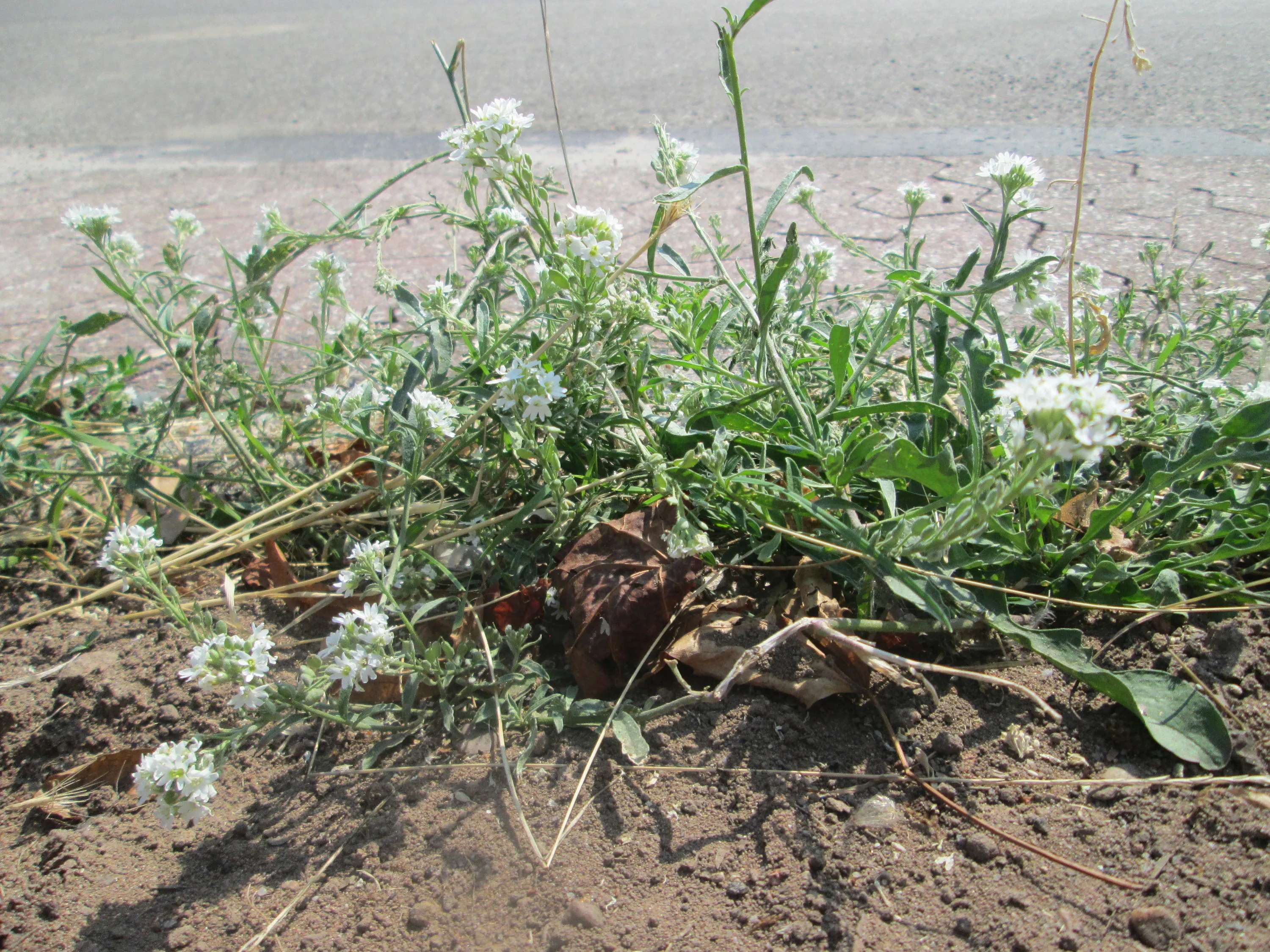
Hoary Alyssum (Berteroa incana)

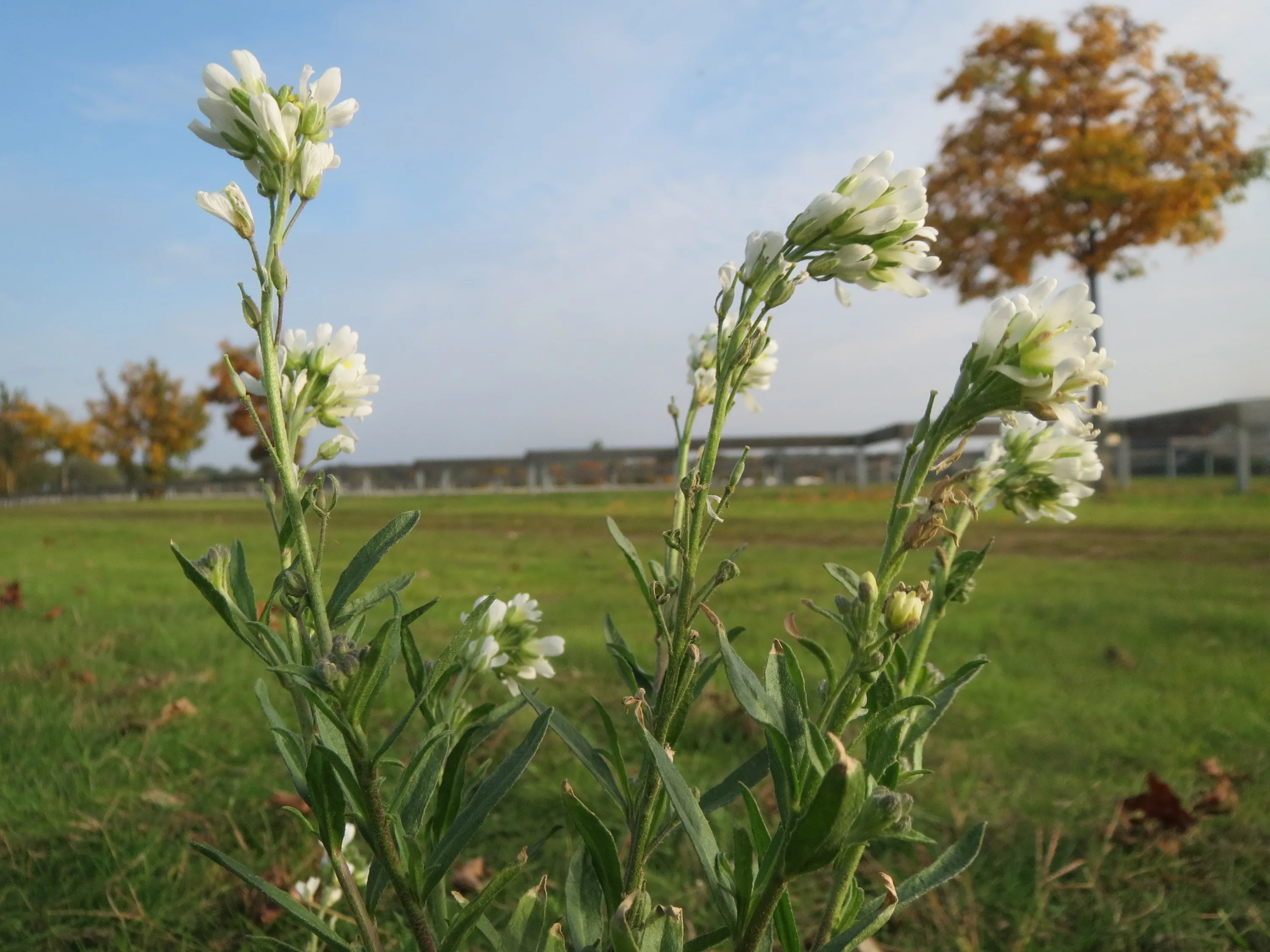
Hoary Alyssum (Berteroa incana)

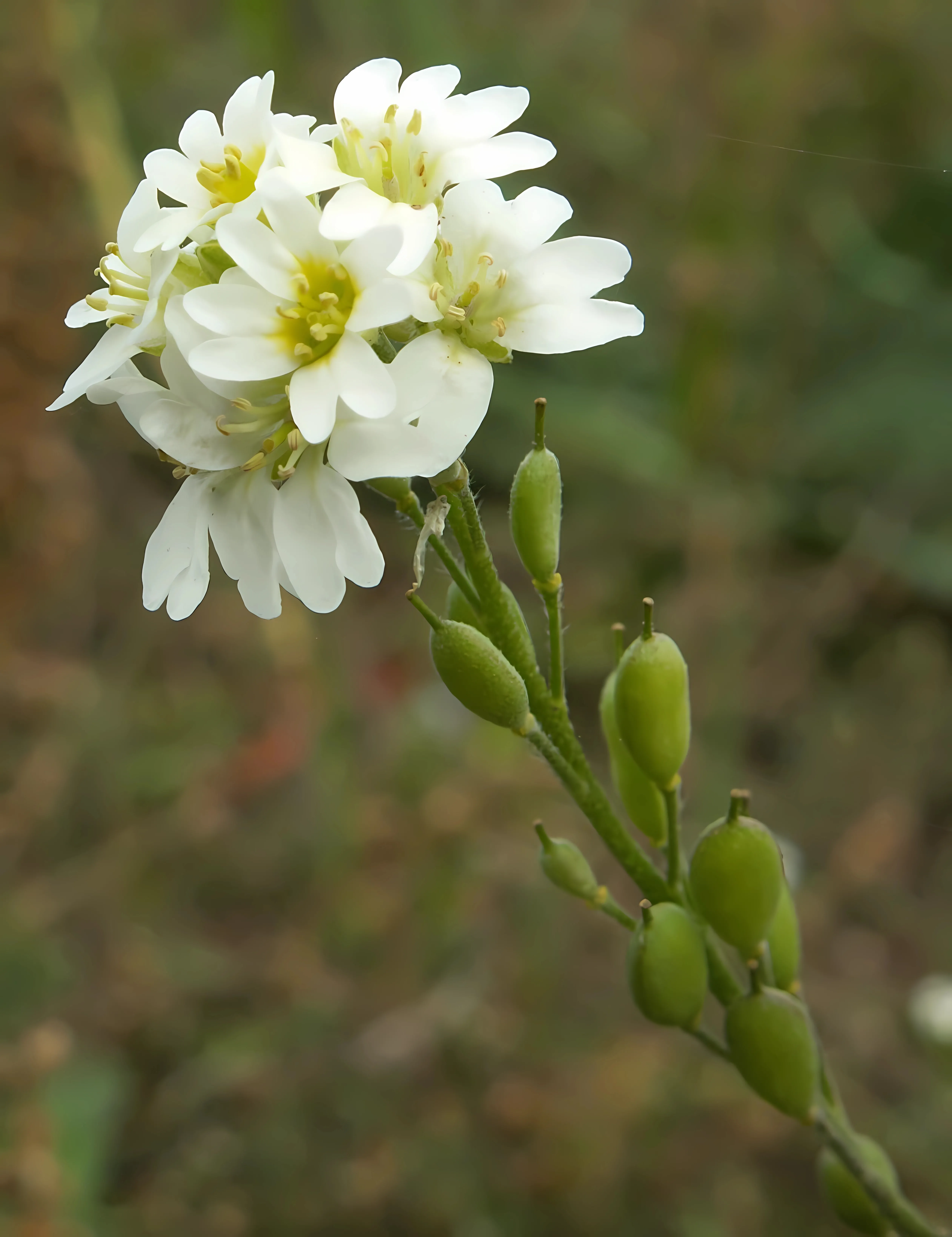
Hoary Alyssum (Berteroa incana)


LCD 4-in-1 Soil Tester
Check essential growing conditions with one compact tool. Measure soil pH, moisture, temperature and light intensity — ideal for gardens, potted plants and greenhouses.
- 4-in-1 measurement
- Easy-to-read LCD display
- Portable design
Affiliate link · For indicative measurements only.
Botanical Description
Root System
Taproot, branched, curved.
Seeds
Seeds round, oval‑flattened or lens‑shaped, dark reddish‑brown, brown, or greyish‑green, 1.3–1.8 mm long, 1.3–1.4 (1.5) mm wide, up to 0.5 mm thick. Margins have a narrow membranous rim; an orange translucent wing is visible under high magnification.
Seedlings
Cotyledons round, broadly elliptic or club‑shaped, 3–5 (8) mm long, (1.5) 2.5–3.5 (4) mm wide, surface with a whitish bloom.
First leaves spatulate, upper surface with numerous stellate hairs, lower surface densely covered with stellate hairs.
Leaves
Leaves alternate, lanceolate, 1–4 cm long, sessile and not clasping the stem, with sparse teeth, covered with whitish‑grey stellate hairs.
Basal leaves oblong to lanceolate, long‑petiolate, margins entire.
Stem leaves sessile, entire or with indistinct teeth.
Stems
Plants leafy.
Stems erect, greyish‑green due to grey stellate hairs, often purple and branched at the top.
Several stems arise from one rootstock.
Plant height (10) 20–65 (90) cm.
Inflorescences
Inflorescence – a terminal dense raceme, 5–25 cm long, compact at flowering and elongating in fruit.
Flowers white, numerous, 2–3 mm across.
Four sepals densely hairy.
Four petals deeply divided into two lobes.
Six stamens. One pistil.
Pedicels 7–8 mm long.
Fruit
Fruit – an elongated, oval (oblong‑elliptic) silique, 5–8 mm long, 3–4 mm wide, surface whitish‑grey or whitish‑brown with stellate hairs, containing 4–12 seeds (2–6 per locule), two‑valved, with flat or convex valves.
Ecology
Natural Zones
Grows in forest and steppe zones, sometimes extends into the Far North up to the Arctic Circle. In semi‑desert and desert zones it is rare, occurring only in places with additional moisture, as well as in mountainous areas and on virgin lands.
Soil Requirements
Prefers open, fertile soils; tolerates compacted and various soil types.
Habitats
Often forms nearly pure stands on abandoned fields.
Hoary alyssum is a ruderal weed.
Habitats: meadows, fallow lands, near dwellings, weedy places, roadsides, dry open places and slopes, pastures.
Unstable apophyte.

Solar Automatic Drip Irrigation Kit for Gardens
Automate watering for pots, gardens and small greenhouses. This solar-powered system features a timer to help schedule water delivery to your plants.
- Solar-powered
- 15 m irrigation hose
- Programmable watering
Affiliate link · Check included accessories.
Physiology
Germination
Seed viability in soil is at least 9 years.
Freshly ripened seeds are capable of germination.
Germination occurs from a depth of 1–4 cm. According to other sources, the maximum germination depth is 2 cm (Bazdyrev).
Minimum germination temperature 2–4 °C, optimum 20 °C (according to other sources, 18–26 °C, Bazdyrev).
Vegetation
Flowering May–September (Gubanov), according to other sources, until soil freezing (Dickinson). Fruiting from June (Gubanov). Also, flowering and fruiting May–June (Larin).
Reproduction
Reproduces by seeds.
Plants can produce up to 2,700 seeds (Dickinson). According to other sources, up to 182,600 seeds (Bazdyrev).
Weight of 1,000 seeds – 0.8 g.
Distribution
Hoary alyssum is widely distributed in Europe and Asia.
In Russia, it is one of the most common plants.
Regions of Distribution
Russia:
- European part – all regions;
- North Caucasus – all regions;
- Western and Eastern Siberia: Ob region (Tomsk Oblast, Tyumen Oblast, Sverdlovsk Oblast (east), Yamalo‑Nenets Autonomous Okrug, Khanty‑Mansi Autonomous Okrug, Krasnoyarsk Krai (west)), Upper Tobol region (Chelyabinsk Oblast (east), Kurgan Oblast, Orenburg Oblast (east)), Irtysh region (Omsk Oblast, Novosibirsk Oblast, Kemerovo Oblast, Altai Krai), Altai region (Republic of Altai), Angara‑Sayan region (Krasnoyarsk Krai (south), Republic of Khakassia, Republic of Tyva, Irkutsk Oblast, Republic of Buryatia (south‑west));
- Far East: Ussuri region (Primorsky Krai, Khabarovsk Krai (south)), Kamchatka region (Kamchatka Krai).
Belarus, Ukraine, Moldova, Latvia, Lithuania, Estonia, Armenia, Azerbaijan (except Talysh mountains), Georgia, Kazakhstan (except Syr Darya basin) – all regions.
Uzbekistan: Karakalpakstan (west), Tien‑Shan mountains.
Kyrgyzstan – Tien‑Shan mountains.

7-in-1 Wi-Fi Weather Station
Monitor local weather conditions with a wireless outdoor sensor. Track temperature, humidity, rainfall, wind speed and direction, and atmospheric pressure. Ideal for gardens, farms and greenhouses.
- Wireless outdoor sensor
- Solar-powered
- Wi-Fi connectivity
Affiliate link · Check regional compatibility.
Harmfulness
Crop Infestation
Rarely infests perennial grass crops.
Hoary alyssum is a carrier of viruses of cauliflower ring necrosis and turnip mosaic.
Beneficial Properties
Honey Production
Honey plant.
Fodder Value
According to old observations, it is eaten by all farm animals except horses (Larin → Rabotnov). According to other observations, it is not eaten or eaten very poorly by horses and cattle. Possibly eaten by sheep.

40W Full Spectrum LED Grow Light
Support healthy plant growth with full-spectrum LED lighting. Ideal for seedlings, indoor plants and small growing spaces. A practical solution for indoor gardening and year-round cultivation.
- Full-spectrum LED
- Energy-efficient design
- Indoor plant growing
Affiliate link · Check actual power and light coverage.
Chemical Composition
Chemical composition of plants at budding stage (June 26) with moisture content 80.0%, calculated on dry matter, in %:
- ash – 14.3;
- protein – 25.2;
- silicon – 0.15;
- phosphorus – 0.34;
- calcium – 2.62;
- magnesium – 0.25.
Chemical composition of plants at flowering stage (July 26) with moisture content 76.4%, calculated on dry matter, in %:
- ash – 12.1;
- protein – 19.9;
- silicon – 0.51;
- phosphorus – 0.30;
- calcium – 2.40;
- magnesium – 0.24.
Chemical composition of plants at fruiting stage (August 14) with moisture content 56.5%, calculated on dry matter, in %:
- ash – 7.4;
- protein – 10.1;
- silicon – 0.15;
- phosphorus – 0.32;
- calcium – 0.13;
- magnesium – 0.12.
As the above data show, the plants contain a relatively high amount of calcium.
Traces of alkaloids have been found in the plants.
Seeds contain 25.1% fat.
Control Methods
Agronomic Methods
Control of hoary alyssum is not difficult: it is easily destroyed by standard agronomic methods during crop care, and by surface and radical improvement of meadows and pastures.
References
- Bazdyrev, G.I. (1993) Weed Plants and Their Control in Modern Agriculture: A Textbook for Universities. Moscow: Publishing House of the Moscow Agricultural Academy.
- Nikitin, V.V. (1983) Weed Plants of the USSR Flora. Leningrad: Nauka.
- Dickinson, R., Royer, F. (2014) Weeds of North America. The University of Chicago Press.
- Gubanov, I.A., Kiseleva, K.V., Novikov, V.S., Tikhomirov, V.N. (2003) Illustrated Guide to Plants of Central Russia. Volume 2: Angiosperms (dicotyledons: choripetalous). Moscow: KMK Scientific Press, Institute of Technological Research.
- Larin, I.V. et al. (1951) Fodder Plants of Hayfields and Pastures of the USSR. Volume II. Dicotyledons (Chloranthaceae – Fabaceae). Moscow: State Publishing House of Agricultural Literature.
