
Common hemp-nettle (Galeopsis tetrahit)

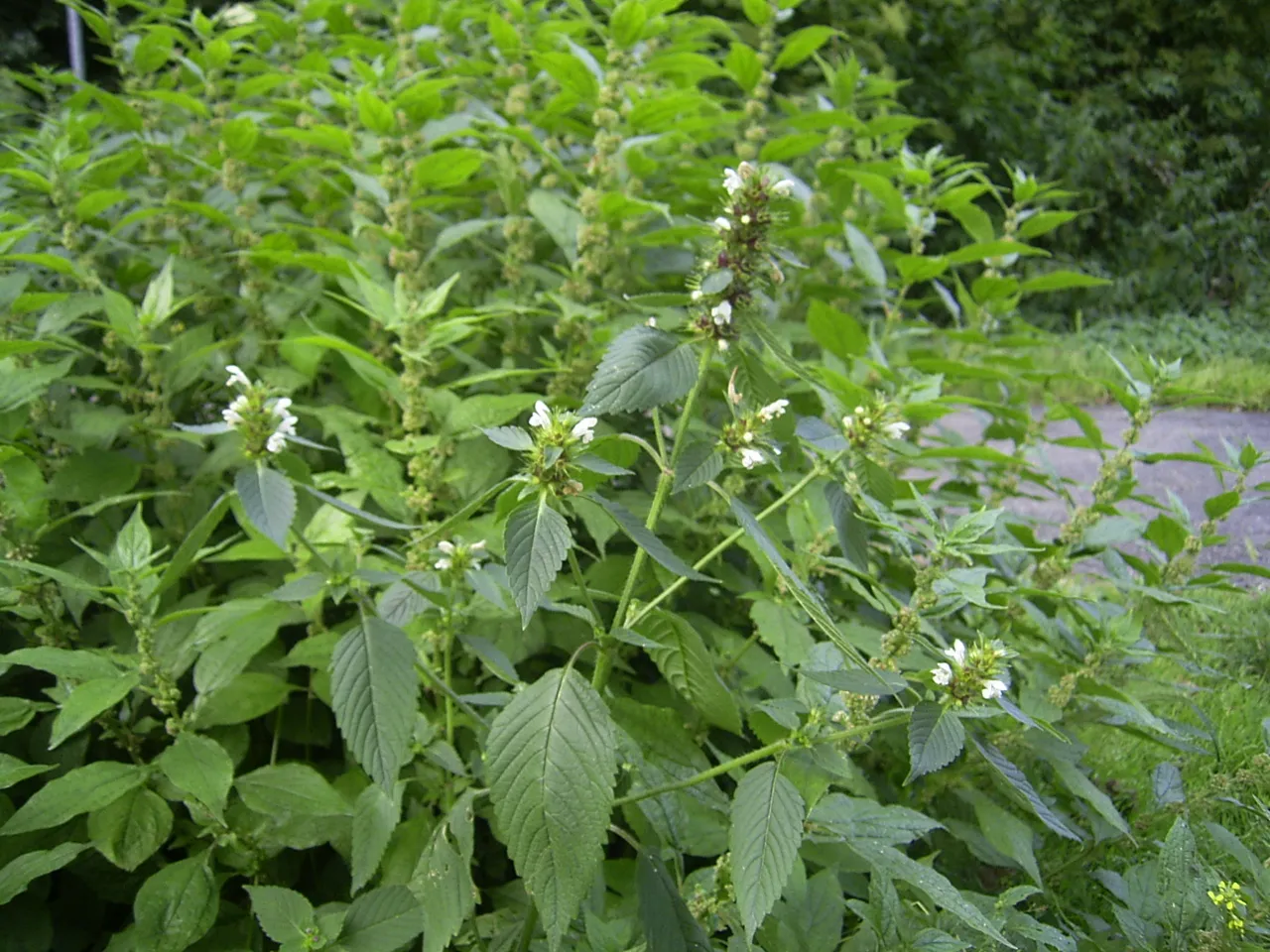
Common hemp-nettle (Galeopsis tetrahit)
Common hemp-nettle (Galeopsis tetrahit) is a non-parasitic, annual, spring-germinating quarantine weed of the family Lamiaceae (Lamiaceae).
Life cycle: annual.
Other names: hemp nettle, dog nettle, bee nettle, wild hemp, flowering nettle, ironweed, brittle-stem hemp nettle, ironwort, Simon's weed.
Taxonomy
Classification
Kingdom: Plants (Plantae)
Division: Flowering plants (Angiosperms) (Angiospermae)
Class: Dicotyledons (Dicotyledoneae)
Order: Lamiales (Lamiales)
Family: Lamiaceae (Lamiaceae), or Labiatae (Labiatae)
Genus: Hemp-nettle (Galeopsis)
Species: Common hemp-nettle (Galeopsis tetrahit L.)
Synonyms
- Galeopsis ochroleuca L.
Similar species
Showy hemp-nettle (Galeopsis speciosa). It differs by taller plants and more varied flower colours (in common hemp-nettle, the flower colour is uniform).
Origin
Native to Europe and Asia.
Introduced to Canada before 1884.
Photographs

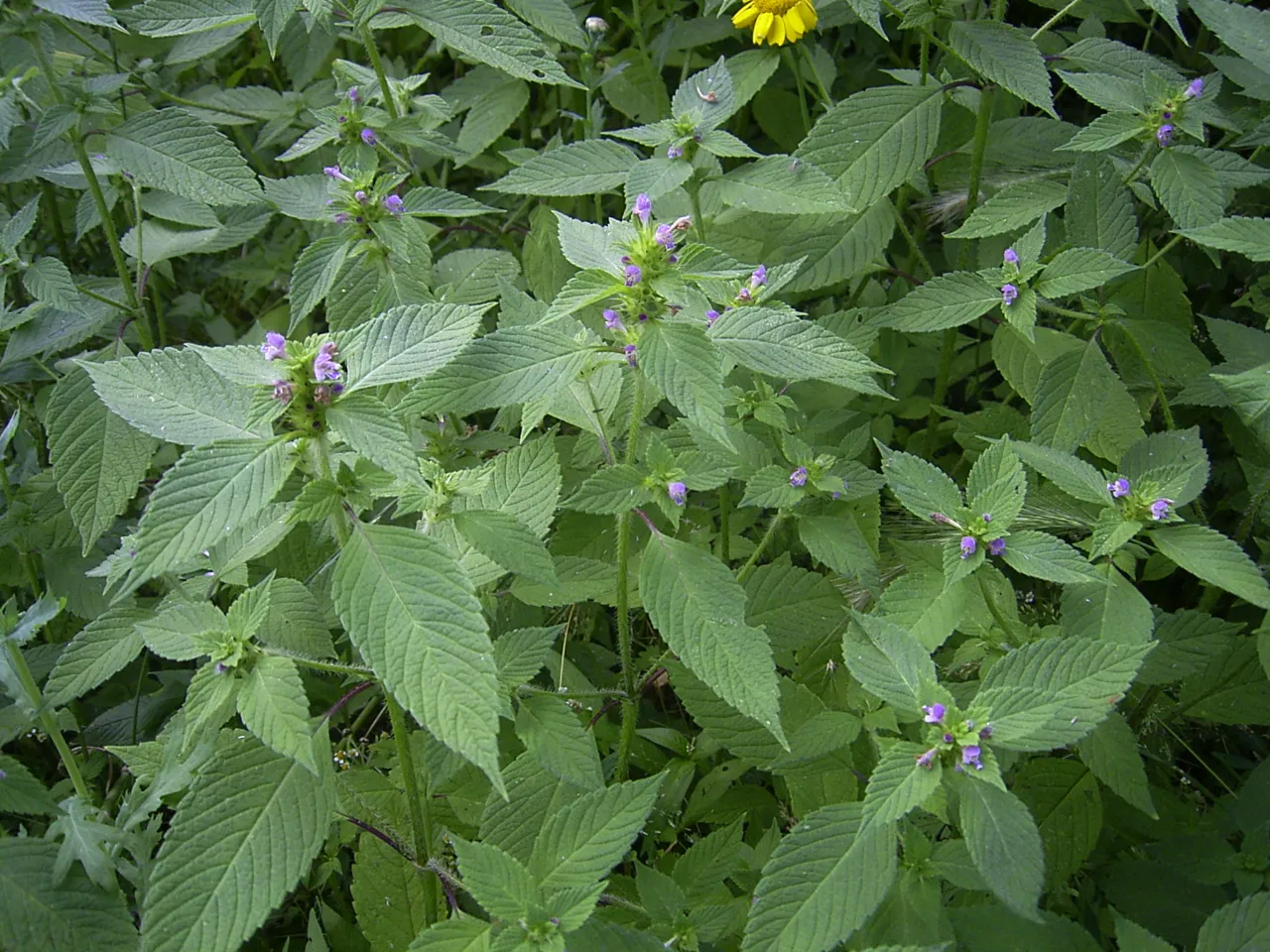
Common hemp-nettle (Galeopsis tetrahit)

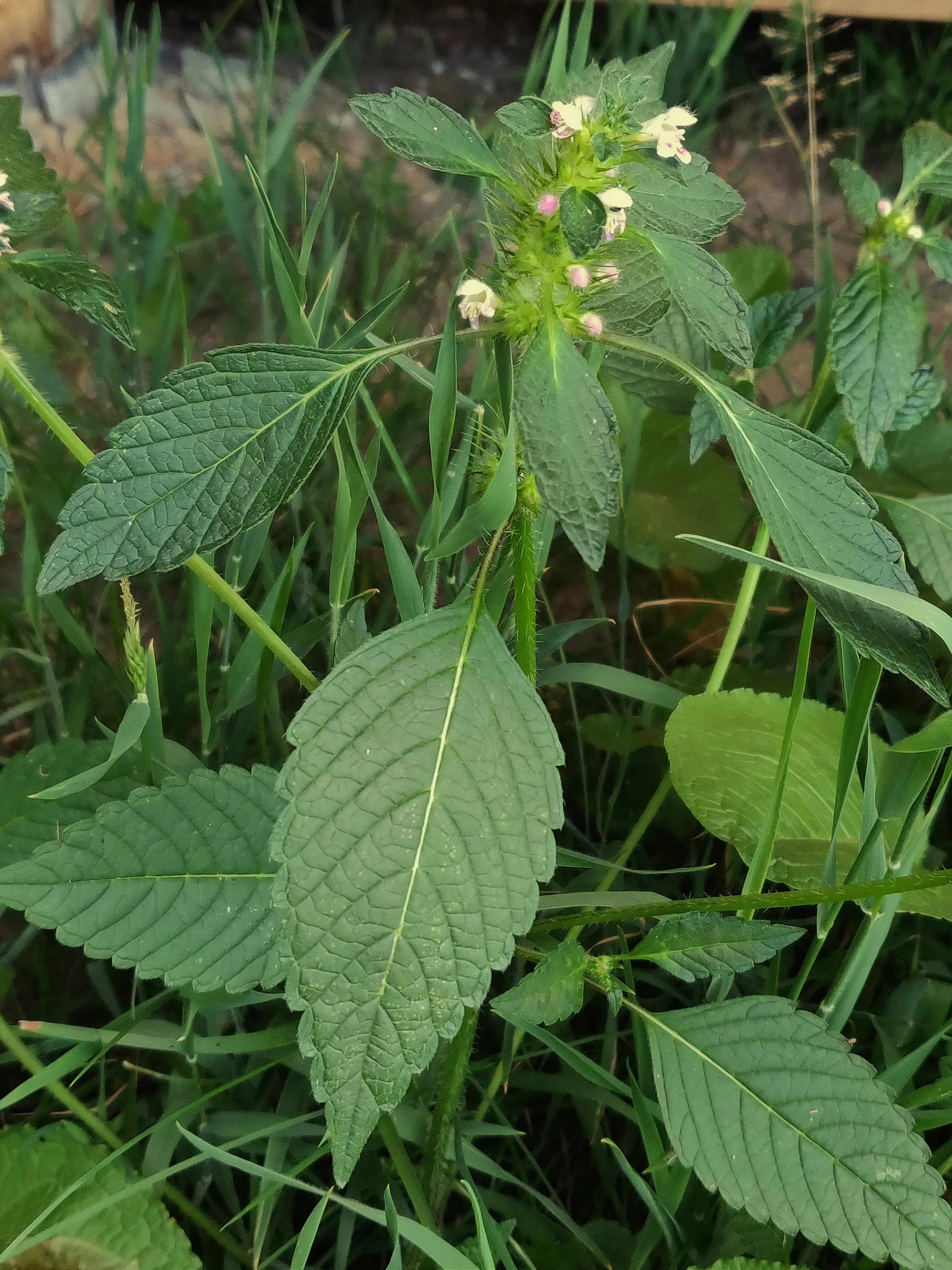
Common hemp-nettle (Galeopsis tetrahit)

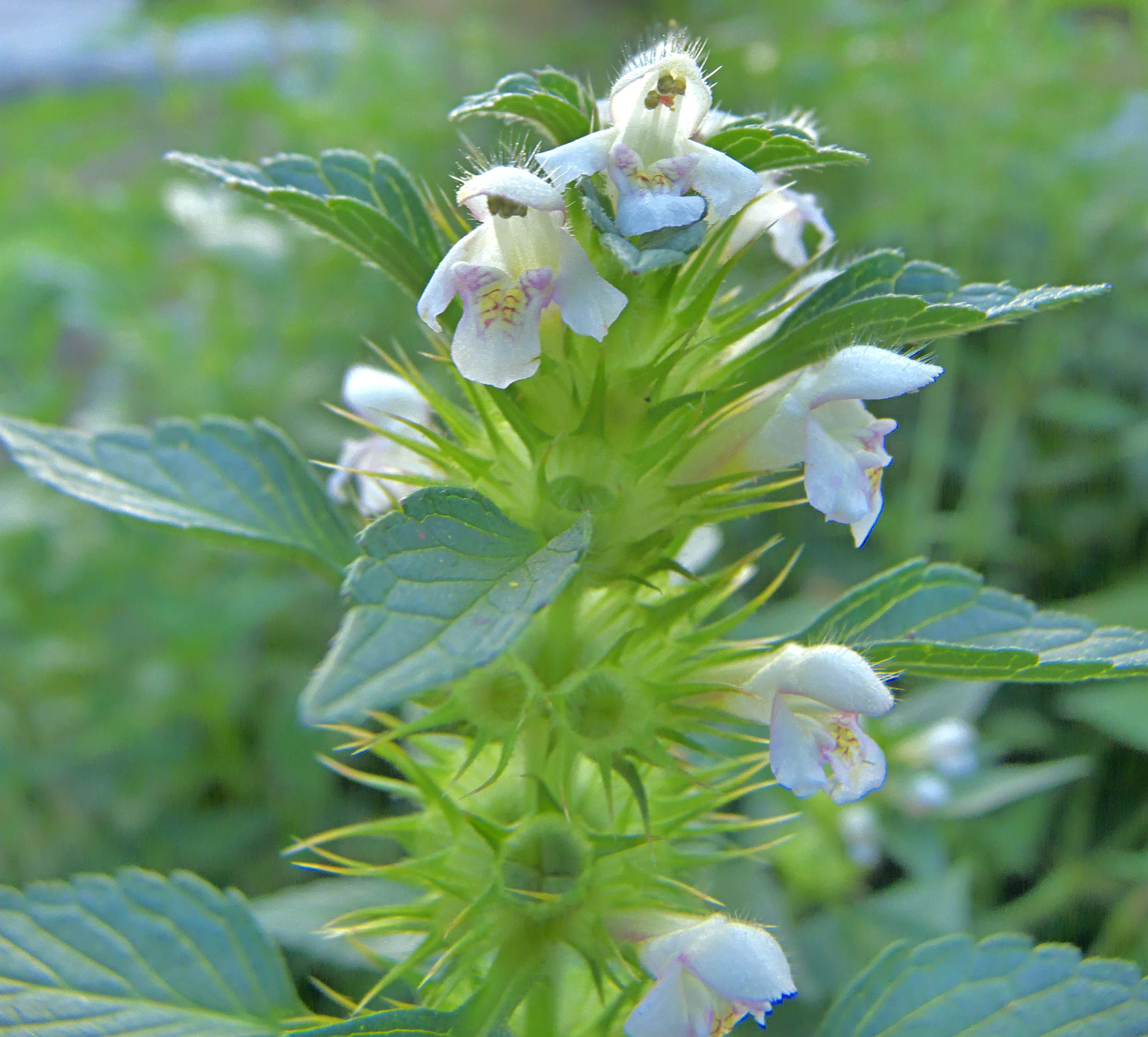
Common hemp-nettle (Galeopsis tetrahit)


LCD 4-in-1 Soil Tester
Check essential growing conditions with one compact tool. Measure soil pH, moisture, temperature and light intensity — ideal for gardens, potted plants and greenhouses.
- 4-in-1 measurement
- Easy-to-read LCD display
- Portable design
Affiliate link · For indicative measurements only.
Botanical description
Root system
Taproot, thin.
Seeds
Seeds round or ovoid, mottled greyish-brown, 3–4 mm long, with brown or black spots.
Seedlings
Seedlings with oval or oval-round cotyledons, 5–10 mm long, 2–5 mm wide, base with two pointed lobes, tip slightly toothed (slightly retuse), margins entire.
In the notch of the leaf, the petiole is attached with two strips of hairs.
The hypocotyl is often purple at ground level.
First leaves opposite, oval, coarsely toothed, strongly veined, surface rough due to fine stiff hairs.
Leaves
Leaves opposite, elongated ovate, oval or lanceolate, 3–12 cm long, surface bristly hairy, margins with 5–10 large, mostly rounded teeth on each side, rounded at the base.
Petioles 1–3 cm long.
Stems
Stems four-angled, bristly hairy, branched, sturdy, with numerous stiff downward-pointing hairs (bristles). Nodes swollen.
Plants 20–80 (100) cm tall, usually low-growing up to 50 cm.
Inflorescences
Inflorescence — terminal spike (verticillaster), with many flowers.
Flowers white, pink, purple, lilac-pink, red or variegated, with two yellow spots, about 1 cm across.
Five sepals fused together, 7–11 mm long, prominently 10-ribbed and spiny.
Five petals fused into a tube, 15–22 mm long.
Upper and lower lip of the flower with a broad, lighter border and a yellow spot edged with red on the palate.
Four stamens, hairy. One pistil.
Fruit
Fruit — a nutlet. One flower produces four nutlets.
Ecology
Natural zones
A plant of humid and cool climates.
Soil requirements
Common hemp-nettle prefers low-lying areas. Grows well on aerated, moist, humus-rich soils with high nitrogen content.
Habitats
Often forms dense thickets on pastures, fields, fresh fallows, roadsides, wastelands, near rubbish dumps. Occurs in gardens and vegetable patches, forests, less frequently in meadows.

Solar Automatic Drip Irrigation Kit for Gardens
Automate watering for pots, gardens and small greenhouses. This solar-powered system features a timer to help schedule water delivery to your plants.
- Solar-powered
- 15 m irrigation hose
- Programmable watering
Affiliate link · Check included accessories.
Physiology
Germination
Seed viability in soil up to 10 years (Dickinson), according to other data — 35–68 years (Klaassen), up to 14 years (Larin).
Germination occurs from depths of 1–4 cm.
Minimum germination temperature 2–5 °C, optimum 13 °C. Autumn seedlings die at frosts of -2 °C.
Vegetation
Flowering late July–September.
Reproduction
Reproduces by seeds.
Plants can produce up to 2,800 seeds. According to other data, up to 3,000 (Klaassen), up to 8,000 seeds per stem (Larin).
Distribution
Relatively widespread. Found in cultivated crops of the forest zone of the European part of Russia, more often in western regions. In the east it diminishes and is replaced by the related species — bifid hemp-nettle (Galeopsis bifida).
Distribution regions
Russia:
- European part: Karelo-Murmansk (Murmansk Oblast, Republic of Karelia), Baltic (Kaliningrad Oblast), Ladoga-Ilmen (Saint Petersburg and Leningrad Oblast, Novgorod Oblast, Pskov Oblast), Upper Dnieper (Smolensk Oblast, Bryansk Oblast), Upper Volga (Tver Oblast, Kaluga Oblast, Yaroslavl Oblast, Moscow and Moscow Oblast, Vladimir Oblast, Nizhny Novgorod Oblast (west), Ivanovo Oblast), Volga-Don (Tula Oblast, Oryol Oblast, Ryazan Oblast, Lipetsk Oblast, Kursk Oblast, Penza Oblast, Tambov Oblast, Belgorod Oblast, Ulyanovsk Oblast (west), Republic of Tatarstan (west), Voronezh Oblast, Chuvash Republic, Republic of Mordovia, Nizhny Novgorod Oblast (south));
- Far East: Ussuri (Primorsky Krai, Khabarovsk Krai (south)).
Also in the Caucasus and Western Siberia (Larin).
Belarus, Latvia, Lithuania, Estonia — all regions.
Ukraine:
- Carpathian (Lviv Oblast, Chernivtsi Oblast, Zakarpattia Oblast, Ivano-Frankivsk Oblast);
- Dnieper (Volyn Oblast, Rivne Oblast, Ternopil Oblast, Khmelnytskyi Oblast, Zhytomyr Oblast, Vinnytsia Oblast, Kyiv and Kyiv Oblast, Chernihiv Oblast, Sumy Oblast, Poltava Oblast, Kirovohrad Oblast, Cherkasy Oblast, Dnipropetrovsk Oblast, Kharkiv Oblast, Luhansk Oblast).

7-in-1 Wi-Fi Weather Station
Monitor local weather conditions with a wireless outdoor sensor. Track temperature, humidity, rainfall, wind speed and direction, and atmospheric pressure. Ideal for gardens, farms and greenhouses.
- Wireless outdoor sensor
- Solar-powered
- Wi-Fi connectivity
Affiliate link · Check regional compatibility.
Harmfulness
Infestation of crops
Infests cereal crops, especially spring cereals, row crops, legumes, sugar beet, maize, potatoes.
It is a major competitor of agricultural crops for soil moisture and nutrients.
Yield losses of 24% wheat and 25% oilseed rape have been reported.
Seeds usually shed before harvest.
Toxicity
Considered a poisonous plant, probably due to alkaloids contained in leaves and stems, but no cases of livestock mortality have been recorded (Larin). Horses avoid hemp-nettle, but accidental ingestion causes poisoning with the following symptoms: trembling, profuse sweating, dilated pupils, elevated temperature, rapid heartbeat. Animals recover; no deaths have been recorded.
Beneficial properties
Medicinal use
Leaves and stems of hemp-nettle are used in Tibetan medicine.
Fodder value
Common hemp-nettle is grazed by livestock when young. Eaten by sheep and cattle. Not eaten by horses.
Kostychev in 1912 noted the suitability of this plant for ensiling.

40W Full Spectrum LED Grow Light
Support healthy plant growth with full-spectrum LED lighting. Ideal for seedlings, indoor plants and small growing spaces. A practical solution for indoor gardening and year-round cultivation.
- Full-spectrum LED
- Energy-efficient design
- Indoor plant growing
Affiliate link · Check actual power and light coverage.
Chemical composition
Chemical composition of common hemp-nettle hay (Larin → Belyaev, % of dry matter):
- ash — 14.7;
- protein — 23.8;
- fats — 5.1;
- fibre — 13.3;
- nitrogen-free extractables — 43.1.
Control methods
Agronomic methods
Ploughing immediately after crop harvest to allow ploughed-under seeds that have passed dormancy to germinate.
Spring weed seedlings are destroyed by pre-sowing tillage.
References
- Nikitin, V.V. (1983) Weed plants of the flora of the USSR. Leningrad: Nauka.
- Dickinson, R., Royer, F. (2014) Weeds of North America. The University of Chicago Press.
- Bazdyrev, G.I. (1993) Weed plants and control measures in modern agriculture: A textbook for universities. Moscow: Publishing House of the Moscow Agricultural Academy.
- Klaassen, H., Freitag, J. (2004) Weed plants, distribution and harmfulness, species identification. Joint publication of Landwirtschaftsverlag Münster-Hiltrup and BASF AG, Limburgerhof.
- Larin, I.V. et al. (1956) Fodder plants of hayfields and pastures of the USSR. Volume III. Dicotyledons (Geraniaceae — Asteraceae). Moscow: State Publishing House of Agricultural Literature.
