
Puncture vine (Tribulus terrestris)

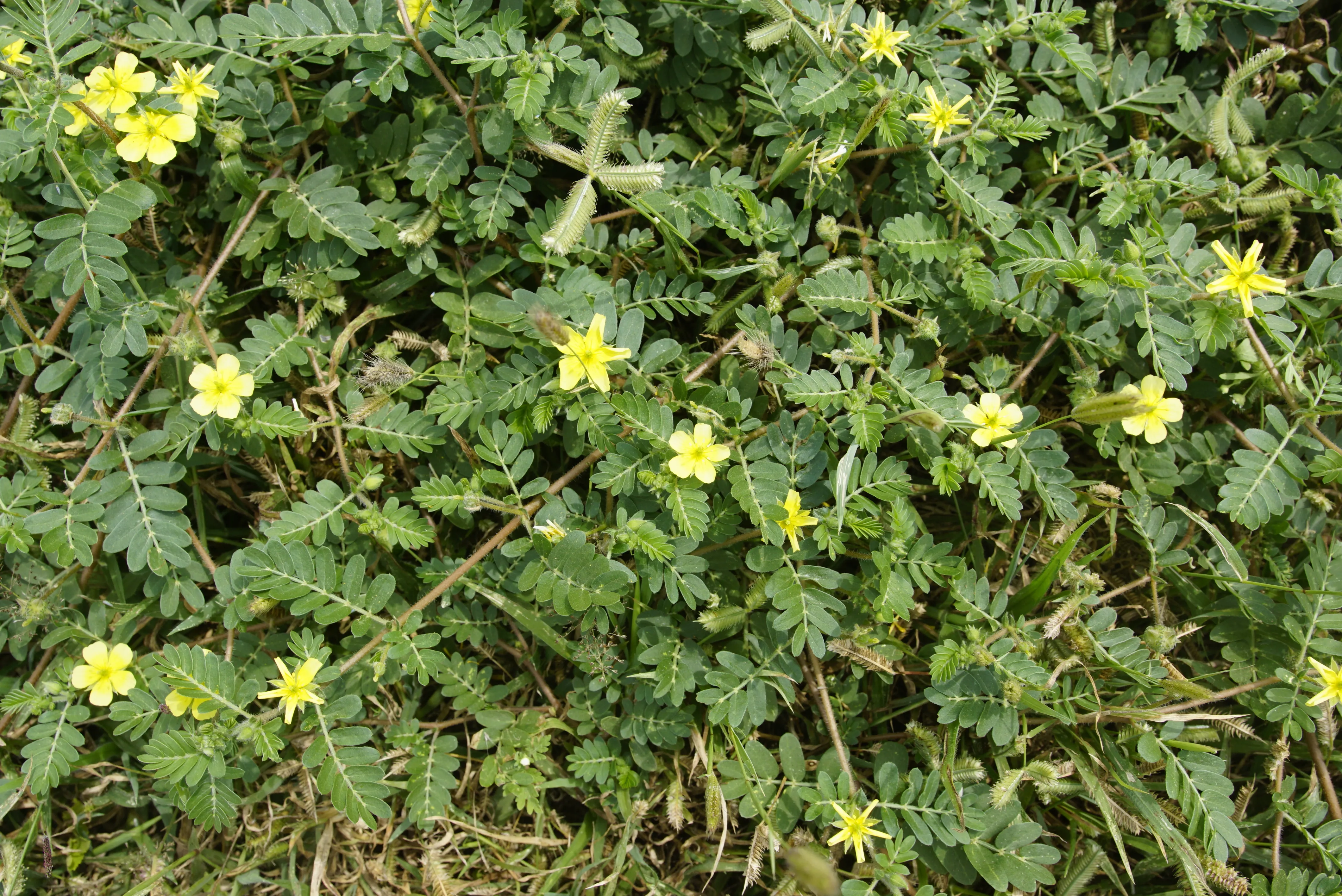
Puncture vine (Tribulus terrestris)
Puncture vine (Tribulus terrestris) is a non‑parasitic, short‑lived, early spring weed of the family Zygophyllaceae (Zygophyllaceae).
Life cycle: annual.
Other names: темир-ткен (Kazakh, Turkmen), беш-ткин (Uzbek), puncture vine, caltrop, ground burnut, tackweed, bullhead, goathead, Mexican sandbur, Texas sandbur.
Taxonomy
Classification
Kingdom: Plants (Plantae)
Division: Flowering plants (Angiosperms) (Angiospermae)
Class: Dicotyledons (Dicotyledones)
Order: Zygophyllales (Zygophyllales)
Family: Zygophyllaceae (Zygophyllaceae)
Genus: Caltrop (Tribulus)
Species: Puncture vine (Tribulus terrestris L.)
Synonyms
- Tribulus terrester Landolt.
Origin
Puncture vine is native to the Mediterranean region of Southern Europe and the northern edge of the Sahara Desert in Africa.
It has spread worldwide with sheep wool.
Photos

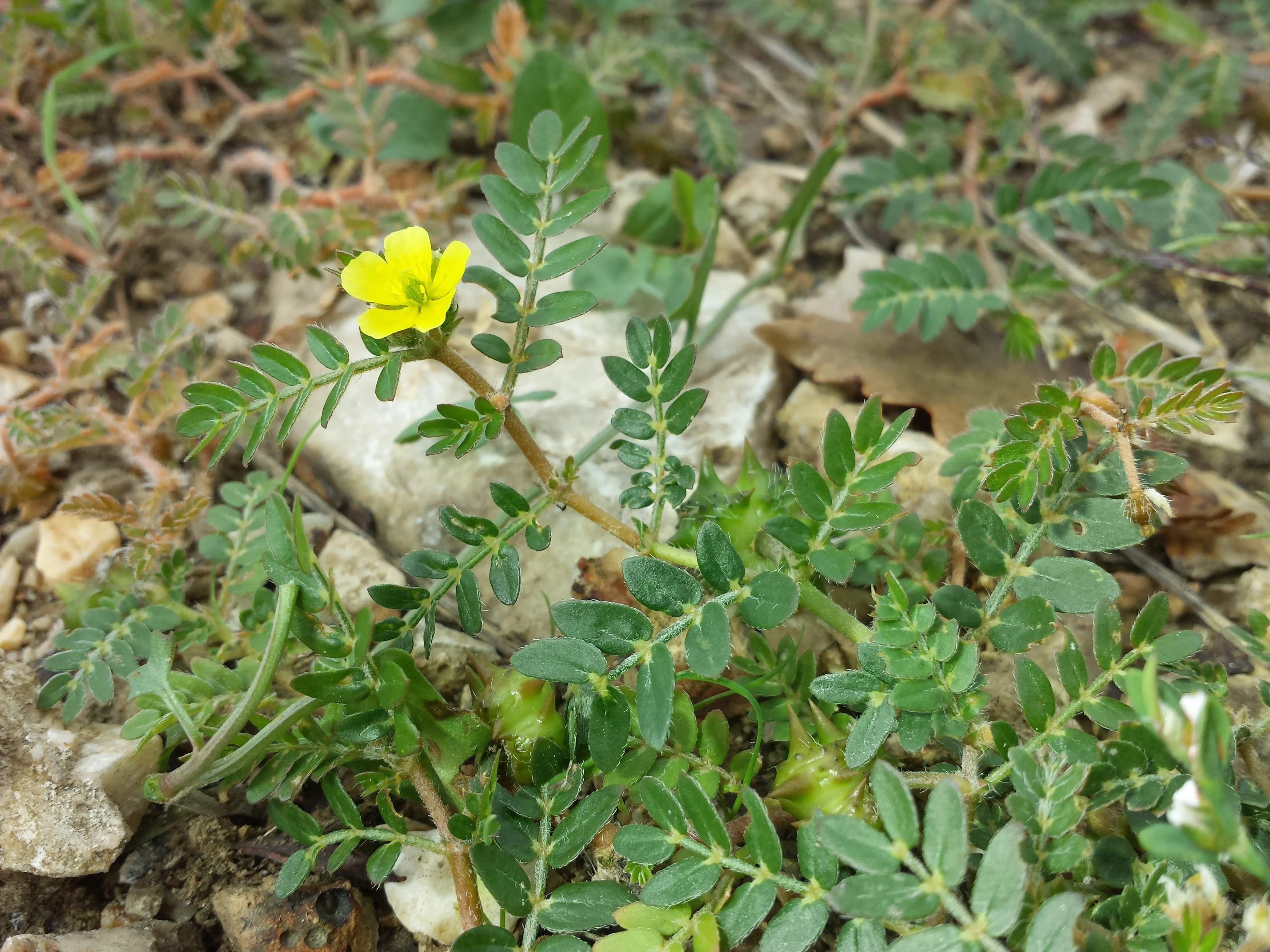
Puncture vine (Tribulus terrestris)

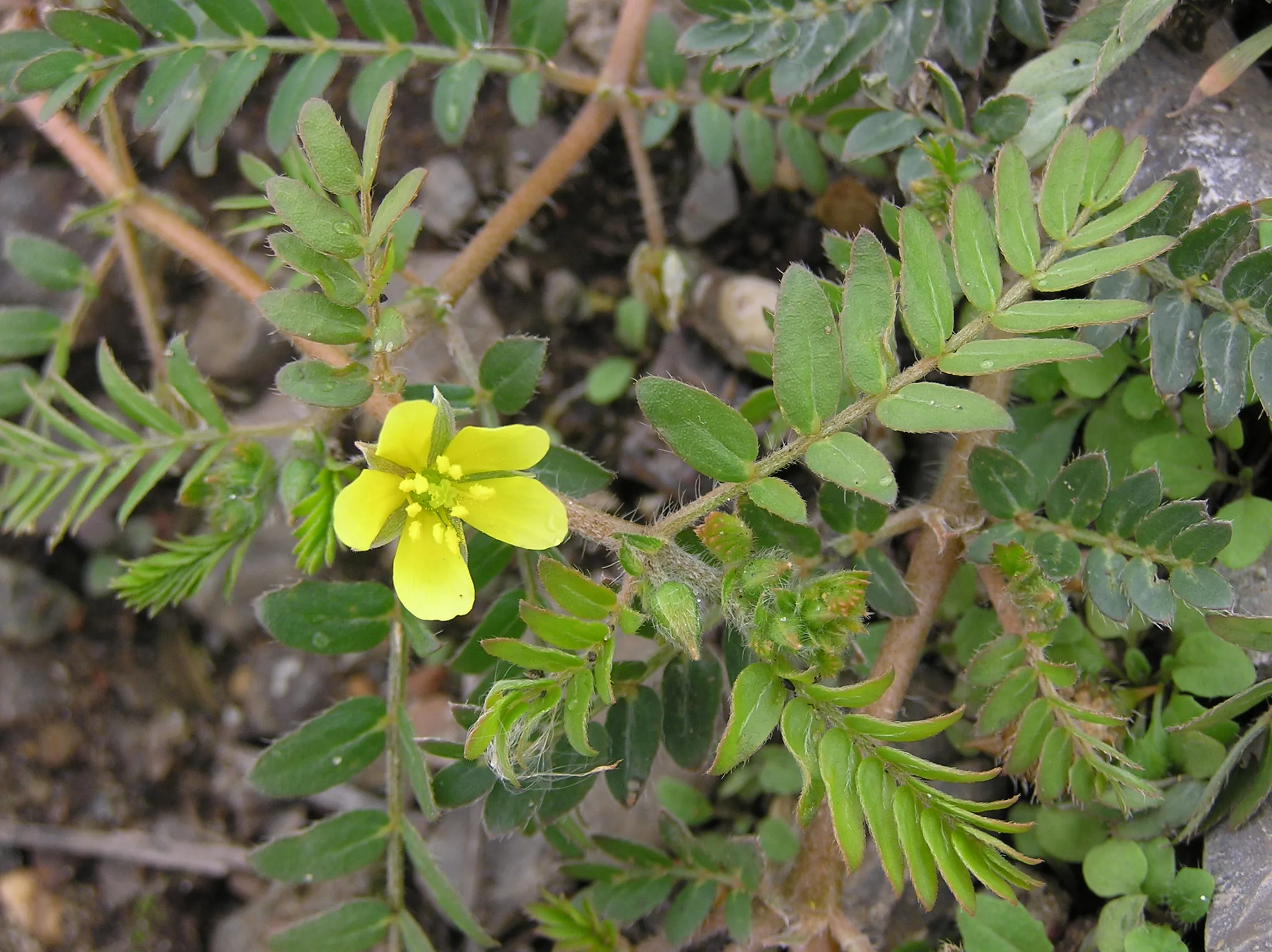
Puncture vine (Tribulus terrestris)

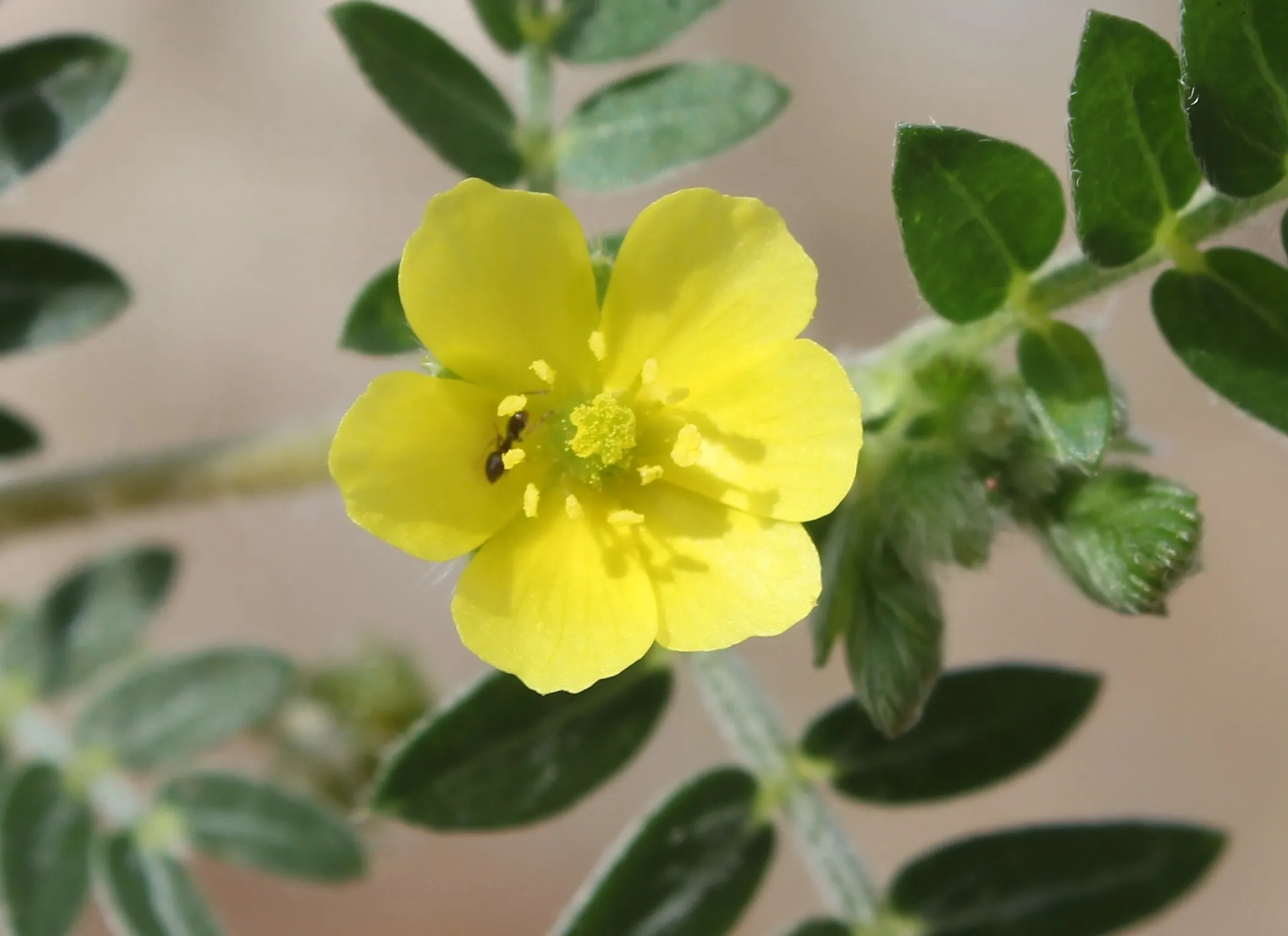
Puncture vine (Tribulus terrestris)


LCD 4-in-1 Soil Tester
Check essential growing conditions with one compact tool. Measure soil pH, moisture, temperature and light intensity — ideal for gardens, potted plants and greenhouses.
- 4-in-1 measurement
- Easy-to-read LCD display
- Portable design
Affiliate link · For indicative measurements only.
Botanical description
Root system
The root system is taprooted, woody, reaching 2.6 m in depth and 6.6 m in diameter.
Seeds
Seeds are wedge‑shaped, brown, 4.7–5.7 mm long, 3.5–6 mm wide.
One or two short spines about 3–5 mm long arise from the middle of the seed.
The surface is covered with ridges and conspicuous white bristles.
Seedlings
Seedlings have oblong to oblong‑elliptic (almost quadrangular), notched cotyledons, 8–12 (15) mm long, 3–4 (5) mm wide, peach to green in colour, thick, the upper surface distinctly wrinkled and rough, toothed at the tip.
The stem below the cotyledons is salmon‑coloured, with short hairs.
The first leaf is compound with 6–10 leaflets, the surface bristly with short pointed hairs. The underside is glaucous green.
Leaves
Leaves are opposite, about 6 cm long, compound with 8–16 leaflets, even‑pinnate.
Leaflets 5–15 mm long, about 5 mm wide, surface from sparsely to densely hairy. Upper surface glabrous, lower pubescent.
Stipules up to 1 cm long.
Stems
The plant is prostrate, forming mats up to 5 m across.
Stems green to reddish‑brown, decumbent, branched, surface covered with dense bristly hairs.
Height/length of plants 10–60 (240) cm.
Inflorescence
Inflorescence is a solitary flower, located in leaf axils.
Flowers pale yellow, about 2 cm across.
Five sepals, 3–5 mm long.
Five petals, 3–12 mm long.
Ten stamens. One pistil.
Fruit
The fruit is a straw‑green or dark grey schizocarp (capsule, also nutlet), about 1.2 cm long, splitting at maturity into five triangular (angular), star‑shaped, woody parts (mericarps or carpels), each containing one to four seeds. Each segment has two to four sharp, sturdy spines, as well as tubercles and bristles.
Ecology
Natural zones
Puncture vine prefers semi‑arid regions. It grows on dry sandy soils of steppe, semi‑desert and desert zones, on dry slopes of foothills and mountains of the Caucasus and Central Asia. In the forest‑steppe zone it is rare, as an adventive plant.
Soil requirements
Grows on dry sandy soils. Very tolerant of trampling.
Habitats
Habitats: weedy places, wastelands, along roads, rocky slopes, sandy and pebble deposits in river valleys, in vineyards, orchards, sometimes spreads in melon fields.

Solar Automatic Drip Irrigation Kit for Gardens
Automate watering for pots, gardens and small greenhouses. This solar-powered system features a timer to help schedule water delivery to your plants.
- Solar-powered
- 15 m irrigation hose
- Programmable watering
Affiliate link · Check included accessories.
Physiology
Germination
Seed viability in soil is 5 years.
Germination requires a dormancy period of 6 months to 1 year. Freshly matured seeds do not germinate.
Optimal depth – 5 cm of soil, maximum – 12–15 cm.
Optimal temperature for seed germination is 20–35 °C.
Vegetation
After overwintering, seeds begin to germinate from April.
Flowering begins 2 weeks after seed germination. Under favourable conditions it continues all summer.
Fruits form within 5 weeks after germination.
Flowering June–August (Bazdyrev), according to other data April–May (Larin). Fruiting August–November (Bazdyrev), according to other data June–July (Larin).
Reproduction
Spreads by seeds.
One plant produces up to 10,000 (Dickinson), according to other data – up to 5,700 fruits (Bazdyrev).
Weight of 1000 fruits – about 5 g.
Distribution
It grows in the south of the European part of Russia, the Caucasus, Siberia and Central Asia.
Distribution regions
Russia:
- European part:
- Oryol Oblast, Lipetsk Oblast, Kursk Oblast, Penza Oblast, Tambov Oblast, Belgorod Oblast, Ulyanovsk Oblast (west), Voronezh Oblast (Volga‑Don region partly);
- North Caucasus – all regions;
- Western and Eastern Siberia: Verkhne‑Tobolsk (Chelyabinsk Oblast (east), Kurgan Oblast, Orenburg Oblast (east)), Irtysh (Omsk Oblast, Novosibirsk Oblast, Kemerovo Oblast, Altai Krai), Altai (Altai Republic), Dauria (Buryatia Republic (east of Lake Baikal), Zabaykalsky Krai).
Moldova, Georgia, Armenia, Azerbaijan, Kazakhstan, Turkmenistan, Kyrgyzstan, Uzbekistan, Tajikistan – all regions.
Ukraine:
- Dnieper (Volyn Oblast, Rivne Oblast, Ternopil Oblast, Khmelnytskyi Oblast, Zhytomyr Oblast, Vinnytsia Oblast, Kyiv and Kyiv Oblast, Chernihiv Oblast, Sumy Oblast, Poltava Oblast, Kirovohrad Oblast, Cherkasy Oblast, Dnipropetrovsk Oblast, Kharkiv Oblast, Luhansk Oblast);
- Black Sea (Odesa Oblast, Mykolaiv Oblast, Kherson Oblast, Zaporizhzhia Oblast, Donetsk Oblast).

7-in-1 Wi-Fi Weather Station
Monitor local weather conditions with a wireless outdoor sensor. Track temperature, humidity, rainfall, wind speed and direction, and atmospheric pressure. Ideal for gardens, farms and greenhouses.
- Wireless outdoor sensor
- Solar-powered
- Wi-Fi connectivity
Affiliate link · Check regional compatibility.
Harmfulness
Crop contamination
Infests vegetable and melon crops.
It is not considered a noxious weed because it is easily destroyed.
In dry years it can spread heavily (Turkmenistan, Ashgabat district, 1936), especially due to late May rainfall.
Considered a weed in 37 countries.
Toxicity
Puncture vine is poisonous to livestock. Light‑coloured animals that eat this plant become very sensitive to bright light and should be provided with shade to protect from sunlight.
In sheep, horses, cattle it causes mouth injuries. In cows it leads to gastric ulcers.
Sheep, when the weed is widespread, suffer from tribulosis, especially lambs, goats and Merino sheep. Signs of poisoning: after a few days animals develop fever, loss of appetite, swellings on the head (on parts not covered with wool) and limbs, nasal discharge, and jaundice (yellowing of mucous membranes). The illness lasts 10–20 days, and mortality can reach 50% (for a mass poisoning case in Turkmenistan, 1936, Larin) and 85–90% (for a mass poisoning case in South Africa, Larin) depending on animal age and amount of plant consumed. Autopsies of dead animals showed inflammation of the stomach and intestinal mucous membranes and liver hyperaemia.
When the first signs of poisoning appear in animals, livestock should be immediately moved to another pasture.
It has been established that the toxic properties of puncture vine appear under certain conditions – during intensive growth on hot sunny days after heavy rains and before seed formation.
Cases of poisoning of cattle and horses have not been recorded (Larin → Borovsky).
In late summer, livestock often refuse to graze in areas where this plant grows abundantly. The spiny fruits can injure livestock and people, and can damage car tyres.
Useful properties
Fodder value
According to observations, on pastures of Turkmenistan it is well eaten in late May – early June. In the North Caucasus it is eaten by sheep in autumn, starting from August. Despite this, the plant is poisonous.

40W Full Spectrum LED Grow Light
Support healthy plant growth with full-spectrum LED lighting. Ideal for seedlings, indoor plants and small growing spaces. A practical solution for indoor gardening and year-round cultivation.
- Full-spectrum LED
- Energy-efficient design
- Indoor plant growing
Affiliate link · Check actual power and light coverage.
Chemical composition
A small amount of alkaloids has been found in the above‑ground parts, but absent in the fruits.
Control methods
Agrotechnical methods
Control measures should be carried out before the weed matures and sheds seeds.
Fields heavily infested with puncture vine are put under black fallow.
Under irrigation, intensive weed control measures are maintained.
Sowing in fields where this weed occurs should be done at very early dates with increased seeding rates.
Chemical methods
Puncture vine is relatively resistant to herbicides.
References
- Bazdyrev G.I. (1993) Weed plants and measures to control them in modern agriculture: A textbook for universities. Moscow: Publishing house of the Moscow Agricultural Academy.
- Dickinson, R., Royer, F. (2014) Weeds of North America. The University of Chicago Press.
- Nikitin, V.V. (1983) Weed plants of the flora of the USSR. Leningrad: Nauka.
- Larin I.V. et al. (1950) Fodder plants of hayfields and pastures of the USSR. Volume I. Spore plants, gymnosperms and monocots. Moscow: State Publishing House of Agricultural Literature.
