
Silverweed (Potentilla anserina)

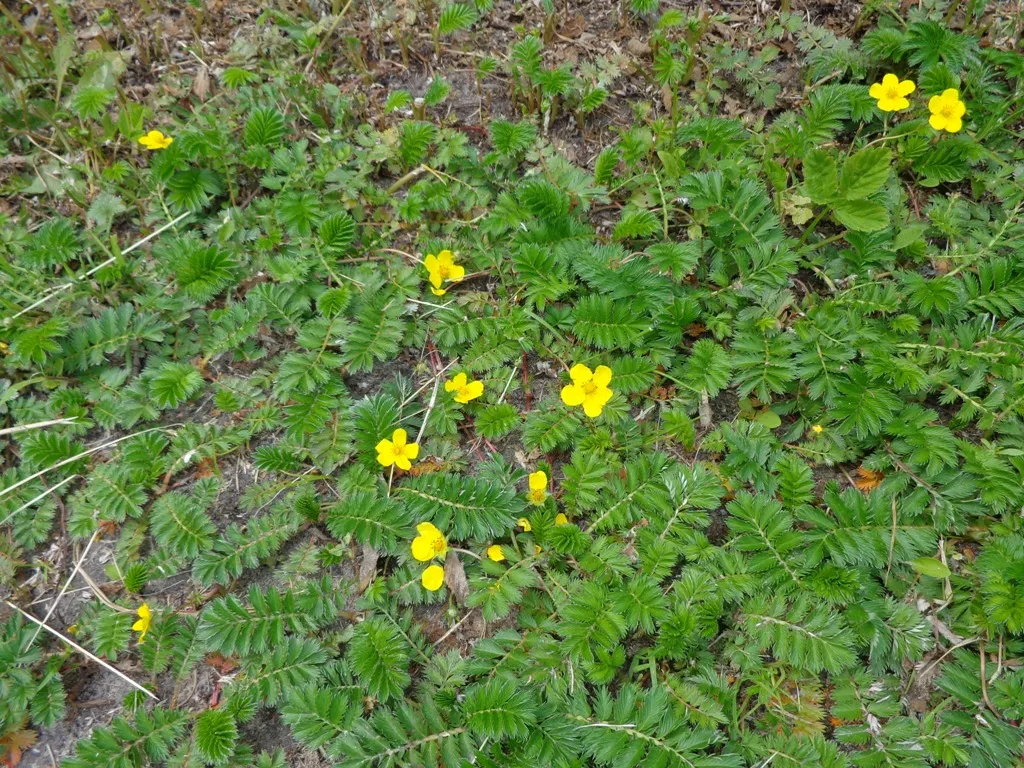
Silverweed (Potentilla anserina)
Silverweed (Potentilla anserina) is a non‑parasitic creeping weed of the family Rosaceae (Rosaceae).
Life cycle: perennial.
Other names: goosewort, goose grass.
Taxonomy
Classification
Kingdom: Plants (Plantae)
Division: Flowering plants (Angiosperms) (Angiospermae)
Class: Dicotyledons (Dicotyledoneae)
Order: Rosales (Rosales)
Family: Rosaceae (Rosaceae)
Genus: Potentilla (Potentilla)
Species: Silverweed (Potentilla anserina L.)
Similar species
Potentilla heidenreichii Zimm. Distributed throughout the central belt of Russia. Grows in dry meadows, pastures, and field margins.
Potentilla canescens Bess. Occurs in southern regions, in steppes and dry meadows, along roads, and on secondary habitats. Differs by a well‑developed thin, ash‑grey tomentose pubescence on the lower surface of the leaves.
Photographs

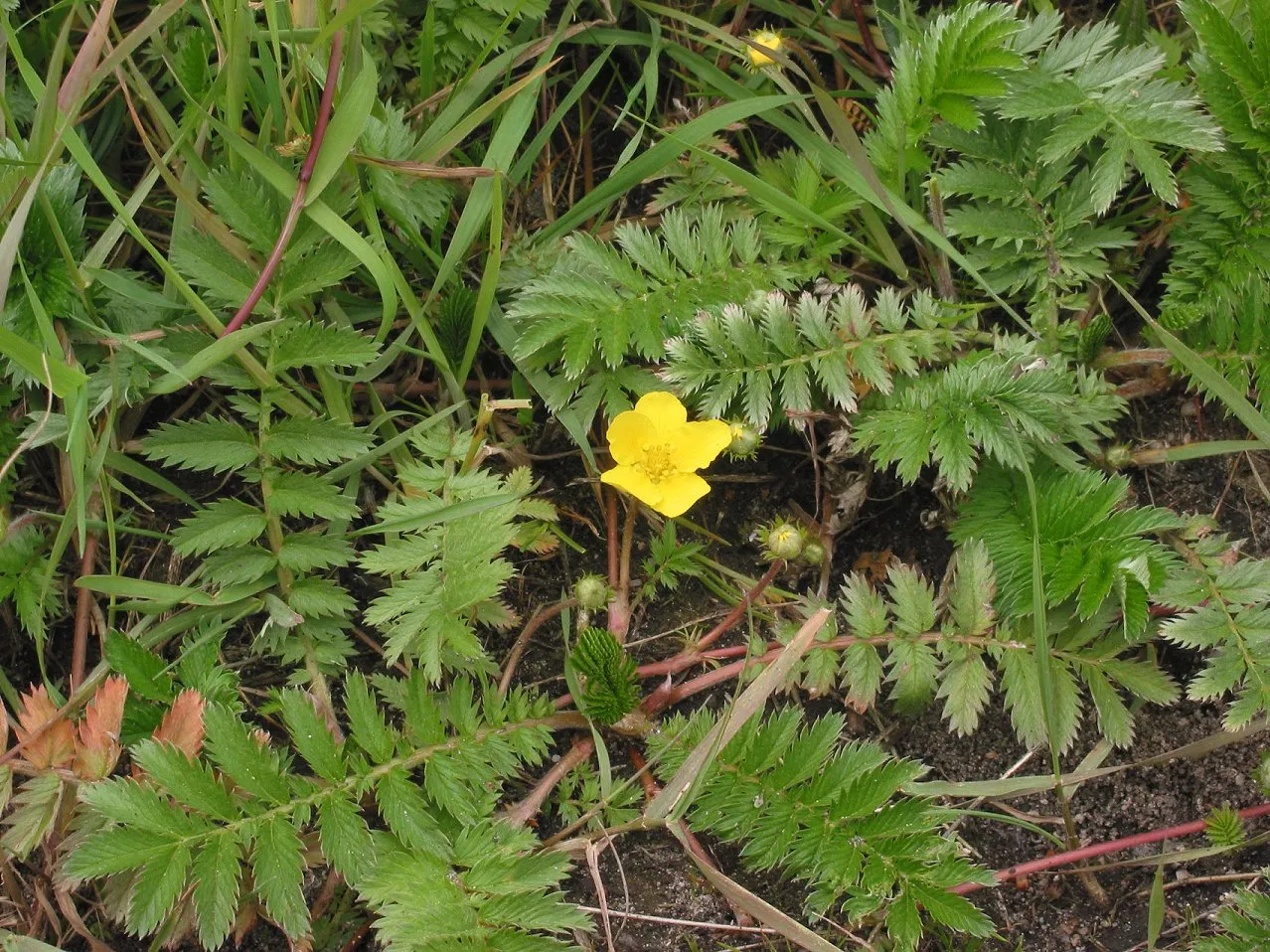
Silverweed (Potentilla anserina)

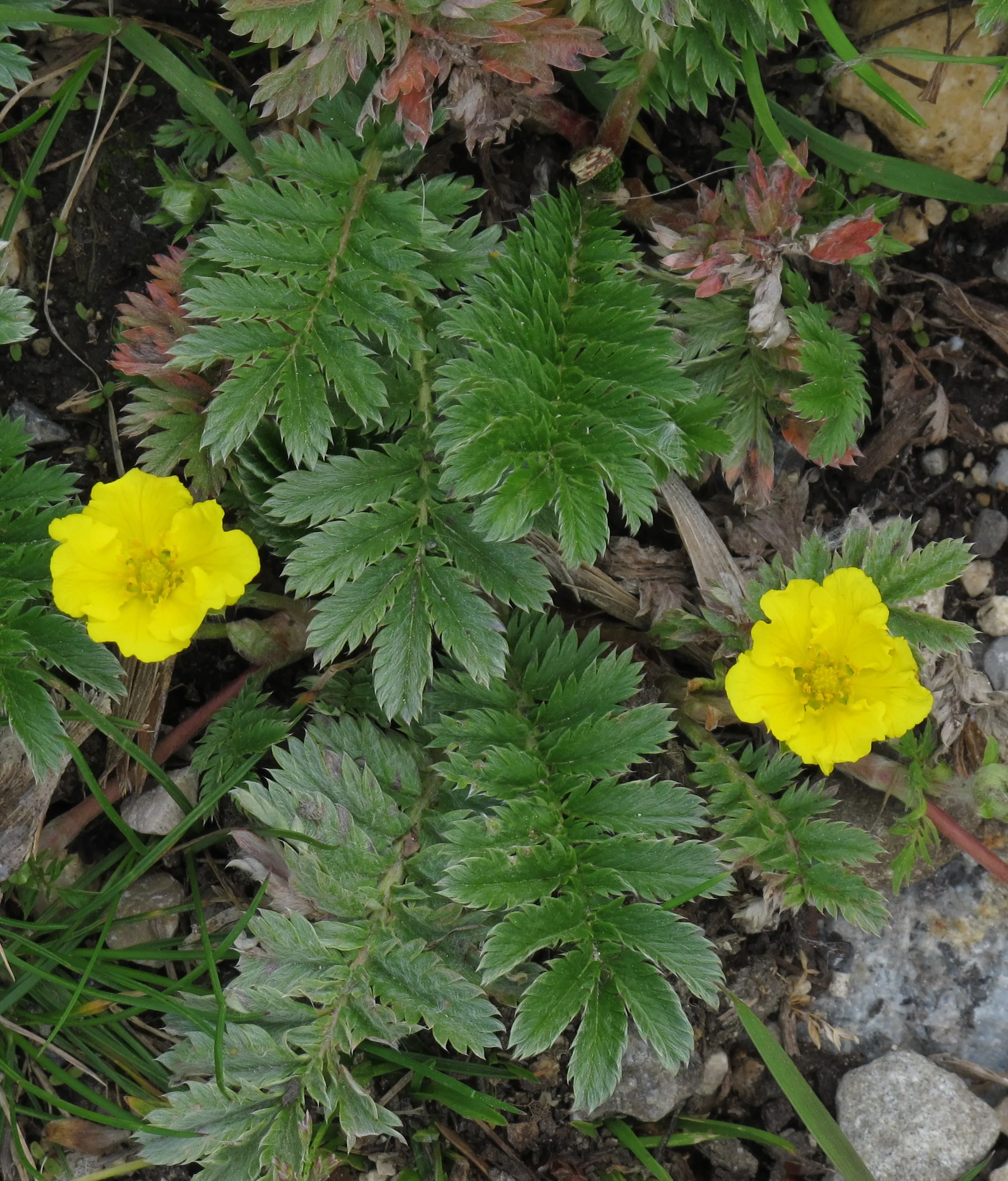
Silverweed (Potentilla anserina)

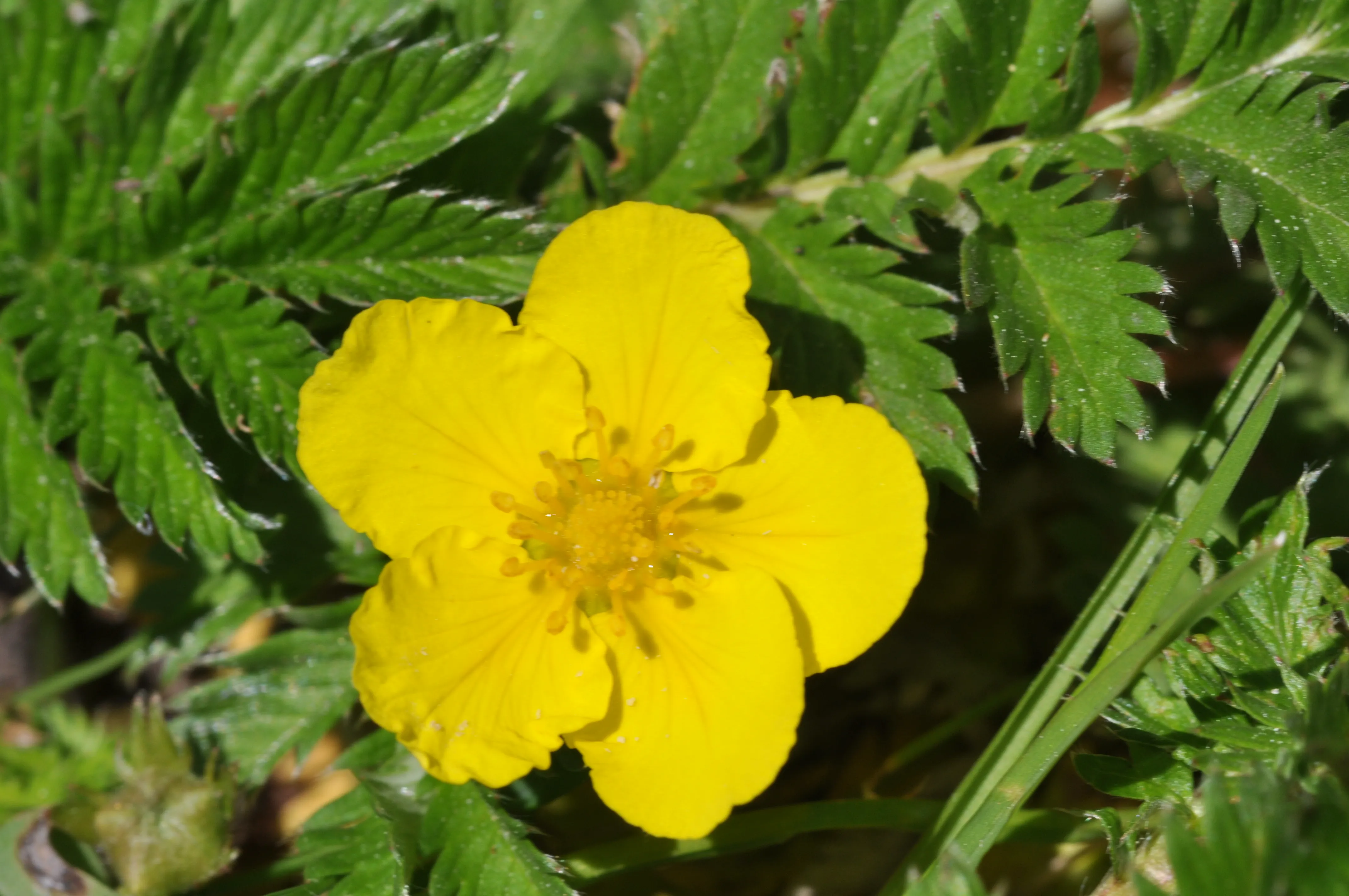
Silverweed (Potentilla anserina)


LCD 4-in-1 Soil Tester
Check essential growing conditions with one compact tool. Measure soil pH, moisture, temperature and light intensity — ideal for gardens, potted plants and greenhouses.
- 4-in-1 measurement
- Easy-to-read LCD display
- Portable design
Affiliate link · For indicative measurements only.
Botanical description
Root system
Root spindle‑shaped, thickened (root tuber), branched.
Seedlings
Cotyledon leaves elliptic, 3.5–5 mm long, 2–2.5 mm wide, on petioles.
Leaves
Leaves odd‑pinnate, nearly glabrous above, silky‑pubescent beneath.
Basal leaves rosette‑forming, interruptedly odd‑pinnately compound, with numerous leaflets, up to 20 cm long, with large stipules, on long petioles.
Lower stem leaves similar to basal ones.
Upper leaves reduced.
Leaflets elliptic, deeply serrate‑dentate, silky‑tomentose beneath.
Stems
Main stem shorter than lateral ones, prostrate (creeping).
Stems pubescent, rooting at nodes with thin stolon‑like shoots.
Flower‑bearing stems 15–60 cm long.
Plant height (length) 25–80 cm.
Inflorescences
Flowers solitary, large, yellow, arising from leaf axils of creeping shoots.
Outer sepals incised, equal in length to inner ones, broadly ovate. Petals 7–10 mm long, twice as long as sepals.
Stamens 20–25, with short filaments.
Fruit
Fruit – an oval or ovoid, relatively large, brown achene, pitted, with a groove on the back and short lateral styles.
Ecology
Natural zones
Silverweed is distributed mainly in the Northern Hemisphere in temperate climate regions.
Soil requirements
Oxylomesophyte, i.e. grows on soils with a reaction from slightly acidic to slightly neutral.
Habitats
Habitats: dry and floodplain meadows, forest glades, fallow fields, wastelands, along roads, railway embankments, near dwellings, disturbed lands, dry light forests, field margins, sparse pine forests.
Unstable apophyte.

Solar Automatic Drip Irrigation Kit for Gardens
Automate watering for pots, gardens and small greenhouses. This solar-powered system features a timer to help schedule water delivery to your plants.
- Solar-powered
- 15 m irrigation hose
- Programmable watering
Affiliate link · Check included accessories.
Physiology
Germination
Seeds almost do not germinate after ripening; they germinate the next year after overwintering.
Maximum germination depth no more than 2–3 cm.
Vegetation
Seedlings from achenes and shoots from buds of the root collar appear in spring and summer.
The shape of root tubers depends on the habitat: in wet places and on compacted field soils, roots are shortened and strongly branched below; on loose soils they penetrate up to 40 cm and branch rarely. The lifespan of root tubers is no more than one year; by spring of the following year they form a rosette‑daughter near the root collar, which develops at the expense of the mother root tuber and forms its own root tuber.
Flowering May–September. Fruiting from June.
Reproduction
Reproduces intensively by seeds and vegetatively.
Vegetative reproduction occurs via creeping rooting shoots at nodes, root segments with adventitious buds, and formation of daughter rosettes from stem‑derived rosettes.
Cutting root tubers at any depth leads to their regeneration. Therefore, autumn ploughing, which fragments root tubers, in the absence of spring tillage, promotes the spread of the weed.
Seed productivity – up to 300,000 achenes (Bazdyrev).
Weight of 1000 achenes – 0.7–0.8 g.
Distribution
Silverweed is distributed mainly in the Northern Hemisphere in temperate climate regions. Also found in Chile and southern Australia.
In Russia it occurs almost everywhere except the Arctic. More abundantly in the forest zone.
Distribution regions
Russia:
- European part – all regions;
- North Caucasus – all regions;
- Western and Eastern Siberia – all regions;
- Far East: Ussuri (Primorsky Krai, Khabarovsk Krai (south)), Zeya‑Bureya (Khabarovsk Krai (west), Jewish Autonomous Oblast, Amur Oblast).
Latvia, Lithuania, Estonia, Belarus, Ukraine, Moldova, Georgia, Armenia, Kyrgyzstan, Tajikistan, Turkmenistan, Kazakhstan – all regions.

7-in-1 Wi-Fi Weather Station
Monitor local weather conditions with a wireless outdoor sensor. Track temperature, humidity, rainfall, wind speed and direction, and atmospheric pressure. Ideal for gardens, farms and greenhouses.
- Wireless outdoor sensor
- Solar-powered
- Wi-Fi connectivity
Affiliate link · Check regional compatibility.
Harmfulness
Infestation of crops
Sometimes infests crops of perennial grasses, vegetable crops, meadows, pastures.
Useful properties
Use as food
Rhizomes, rich in starch, are occasionally used as food (Yakuts, Tibetans). Young shoots can be used for salads, drinks, and decoctions.
Honey plant
Honey plant, provides nectar and pollen.
Medicinal use
Decoctions from the roots of silverweed are used as an astringent and fixative.
Fodder value
There are reports of possible poisoning when eaten by animals, accompanied by loss of appetite and stomach upset. Horses are most sensitive and easily poisoned.
The earlier opinion that silverweed is readily eaten by geese is not confirmed in specially conducted experiments. However, in ground form it is suitable as feed for poultry, including geese.
According to old observations in Sweden, it is eaten by pigs and goats. Also, according to observations in the Caucasus, it is eaten by pigs.
Silverweed withstands intensive grazing, but is not eaten or is poorly eaten by cattle, so it often dominates old pastures.

40W Full Spectrum LED Grow Light
Support healthy plant growth with full-spectrum LED lighting. Ideal for seedlings, indoor plants and small growing spaces. A practical solution for indoor gardening and year-round cultivation.
- Full-spectrum LED
- Energy-efficient design
- Indoor plant growing
Affiliate link · Check actual power and light coverage.
Chemical composition
Chemical composition of plants, % of dry matter:
- ash – 8.0;
- protein – 17.6;
- fibre – 14.6.
Vitamin C content in leaves is 260–297 mg%. In underground organs in a sample collected on 20 September, vitamin C content was 105.6 mg%.
Underground and above‑ground organs contain tannins.
Control methods
Agronomic methods
Silverweed is resistant to control measures in perennial grass crops, meadows, and pastures.
The radical means of eradication in crop fields is ploughing.
In fields, ploughing with a plow and a skim coulter is carried out to a depth of 20–25 cm, with good soil inversion being important. Then the fields are planted with shade‑providing crops with dense sowing.
On newly developed virgin lands and peatlands, deep ploughing with high‑quality soil inversion is carried out under black fallow, followed by fallow cultivation.
Chemical methods
Relatively resistant to herbicides.
References
- Bazdyrev, G.I. (1993) Weed Plants and Their Control in Modern Agriculture: A Textbook for Universities. Moscow: Publishing House of the Moscow Agricultural Academy.
- Nikitin, V.V. (1983) Weed Plants of the Flora of the USSR. Leningrad: Nauka.
- Gubanov, I.A., Kiseleva, K.V., Novikov, V.S., Tikhomirov, V.N. (2003) Illustrated Guide to Plants of Central Russia. Volume 2: Angiosperms (dicotyledons: choripetalous). Moscow: KMK Scientific Press, Institute of Technological Research.
- Larin, I.V. et al. (1951) Fodder Plants of Hayfields and Pastures of the USSR. Volume II. Dicotyledons (Chloranthaceae – Leguminosae). Moscow: State Publishing House of Agricultural Literature.
