
Silver Cinquefoil (Potentilla argentea)

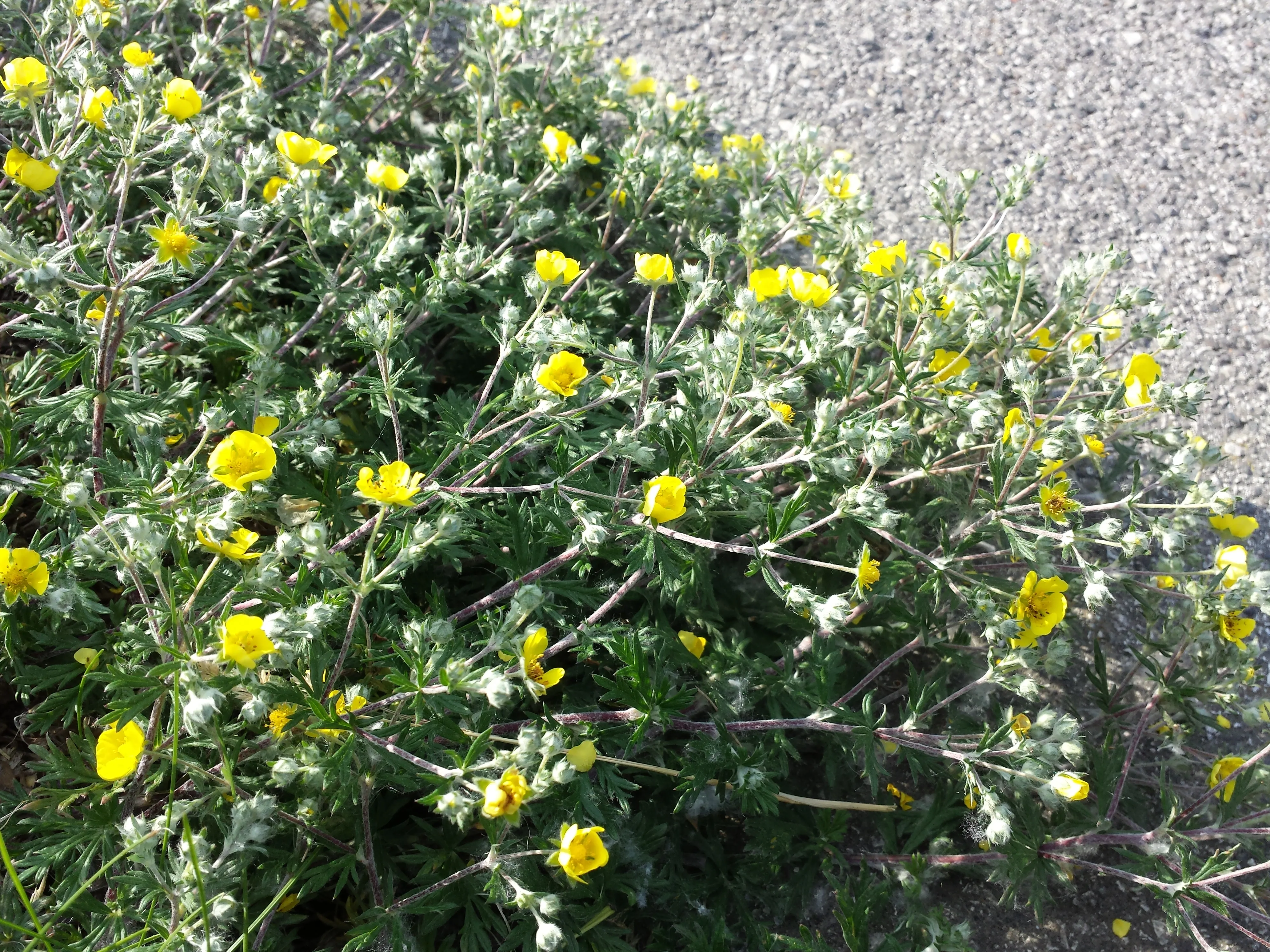
Silver Cinquefoil (Potentilla argentea)
Silver Cinquefoil (Potentilla argentea) is a non-parasitic, taprooted perennial weed plant of the rose family (Rosaceae). It is a polymorphic species, varying in the degree and type of pubescence.
Life cycle: perennial.
Other names: komyr-stan.
Taxonomy
Classification
Kingdom: Plants (Plantae)
Division: Flowering plants (Angiosperms) (Angiospermae)
Class: Dicotyledons (Dicotyledoneae)
Order: Rosales (Rosales)
Family: Rosaceae (Rosaceae)
Genus: Cinquefoil (Potentilla)
Species: Silver Cinquefoil (Potentilla argentea L.)
Similar species
Heidenreich's Cinquefoil (Potentilla heidenreichii Zimm.). Distributed throughout the entire central zone of Russia. Grows on dry meadows, pastures, and field margins.
Hoary Cinquefoil (Potentilla canescens Bess.). Occurs in southern regions in steppes and dry meadows, along roads, and in secondary habitats. Distinguished by a well-developed fine, ash-grey tomentose pubescence on the underside of leaves.
Photographs

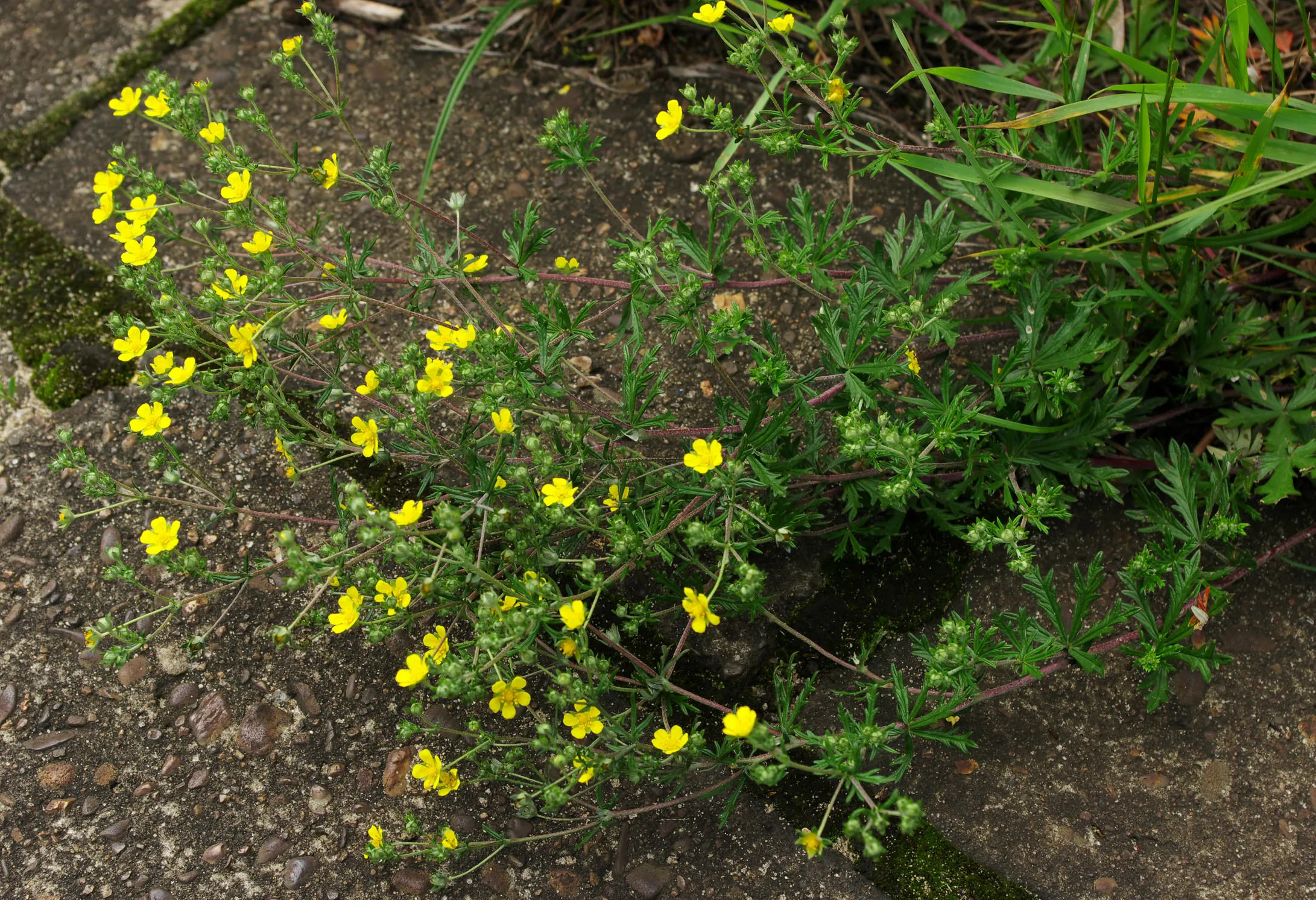
Silver Cinquefoil (Potentilla argentea)

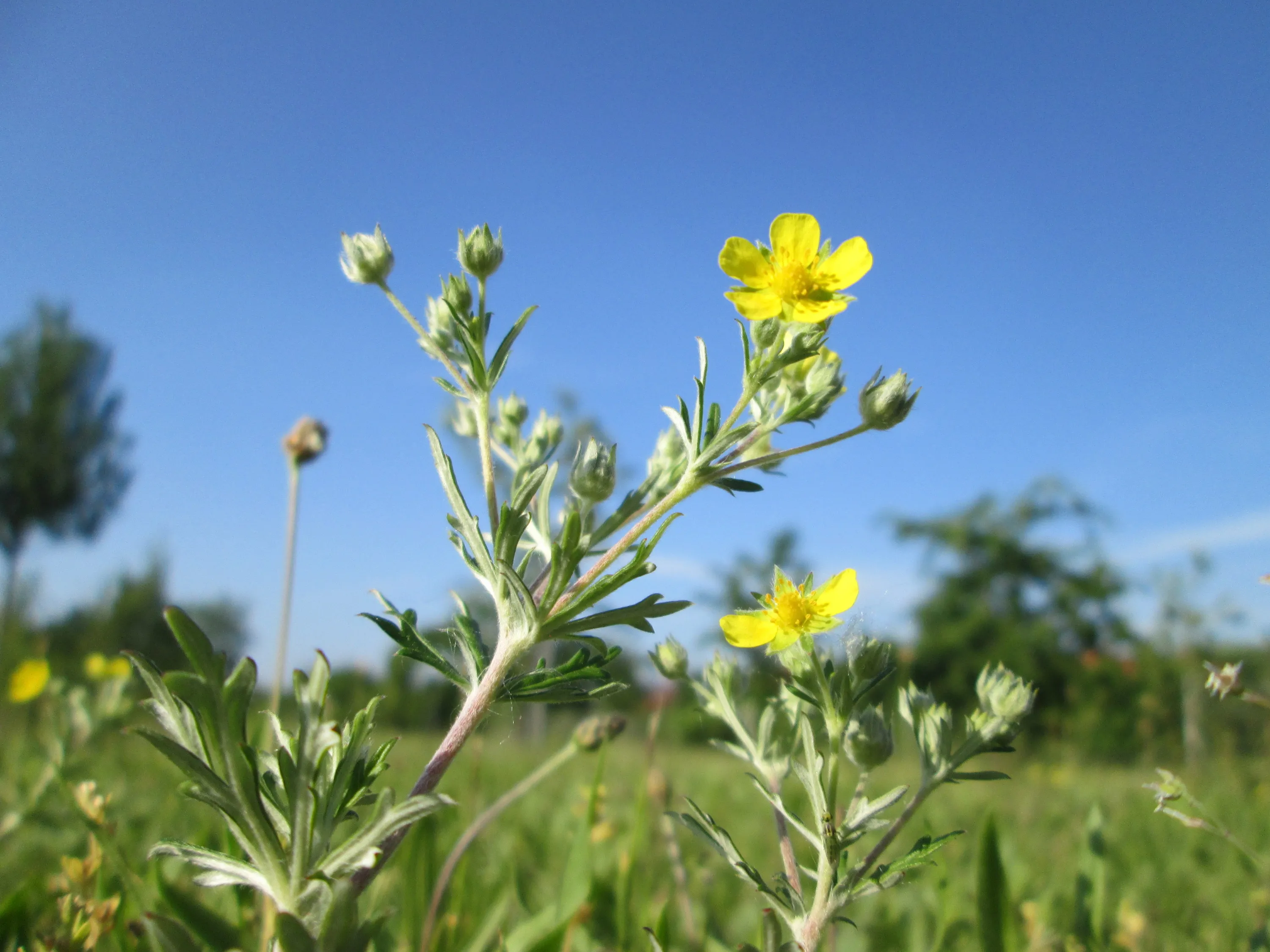
Silver Cinquefoil (Potentilla argentea)

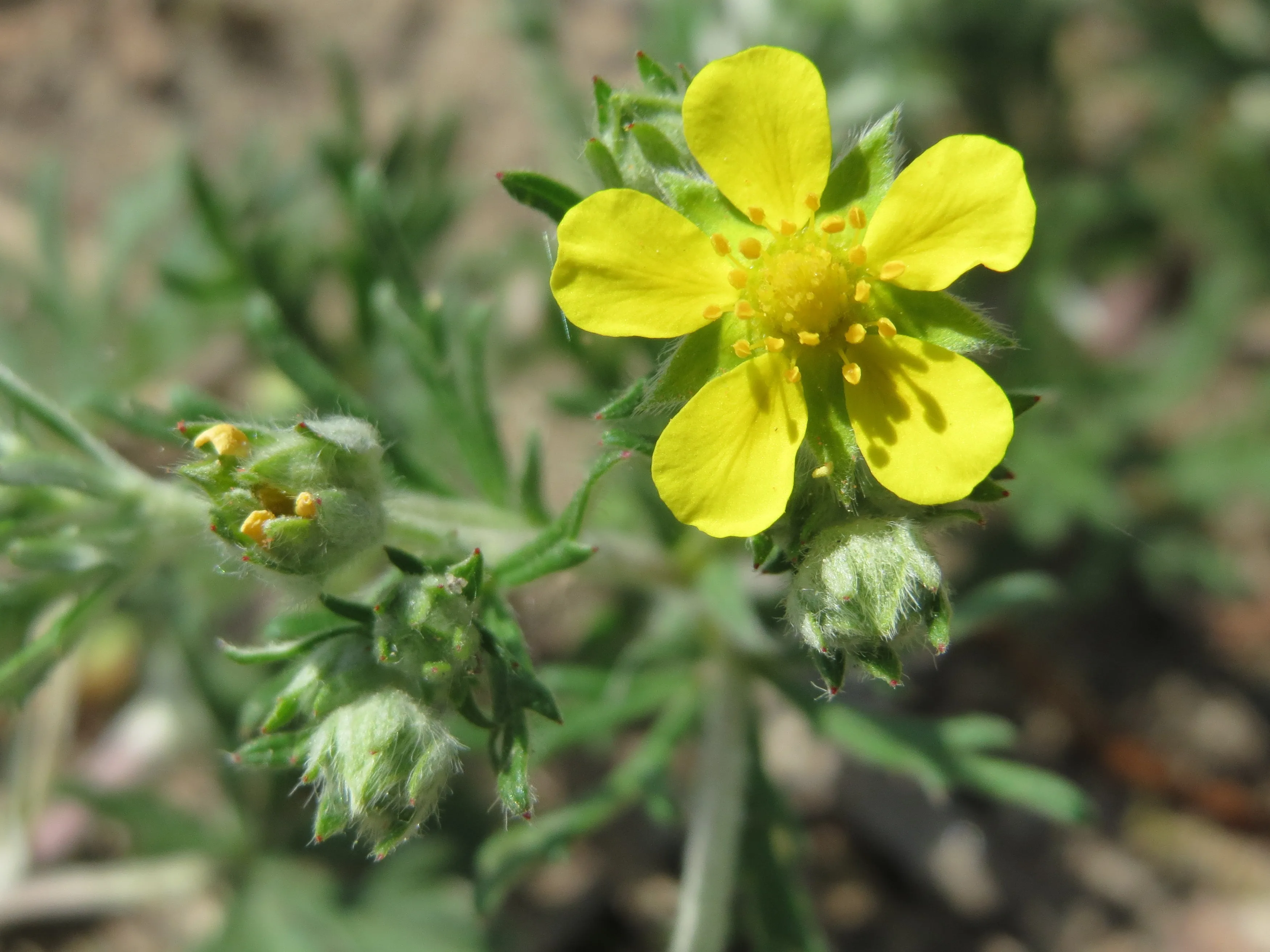
Silver Cinquefoil (Potentilla argentea)


LCD 4-in-1 Soil Tester
Check essential growing conditions with one compact tool. Measure soil pH, moisture, temperature and light intensity — ideal for gardens, potted plants and greenhouses.
- 4-in-1 measurement
- Easy-to-read LCD display
- Portable design
Affiliate link · For indicative measurements only.
Botanical description
Root system
The root system is taprooted, robust, and branched.
Seedlings
Seedlings have short-oval cotyledon leaves, up to 2.5–4 mm long, 1–3 mm wide, on short petioles.
The first leaves are toothed and rounded.
Leaves
Leaves alternate, palmate, five-parted (except for the upper ones). The underside is covered with dense white tomentose pubescence. The upper side is bright dark green, slightly pubescent or glabrous, glossy.
Upper leaves are ternate (lower down the stem they are quinate), sessile.
Basal and lower leaves are on petioles, palmate, with 5 or 7 leaflets.
Leaflets are obovate, 1–3 cm long, with a narrow cuneate base, and irregularly coarsely incised‑dentate at the apex.
Stems
Stems are ascending or arcuate‑ascending, well leafy, covered with silvery‑tomentose curly intertwined hairs (as are petioles and pedicels).
Plant height: (10) 15–30 (50) cm.
Inflorescence
Inflorescence terminal, lax, corymbose‑paniculate (corymbose panicle), many‑flowered.
Flowers yellow or lemon‑yellow, 10–12 mm in diameter, on pedicels.
Outer sepals oblong‑linear, usually equal in length to the ovoid inner sepals.
Petals emarginate, some slightly longer than the sepals.
Stamens 20, with short filaments.
Fruit
Fruit is an ovoid or reniform achene, dark grey or light brown, up to 1 mm long, 0.5–0.75 mm wide, 0.25–0.5 mm thick, finely wrinkled, with an apical conical style widened at the base, with a broad stigma, slightly shorter than the fruitlet.
Ecology
Natural zones
Silver Cinquefoil is more common in forest and forest‑steppe zones, less often in the steppe zone.
Light requirements
Prefers bright habitats.
Soil requirements
Grows on moisture‑supplied, fertile, light soils.
Habitats
On fallow lands in the steppe and forest‑steppe it can form abundant populations.
Habitats: dry meadows and floodplain meadows, forest clearings, fallow fields, abandoned lands, along roads, railway embankments, near dwellings, disturbed lands, dry light forests, field margins, sparse pine forests.
It is an unstable apophyte.

Solar Automatic Drip Irrigation Kit for Gardens
Automate watering for pots, gardens and small greenhouses. This solar-powered system features a timer to help schedule water delivery to your plants.
- Solar-powered
- 15 m irrigation hose
- Programmable watering
Affiliate link · Check included accessories.
Physiology
Germination
Germination of freshly matured seeds is low (1–20%).
Seeds germinate from the soil surface or from a depth of no more than 1–2 cm.
Minimum germination temperature is 10–12 °C, optimum 26–28 °C.
Vegetation
Seedlings from achenes and shoots from renewal buds begin to appear in March–May and in autumn.
Flowering: (May) June–September. Fruit ripening from early July.
Reproduction
Reproduces by seeds and vegetatively.
One plant produces from 28 to 494.2 thousand achenes (according to Bazdyrev).
Weight of 1000 achenes is about 0.1 g.
Distribution
Silver Cinquefoil is distributed in Europe and Asia. Introduced to North America.
In Russia it grows in the European part, the North Caucasus and Ciscaucasia, and Siberia.
Distribution regions
Russia:
- European part – all regions;
- North Caucasus – all regions;
- Western and Eastern Siberia: Verkhne‑Tobolsky (Chelyabinsk Oblast (east), Kurgan Oblast, Orenburg Oblast (east)), Irtyshsky (Omsk Oblast, Novosibirsk Oblast, Kemerovo Oblast, Altai Krai), Altai (Altai Republic), Angara‑Sayansky (Krasnoyarsk Krai (south), Republic of Khakassia, Republic of Tuva, Irkutsk Oblast, Republic of Buryatia (south‑west));
- Far East: Ussuriysky (Primorsky Krai, Khabarovsk Krai (south)), Zeya‑Bureinsky (Khabarovsk Krai (west), Jewish Autonomous Oblast, Amur Oblast).
Belarus, Ukraine, Latvia, Lithuania, Estonia, Moldova, Georgia, Armenia, Azerbaijan.
Kazakhstan:
- Lower Volga (West Kazakhstan Oblast (west), Atyrau Oblast (west));
- Verkhne‑Tobolsky (Kostanay Oblast (north));
- Irtyshsky (North Kazakhstan Oblast, Akmola Oblast, Karaganda Oblast (north), Pavlodar Oblast, Kostanay Oblast (south), East Kazakhstan Oblast (west));
- Altai (East Kazakhstan Oblast (east)).

7-in-1 Wi-Fi Weather Station
Monitor local weather conditions with a wireless outdoor sensor. Track temperature, humidity, rainfall, wind speed and direction, and atmospheric pressure. Ideal for gardens, farms and greenhouses.
- Wireless outdoor sensor
- Solar-powered
- Wi-Fi connectivity
Affiliate link · Check regional compatibility.
Weediness
Infestation of crops
Occasionally infests crops of perennial meadow grasses, vegetable crops, meadows, pastures.
Useful properties
Medicinal use
Used in medicine.
Fodder value
Before the budding phase, Silver Cinquefoil contains a lot of protein (16.2%) and little fibre (18.1%), but during flowering the nutritional value decreases.
It is satisfactorily grazed on pastures before flowering by sheep, goats and camels; poorly grazed by cattle and horses. Also eaten by sika deer.
Vegetative parts are satisfactorily eaten by geese.
In spring and summer, leaves are poorly eaten by rabbits, and in autumn they are not eaten at all.
Eaten by pigs.
When mixed in hay at no more than 20–25%, it is almost completely eaten.

40W Full Spectrum LED Grow Light
Support healthy plant growth with full-spectrum LED lighting. Ideal for seedlings, indoor plants and small growing spaces. A practical solution for indoor gardening and year-round cultivation.
- Full-spectrum LED
- Energy-efficient design
- Indoor plant growing
Affiliate link · Check actual power and light coverage.
Chemical composition
Chemical composition of plants collected in the vegetative phase (June), at moisture content 5.6%, % of dry matter:
- ash — 8.4;
- protein — 16.2 (crude protein — 15.7);
- fats — 4.1;
- fibre — 18.1;
- nitrogen‑free extractives — 53.2.
Chemical composition of plants collected in the budding phase (10 July), at moisture content 7.0%, % of dry matter:
- ash — 7.0;
- protein — 13.6 (crude protein — 10.3);
- fats — 3.0;
- fibre — 26.0;
- nitrogen‑free extractives — 50.4.
Chemical composition of plants collected in the flowering and fruiting phase (10 August), at moisture content 7.1%, % of dry matter:
- ash — 5.5;
- protein — 8.8 (crude protein — 7.4);
- fats — 4.2;
- fibre — 27.6;
- nitrogen‑free extractives — 53.9.
Control methods
Agrotechnical methods
In crop fields it is destroyed by autumn ploughing and pre‑sowing tillage.
On meadows and pastures it is destroyed during renovation and reconstruction of the land.
References
- Bazdyrev, G.I. (1993) Weed plants and measures for their control in modern agriculture: A textbook for universities. Moscow: Publishing House of the Moscow Agricultural Academy.
- Nikitin, V.V. (1983) Weed plants of the flora of the USSR. Leningrad: Nauka.
- Gubanov, I.A., Kiseleva, K.V., Novikov, V.S., Tikhomirov, V.N. (2003) Illustrated guide to plants of Central Russia. Volume 2: Angiosperms (dicotyledons: choripetalous). Moscow: KMK Scientific Press, Institute of Technological Research.
- Larin, I.V. et al. (1951) Fodder plants of hayfields and pastures of the USSR. Volume II. Dicotyledons (Chloranthaceae – Leguminosae). Moscow: State Publishing House of Agricultural Literature.
