
Corn Spurrey (Spergula arvensis)

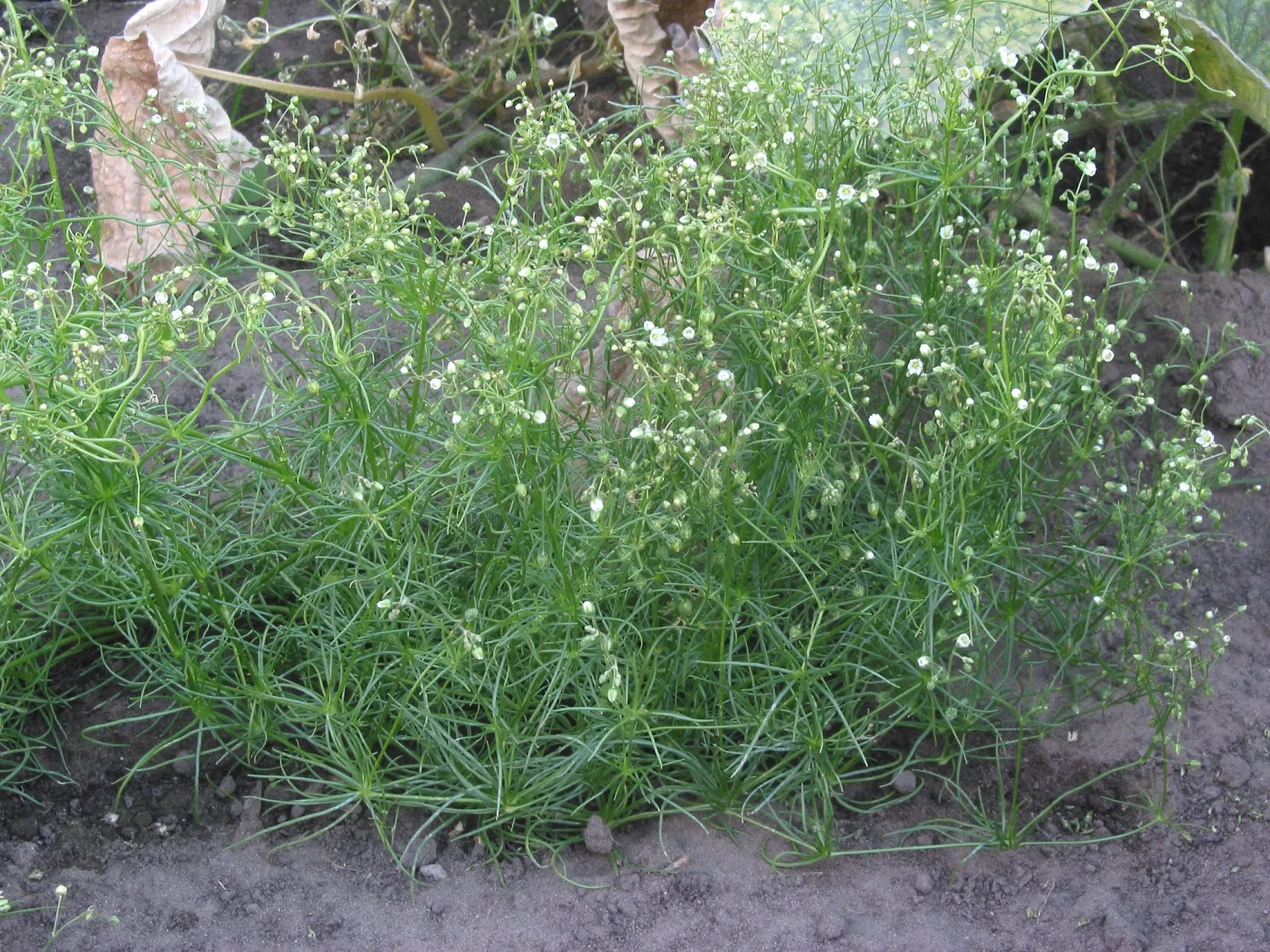
Corn Spurrey (Spergula arvensis)
Corn spurrey (Spergula arvensis L.) is a short‑lived, early spring weed plant of the family Caryophyllaceae (Caryophyllaceae). It is a polymorphic species.
Life cycle: annual.
Other names: corn spurrey, stickwort, starwort, devil’s guts, sandweed, pickpurse, yarr, pinecheat, povertyweed, cowquake.
Taxonomy
Classification
Kingdom: Plants (Plantae)
Division: Flowering plants (Angiosperms) (Angiospermae)
Class: Dicotyledons (Dicotyledoneae)
Order: Caryophyllales (Caryophyllales)
Family: Caryophyllaceae (Caryophyllaceae)
Genus: Spergula (Spergula)
Species: Corn spurrey (Spergula arvensis L.)
Synonyms
- Spergula sativa Boenn.;
- Spergula sativa Boeningh.;
- Spergula arvensis var. sativa Rchb.
Origin
Native to Europe.
Introduced to the United States as a forage crop in 1888.
Similar species
Annual knawel (Scleranthus annuus). Often confused with corn spurrey because of its growth habit. Annual knawel differs by its awl‑shaped leaves that are arranged in pairs at the stem nodes; flowers lack petals, and the fruit is one‑seeded and surrounded by an enlarged calyx.
Salsola kali. Seedlings can be confused with those of corn spurrey. The distinguishing feature of these two species is that the leaves of Salsola kali bear spines.
Photographs

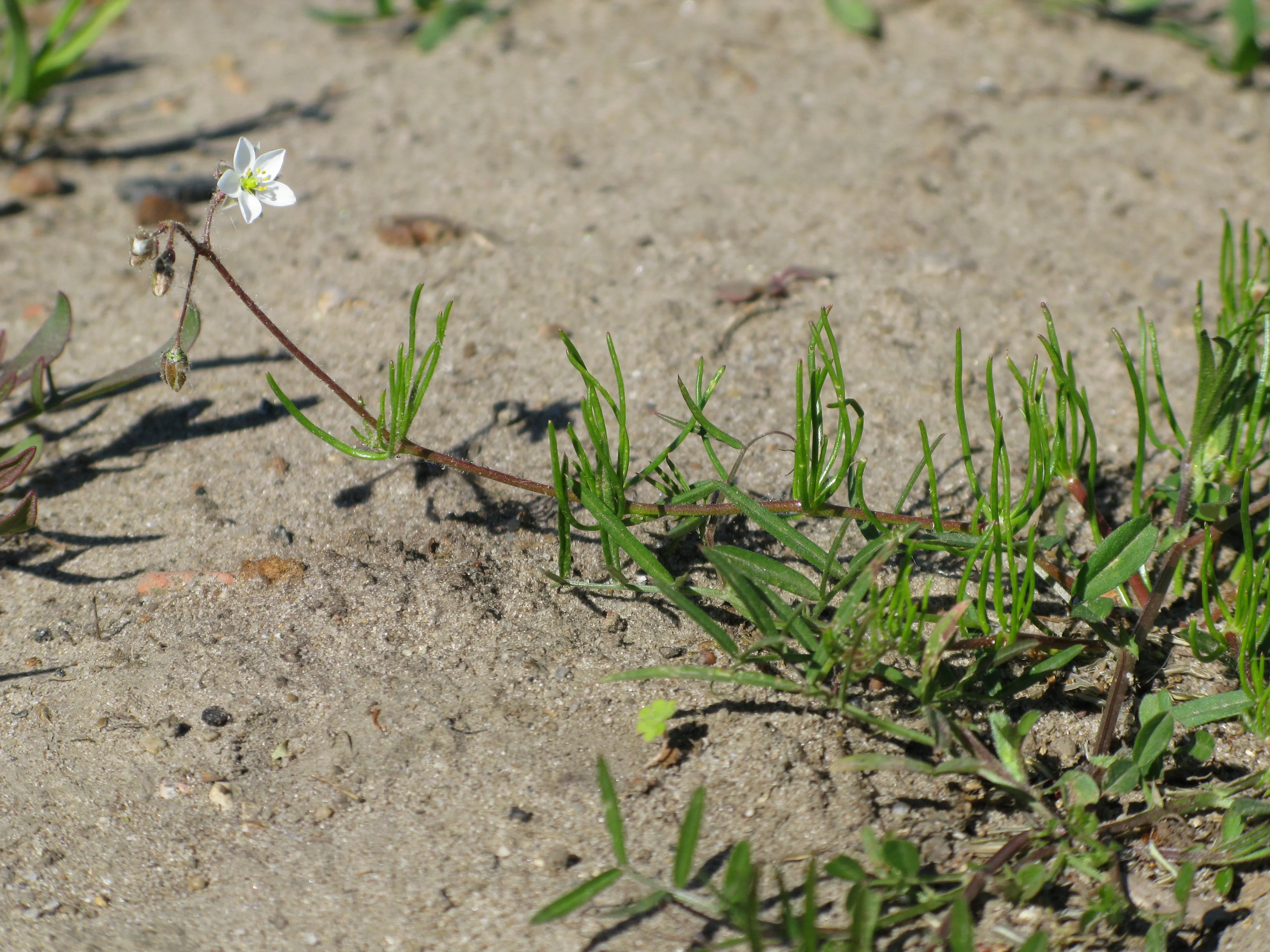
Corn Spurrey (Spergula arvensis)

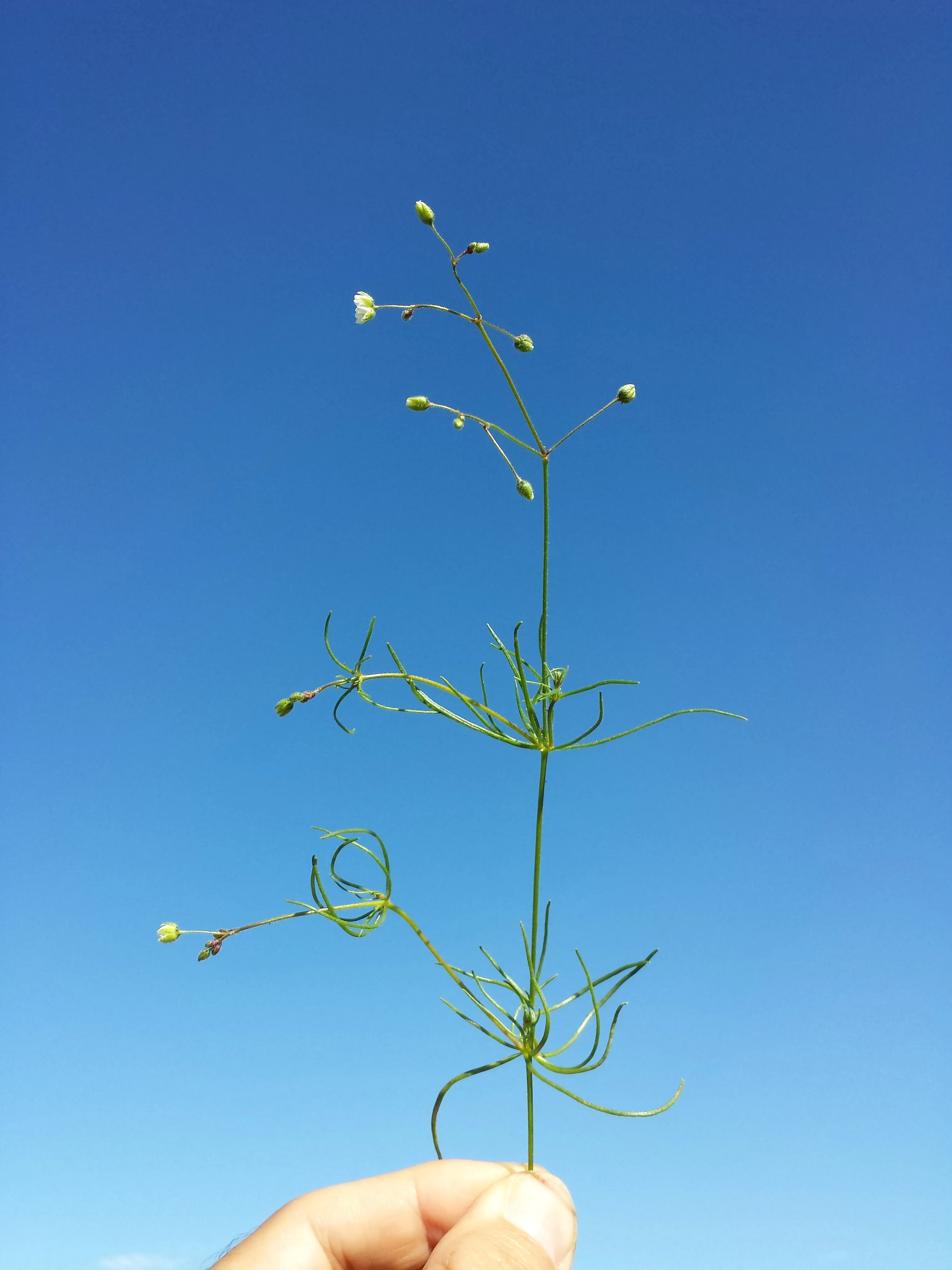
Corn Spurrey (Spergula arvensis)

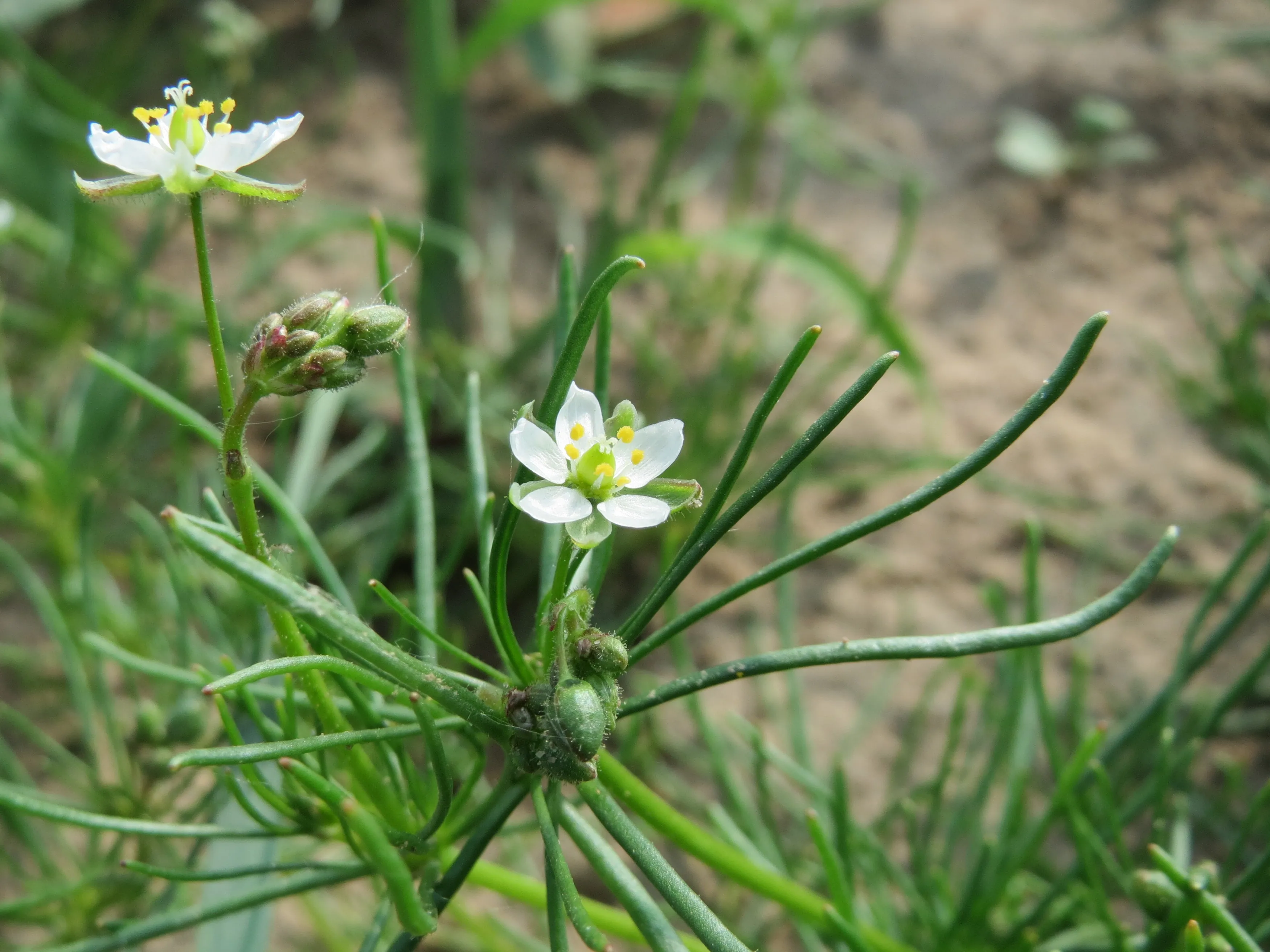
Corn Spurrey (Spergula arvensis)


LCD 4-in-1 Soil Tester
Check essential growing conditions with one compact tool. Measure soil pH, moisture, temperature and light intensity — ideal for gardens, potted plants and greenhouses.
- 4-in-1 measurement
- Easy-to-read LCD display
- Portable design
Affiliate link · For indicative measurements only.
Botanical description
Root system
Taproot, branched.
Seeds
Seeds round or lenticular, slightly compressed, dark brown or black, 1‑2 mm in diameter. Surface often pitted (finely tuberculate), with a white ring appearing around the centre.
Seedlings
Seedlings with needle‑like cotyledons, 10‑15 mm long and less than 1 mm wide (nearly uniform in width throughout), tip blunt, growing obliquely upward.
First leaves resemble the cotyledons.
Leaves
Leaves opposite but appearing curiously interwoven, with six to eight pairs at one node, forming whorls of several leaves.
Leaves thread‑like (linear‑filiform) or awl‑shaped, (10) 15‑30 (50) mm long, slightly fleshy, somewhat rounded in cross‑section, wavy‑convex on the upper side, with a longitudinal groove on the underside, and bearing sticky, glandular hairs.
Stems
Plant bushy. Branching from the middle of the stem.
Stems fleshy, erect or slightly ascending, usually with four internodes, pubescent with glandular hairs, hence slightly sticky.
Nodes pubescent.
Height (10) 20‑60 (100) cm.
Inflorescences
Inflorescence – a weakly branched (loose) umbel‑like cyme (false umbel, also a paniculate inflorescence) at the ends of the branches.
Flowers white, 4‑6 mm in diameter, opening only in bright light, faintly scented, on long pedicels.
Five ovate, obtuse sepals, 3‑4 mm long.
Five white oval petals of the corolla, slightly longer than the sepals.
5‑10 stamens. One pistil. Five stigmas.
After flowering, the shoots droop downward.
Fruit
Fruit – a round or broadly ovoid capsule, five‑chambered, many‑seeded.
Fruits produced in early summer contain up to 25 seeds, while those in late autumn contain only 5.
Ecology
Natural zones
Corn spurrey is widely distributed in the Northern Hemisphere, especially in the forest zone. North of 60° N latitude it occurs rarely.
In the taiga, deciduous forests and forest‑steppe (less frequently) zones – it is one of the most common weed plants.
In the steppe zone it occurs only as a ruderal weed and on moist soils.
In the semi‑desert and desert zones it is very rare and is not considered a weed.
Soil requirements
Undemanding to soil. Grows well on low‑productivity sandy soils. It grows mainly on light, sandy, low‑calcium, strongly acidic and moderately acidic, fertile, moist soils. Tolerates neutral soils well.
Phosphatophilous, i.e., prefers soils with high phosphorus content.
Habitats
It grows everywhere in meadows and pastures, in orchards and vegetable gardens, on fallow lands and on shifting sands.
As a ruderal weed it is found on roadsides, near dwellings, in vegetable gardens, and on fallow fields.

Solar Automatic Drip Irrigation Kit for Gardens
Automate watering for pots, gardens and small greenhouses. This solar-powered system features a timer to help schedule water delivery to your plants.
- Solar-powered
- 15 m irrigation hose
- Programmable watering
Affiliate link · Check included accessories.
Physiology
Germination
Seed viability in soil up to 10 years, according to other data up to 5 years (Bazdyrev). Seeds extracted from Iron Age dwellings (about 2,000 years ago) germinated in laboratory experiments.
Seeds germinate from a depth of 0.5‑3 cm. Also, the maximum germination depth is 4‑5 cm (Bazdyrev).
Germination occurs at temperatures from 20 to 25 °C (also considered optimal, Bazdyrev).
Vegetation
Seedlings appear early in spring.
Flowering occurs 8 weeks after germination.
From germination to seed maturity takes 10 weeks.
It develops especially abundantly in crops during cold and wet years. Under favourable conditions it forms a continuous cover.
It usually sheds seeds before harvest.
Flowering June‑August (September). Fruiting July‑September (October).
Reproduction
Reproduces by seeds. When ripe, the seeds fall out of the capsules, contaminating the soil. Seeds can be dispersed by wind.
Large plants can produce up to 500 fruits. Plants can produce up to 10,000 seeds (Dickinson), according to other data up to 3,000 seeds (Klaassen) and up to 28,000 seeds (Bazdyrev).
Often more than 1,000 seedlings of corn spurrey can be found per 1 m².
Weight of 1,000 seeds – 0.4‑0.5 g.
Distribution
Distribution areas
Russia:
- European part: Karelo‑Murmansk (Murmansk Oblast, Republic of Karelia), Dvino‑Pechora (Komi Republic, Arkhangelsk Oblast, Vologda Oblast), Baltic (Kaliningrad Oblast), Ladoga‑Ilmen (Saint Petersburg and Leningrad Oblast, Novgorod Oblast, Pskov Oblast), Upper Dnieper (Smolensk Oblast, Bryansk Oblast), Upper Volga (Tver Oblast, Kaluga Oblast, Yaroslavl Oblast, Moscow and Moscow Oblast, Vladimir Oblast, Nizhny Novgorod Oblast (west), Ivanovo Oblast), Volga‑Kama (Kostroma Oblast, Kirov Oblast, Perm Krai, Mari El Republic, Udmurt Republic, Nizhny Novgorod Oblast (east), Chelyabinsk Oblast (west), Sverdlovsk Oblast (west), Tatarstan (north)), Volga‑Don (Tula Oblast, Oryol Oblast, Ryazan Oblast, Lipetsk Oblast, Kursk Oblast, Penza Oblast, Tambov Oblast, Belgorod Oblast, Ulyanovsk Oblast (west), Tatarstan (west), Voronezh Oblast, Chuvash Republic, Mordovia Republic, Nizhny Novgorod Oblast (south));
- North Caucasus: Ciscaucasia (Krasnodar Krai (south), Adygea Republic, Stavropol Krai, Karachay‑Cherkess Republic, Kabardino‑Balkarian Republic, North Ossetia Republic, Chechen Republic, Ingushetia Republic), Western Transcaucasia (Krasnodar Krai (coast));
- Western and Eastern Siberia: Ob (Tomsk Oblast, Tyumen Oblast, Sverdlovsk Oblast (east), Yamalo‑Nenets Autonomous Okrug, Khanty‑Mansi Autonomous Okrug, Krasnoyarsk Krai (west)), Omsk Oblast, Novosibirsk Oblast, Kemerovo Oblast, Angara‑Sayan (Krasnoyarsk Krai (south), Khakassia Republic, Tuva Republic, Irkutsk Oblast, Buryatia Republic (south‑west));
- Far East: Ussuri (Primorsky Krai, Khabarovsk Krai (south)), Zeya‑Bureya (Khabarovsk Krai (west), Jewish Autonomous Oblast, Amur Oblast), Sakhalin (Sakhalin Oblast), Kamchatka (Kamchatka Krai).
Belarus, Lithuania, Latvia, Estonia, Georgia – all regions.
Azerbaijan – all regions except Talysh and Nakhchivan Autonomous Republic.
Ukraine – Dnieper (Volyn Oblast, Rivne Oblast, Ternopil Oblast, Khmelnytskyi Oblast, Zhytomyr Oblast, Vinnytsia Oblast, Kyiv and Kyiv Oblast, Chernihiv Oblast, Sumy Oblast, Poltava Oblast, Kirovohrad Oblast, Cherkasy Oblast, Dnipropetrovsk Oblast, Kharkiv Oblast, Luhansk Oblast).

7-in-1 Wi-Fi Weather Station
Monitor local weather conditions with a wireless outdoor sensor. Track temperature, humidity, rainfall, wind speed and direction, and atmospheric pressure. Ideal for gardens, farms and greenhouses.
- Wireless outdoor sensor
- Solar-powered
- Wi-Fi connectivity
Affiliate link · Check regional compatibility.
Harmfulness
Infestation of crops
Recorded as a weed in 33 countries.
Corn spurrey is considered a noxious weed on cultivated fields and row crops. It is also considered a weed of cereals, vegetables and industrial crops, occurring in potato and maize crops, annual and perennial grasses.
The main damage is caused in the early growth stages of crop plants.
It can reduce the growth of fibre flax by 1.5‑2.0 times, and the stem density by 5‑20 times. It also negatively affects barley crops. Aqueous extracts reduce germination and germination energy of winter rye, oats, fibre flax and red clover seeds by 1.3‑4.0 times or more.
In the taiga, deciduous forests and forest‑steppe (less frequently) zones – it is one of the most common and relatively abundant weed plants in all crop sowings.
Reservoir of pests and diseases
It is a carrier of viruses of sugar beet yellows, alfalfa mosaic and tobacco mosaic.
Useful properties
Fodder value
Readily eaten by livestock.
Raw seeds have a bitter taste and livestock eat them reluctantly, but after steaming and cleaning they can be used as animal feed.
It can serve as a good nutritious and healthy feed for poultry, although birds must be accustomed to it beforehand. When fed to hens, turkeys and other birds, the onset of egg‑laying is significantly shortened.
For horses, besides its feeding qualities, it serves as a medicinal remedy for exhaustion.
Cultivation
In the USSR, it was actively introduced into cultivation by Baryatinsky, Gusyatnikov and Prof. Bogdanov.
In dry years it can produce up to 1 t/ha of hay, in normal and wet years – up to 1.5 t/ha. It responds well to potassium‑phosphorus fertilisers, giving yield increases in the conditions of Yaroslavl Oblast (Yaroslavl Governorate, Poshekhonsky and Mologsky districts, 1911‑1912) on heavy, medium and alluvial medium loamy soils of up to 180‑420%. After harvest it gave aftermath of 6‑7 t/ha of green mass. After application of manure and manure with a reduced dose of phosphorus‑potassium fertilisers it gave 17 t/ha of green mass.
Seeding rate 24‑32 kg/ha. The growth period until haymaking ripeness is 46‑57 days (Larin → Bahumen). Owing to its early maturity and resistance to cool weather, it can be grown as a stubble crop in autumn.
Seed productivity is high.
Indicator plant
Indicator plant of acidic soils.
Other uses
Oil plant.

40W Full Spectrum LED Grow Light
Support healthy plant growth with full-spectrum LED lighting. Ideal for seedlings, indoor plants and small growing spaces. A practical solution for indoor gardening and year-round cultivation.
- Full-spectrum LED
- Energy-efficient design
- Indoor plant growing
Affiliate link · Check actual power and light coverage.
Chemical composition
In the above‑ground parts of corn spurrey without fruits, 113 mg% of vitamin C is present (Larin → Pankova).
Control methods
Agronomic methods
Corn spurrey is persistent only under poor management.
Chemical methods
Corn spurrey is resistant to post‑emergence herbicides, sensitive to soil herbicides and non‑selective herbicides.
References
- Nikitin, V.V. (1983) Weed plants of the flora of the USSR. Leningrad: Nauka.
- Dickinson, R., Royer, F. (2014) Weeds of North America. The University of Chicago Press.
- Bazdyrev G.I. (1993) Weed plants and control measures in modern agriculture: A textbook for universities. Moscow: Publishing House of the Moscow Agricultural Academy.
- Klaassen, H., Freitag, J. (2004) Weed plants, distribution and harmfulness, species identification. Joint publication of Landwirtschaftsverlag Münster‑Hiltrup and BASF AG, Limburgerhof.
- Gubanov, I.A., Kiseleva, K.V., Novikov, V.S., Tikhomirov, V.N. (2003) Illustrated guide to plants of Central Russia. Volume 2: Angiosperms (dicotyledons: choripetalous). Moscow: KMK Scientific Press, Institute of Technological Research.
- Larin I.V. et al. (1951) Fodder plants of hayfields and pastures of the USSR. Volume II. Dicotyledons (Chloranthaceae – Leguminosae). Moscow: State Publishing House of Agricultural Literature.
