
Common cocklebur (Xanthium strumarium)

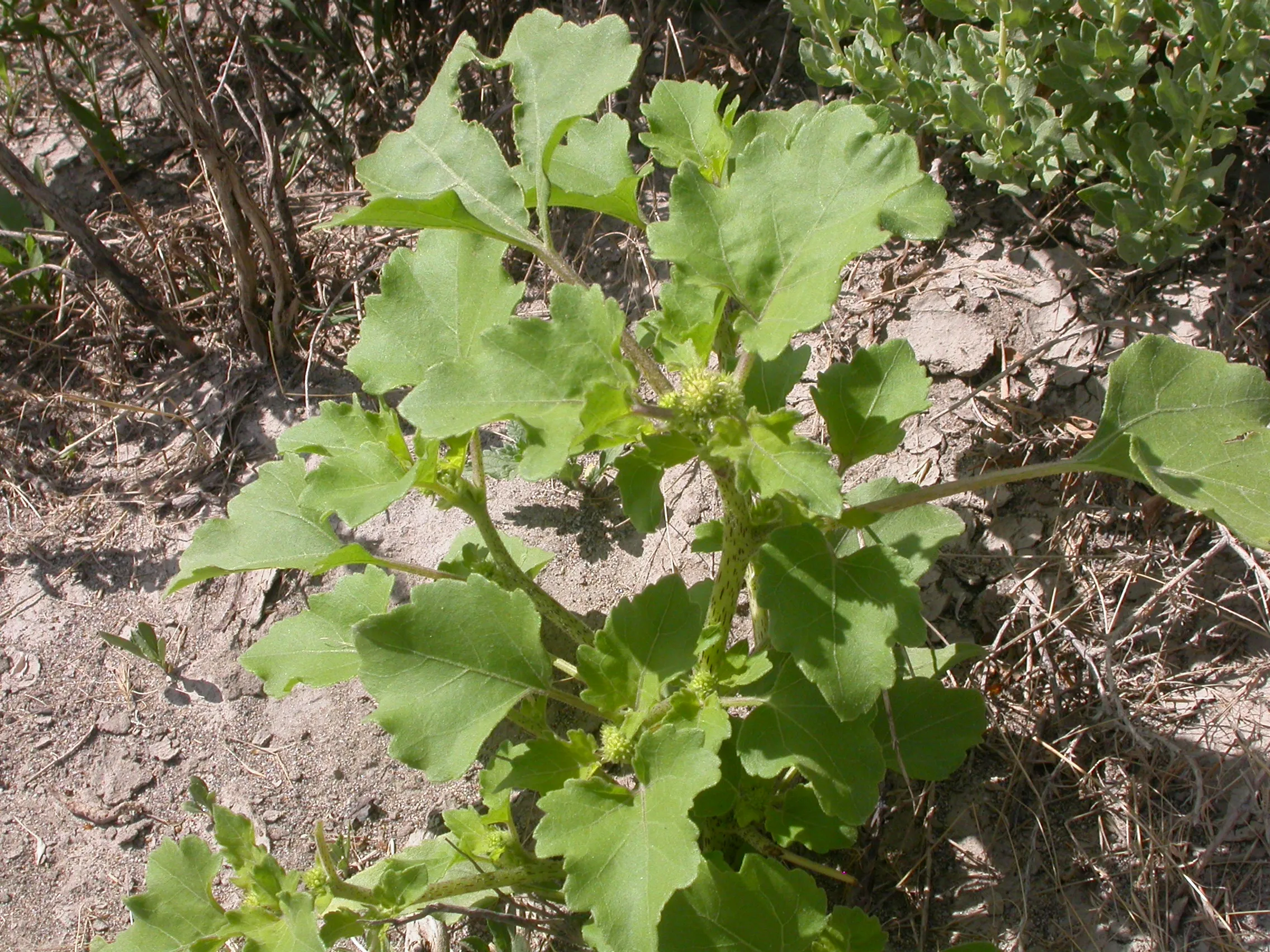
Common cocklebur (Xanthium strumarium)
Common cocklebur (Xanthium strumarium Linn.) is an annual early spring weed of the family Asteraceae (Asteraceae).
Life cycle: annual, biennial, or short-lived perennial.
Other names: cocklebur (Eng.), broadleaved cocklebur (Eng.), clotbur (Eng.), sheepbur (Eng.), ditchbur (Eng.), buttonbur (Eng.), noogoora bur (Eng.), rough cocklebur (Eng.), common cocklebur (Eng.), large cocklebur (Eng.), woolgarie bur (Eng.).
Taxonomy
Classification
Kingdom: Plants (Plantae)
Division: Flowering plants (Angiosperms) (Angiospermae)
Class: Dicotyledons (Dicotyledoneae)
Order: Asterales (Asterales)
Family: Asteraceae (Asteraceae)
Genus: Cocklebur (Xanthium)
Species: Common cocklebur (Xanthium strumarium Linn.)
Synonyms
- Xanthium macrocarpum DC.;
- Xanthium natalense Widder;
- Xanthium pungens Wallr.;
- Xanthium vulgare Hill.
Origin
Probably native to North America and widely naturalized elsewhere.
Similar species
Spiny cocklebur (Xanthium spinosum). It differs by having nodose spines 15‑30 mm long, lanceolate leaves 4‑8 cm long and 1‑3 cm wide, and burs 10‑12 mm long.
Photos

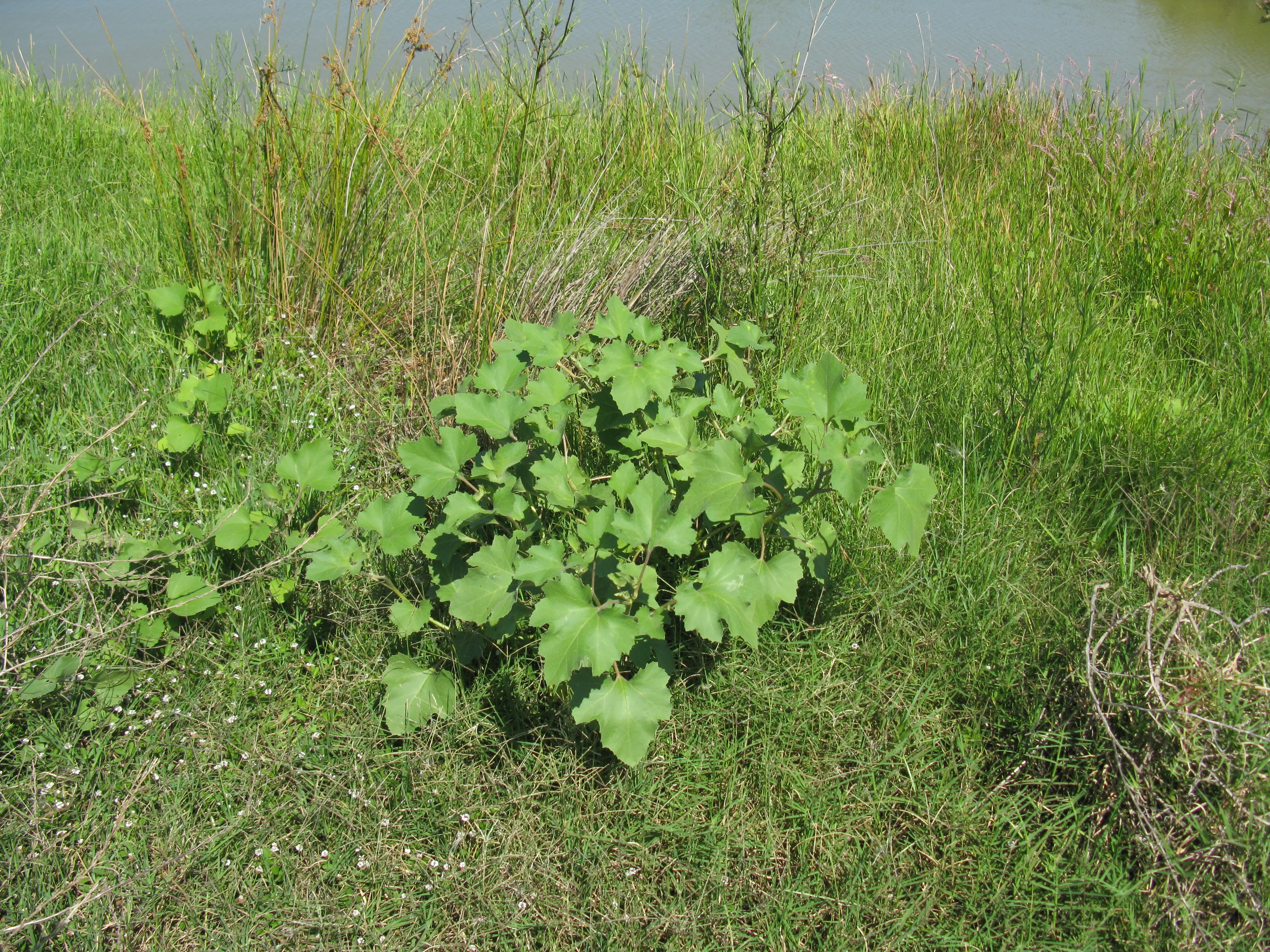
Common cocklebur (Xanthium strumarium)

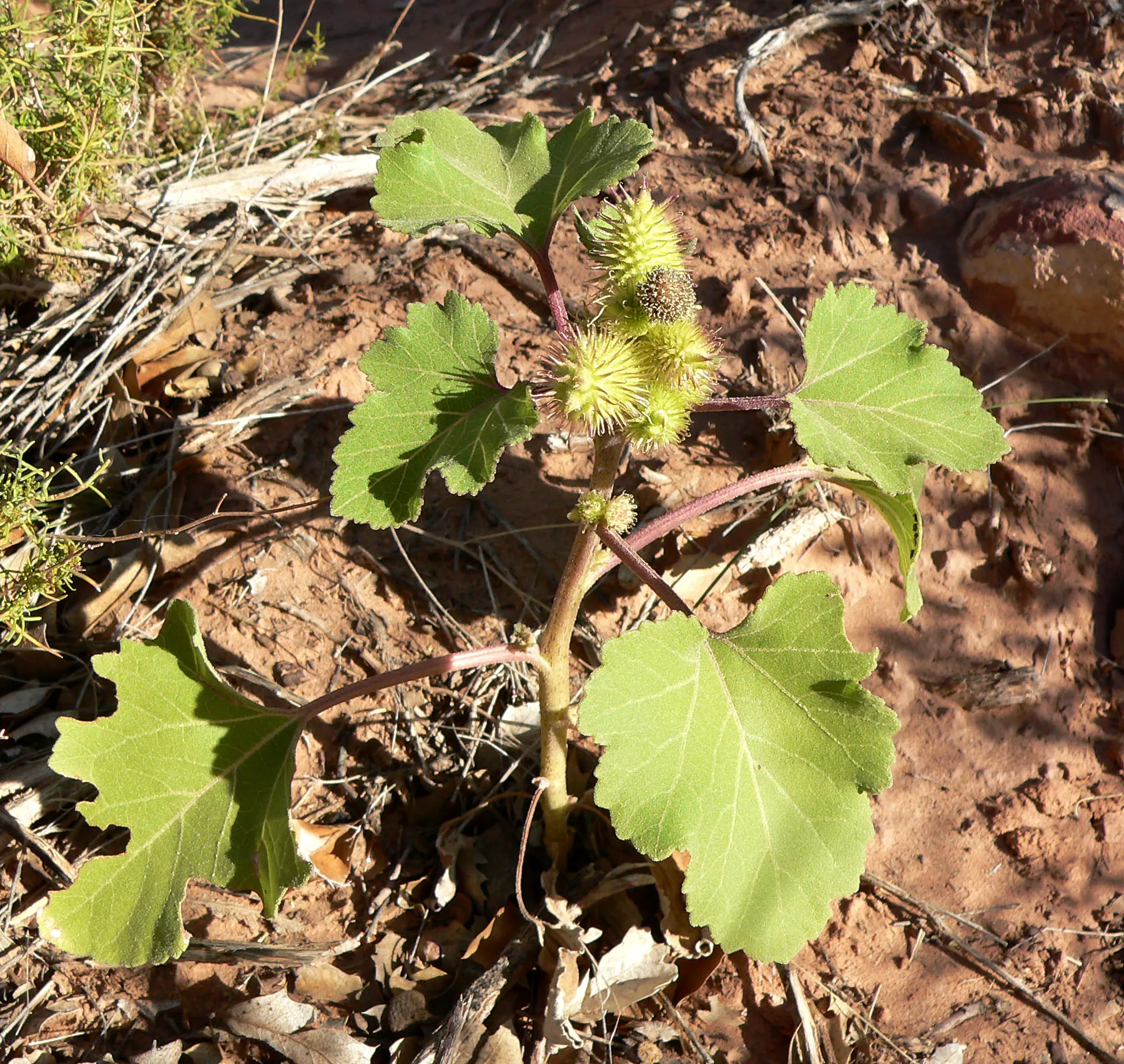
Common cocklebur (Xanthium strumarium)

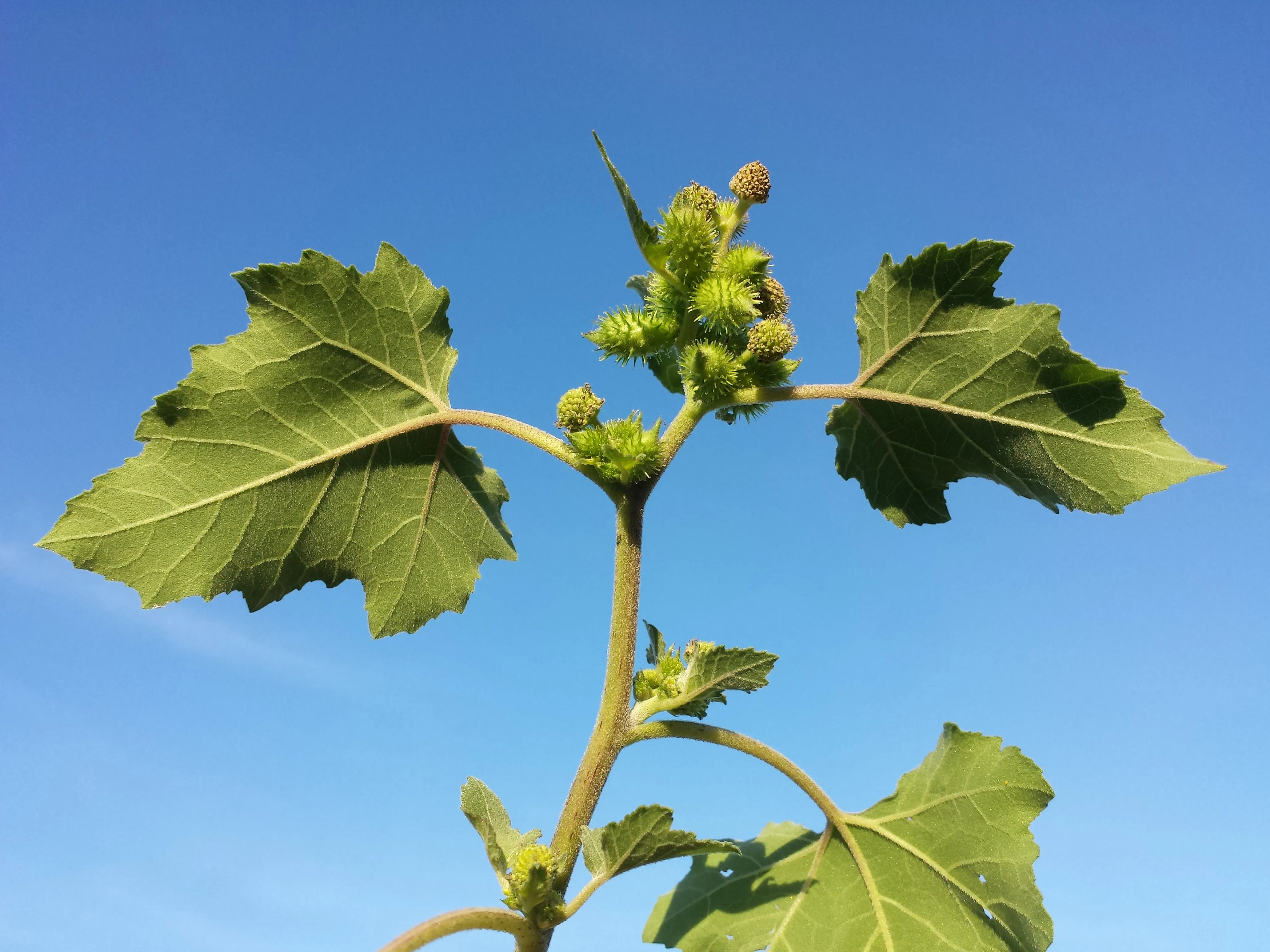
Common cocklebur (Xanthium strumarium)


LCD 4-in-1 Soil Tester
Check essential growing conditions with one compact tool. Measure soil pH, moisture, temperature and light intensity — ideal for gardens, potted plants and greenhouses.
- 4-in-1 measurement
- Easy-to-read LCD display
- Portable design
Affiliate link · For indicative measurements only.
Botanical description
Root system
Taproot distinct or indistinct, branched or unbranched. Root system powerful.
Roots up to 1.2 m deep, allowing the plant to overwinter in warmer climates.
Seeds
Seeds elliptical, flat, light brown to black, 8‑15 mm long, 5‑7 mm wide, with longitudinal stripes, surface covered with a silvery‑black papery coat, pappus absent.
Seedlings
Seedlings with lanceolate or oblong‑elliptic cotyledons, 6‑7.5 mm long (up to 40 mm long, up to 12 mm wide, Bazdyrev), glabrous, somewhat fleshy.
Cotyledons photosynthetically active and provide rapid growth of young plants.
Cotyledons usually present at maturity.
Stem below cotyledons purple‑green. First pair of leaves (about day 14) opposite, triangular, toothed, distinctly three‑angled; later leaves opposite or alternate.
Leaves
Lower leaves opposite, upper alternate.
Leaf blades oval, triangular‑ovate or cordate, 2‑12 cm long, 3‑10 cm wide. Apex acute or obtuse. Base slightly cordate or truncate, departing from petiole, three‑veined. Margins almost entire or inconspicuously 3‑5‑lobed or toothed (coarsely serrate), grooved. Abaxial surface pale whitish, with a sandpapery texture.
Petioles 2‑14 cm long.
Stems
Stem erect or ascending, much branched, rough, purple‑green with purple‑black spots, grayish‑green or reddish, coarsely hairy, ribbed.
Plants have an unpleasant odour when crushed. Entire plant covered with velvety pubescence.
Height (15) 30‑120 (150) cm.
Inflorescences
Heads terminal or axillary, monoecious; 15‑20 disc‑shaped inflorescences.
In the upper part of the general inflorescence are heads with male flowers, in the lower part — heads with female flowers.
Flowers unisexual, brownish‑green.
Male inflorescences globose, gathered in heads, dense at the top, 4‑8 mm in diameter. Bracts 5 to 16, oblong‑lanceolate, hairy, arranged in one or two rows. Receptacle cylindrical, lobes lanceolate, apex acute, male flowers numerous, tubular‑campanulate, apex 5‑lobed, anthers oblong.
Female heads (capitula) elliptic, up to 1.5 cm long, located in leaf axils, unpaired bracts bipartite, outer lanceolate, smaller, hairy, inner fused, sac‑like, broadly ovate, pale yellowish‑green or grayish. 2 bracts become the wall of the spiny bur.
Fruit
Achenes two per bract.
Fruits (syncarps) fusiform, oblong or ovoid, hardening at maturity, green, grayish‑green or light brown, 12‑28 mm (8‑14 mm) long including beak, 14‑17 mm (4‑7 mm) wide, rarely hooked‑spiny, spines 1.5‑5 mm, basal slightly swollen or not swollen, beaks two, entire, conical, upper falcate, often unequal, rarely fused with only one beak. Walls of the syncarp tough.
Ecology
Soil requirements
Prefers fertile, light sandy, moist or wet soil, also tolerates drought and can form dense stands.
Habitats
Xanthium strumarium is often found in meadows and ruderal communities, and sometimes appears on upland or swampy fields.
It inhabits wastelands, dumps, weedy places, near dwellings, hillsides, forest edges, uplands, meadows, vacant lots, pastures, roadsides, field margins, along streams, river floodplains, sands.

Solar Automatic Drip Irrigation Kit for Gardens
Automate watering for pots, gardens and small greenhouses. This solar-powered system features a timer to help schedule water delivery to your plants.
- Solar-powered
- 15 m irrigation hose
- Programmable watering
Affiliate link · Check included accessories.
Physiology
Germination
Viable for about 30 months in soil.
Germination depends on seed type — one type germinates soon after shedding, while another has a delayed germination period.
Optimal depth 1‑8 cm. Does not germinate on soil surface or below 15 cm (below 18 cm, Bazdyrev).
Minimum germination temperature 14‑16 °C, optimum 20‑30 °C (20‑24 °C, Bazdyrev).
Growth
Flowering July‑September. Fruiting September‑October.
Reproduction
Reproduces only by seeds.
Plants can produce more than 10,800 seeds, also up to 5,400 burs. According to other data, up to 25,000 seeds (Bazdyrev).
Weight of 1000 syncarps about 100 g.
Distribution
Distributed in Eurasia, North and South America, Africa, Australia.
An introduced weed, especially widespread in southern Russia, less common in the middle and northern zones.
The most widely distributed species of cocklebur, penetrating as a ruderal farthest north.
In southern regions, especially in Central Asia, recently as a segetal weed in cotton crops.
Distribution regions
Russia:
- European part: Dvina‑Pechora (Komi Republic, Arkhangelsk Oblast, Vologda Oblast), Baltic (Kaliningrad Oblast), Upper Dnieper (Smolensk Oblast, Bryansk Oblast), Upper Volga (Tver Oblast, Kaluga Oblast, Yaroslavl Oblast, Moscow and Moscow Oblast, Vladimir Oblast, Nizhny Novgorod Oblast (west), Ivanovo Oblast), Volga‑Kama (Kostroma Oblast, Kirov Oblast, Perm Krai, Mari El Republic, Udmurt Republic, Nizhny Novgorod Oblast (east), Chelyabinsk Oblast (west), Sverdlovsk Oblast (west), Tatarstan Republic (north)), Volga‑Don (Tula Oblast, Oryol Oblast, Ryazan Oblast, Lipetsk Oblast, Kursk Oblast, Penza Oblast, Tambov Oblast, Belgorod Oblast, Ulyanovsk Oblast (west), Tatarstan Republic (west), Voronezh Oblast, Chuvash Republic, Mordovia Republic, Nizhny Novgorod Oblast (south)), Lower Don (Volgograd Oblast (west), Rostov Oblast, Krasnodar Krai (north), Kalmykia Republic), Trans‑Volga (Saratov Oblast, Samara Oblast, Ulyanovsk Oblast (east), Tatarstan Republic (south), Bashkortostan Republic, Orenburg Oblast (north‑west)), Lower Volga (Astrakhan Oblast, Volgograd Oblast (west)), Crimean (Republic of Crimea and Sevastopol);
- North Caucasus — all areas;
- Western Siberia: Upper Tobol (Chelyabinsk Oblast (east), Kurgan Oblast, Orenburg Oblast (east)), Irtysh (Omsk Oblast, Novosibirsk Oblast, Kemerovo Oblast, Altai Krai).
Belarus, Ukraine, Moldova, Lithuania, Latvia, Estonia, Georgia, Armenia, Azerbaijan — all areas.
Kazakhstan — all areas except East Kazakhstan Oblast (east).

7-in-1 Wi-Fi Weather Station
Monitor local weather conditions with a wireless outdoor sensor. Track temperature, humidity, rainfall, wind speed and direction, and atmospheric pressure. Ideal for gardens, farms and greenhouses.
- Wireless outdoor sensor
- Solar-powered
- Wi-Fi connectivity
Affiliate link · Check regional compatibility.
Harmfulness
Weediness in crops
Common cocklebur is a weed of cultivated lands, pastures, and wastelands. According to available data, it sharply reduces crop yields.
Occasionally appears in irrigated crops, more often on cotton, less often on alfalfa (in Tajikistan, Turkmenistan, Uzbekistan).
According to available data, this weed grows in at least 30 countries.
Toxicity
Seeds and seedlings are poisonous to livestock and humans. Seeds are rarely used as feed because of the spiny bur that surrounds them.
Young pigs are often poisoned because they seek and eat succulent seedlings. The lethal dose is 0.75‑1.5% of body weight or about 100 seedlings.
Mature plants are not poisonous.
Usually not eaten by livestock, possibly except goats and horses.
Other harmful properties
The tenacious fruits get into sheep's wool and horses' manes.
Useful properties
Honey plant
Honey plant.
Medicinal use
Common cocklebur can be used for medicinal purposes.
Other uses
Formerly used as a yellow dye. In ancient Rome it was used to dye hair blond (Rollov).
Seeds contain up to 30‑40% fatty oil, which can be used for technical purposes.

40W Full Spectrum LED Grow Light
Support healthy plant growth with full-spectrum LED lighting. Ideal for seedlings, indoor plants and small growing spaces. A practical solution for indoor gardening and year-round cultivation.
- Full-spectrum LED
- Energy-efficient design
- Indoor plant growing
Affiliate link · Check actual power and light coverage.
Chemical composition
The above‑ground part contains a large amount of alkaloids.
Control methods
Agronomic methods
Following soil cultivation technology (timing and quality), combining deep and layer‑by‑layer tillage.
Chemical methods
Herbicides are usually used for control.
References
- Bazdyrev G.I. (1993) Weed Plants and Control Measures in Modern Agriculture: Textbook for Universities. Moscow: MSHA Publishing House.
- Dickinson, R., Royer, F. (2014) Weeds of North America. The University of Chicago Press.
- Nikitin, V.V. (1983) Weed Plants of the Flora of the USSR. Leningrad: Nauka.
- Gubanov I.A., Kiseleva K.V., Novikov V.S., Tikhomirov V.N. (2004) Illustrated Guide to Plants of Central Russia. Volume 3: Angiosperms (dicotyledons: choripetalous). Moscow: KMK Scientific Press, Institute of Technological Research.
- Xu, Zh., Chang, L. (2017) Identification and Control of Common Weeds Volume 3. Hangzhou, Zhejiang, China.
- Larin I.V. et al. (1956) Forage Plants of Hayfields and Pastures of the USSR. Volume III. Dicotyledons (Geraniaceae – Asteraceae). Moscow: State Publishing House of Agricultural Literature.
- Rollov A.Kh. (1908) Wild Plants of the Caucasus, Their Distribution, Properties and Uses. Tiflis.
