
Diagnostics of sweet cherry: from symptom to cause
1. How to conduct diagnostics correctly
Diagnosing sweet cherry is not just finding the name of a disease or pest. It is the sequential identification of the cause that makes a tree grow weaker, bloom poorly, drop fruit set, or produce poor-quality fruit. The same symptom can be caused by different factors: weather, soil, nutrition, a pathogen, a pest, or a management mistake. Therefore, a reliable diagnosis is built on a system of observations, not on a single sign.
Sweet cherry is a crop demanding in terms of water, temperature, soil drainage, and pollination. It tolerates waterlogging poorly, is sensitive to salinity, oxygen deficiency in the root zone, and sharp temperature fluctuations (Mandal et al., 2021; Long et al., 2021). Many problems manifest as a complex, so it is important to assess not only leaves and fruit but also the root collar, trunk, scaffold branches, and growing conditions.
1.1. Principles of diagnostics
1. Systematic approach. Assess the plant, soil, climate, and agronomic practices as a whole. A symptom cannot be considered in isolation from the conditions.
2. Timeliness. Inspect during key phenological stages: budbreak, flowering, shoot growth, fruit swelling, harvest, and leaf fall. Some diseases and pests are visible only during certain periods (Buckingham, 2010; Quero-García et al., 2017).
3. Comparison. Compare affected trees with healthy ones, as well as different parts of the canopy and orchard.
4. From general to specific. First rule out widespread and environmental causes, then move to local and biotic ones.
5. Documentation. Record dates, weather, developmental stages, symptoms, treatments, and yield. This helps distinguish coincidence from a pattern.
6. Differential approach. Always consider several possible causes and look for confirmation rather than forcing symptoms to fit the first diagnosis.
1.2. Collecting baseline information
Before a detailed examination of the tree, gather the following information:
- cultivar and rootstock;
- tree age and planting scheme;
- soil type, groundwater depth, drainage;
- pH level and previous analysis data;
- irrigation regime and water quality;
- fertilizers applied and timing;
- weather conditions of the season: frosts, heat, rains, hail, wind;
- pesticide and herbicide treatments carried out;
- pruning, crop load, presence of pollinators.
The rootstock strongly influences stress resistance, vigor, and water requirements. Dwarf and semi-dwarf rootstocks require more frequent irrigation and fertile soil (Long et al., 2021; Mandal et al., 2021). The optimal pH for sweet cherry is about 6.0–7.0. With a strong deviation in acidity, nutrients become unavailable even when present in sufficient amounts in the soil (Long et al., 2021; Potapov et al., 2000). Poor drainage and water stagnation are a common hidden cause of root inhibition and rot development (Mandal et al., 2021; Long et al., 2021).
1.3. Examining the whole plant
Begin the examination at the base of the tree:
1. Root collar and trunk. Look for gummosis, cracks, frost injuries, sunscald, rodent damage, and signs of rot (Buckingham, 2010; Mikheev and Revyakina, 2004).
2. Scaffold branches. Assess bark condition, presence of cankers, dieback, gum, and pest damage.
3. Shoots. Note internode length, lignification, curvature, “witches’ brooms,” and dieback of tips.
4. Leaves. Examine the upper and lower sides, petioles, and veins. It is important to check leaves of different ages and positions in the canopy.
5. Flowers and fruit set. Assess bloom fullness, stigma necrosis, frost damage, and the presence of pollinators.
6. Fruit. Check color, cracks, spots, deformations, swelling, and pedicel condition.
7. Roots. If root problems are suspected, carefully expose the root collar and upper roots. Assess color, odor, presence of rot, and soil density.
Sweet cherry roots are shallow and sensitive to oxygen deficiency. Therefore, inhibition of the aboveground part is often associated with waterlogging, soil compaction, or root damage (Long et al., 2021; Mandal et al., 2021).
1.4. Assessing symptom distribution
The spatial pattern helps separate biotic causes from abiotic ones:
- On a single tree: top / bottom, south / north side, inside / outside the canopy.
- In the orchard: individual trees, row, block, area near a road, near a trellis, near a windbreak.
- Over time: suddenly or gradually, annually or sporadically, associated with weather or treatments.
Random or patchy distribution more often indicates infection or a pest. Uniform damage tied to weather, soil, or agronomic practices usually has an abiotic nature (Buckingham, 2010; Long et al., 2021). Marginal leaf damage is often associated with salinity, drought, or herbicides. Local necroses and gum are associated with bacterial and fungal diseases (Quero-García et al., 2017).
1.5. Signs and symptoms: what is the difference
A sign is the pathogen, pest, or trace of its activity itself: mycelium, spores, pycnidia, aphids, larvae, eggs, feeding marks, excrement.
A symptom is the plant’s reaction: chlorosis, necrosis, spots, wilting, deformation, gummosis, premature leaf fall.
For an accurate diagnosis, it is important to find signs. For example:
- with cherry leaf spot, a white or pinkish coating appears on the underside of the leaf, followed by spots and premature leaf fall (Quero-García et al., 2017; Mikheev and Revyakina, 2004);
- with brown rot, flowers turn brown and then become covered with gray sporulation (Quero-García et al., 2017);
- with bacterial canker, cankers, gummosis, and branch dieback are observed (Quero-García et al., 2017);
- with aphid damage, leaves curl, become sticky, and sooty mold appears (Quero-García et al., 2017; Mikheev and Revyakina, 2004).
If signs are absent, this does not rule out disease, but it requires checking abiotic factors and laboratory methods.
1.6. Checking abiotic factors
Abiotic disorders often imitate diseases. It is necessary to assess:
- Water regime. Waterlogging causes yellowing, small leaves, wilting, and root rots. Drought leads to loss of turgor, leaf curling, and smaller fruit (Long et al., 2021; Mandal et al., 2021).
- Temperature. Frosts damage flowers, fruit set, cambium, and cause frost cracks. Heat causes sunscald, soft fruit, and double fruit (Quero-García et al., 2017; Long et al., 2021).
- Soil. Compaction, poor drainage, high groundwater level, salinity. Sweet cherry is sensitive to salts: at 1.9–3.1 dS/m, yield can decrease by 10–50% (Mandal et al., 2021).
- Nutrition. Deficiencies have characteristic signs: nitrogen — yellowing of old leaves; potassium — marginal necrosis; magnesium — interveinal chlorosis; iron — chlorosis of young leaves; boron — death of growing points (Long et al., 2021; Quero-García et al., 2017).
- Chemical damage. Herbicides cause deformations, chlorosis, “witches’ brooms,” and bark damage. Symptoms often appear on one side or in the treated zone (Long et al., 2021).
1.7. Tools and methods
For field diagnostics, the following are sufficient:
- 10–20× magnifying glass;
- sharp knife or pruning shears;
- soil auger;
- pH meter and EC meter;
- moisture meter or tensiometer;
- thermometer;
- color charts for fruit;
- camera and observation journal.
For laboratory confirmation, the following are used:
- leaf analysis;
- soil and water analysis;
- pathogen diagnostics by ELISA, PCR, etc. (Quero-García et al., 2017);
- testing for viruses and phytoplasmas.
Sampling timing is important. Leaves are usually analyzed after growth stops, often after harvest. Soil — before planting and then every 2–4 years (Long et al., 2021). For viral and phytoplasma diseases, young leaves, flowers, bark, and one-year-old shoots are optimal (Quero-García et al., 2017).
1.8. Typical diagnostic mistakes
- Making a diagnosis from a single symptom.
- Ignoring weather, soil, and site history.
- Examining only the canopy without checking roots and root collar.
- Late diagnosis, when the tree is already severely weakened.
- Failing to account for rootstock, cultivar, and age.
- Treatments without a confirmed diagnosis.
- Incorrect sampling for analysis.
- Mixing several problems into one.
1.9. Brief algorithm
1. What exactly is concerning: leaves, shoots, flowers, fruit, roots?
2. Where does it manifest: on one tree, in a row, throughout the orchard?
3. When did it appear: before flowering, after flowering, in heat, after rain?
4. How is it distributed: uniformly, in patches, on one side?
5. What signs are present: coating, spores, insects, feeding marks, gum?
6. What were the weather and irrigation conditions?
7. What is known about soil, pH, drainage, and nutrition?
8. What is the condition of roots and root collar?
9. Are there pollinators and pollinating insects?
10. Are laboratory tests needed?
Sweet cherry diagnostics is the sequential elimination of causes. The more accurately information is collected, the lower the chance of error and unnecessary interventions. In the following sections, specific groups of symptoms will be discussed in detail: leaves, shoots, flowers and fruit set, fruit, roots, and general tree condition.
2. Leaf problems
Leaves are the most accessible organ for inspection, and they are usually the first to signal trouble. However, the same symptom can be caused by a nutrient deficiency, disease, pest, weather stress, or management error. To make an accurate diagnosis, it is important to consider leaf age, position in the canopy, pattern of symptom spread, and accompanying signs (Buckingham, 2010; Long et al., 2021).
2.1. Color changes
Yellowing (chlorosis)
- Interveinal chlorosis of young leaves — tissue between veins turns yellow, while the veins remain green. A typical sign of iron deficiency. It appears more often on alkaline soils and under waterlogging (Long et al., 2021; Quero-García et al., 2017).
- Interveinal chlorosis of old leaves — margins and areas between veins turn yellow, then brown necrosis may appear. Indicates magnesium deficiency. Often occurs on sandy soils and with excess potassium (Long et al., 2021).
- Uniform yellowing of old leaves — leaves become pale, shoot growth weakens. A sign of nitrogen deficiency (Long et al., 2021).
- Marginal chlorosis and necrosis — leaf margins turn yellow, then brown and dry. Characteristic of potassium deficiency (Long et al., 2021).
- Small yellow leaves with short internodes — rosetting, indicates zinc deficiency (Long et al., 2021).
- Yellow leaves with green veins on young shoots — manganese deficiency, often on waterlogged and alkaline soils (Long et al., 2021).
- General yellowing and curling of leaves — can be caused by Cherry leaf roll virus (CLRV) or the phytoplasma European stone fruit yellows (Quero-García et al., 2017).
- Yellowing under waterlogging and soil compaction — roots suffocate, nutrients become unavailable. Symptoms resemble deficiencies, but leaf analysis does not confirm nutrient shortage (Mandal et al., 2021; Long et al., 2021).
Reddening and bronzing
- Dark green leaves followed by reddening or a bronze tint — a sign of phosphorus deficiency. More often manifests on old leaves (Long et al., 2021).
- Premature reddening of leaves in summer — may indicate a viral infection, for example, Cherry leaf roll virus (Quero-García et al., 2017).
- Autumn reddening — a natural process if not accompanied by other symptoms.
Silvery tint
- Metallic sheen, peeling epidermis — characteristic of silver leaf (Chondrostereum purpureum). In sweet cherry, symptoms may be weaker than in plum, but manifest as yellowing and curling (Quero-García et al., 2017).
2.2. Spots and necroses


Mass infection of cherry leaves (Prunus avium) by the fungus Blumeriella jaapii
The leaf blades are abundantly covered with red-purple spots; yellowing and death of leaf tissues (necrosis) are observed.
- Small red-purple spots merging into brown ones, with a white or pinkish coating on the underside — cherry leaf spot (Blumeriella jaapii). Leads to premature leaf fall. Very common on sour cherry and sweet cherry (Quero-García et al., 2017; Mikheev and Revyakina, 2004).
- Large brown spots with black dots (pycnidia) in the center — shot hole disease (Wilsonomyces carpophilus). Spots may fall out, forming holes (Quero-García et al., 2017).
- Small purple or brown spots turning into holes — Clasterosporium shot-hole. Often affects young leaves (Buckingham, 2010; Quero-García et al., 2017).
- Necroses along leaf margins — potassium deficiency, salinity, drought (Long et al., 2021).
- Black spots on leaves and shoots — black knot (Apiosporina morbosa). More often occurs on branches, but can also affect leaves (Hill, 2011).
- Ring spots, lines, mosaic — viral infections: PNRSV, PDV, ACLSV. Symptoms often appear in spring on young leaves (Quero-García et al., 2017).
2.3. Shot holes and chewing


Larva of the Cherry Slug Sawfly (Caliroa cerasi)
The larva has a characteristic shiny, slimy dark olive or black coloration that makes it look like a miniature slug. Its body is club-shaped, with a greatly enlarged front part and a narrowed rear end; the length of a mature larva is about 11 mm. The larvae feed on the upper side of leaves, scraping off the epidermis and flesh but leaving the veins and lower skin intact. As a result, characteristic "skeletonized" areas form on the leaf, which eventually dry out and turn brown. The pest prefers pear and cherry but can also damage plum, quince, hawthorn, and other Rosaceae crops.
- Small holes with a brown rim — shot hole disease (Quero-García et al., 2017).
- Large irregular holes — caterpillars of winter moth, leafrollers, and other Lepidoptera (Buckingham, 2010; Quero-García et al., 2017).
- Skeletonization of leaves, only veins remain — larvae of the cherry slug (Caliroa cerasi). Covered in slime, green-yellow (Quero-García et al., 2017).
- Winding light-colored tunnels inside the leaf (mines) — leaf blotch miner moth (Lyonetia clerkella). Tunnels are clearly visible when held to light (Buckingham, 2010; Quero-García et al., 2017).
- Chewing of margins and excavation of tissues — weevils, beetles, and other leaf-eating insects (Quero-García et al., 2017).
2.4. Deformation and curling


Black cherry aphid (Myzus cerasi) close-up
Macro photograph of wingless individuals of the black cherry aphid (Myzus cerasi). Dark, shiny, oval insects sit densely along the veins on the underside of a green leaf.
- Curling of young leaves, sticky surface, sooty mold — black cherry aphid (Myzus cerasi). Aphid colonies accumulate on the underside and shoot tips (Buckingham, 2010; Quero-García et al., 2017).
- Curling, blistering, thickening of the leaf blade — fungus Taphrina wiesneri (leaf curl) or viral infections (Quero-García et al., 2017).
- Small leaves, shortened internodes, rosetting — zinc deficiency, viruses, phytoplasmas (Long et al., 2021; Quero-García et al., 2017).
- Thread-like, fern-like leaves — herbicide damage (Long et al., 2021).
- Curling upward or downward without other symptoms — reaction to drought, heat, salinity (Long et al., 2021).
2.5. Coatings and sporulation
- White powdery coating on the upper side of the leaf — powdery mildew (Podosphaera clandestina). Leaves may curl and fall (Quero-García et al., 2017).
- White or pinkish coating on the underside — cherry leaf spot (Quero-García et al., 2017).
- Gray fluffy coating — gray mold (Botrytis cinerea) (Quero-García et al., 2017).
- Black velvety coating — sooty mold, develops on honeydew secreted by aphids (Quero-García et al., 2017).
- Orange or rusty pustules — rust, rarely found on sweet cherry.
2.6. Wilting and drying of leaves
- Sudden wilting of the entire canopy — root rots (Phytophthora, Armillaria), bacterial canker, Verticillium wilt (Quero-García et al., 2017; Mandal et al., 2021).
- Wilting of individual branches — brown rot, bacterial canker, root damage (Quero-García et al., 2017).
- Browning and drying of leaves without loss of turgor — Phytophthora, Verticillium wilt (Quero-García et al., 2017).
- Premature leaf fall — cherry leaf spot, brown rot, nutrient deficiency, drought (Quero-García et al., 2017; Long et al., 2021).
2.7. How to distinguish biotic and abiotic causes
- Biotic (diseases, pests): visible signs are often present (spores, coating, insects, feeding marks), patchy distribution, progresses over time.
- Abiotic (weather, soil, nutrition): symptoms are distributed uniformly, associated with weather events or agronomic practices, and signs of the pathogen are absent.
- Viral and phytoplasma-related: systemic, manifest as mosaic, rings, deformation, no sporulation. Require laboratory confirmation (Quero-García et al., 2017).
- Nutrient deficiencies: have a characteristic association with leaf age (old or young) and vein pattern. Confirmed by leaf diagnostics (Long et al., 2021).
Diagnostics by leaves is the first step. It is important not to rush to conclusions and to consider the symptom in the context of the whole tree and site conditions. The following sections will discuss problems of shoots, flowers, fruit, and roots.


LCD 4-in-1 Soil Tester
Check essential growing conditions with one compact tool. Measure soil pH, moisture, temperature and light intensity — ideal for gardens, potted plants and greenhouses.
- 4-in-1 measurement
- Easy-to-read LCD display
- Portable design
Affiliate link · For indicative measurements only.
3. Shoot problems
Shoots are the “skeleton” of the future crop and an indicator of tree vigor. Annual growth can be used to judge whether the sweet cherry has enough water, nutrients, light, and warmth. Weak growth, curvature, gummosis, dieback of tips, or, conversely, excessively vigorous growth — all are signals requiring careful analysis. This section covers the main problems that can be noticed when examining shoots, and their likely causes.
3.1. Assessing shoot growth and development
Normal length of annual growth in sweet cherry depends on tree age and vigor. In young, not yet fruiting trees, growth should be 60–90 cm (24–36 inches). In mature, fruiting trees — about 60 cm (24 inches) throughout the canopy, not only in the upper part (Long et al., 2021). If growth is shorter, the tree is under stress: lack of moisture, nutrients, crop overload, root damage, or disease. If growth is significantly longer, this may indicate excess nitrogen, too severe pruning, or crop loss (for example, due to frost), leading to “vegetative vigor” of the tree at the expense of fruiting.
Shoots should be mature, with lignified bark, without curvature or spots. It is important to assess not only length but also thickness, color, number, and quality of lateral branches. Sweet cherry often forms acute branch angles, which in the future can lead to breakage under the weight of the crop. This is especially characteristic of vigorous cultivars (Potapov et al., 2000).
3.2. Shoot dieback and death


Infected cherry leaves (Prunus avium) that dried and darkened as a result of bacterial canker infection (Pseudomonas syringae)
The leaves are curled and hang on the branch. Location: Chapeltoun, North Ayrshire, Scotland.
Dieback of shoot tips, individual branches, or entire scaffold branches is an alarming symptom. It can be caused by several factors:
- Bacterial canker (Pseudomonas syringae). Manifests as cankers on bark, gummosis, and branch dieback. Often develops in cool and wet weather in spring. Can affect both young and mature trees (Quero-García et al., 2017).
- Fungal cankers (Leucostoma spp., Cytospora spp., Phomopsis spp.). Cause bark necrosis, shoot dieback, formation of cankers and gum. Often associated with winter damage, mechanical injuries, or tree weakening (Quero-García et al., 2017).
- Brown rot (Monilinia spp.). Affects flowers, shoots, and fruit. Shoot dieback occurs after flowering, often with gray sporulation (Quero-García et al., 2017).
- Verticillium wilt (Verticillium dahliae). Causes sudden wilting and dieback of branches, often on one side of the tree. Brown rings are visible on the cut surface of affected wood (Quero-García et al., 2017).
- Root rots (Phytophthora spp., Armillaria spp.). Lead to general inhibition, shoot dieback, and gradual tree death. Often associated with waterlogging (Mandal et al., 2021; Quero-García et al., 2017).
- Winter damage. Frost cracks, freezing of cambium, and sunscald cause bark cracking and subsequent branch dieback (Mikheev and Revyakina, 2004; Quero-García et al., 2017).
With shoot dieback, it is important to pay attention to accompanying signs: presence of gum, color of bark and wood on the cut, location of damage (tip, base of branch, fork). This helps distinguish infection from physiological stress.
3.3. Gummosis

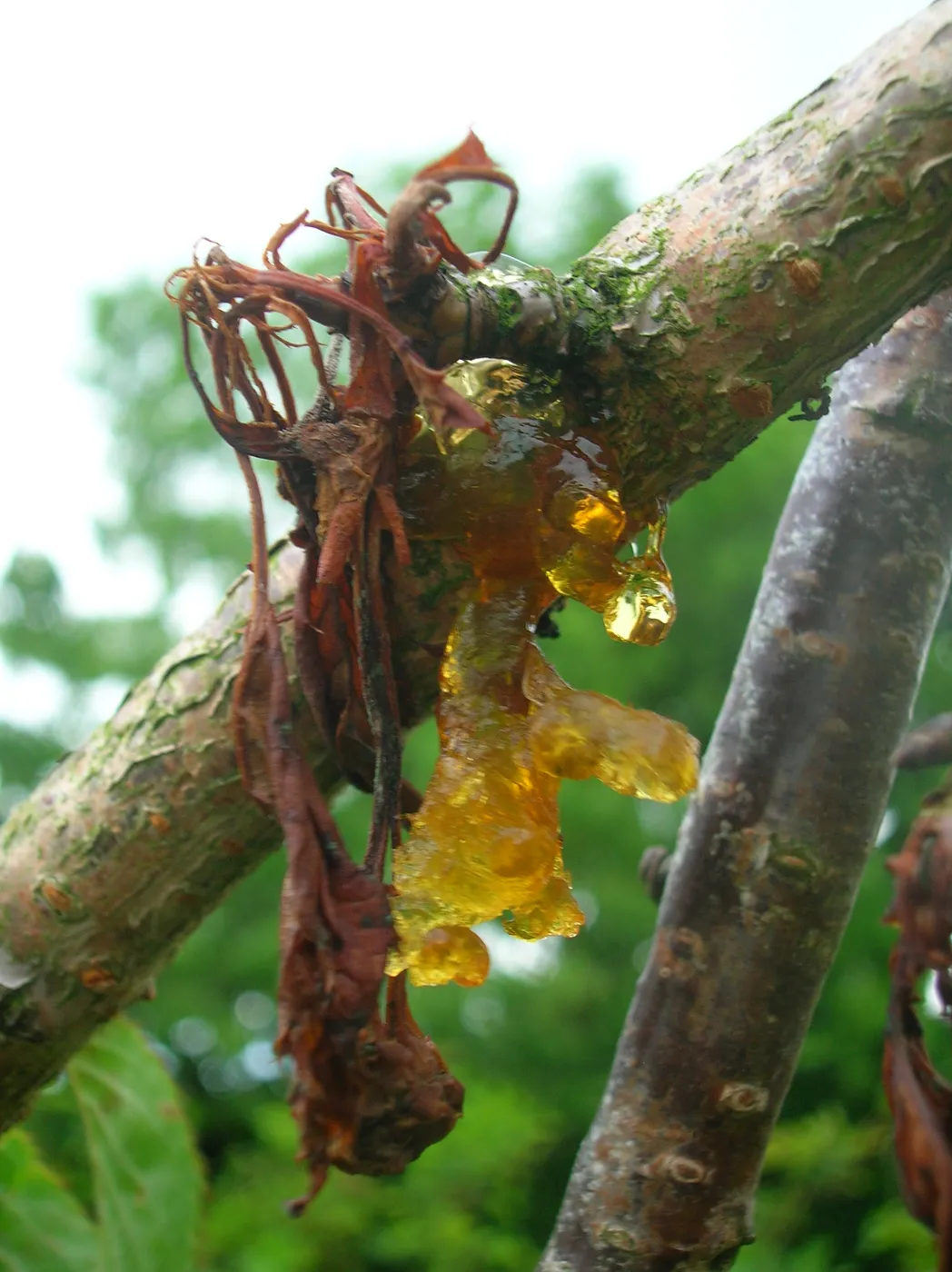
Bacterial canker (Pseudomonas syringae) on sweet cherry: gummosis and leaf dieback
The photo clearly shows two characteristic symptoms of the disease: abundant exudation of amber-yellow gum that hardens in the air (gummosis) from the affected bark tissues, as well as completely dried, necrotized leaves attached to the branch. Location: Chapeltoun, North Ayrshire, Scotland.
Gum exudation is a universal reaction of sweet cherry to stress. It is not a disease in itself but a symptom. Gum may appear on the trunk, scaffold branches, shoots, and even fruit. Causes:
- bacterial canker;
- fungal cankers (Leucostoma, Cytospora);
- mechanical damage (pruning, hail, wind, insect damage);
- frost cracks and sunscald;
- excessive moisture and poor drainage;
- boron deficiency (Long et al., 2021);
- sharp temperature fluctuations.
Gummosis is often accompanied by tissue dieback and canker formation. If gum is released abundantly and constantly, this indicates a chronic problem that must be addressed comprehensively (Quero-García et al., 2017; Buckingham, 2010).
3.4. Tumors, galls, growths
- Black knot (Apiosporina morbosa, syn. Dibotryon morbosum). Black, bumpy, woody growths (galls) form on shoots and branches. More common on sour cherry and plum, but can affect sweet cherry. Galls disrupt sap flow and cause branch dieback (Buckingham, 2010; Hill, 2011).
- Crown gall (Agrobacterium tumefaciens). Usually affects roots and root collar, but can also affect the lower part of shoots. Soft or lignified tumors form (Quero-García et al., 2017).
- “Witches’ brooms” (Taphrina wiesneri). Many thin, shortened shoots collected in a cluster appear on branches. Leaves on them are small and deformed. The disease is more common on sour cherry but possible on sweet cherry (Quero-García et al., 2017).
3.5. Pest damage
- Black cherry aphid (Myzus cerasi). Aphid colonies accumulate on the tips of young shoots and the underside of leaves. Shoots become curved, growth slows, leaves curl, sticky honeydew and sooty mold appear (Quero-García et al., 2017).
- Scale insects (Sphaerolecanium prunastri, Pseudualacaspis pentagona, Quadraspidiotus perniciosus). Convex scales appear on the bark of shoots and branches. Shoots weaken, dry out, and become covered with honeydew (Quero-García et al., 2017).
- Clearwing moths and wood borers (Synanthedon exitiosa, Capnodis tenebrionis). Larvae bore into bark and wood, causing gummosis, branch dieback, and death of young trees. Holes and frass are visible on the bark (Quero-García et al., 2017).
- Spider mites (Panonychus ulmi, Tetranychus spp.). Damaged shoots lag in growth, leaves become bronze-colored and covered with webbing (Quero-García et al., 2017).
- Leafrollers and caterpillars. Damage buds, young shoots, and leaves, often rolling them into webbing (Quero-García et al., 2017; Buckingham, 2010).
3.6. Physiological and abiotic damage
- Winter damage. Freezing of tissues leads to bark cracking and shoot dieback, especially in young trees. The southwest side of the trunk and forks often suffer (Quero-García et al., 2017; Mikheev and Revyakina, 2004).
- Sunscald. Occurs with sharp temperature changes in winter and early spring. Bark on the south and southwest side peels, cracks and necroses form (Quero-García et al., 2017).
- Herbicide damage. Systemic herbicides (glyphosate, 2,4-D) cause shoot curvature, thread-like leaves, “witches’ brooms,” and dieback. Symptoms often appear on one side or in the treated zone (Long et al., 2021).
- Boron deficiency. Death of shoot tips, short internodes, fragility of young branches (Long et al., 2021).
- Zinc deficiency. Small leaves, rosetting, shortened internodes (Long et al., 2021).
- Excess nitrogen. Vigorous shoot growth, poor wood maturation, predisposition to winter damage (Long et al., 2021).
3.7. Diagnostic algorithm for shoots
1. Assess the length and thickness of annual growth. Compare with the norm for age and cultivar.
2. Examine the bark: are there cankers, cracks, gum, growths, insect scales.
3. Check shoot tips: is there dieback, curvature, “witches’ brooms.”
4. Make a cross and longitudinal cut of the affected shoot: wood color, presence of necroses, rot.
5. Note the location of symptoms: throughout the canopy, on individual branches, on one side.
6. Check the root collar and upper roots if dieback is general.
7. Clarify site history: weather, irrigation, treatments, yield in the previous year.
8. If necessary, take samples for laboratory analysis (bacteriology, mycology, PCR).
Shoot problems rarely have a single cause. Often it is a combination of winter damage, infection, and management mistakes. Accurate diagnosis allows choosing the right strategy rather than fighting the symptom. In the next section, we will discuss problems of flowers and fruit set.
4. Flower and fruit set problems
Flowering and fruit set are a critical period for sweet cherry. This is when the future crop is established, and any unfavorable factors can lead to a sharp reduction or complete loss of yield. Problems may be related to weather, diseases, pests, lack of pollinators, or physiological disorders. It is important to notice deviations in time and understand their cause.
4.1. Damage to flowers by low temperatures (frost)


Damage to sweet cherry flowers by spring frosts
Extensive damage is observed to all flowers, including petals, which have turned brown and dried up. Crop losses from this damage are estimated at more than 70%.
Sweet cherry blooms early, and spring frosts are one of the main causes of crop loss in temperate and cold regions. Flowers and fruit set are damaged at temperatures below 0 °C, and sensitivity depends on the stage of development (Quero-García et al., 2017; Long et al., 2021).
- Bud stage (balloon stage): flowers are most resistant. At −2.5 °C there is almost no damage (Szabo et al., 1996).
- Full bloom: at −2.5 °C, 82–100% of flowers die (Szabo et al., 1996).
- Fruit set: at −2 °C, mass freezing occurs (Potapov et al., 2000).
- Young fruitlets: even a short-term drop to −1 °C can cause them to drop.
Symptoms of damage: flowers turn brown, dry out, stigmas and pistils darken, petals lose turgor. Damaged fruit set stops growing, turns yellow, and drops. Often the flower looks normal externally, but internally the tissues have already died. For diagnostics, it is useful to cut the fruit set and examine the ovule: in damaged ones it is brown or watery (Quero-García et al., 2017).
4.2. Diseases of flowers and fruit set
- Brown rot (Monilinia laxa, M. fructicola). Affects flowers, shoots, and fruit. Flowers suddenly turn brown, dry out, and become covered with gray sporulation. Fruit set blackens and mummifies. Infection is especially active in wet, cool weather (Quero-García et al., 2017; Buckingham, 2010).
- Gray mold (Botrytis cinerea). Affects flowers and young fruit set. Petals and receptacle become covered with a gray fluffy coating, tissues soften. High humidity and dense canopy contribute to disease development (Quero-García et al., 2017).
- Bacterial canker (Pseudomonas syringae). Causes browning and death of flowers, especially in cool rainy weather. Gum may appear on affected tissues. The disease often moves to shoots (Quero-García et al., 2017).
- Anthracnose (Colletotrichum acutatum). Brown spots appear on flowers, petals dry out. Later the infection may persist on fruit (Quero-García et al., 2017).
4.3. Pollination and fertilization problems


Bee on a sweet cherry flower
A bee visits a sweet cherry (Prunus avium) flower in Gyumri, Armenia. The photograph clearly shows the role of insects in pollen transfer and fruit set
Most sweet cherry cultivars are self-incompatible and require cross-pollination. Even with abundant flowering, the crop may be low if pollination has not occurred.
- Absence of a pollinator. If only one cultivar grows in the orchard, fruit set does not form. A compatible cultivar blooming at the same time is needed (Quero-García et al., 2017; Long et al., 2021).
- Cultivar incompatibility. Some cultivars cannot pollinate each other due to genetic incompatibility (for example, ‘Bing’ and ‘Emperor Francis’) (Quero-García et al., 2017).
- Poor activity of pollinating insects. Bees and bumblebees do not fly in cold, windy, or rainy weather. Dense canopy, absence of flowering honey plants, and insecticide use during flowering reduce pollinator activity (Buckingham, 2010; Long et al., 2021).
- Unfavorable weather during flowering. High temperature (>30 °C), strong wind, rain, and low humidity impair pollen germination and pollen tube growth.
- Stigma damage. Frosts, thrips, and chemical burns can damage the stigma, making fertilization impossible (Quero-García et al., 2017).
Symptoms of poor pollination: abundant flowering but few or no fruit set; fruit set small, uneven, often drops. On the cut of the fruit set, the ovule is not developed.
4.4. Physiological disorders
- Double fruit. Formed from fused pistils. The cause is high temperature (above 30 °C) during flower bud differentiation, 1–2 months before flowering (Quero-García et al., 2017; Beppu and Kataoka, 1999). Symptom: two fruit fuse, often with one pedicel. Such fruit are unsuitable for market.
- Flower abnormalities (absence of pistil, underdeveloped stamens). Occur at high temperatures during bud initiation or with nutrient deficiency. Flowers may be sterile (Quero-García et al., 2017; Mandal et al., 2021).
- Fruit set drop (June drop). A natural physiological phenomenon when the tree sheds part of the fruit set to regulate load. However, severe drop may be caused by stress: drought, waterlogging, nutrient deficiency, diseases, pests (Long et al., 2021).
- Underdevelopment of fruit set. Small, yellow, non-growing fruit set — a sign of nutrient deficiency, root damage, or viral infection.
4.5. Pest damage
- Weevils (Anthonomus rectirostris, Rhynchites spp.). Beetles eat buds and flowers and damage fruit set. Larvae develop inside fruit (Quero-García et al., 2017).
- Aphids (Myzus cerasi). Damage young shoots and flower buds, causing deformation and drying (Quero-García et al., 2017).
- Thrips (Frankliniella occidentalis). Damage flowers by sucking sap. Scars appear on fruit set, fruit become deformed (Quero-García et al., 2017).
- Mites (Panonychus ulmi, Tetranychus spp.). Feed on leaves and young shoots, weakening the tree, which indirectly affects fruit set (Quero-García et al., 2017).
- Sawflies (Caliroa cerasi). Larvae eat leaves, reducing photosynthesis and nutrient supply to fruit set (Quero-García et al., 2017).
4.6. Abiotic stresses
- Drought. Lack of moisture during flowering and fruit set causes fruit set drop, small fruit, and weak growth.
- Waterlogging. Water stagnation inhibits roots, disrupts nutrition, and promotes rot development.
- Heat. Temperatures above 30 °C during flowering reduce pollen viability and cause fruit set drop.
- Wind. Strong wind injures flowers, reduces pollinator activity, and causes drop.
- Nutrient deficiency. Lack of boron, zinc, nitrogen, and potassium negatively affects fruit set and fruit development (Long et al., 2021).
4.7. Diagnostic algorithm
1. Assess bloom abundance and uniformity of flower opening.
2. Examine flowers for frost damage, diseases, and pests.
3. Check for pollinators and their activity.
4. Compare cultivars: if one cultivar set fruit and another did not, incompatibility or absence of a pollinator is possible.
5. Check weather conditions over the last 2–3 weeks.
6. Assess fruit set condition: color, size, presence of ovule.
7. Check the root collar and roots if fruit set drop is massive.
8. If necessary, conduct laboratory testing for infections.
Flower and fruit set problems are often related to a complex of factors. Accurate diagnosis allows distinguishing frost from diseases, and lack of pollinators from physiological disorders. In the next section, we will discuss fruit problems.

Solar Automatic Drip Irrigation Kit for Gardens
Automate watering for pots, gardens and small greenhouses. This solar-powered system features a timer to help schedule water delivery to your plants.
- Solar-powered
- 15 m irrigation hose
- Programmable watering
Affiliate link · Check included accessories.
5. Fruit problems
Fruit is the result of the season, and any disturbances at previous stages of tree development often manifest on them. Problems may be related to weather, diseases, pests, physiological disorders, or management mistakes. It is important to be able to distinguish these causes in order to correctly assess the situation and not confuse, for example, rain-induced cracking with pest damage.
5.1. Assessing fruit quality


Macro photograph of branches of wild cherry (Prunus avium) with clusters of ripe dark red (almost black) fruits
Sweet cherry fruit quality is determined by size, color, firmness, taste, and absence of defects. Large fruit is valued more highly, but its development depends on crop load, nutrition, and moisture supply. Color should be uniform and characteristic of the cultivar. Flesh should be firm, juicy, without cavities or browning. Pedicels should be green, elastic, without signs of drying.
Deviations from the norm can be caused by both biotic and abiotic factors. Below are the main problems that can be found when examining fruit.
5.2. Fruit cracking
Cracking is one of the most serious problems of sweet cherry, especially in regions with rainy summers. It can lead to loss of a significant part of the crop and a sharp decrease in market quality.
Causes:
- Rain during ripening. Water penetrates through microcracks in the skin, cells swell, and the fruit cracks. Fruit at the stage of rapid growth and ripening are most vulnerable (Long et al., 2021; Quero-García et al., 2017).
- Fluctuations in soil moisture. Alternation of drought and abundant irrigation causes sharp changes in turgor, which also leads to cracking (Long et al., 2021).
- Excess nitrogen and potassium. These elements compete with calcium, and calcium is responsible for cell wall strength. When it is deficient, the skin becomes less elastic (Long et al., 2021).
- Genetic predisposition of the cultivar. Some cultivars (Bing, Skeena, Brooks) are more prone to cracking, others (Regina, Black Pearl) are more resistant (Long et al., 2021).


Fruit cracking in sweet cherry (Prunus avium L.)
The illustration shows fruits with cracks at different ripening stages. It well complements the account of skin damage, especially under moist conditions before harvest.


Fruit cracking in sweet cherry and their infection by phytopathogens
The collage shows sweet cherry (Latin: Prunus avium) fruits on tree branches with pronounced physiological cracking of the skin. This problem often arises from sharp fluctuations in moisture (for example, heavy precipitation after a dry period), when fruits take up water faster than the skin stretches. As stated in the description, deep cracks serve as 'open gates' for the entry of pathogenic microorganisms (fungi and bacteria). The photo clearly shows signs of secondary infection and tissue necrosis at the rupture sites, which leads to rotting and makes the crop unsuitable for sale.
Types of cracks:
- Around the pedicel (bowl crack). Water accumulates around the calyx where the pedicel attaches.
- At the fruit tip (tip crack). Often associated with a large scar from the stigma.
- Side cracks (side crack). Occur when water enters through the roots and the fruit swells uniformly.
- Cracks from contact with other fruit. Water remains longer at points of contact.
Diagnostics: examine fruit after rain or irrigation. Cracks may be superficial or deep. It is important to distinguish cracking from pest damage (for example, cherry fruit fly), which also causes softening and secondary rots.
5.3. Rots and fruit diseases


Cherry fruits infected by the fungus Monilia laxa
The photograph shows characteristic browning, wrinkling (mummification) of fruits and formation of light-colored pads with fungal spores.
- Gray mold (Botrytis cinerea). Affects fruit during ripening and after harvest. Tissues soften and become covered with a gray fluffy coating. High humidity and skin damage contribute to development (Quero-García et al., 2017; Webster, 1996).
- Brown rot (Monilinia laxa, M. fructicola). Fruit turn brown and become covered with concentric rings of white or cream-colored spores. Often mummify and remain on the tree or fall (Quero-García et al., 2017).
- Anthracnose (Colletotrichum acutatum). Sunken brown spots with orange sporulation appear on fruit. The disease is especially damaging on sour cherry and sweet cherry in warm humid climates (Quero-García et al., 2017).
- Alternaria rot (Alternaria alternata). Dark, slightly sunken spots covered with olive-green or black coating. Often develops on overripe fruit and during storage (Quero-García et al., 2017).
- Cladosporium rot (Cladosporium herbarum). Dark green or black spots with velvety coating. Affects fruit with mechanical damage (Quero-García et al., 2017).
- Penicillium rot (Penicillium expansum). Blue mold. Flesh becomes watery, and mold coating appears. Dangerous during storage (Quero-García et al., 2017).
- Rhizopus rot (Rhizopus stolonifer). Fast-developing soft rot with white mycelium and black sporangia. Requires high temperature and humidity (Quero-García et al., 2017).
- Mucor rot (Mucor piriformis). Soft rot, often after damage. Develops during storage (Quero-García et al., 2017).
Diagnostics: pay attention to color, consistency, presence of coating, and odor. It is important to distinguish primary infections (for example, brown rot affecting fruit still on the tree) from secondary ones developing after damage.
5.4. Pest damage
- Cherry fruit fly (Rhagoletis cerasi, R. cingulata). Larvae feed on flesh, causing browning and softening. A puncture point may be visible on the fruit surface. Damaged fruit often fall (Quero-García et al., 2017).
- Spotted-wing drosophila (Drosophila suzukii). The female lays eggs in ripening fruit, larvae destroy the flesh, causing rapid spoilage. Fruit become soft, with sunken areas (Quero-García et al., 2017).
- Cherry slug (Caliroa cerasi). Larvae eat leaves but can also damage young fruit, leaving skeletonized areas (Quero-García et al., 2017).
- Weevils (Anthonomus rectirostris, Rhynchites spp.). Beetles chew holes in fruit, larvae develop inside. Damaged fruit become deformed and often fall (Quero-García et al., 2017).
- Fruit moths (Cydia pomonella, Grapholita spp.). Caterpillars bore into fruit, eating flesh and seeds. Tunnels and excrement are visible inside (Buckingham, 2010).
- Mites (Tetranychus spp.). Damage on fruit manifests as small dots, “webbing,” but leaves are more often affected (Quero-García et al., 2017).


Signs of Drosophila oviposition on sweet cherry fruits
A sweet cherry fruit with characteristic signs of oviposition by Drosophila suzukii. The image shows external damage to the skin that may precede softening of the flesh and subsequent rotting of the fruit.


Close-up of a cut cherry containing a white larva of the European cherry fruit fly (Rhagoletis cerasi)
The pit and juicy flesh are visible nearby. Location: Erbach, Ringingen, Germany.
Diagnostics: examine fruit for holes, tunnels, larvae, and excrement. Use traps for adult insects. It is important to distinguish pest damage from diseases and physiological disorders.
5.5. Physiological fruit disorders
- Double fruit. Fusion of two fruit, often with one pedicel. Cause — high temperature during flower bud differentiation (Quero-García et al., 2017).
- “Bird beak.” An underdeveloped second fruit in the form of a growth. Also associated with high temperature (Long et al., 2021).
- Internal browning. May be caused by chilling injury during storage, calcium deficiency, or viral infections (Long et al., 2021; Quero-García et al., 2017).
- Pitting. Small sunken spots on the skin appearing after mechanical impacts and storage. Associated with loss of turgor and cell damage (Long et al., 2021; Webster, 1996).
- Pebbling, alligator skin. Rough skin, “alligator skin.” Develops during long storage, especially in some cultivars (Long et al., 2021).
- Fruit softening. May be a cultivar trait, but is enhanced by crop overload, calcium deficiency, high temperatures, and drought (Long et al., 2021).
- Uneven color. Associated with lack of light in the canopy, viral infections, and nutritional disorders (Long et al., 2021; Quero-García et al., 2017).
- Skin cracking without flesh cracking. May be caused by sunscald or sharp temperature fluctuations (Long et al., 2021).
5.6. Abiotic factors affecting fruit
- Temperature. Heat above 30 °C accelerates ripening, reduces firmness and taste. Frosts damage fruit set and young fruit.
- Water. Lack of moisture reduces fruit size, excess causes cracking and rots.
- Nutrition. Calcium deficiency increases susceptibility to cracking and browning, potassium deficiency reduces taste and color, boron deficiency causes deformations.
- Light. Lack of light in a dense canopy reduces sugar content and fruit color.
- Crop load. Overload leads to smaller fruit, reduced taste, and poor ripening.
5.7. Diagnostic algorithm for fruit
1. Assess size, shape, color, and firmness of fruit.
2. Examine the skin: cracks, spots, coating, holes.
3. Cut the fruit: condition of flesh, seed, presence of tunnels.
4. Check the pedicel: color, turgor, damage.
5. Compare fruit in different parts of the canopy and on different trees.
6. Clarify weather conditions over the last weeks.
7. Assess crop load, irrigation, and nutrition.
8. If necessary, take samples for laboratory analysis (mycology, entomology, virology).
Fruit problems are almost always related to a complex of causes. Accurate diagnosis helps understand what is primary: disease, pest, physiology, or agronomic practice. In the next section, we will discuss root problems and general tree condition.
6. Root and general condition problems
The root system of sweet cherry is the foundation of the whole tree’s health. It is shallow, sensitive to oxygen deficiency, waterlogging, soil compaction, and mechanical damage. Many problems that a grower notices on leaves, shoots, and fruit actually originate underground. Therefore, when diagnosing, it is important to assess not only the aboveground part but also the condition of roots, root collar, and soil conditions.
6.1. Assessing general tree condition
General inhibition manifests as a whole complex of signs:
- weak annual growth (shorter than 30–40 cm in mature trees);
- small, pale leaves, often with premature yellowing;
- dieback of individual branches or the entire canopy;
- reduced yield, smaller fruit;
- premature leaf fall;
- gummosis on the trunk and scaffold branches;
- general slowdown in development, no response to care.
Such symptoms can be caused by root problems, viral infections, phytoplasmas, nutritional disorders, or chronic stress. It is important to assess dynamics: did the problem appear suddenly or develop over years? Is one tree, a group, or the whole orchard affected? This helps narrow down the causes (Long et al., 2021; Quero-García et al., 2017).
6.2. Root system diagnostics
Sweet cherry roots are located mainly in the upper 30–60 cm of soil. To examine them, carefully expose the root collar and upper scaffold roots. Assess:
- Color and condition of bark. Healthy roots are light-colored, elastic, with greenish or white cambium. Affected ones are brown, black, soft, with an unpleasant odor.
- Presence of rots. Brown or black rot, tissue softening, bark peeling — signs of root rots (Phytophthora, Armillaria, Verticillium).
- Mycelial films and rhizomorphs. White fan-shaped films under the bark and dark cord-like rhizomorphs in the soil — a characteristic sign of Armillaria (honey fungus).
- Mechanical damage. Breaks, fractures, damage by rodents, wood borer larvae.
- Deep planting of the root collar. If the graft union is below soil level, this causes chronic inhibition and rots.
- Soil compaction. Dense, structureless soil around roots impedes respiration and growth.
- Groundwater level. Closer than 1.5–2 m from the surface — risk of waterlogging and oxygen starvation (Mandal et al., 2021; Long et al., 2021; Potapov et al., 2000).
6.3. Diseases of roots and root collar


Rhizomorphs of honey fungus — signs of fungal wood damage
Dark cord-like rhizomorphs of the fungus Armillaria mellea developing on the wood surface. Such structures help recognize armillaria root rot when examining the root system and adjacent tissues. Location: Lainshaw Woods, East Ayrshire, Scotland.
- Phytophthora root rot (Phytophthora spp.). Affects roots and root collar. Bark darkens, becomes brown, tissues die. Aboveground symptoms: inhibition, small leaves, branch dieback, sudden tree death. The disease is associated with waterlogging and poor drainage (Quero-García et al., 2017; Mandal et al., 2021).
- Armillaria root rot (Armillaria mellea). White fan-shaped mycelial films under the bark, dark rhizomorphs in the soil. The tree gradually dries out, starting from the periphery of the canopy. Often found in old orchards and areas where forest previously grew (Quero-García et al., 2017).
- Verticillium wilt (Verticillium dahliae). Affects the vascular system. Brown rings are visible on cuts of branches and roots. Symptoms: sudden wilting, branch dieback, often on one side of the tree (Quero-García et al., 2017).
- Crown gall (Agrobacterium tumefaciens). Formation of tumors on roots and root collar. Disrupts sap flow, causes inhibition and death of young trees (Quero-García et al., 2017).
- Bacterial canker (Pseudomonas syringae). Can affect the root collar, causing cankers, gummosis, and dieback (Quero-García et al., 2017).
6.4. Abiotic factors inhibiting roots
- Waterlogging and water stagnation. Roots suffocate, rots develop. Sweet cherry is especially sensitive to waterlogging (Mandal et al., 2021).
- Drought. Shallow roots dry out quickly, the tree experiences water stress, leading to smaller fruit and fruit set drop.
- Soil compaction. Heavy machinery, frequent foot traffic, and lack of organic matter lead to compaction, reduced porosity and oxygen.
- Salinity. High salt content in soil or irrigation water inhibits roots, causes marginal leaf necrosis, and reduces yield (Mandal et al., 2021).
- Acidity or alkalinity. At pH below 5.5 or above 8.0, nutrients become unavailable, and roots suffer from aluminum or manganese toxicity (Long et al., 2021; Potapov et al., 2000).
- Mechanical damage. Deep tillage, damage by rodents, larvae, frost.
- Deep planting of the root collar. A common planting mistake, leads to chronic inhibition and rots.
6.5. Viral and phytoplasma diseases affecting general condition
Some systemic infections cause general inhibition, dieback, and tree death without bright specific symptoms on leaves or fruit:
- X-disease (X-disease phytoplasma). Gradual dieback, small leaves, small pale fruit, sudden wilting. Diagnosed in the laboratory (Quero-García et al., 2017).
- European stone fruit yellows (ESFY, Candidatus Phytoplasma prunorum). Inhibition, chlorosis, leaf curling, branch dieback. Transmitted by leafhoppers (Quero-García et al., 2017).
- Cherry leaf roll virus (CLRV). Yellowing, leaf curling, general inhibition, reduced yield. Transmitted by pollen and seeds (Quero-García et al., 2017).
- Little cherry virus 1 and 2. Small, underdeveloped, pale fruit, reddening of leaves in summer, general weakening of the tree (Quero-García et al., 2017).
These diseases require laboratory confirmation because their symptoms are nonspecific.
6.6. Diagnostic algorithm for roots and general condition
1. Assess the general condition of the tree: growth, leaves, dieback, yield.
2. Compare with neighboring trees and the norm for cultivar and age.
3. Dig out the root collar and upper roots. Examine color, odor, presence of rots, mycelium, rhizomorphs.
4. Check planting depth: whether the root collar is buried.
5. Assess soil conditions: drainage, compaction, groundwater level, pH, salinity.
6. Clarify site history: predecessors, treatments, irrigation, weather.
7. If infection is suspected, take samples for laboratory analysis.
8. Rule out viral and phytoplasma diseases if symptoms are systemic and nonspecific.
Root and general condition problems are often the hidden cause of many visible disorders. Accurate diagnosis requires attention to detail and, if necessary, laboratory methods. In the next section, we will summarize the main symptoms and their likely causes in a single table for quick reference.

7-in-1 Wi-Fi Weather Station
Monitor local weather conditions with a wireless outdoor sensor. Track temperature, humidity, rainfall, wind speed and direction, and atmospheric pressure. Ideal for gardens, farms and greenhouses.
- Wireless outdoor sensor
- Solar-powered
- Wi-Fi connectivity
Affiliate link · Check regional compatibility.
7. Summary table
The summary table helps quickly match external symptoms with likely causes. It does not replace a full diagnosis but serves as a convenient guide. The tables indicate the most characteristic signs and possible factors — biotic, abiotic, or physiological. To make an accurate diagnosis, it is recommended to consider context: weather, soil, agronomic practices, site history, and analysis results (Long et al., 2021; Quero-García et al., 2017).
7.1. Leaves
| Symptom | Likely causes | Distinguishing signs / notes |
|---|---|---|
| Interveinal chlorosis of young leaves | Iron deficiency | Veins green, tissue between them yellow. More often on alkaline soils (Long et al., 2021) |
| Interveinal chlorosis of old leaves, marginal necrosis | Magnesium, potassium deficiency | Magnesium — areas between veins turn yellow; potassium — margins brown and dry (Long et al., 2021) |
| Uniform yellowing of old leaves | Nitrogen deficiency | Weak growth, pale color (Long et al., 2021) |
| Small yellow leaves, rosetting | Zinc deficiency | Short internodes, small leaves (Long et al., 2021) |
| Yellow leaves with green veins | Manganese deficiency | Often on waterlogged soils (Long et al., 2021) |
| Red-purple spots, white coating underneath | Cherry leaf spot | Premature leaf fall (Quero-García et al., 2017) |
| Brown spots with black dots, holes | Shot hole disease | Spots fall out, forming holes (Quero-García et al., 2017) |
| White powdery coating | Powdery mildew | Leaf curling (Quero-García et al., 2017) |
| Sticky curled leaves, sooty mold | Aphids | Colonies on the underside (Quero-García et al., 2017) |
| Skeletonization, only veins remain | Sawfly | Larvae covered with slime (Quero-García et al., 2017) |
| Winding light-colored tunnels | Leaf blotch miner moth | Mines visible when held to light (Buckingham, 2010) |
| Thread-like, fern-like leaves | Herbicides | Damage by systemic herbicides (Long et al., 2021) |
| Mosaic, rings, lines | Viruses (PNRSV, PDV, ACLSV) | Systemic symptoms, require laboratory confirmation (Quero-García et al., 2017) |
7.2. Shoots
| Symptom | Likely causes | Distinguishing signs / notes |
|---|---|---|
| Weak growth (<30–40 cm) | Stress, nutrient deficiency, crop overload | Compare with norm for age (Long et al., 2021) |
| Vigorous growth, “vegetative vigor” | Excess nitrogen, severe pruning | Poor wood maturation (Long et al., 2021) |
| Dieback of tips, branches | Bacterial canker, fungal cankers, brown rot | Cankers, gum, bark necrosis (Quero-García et al., 2017) |
| Gummosis | Canker, frost cracks, mechanical damage | Universal reaction to stress (Quero-García et al., 2017) |
| Black bumpy growths | Black knot | Galls on branches (Buckingham, 2010) |
| “Witches’ brooms” | Taphrina wiesneri, herbicides | Clusters of thin shoots (Quero-García et al., 2017) |
| Shoot curvature, stickiness | Aphids | Colonies on tips (Quero-García et al., 2017) |
| Scales on bark | Scale insects | Convex formations, honeydew (Quero-García et al., 2017) |
| Tunnels under bark, frass | Wood borers, clearwing moths | Branch dieback (Quero-García et al., 2017) |
| Frost cracks, bark cracks | Winter damage | Southwest side of trunk (Mikheev and Revyakina, 2004) |
7.3. Flowers and fruit set
| Symptom | Likely causes | Distinguishing signs / notes |
|---|---|---|
| Browning of flowers, stigma necrosis | Frost | At −2.5 °C, 82–100% of flowers die (Szabo et al., 1996) |
| Brown flowers with gray coating | Brown rot | Sporulation, mummification (Quero-García et al., 2017) |
| Gray fluffy coating | Gray mold | High humidity (Quero-García et al., 2017) |
| Abundant flowering, no fruit set | Absence of pollinator, incompatibility | Need a compatible cultivar (Long et al., 2021) |
| Fused fruit | Double fruit | High temperature during bud differentiation (Beppu and Kataoka, 1999) |
| Fruit set drop | June drop, stress, diseases | Natural or pathological (Long et al., 2021) |
| Damaged flowers, scars | Thrips, weevils | Insects visible on examination (Quero-García et al., 2017) |
7.4. Fruit
| Symptom | Likely causes | Distinguishing signs / notes |
|---|---|---|
| Cracking | Rain, moisture fluctuations, calcium deficiency | Cracks at pedicel, at tip, on side (Long et al., 2021) |
| Brown spots with spore rings | Brown rot | Mummification (Quero-García et al., 2017) |
| Gray coating, softening | Gray mold | High humidity (Quero-García et al., 2017) |
| Sunken brown spots with orange sporulation | Anthracnose | Warm humid climate (Quero-García et al., 2017) |
| Dark spots with olive coating | Alternaria rot | Overripe fruit (Quero-García et al., 2017) |
| Blue mold | Penicillium rot | During storage (Quero-García et al., 2017) |
| Soft rot with white mycelium | Rhizopus, Mucor | Rapid development (Quero-García et al., 2017) |
| Holes, tunnels, larvae | Cherry fruit fly, drosophila, weevils | Damage inside fruit (Quero-García et al., 2017) |
| Small sunken spots | Pitting | After mechanical impact (Webster, 1996) |
| Rough skin | Pebbling | Long storage (Long et al., 2021) |
| Flesh browning | Chilling injury, calcium deficiency | During storage (Long et al., 2021) |
7.5. Roots and general condition
| Symptom | Likely causes | Distinguishing signs / notes |
|---|---|---|
| General inhibition, weak growth | Root rots, compaction, drought, viruses | Complex of symptoms (Long et al., 2021) |
| Brown, soft roots, odor | Phytophthora, Armillaria | Root rots (Quero-García et al., 2017) |
| White fan-shaped films under bark | Armillaria | Honey fungus mycelium (Quero-García et al., 2017) |
| Brown rings on cut | Verticillium wilt | Vascular wilt (Quero-García et al., 2017) |
| Tumors on roots | Crown gall | Agrobacterium tumefaciens (Quero-García et al., 2017) |
| Deep planting of root collar | Planting mistake | Chronic inhibition (Potapov et al., 2000) |
| Marginal leaf necrosis, inhibition | Salinity | High EC of soil or water (Mandal et al., 2021) |
| Systemic dieback, small fruit | X-disease, ESFY, viruses | Require laboratory analysis (Quero-García et al., 2017) |
7.6. How to use the table
1. Find the group of symptoms (leaves, shoots, flowers, fruit, roots).
2. Match external signs with likely causes.
3. Clarify context: weather, soil, irrigation, treatments, tree age.
4. Check several versions; do not stop at the first one.
5. If necessary, use laboratory methods (leaf analysis, soil analysis, PCR, ELISA).
6. Remember that the same cause can produce different symptoms, and one symptom can have several causes.
The summary table is a tool for quick reference. It helps narrow the search, but a final diagnosis always requires a comprehensive approach. In the next section, we will discuss the main diagnostic mistakes and answer frequently asked questions.
8. Main mistakes and questions (FAQ)
Diagnosing sweet cherry is rarely unambiguous. Below are the most common mistakes that lead to incorrect conclusions, and answers to questions that arise for growers.
8.1. Main diagnostic mistakes
1. Making a diagnosis from a single symptom. The same sign — yellowing, gum, spots, dieback — can be caused by different factors: nutrient deficiency, disease, pest, weather, herbicide (Long et al., 2021; Quero-García et al., 2017).
2. Ignoring roots and root collar. Aboveground symptoms often reflect underground problems: waterlogging, rots, soil compaction, deep planting of the graft union (Mandal et al., 2021; Potapov et al., 2000).
3. Underestimating weather conditions. Frosts, heat, rain, and wind explain many “sudden” symptoms. Without weather context, it is easy to mistake physiology for infection (Long et al., 2021; Quero-García et al., 2017).
4. Mixing abiotic and biotic causes. Uniform symptoms tied to soil or weather are more often abiotic; patchy ones with signs of the pathogen are biotic (Buckingham, 2010; Long et al., 2021).
5. Late diagnosis. When a tree is severely weakened, symptoms become nonspecific, and the choice of actions is limited. Early detection improves accuracy (Quero-García et al., 2017).
6. Relying on memory, lack of records. Dates, weather, treatments, and yield help distinguish coincidence from pattern (Buckingham, 2010).
7. Failing to account for cultivar, rootstock, and age. Different cultivars and rootstocks react differently to stress, diseases, and nutrition (Long et al., 2021; Mandal et al., 2021).
8. Ignoring pollinators. Abundant flowering without fruit set is often related to the absence of a compatible cultivar or pollinating insects (Long et al., 2021; Quero-García et al., 2017).
9. Self-diagnosis from photos without examining the plant. A photo does not convey turgor, odor, root condition, or distribution in the canopy (Buckingham, 2010).
10. Lack of laboratory confirmation for systemic symptoms. Viruses, phytoplasmas, and some deficiencies require analyses (Quero-García et al., 2017; Long et al., 2021).
8.2. FAQ
Can a diagnosis be made only from leaves?
No. Leaves are an important but not the only source of information. It is necessary to examine shoots, flowers, fruit, root collar, and assess site conditions (Long et al., 2021; Quero-García et al., 2017).
How can a nutrient deficiency be distinguished from a disease?
Deficiencies usually manifest systemically and symmetrically, often tied to leaf age: old or young. Diseases more often produce spots, coatings, necroses, and patchiness. Leaf analysis helps confirm a deficiency (Long et al., 2021; Quero-García et al., 2017).
Why does a tree bloom abundantly but not set fruit?
The most likely causes: absence of a compatible pollinator, weather unsuitable for bee flight, stigma damage by frost, high temperature, or cultivar incompatibility (Long et al., 2021; Quero-García et al., 2017).
How can I tell that flowers died from frost and not disease?
After frost, flowers turn brown, stigmas and pistils darken, but there is no sporulation. Diseases are often accompanied by gray or brown coating, sporulation, and mummification (Quero-García et al., 2017; Szabo et al., 1996).
Why have holes appeared on leaves?
Likely causes: shot hole disease, Clasterosporium shot-hole, caterpillars, weevils, hail, wind. It is necessary to examine the underside of the leaf and shoots for the pathogen or pest (Quero-García et al., 2017; Buckingham, 2010).
What does gum on the trunk mean?
Gummosis is not a diagnosis but a reaction to stress: canker, frost cracks, mechanical damage, waterlogging, boron deficiency. It is necessary to look for the primary cause (Quero-García et al., 2017; Long et al., 2021).
Why do fruit crack even though irrigation is regular?
Cracking may be caused by rain during ripening, fluctuations in soil moisture, calcium deficiency, or cultivar susceptibility. Regular irrigation does not always prevent water uptake through the skin (Long et al., 2021).
How can roots be checked without damaging the tree?
Carefully expose the root collar and upper roots on one side, assess color, odor, presence of rots and mycelium. After examination, return the soil and water. Deep digging is not required (Long et al., 2021; Quero-García et al., 2017).
If symptoms are only on one side of the tree, what does that mean?
One-sided damage is more often associated with mechanical injury, local water stagnation, sunscald, root damage on one side, or herbicide drift (Long et al., 2021; Quero-García et al., 2017).
How can a virus be distinguished from herbicide damage?
Viruses produce mosaic, rings, deformations, often systemically. Herbicides cause thread-like leaves, curling, “witches’ brooms,” often on one side or in the treated zone. Accurate diagnosis is laboratory-based (Quero-García et al., 2017; Long et al., 2021).
When should samples be sent to a laboratory?
If symptoms are systemic, do not correspond to known deficiencies, or there is suspicion of a virus, phytoplasma, bacterial canker, or root rot. Also in cases of mass damage and economic losses (Quero-García et al., 2017; Long et al., 2021).
Can a diagnosis be made from a photograph?
A photo is useful for preliminary assessment but does not replace examination. Many symptoms require checking turgor, odor, cuts, root condition, and laboratory tests (Buckingham, 2010; Quero-García et al., 2017).
How often should trees be inspected?
At minimum during key stages: budbreak, flowering, shoot growth, fruit swelling, harvest, and leaf fall. In problem years — more often. Regular records improve diagnostic accuracy (Buckingham, 2010; Long et al., 2021).
Does the region affect diagnosis?
Yes. The set of diseases, pests, weather stresses, and availability of laboratories differ. Universal principles remain, but local recommendations and observations must be taken into account (Mandal et al., 2021; Quero-García et al., 2017).
What should be done if the cause is unclear?
Rule out abiotic factors, check roots and soil, compare with neighboring trees, collect history, and if necessary perform laboratory tests. Do not apply treatments without a confirmed diagnosis (Long et al., 2021; Quero-García et al., 2017).

40W Full Spectrum LED Grow Light
Support healthy plant growth with full-spectrum LED lighting. Ideal for seedlings, indoor plants and small growing spaces. A practical solution for indoor gardening and year-round cultivation.
- Full-spectrum LED
- Energy-efficient design
- Indoor plant growing
Affiliate link · Check actual power and light coverage.
References
- Buckingham, Alan (2010). ‘Cherries’, in Grow Fruit. New York, NY: DK Publishing, pp. 121-136.
- Børve, J., Ippolito, A., Tanovic, B., Michalecka, M., Sanzani, S.M., Poniatowska, A., Mari, M., Hrustic, J. (2017). ‘Fungal diseases.’, in Cherries: botany, production and uses. Wallingford: CABI, 338-364. doi: 10.1079/9781780648378.0338
- Gonçalves, B., Aires, Alfredo, Oliveira, Ivo, Afonso, S., Morais, M.Cristina, Correia, Sofia, Martins, Sandra, Silva, A.Paula (2021). ‘Sweet Cherry’, in Mandal, Debashis, Wermund, Ursula, Phavaphutanon, Lop, Cronje, Regina (ed.) Temperate Fruits. Production, Processing, and Marketing. Burlington, Canada: Apple Academic Press, pp. 333-416.
- Hessayon, D.G. (1993). ‘Tree fruit’, in The Fruit Expert. London, UK: Expert Books, pp. 3-57.
- Hill, Lewis, Perry, Leonard (2011). ‘Cherries, Sweet and Sour’, in The Fruit Gardener’s Bible. North Adams, MA: Storey Publishing, pp. 181-198.
- James, D., Cieślińska, M., Pallás, V., Flores, R., Candresse, T., Jelkmann, W. (2017). ‘Viruses, viroids, phytoplasmas and genetic disorders of cherry.’, in Cherries: botany, production and uses. Wallingford: CABI, 386-419. doi: 10.1079/9781780648378.0386
- Long, L.E., Lang, G.A., Kaiser, Clive (2021). ‘Fruit Ripening and Harvest’, in Sweet Cherries. Crop Production Science In Horticulture. Boston, MA: CABI Publishing, pp. 282-303.
- Long, L.E., Lang, G.A., Kaiser, Clive (2021). ‘Managing the Orchard Environment’, in Sweet Cherries. Crop Production Science In Horticulture. Boston, MA: CABI Publishing, pp. 236-281.
- Looney, N.E., Webster, A.D., Kupferman, E.M. (1996). ‘Harvest and Handling Sweet Cherries for the Fresh Market’, in Webster, A.D., Looney, N.E. (ed.) Cherries. Crop Physiology, Production and Uses. Cambridge, MA: CABI Publishing, pp. 411-442.
- Papadopoulos, N.T., Lux, S.A., Köppler, K., Beliën, T. (2017). ‘Invertebrate and vertebrate pests: biology and management.’, in Cherries: botany, production and uses. Wallingford: CABI, 305-337. doi: 10.1079/9781780648378.0305
- Wenden, B., Campoy, J.A., Jensen, M., López-Ortega, G. (2017). ‘Climatic limiting factors: temperature.’, in Cherries: botany, production and uses. Wallingford: CABI, 166-188. doi: 10.1079/9781780648378.0166
- Zoffoli, J.P., Toivonen, P., Yan, W.YanW. (2017). ‘Postharvest biology and handling for fresh markets.’, in Cherries: botany, production and uses. Wallingford: CABI, 460-484. doi: 10.1079/9781780648378.0460
- Михеев, А.М., Ревякина, Н.Т. (2004). ‘Сорта, рекомендуемые для выращивания в центральных районах России, Поволжье, на Урале, в Сибири и наДальнем Востоке [Varieties recommended for cultivation in central Russia, the Volga region, the Urals, Siberia, and the Far East]’, in Вишня, черешня [Cherry, sweet cherry]. Москва: Издательский Дом МСП, pp. 57-100.
- Потапов, В.А., Фаустов, В.В., Пильщикова, Ф.Н. (2000). ‘Косточковые культуры [Stone fruits]’, in Плодоводство [Fruit growing]. Москва: Колос, pp. 386-408.
