
Sweet Cherry: Site Selection and Soil Preparation
1. Requirements of Sweet Cherry for the Growing Site


Sweet cherry orchard in bloom
Sweet cherry orchard (Prunus avium) in bloom. The photograph shows the general appearance of the orchard and the characteristic arrangement of trees.
Sweet cherry is a temperate-climate crop. For successful growth and fruiting, it needs not only a suitable cultivar and rootstock but also a site that matches its biological requirements. Mistakes at this stage are difficult to correct later: the tree may be sick for a long time, bear poorly, or die (Longstroth & Perry, 1996; Potapov et al., 2000).
1.1. Climate and Temperature
Sweet cherry needs a warm growing season, a cool winter for breaking dormancy, and a relatively dry fruit-ripening period (Westwood, 1993; Longstroth & Perry, 1996). In different regions, specific dates and cultivars differ, so the guidelines below should be checked against local recommendations.
Winter dormancy. Most sweet cherry cultivars require 700 to 1200 hours at temperatures below 7°C, according to various data — from 400 to 1500 hours depending on cultivar and rootstock (Hill, 2011; Longstroth & Perry, 1996; Westwood, 1993). If the winter is too mild and chilling requirements are not met, buds open unevenly, bloom is prolonged, pollination worsens, and the crop ripens unevenly (Mandal et al., 2021). Therefore, in warm subtropical areas, sweet cherry is grown only in highlands or special low-chill cultivars are selected.
Winter frosts. In full dormancy, an adult sweet cherry tree can withstand frosts down to −29°C, but the roots are much more sensitive: in Mazzard rootstock they are damaged below −11°C, in Mahaleb below −15°C (Longstroth & Perry, 1996). Therefore, in regions with severe winters, snow cover, mulching, and correct rootstock selection are important.


Flowering of sweet cherry (Prunus avium)
Spring frosts. This is one of the main limiting factors. Sweet cherry blooms early, and its flowers are easily damaged by frost. At full bloom, loss of 10% of flowers in sweet cherry is possible already at −2.2°C, and 90% at −3.9°C; in sour cherry, 50% of flowers are damaged around −3.5°C (Longstroth & Perry, 1996). Young fruitlets are even more vulnerable. Therefore, one must not choose lowlands, hollows, or flat sites without cold-air drainage for sweet cherry. Slopes, elevated places, and areas near large water bodies that moderate the climate are better suited (Longstroth & Perry, 1996; Webster & Looney, 1996; Buckingham, 2010).
Summer heat. Sweet cherry does not like excessively hot summers. If during flower-bud differentiation the temperature remains above 30°C for a long time, the risk of double fruits increases; temperatures above 35°C are especially dangerous (Mandal et al., 2021; Blanke et al., 2017). In hot regions, a grower should choose more resistant cultivars and use shading or cooling, but for small plots it is easier to find a site with a moderate summer.
1.2. Precipitation, Humidity, and Fruit Cracking
Sweet cherry is one of the most rain-sensitive fruit crops. Rain during bloom reduces pollination and promotes disease development. Rain before harvest and during ripening causes fruit cracking and crop losses (Longstroth & Perry, 1996; Mandal et al., 2021). Therefore, in regions with frequent rain during ripening, it is recommended to choose cracking-resistant cultivars, provide covers, or grow sweet cherry in a protected place (Blanke et al., 2017; Buckingham, 2010).
High air humidity also increases the risk of fungal diseases. Areas with dry and warm summers but with a sufficient reserve of moisture in the soil are ideal (Westwood, 1993). If the summer is rainy, good drainage, crown ventilation, and disease prevention are especially important.
1.3. Light and Air Drainage
Sweet cherry needs full sun. Good illumination is necessary for flower-bud initiation, sugar accumulation, color, and fruit quality (Buckingham, 2010; Longstroth & Perry, 1996). Shading leads to elongated branches, poor fruiting, and diseases.
Air drainage is no less important. Cold air is heavier than warm air and flows down the slope. If there is an obstacle in its path — a dense windbreak, fence, building — a "frost pocket" forms. Therefore, the site must have free outflow of cold air. On a plain where air does not move, frosts are more dangerous than on a gentle slope (Longstroth & Perry, 1996; Potapov et al., 2000). Slopes with a gradient of up to 5–8° are optimal; on steeper slopes, terracing and special agricultural practices are used.
1.4. Wind
Strong wind breaks branches, injures fruits, reduces bee flight, and increases moisture evaporation. Large, tender fruits of yellow-pink cultivars suffer especially (Blanke et al., 2017). Therefore, sweet cherry needs wind protection. However, a windbreak strip must not block cold-air drainage: it is better to use permeable structures or place protection so that cold air can flow down the slope (Longstroth & Perry, 1996; Buckingham, 2010).
1.5. Soil and Water
Sweet cherry prefers deep, well-drained but moisture-retentive soils. The optimal pH is about 6.0–7.0 (Neilsen et al., 2017; Longstroth & Perry, 1996). On acidic soils, toxic excess of aluminum and manganese is possible; on alkaline soils, deficiency of iron, zinc, boron, and manganese (Neilsen et al., 2017). Sweet cherry tolerates salinity poorly: growth reduction is noted already at 1.5–1.7 dS/m (Neilsen et al., 2017). In Central Asia, for example, sweet cherry is especially sensitive to saline soils, as well as to excess and lack of moisture (Vdovtseva, Chernovalova, 1980).
Waterlogging is destructive for roots. The groundwater level for stone fruit crops should be no closer than 1.5–2 m from the surface (Potapov et al., 2000). Even short-term flooding can weaken a tree for a long time, and prolonged flooding can lead to death (Longstroth & Perry, 1996). Therefore, wet, heavy, clayey, and poorly drained sites without preliminary drainage are unsuitable for sweet cherry.
1.6. What This Means for Site Selection
To put it briefly, a good site for sweet cherry should have:
- full sun for most of the day;
- free cold-air drainage, without lowlands and closed depressions;
- deep, drained, moisture-retentive soil with pH about 6.0–7.0;
- groundwater level no closer than 1.5–2 m;
- protection from strong winds without blocking air drainage;
- sufficient moisture, but without waterlogging;
- a climate with a cool winter, without severe frosts and with minimal risk of frost during bloom;
- a dry and warm ripening period, especially for cultivars prone to cracking.
In different regions of the world, these requirements manifest differently: in some places the limiting factor is winter frosts, in others spring frosts, summer heat, rains, or soil salinity (Mandal et al., 2021; Longstroth & Perry, 1996; Neilsen et al., 2017). Therefore, before establishing an orchard, it is important not only to evaluate the site "by eye" but also to take into account local climatic data, land history, and recommendations for the specific zone.
If the structure suits, in the next message we can write section 2. Site Selection: Where It Can Be Grown; Where It Is Undesirable to Grow.
2. Site Selection: Where It Can Be Grown; Where It Is Undesirable to Grow
After the requirements of sweet cherry for climate, relief, and soil have been determined, one can proceed to practical evaluation of the site. The main principle is simple: the site must suit the crop, not the other way around. Sweet cherry is a long-lived crop, and mistakes in site selection often cannot be corrected by fertilizers, irrigation, or pruning (Potapov et al., 2000; Longstroth & Perry, 1996).
2.1. Climatic Criteria
A site can be considered if:
- in winter, a sufficient number of chilling hours accumulates — usually 700 to 1200 hours at temperatures below 7°C, depending on cultivar and region (Hill, 2011; Mandal et al., 2021);
- winter frosts do not exceed critical values for the selected cultivar and rootstock; sweet cherry roots are damaged at −11…−15°C depending on rootstock (Longstroth & Perry, 1996);
- spring frosts during bloom are rare or the site is protected from them;
- the summer is warm enough for fruit ripening, but without prolonged heat above 35°C, which increases the risk of double fruits and quality deterioration (Blanke et al., 2017; Mandal et al., 2021);
- the ripening period is relatively dry, especially for cultivars prone to cracking (Longstroth & Perry, 1996; Buckingham, 2010).
Sweet cherry is more demanding for warmth, dryness, and drainage than sour cherry. Sour cultivars tolerate a more humid climate and heavier soils better, whereas sweet cherry under such conditions suffers more from diseases and cracking (Hill, 2011; Westwood, 1993).
2.2. Relief and Air Drainage
Most desirable:
- gentle slopes with a gradient of about up to 5–8°;
- elevated sites with natural cold-air drainage;
- places protected from strong winds but not enclosed on all sides;
- sites near large water bodies, if the regional climate allows growing sweet cherry: water moderates temperature, delays bloom, and reduces frost risk (Westwood, 1993; Longstroth & Perry, 1996).
Undesirable and dangerous:
- lowlands, hollows, closed depressions, ends of valleys — cold air accumulates there;
- leveled plains without air drainage: frosts are stronger there than on a slope (Longstroth & Perry, 1996; Potapov et al., 2000);
- dams, dense windbreaks, solid fences, and buildings that block cold-air drainage; if necessary, wind protection is designed with gaps for air drainage (Longstroth & Perry, 1996; Phillips, 2005);
- southern and southeastern slopes for early-blooming cultivars: in spring they warm faster and accelerate bud break, increasing the risk of frost damage (Longstroth & Perry, 1996).
In regions with frequent spring frosts, northern and northwestern slopes are sometimes used: they delay bloom. However, one must consider that such slopes warm up worse, and the crop may ripen later. In the middle zone, western and northwestern exposures are often preferable; in southern areas, more humid northern slopes; in northern areas, warmer southern and southwestern slopes (Trunov et al., 2012).
2.3. Water: Groundwater, Drainage, Salinity
Sweet cherry does not tolerate waterlogging. Roots must breathe, and groundwater must be sufficiently deep.
A site can be used if:
- groundwater lies no closer than 1.5–2 m from the surface; for vigorous rootstocks, 2.5–3 m is desirable (Potapov et al., 2000);
- the soil is well drained, with no prolonged flooding even in spring;
- irrigation water is not saline; sweet cherry is sensitive to salt, and growth reduction is possible already at 1.5–1.7 dS/m (Neilsen et al., 2017).
Undesirable:
- sites with a high groundwater level;
- heavy clay soils without drainage;
- places where water stands for a long time in spring;
- saline soils and irrigation with saline water; in Central Asia, sweet cherry tolerates salinity, excess, and lack of moisture especially poorly (Vdovtseva, Chernovalova, 1980; Neilsen et al., 2017);
- sites with close occurrence of gravel or a dense subsoil layer: there trees grow weakly and suffer more from gummosis (Vdovtseva, Chernovalova, 1980).
If the site is generally suitable but has local wet spots, drainage ditches, ridges, or planting on raised beds can be provided. However, it is simpler and more reliable to choose a site with natural drainage.
2.4. Soil Criteria
Optimal:
- deep soils, not less than 1 m, preferably 1.5–2 m;
- medium in granulometric composition: loams, well drained but moisture-retentive;
- pH about 6.0–7.0;
- sufficient organic matter content;
- absence of strong carbonation, salinity, waterlogging, and compaction (Neilsen et al., 2017; Potapov et al., 2000; Mandal et al., 2021).
Undesirable:
- sandy and gravelly soils without irrigation and organic matter;
- heavy clays with poor drainage;
- soils with pH below 5.5: aluminum and manganese toxicity is possible;
- soils with pH above 7.5–8.0: risk of iron, zinc, boron, and manganese deficiency increases;
- calcareous soils causing chlorosis;
- saline soils;
- compacted horizons, plow pans, dense layers that restrict root growth (Neilsen et al., 2017; Longstroth & Perry, 1996).
2.5. Site History and Biotic Risks
Even a site ideal in relief and soil may be unsuitable if an orchard previously grew there or if there are sources of infection.
Undesirable:
- an old sweet cherry or stone fruit orchard: soil fatigue, nematodes, root rots, bacterial canker, Verticillium wilt are possible;
- sites after potato, strawberry, alfalfa: they can be a source of Verticillium (Longstroth & Perry, 1996);
- proximity of wild sweet cherry, blackthorn, plum, peach: they can be a reservoir of diseases and pests;
- infection with Armillaria, Phytophthora, Agrobacterium, Pratylenchus and other soil pathogens (Longstroth & Perry, 1996; Neilsen et al., 2017);
- sites with perennial weeds, especially rhizomatous ones, which are difficult to destroy before planting.
If the site was previously under an orchard, at least several years of another crop, removal of roots, deep cultivation, and, if necessary, biological or chemical disinfection are needed. But it is better not to choose such places for sweet cherry.
2.6. Where Sweet Cherry Is Undesirable to Grow
Briefly, the following situations can be identified:
- cold lowlands and closed depressions;
- flat plains without air drainage;
- sites with a high groundwater level and prolonged flooding;
- heavy clay and poorly drained soils;
- saline and strongly calcareous soils;
- sandy and gravelly soils without irrigation and organic matter;
- places with strong wind without the possibility of wind protection;
- proximity of old stone fruit orchards and wild sweet cherry;
- sites after potato, strawberry, alfalfa with risk of Verticillium;
- southern and southeastern slopes for very early-blooming cultivars in frost-prone zones.
2.7. Where It Can Be Grown, but with Limitations
Sometimes a site is not ideal, but with additional measures it can be used:
- in slightly lowered places — drainage, ridges, planting on raised beds;
- on sandy soils — irrigation, mulching, organic fertilizers;
- on alkaline soils — selection of resistant rootstocks, chelated forms of microelements, organic mulch;
- in regions with rainy ripening — cracking-resistant cultivars, covers, disease protection;
- in zones with spring frosts — selection of later-blooming cultivars, smoking, irrigation, wind protection without blocking air drainage.
2.8. Practical Checklist for Site Evaluation
Before buying or establishing an orchard, one should answer the questions:
1. What is the minimum winter temperature and how often do thaws occur?
2. How many chilling hours accumulate in a normal winter?
3. When does the last spring frost usually occur?
4. Are there lowlands on the site where cold air flows?
5. Is air drainage free or blocked by forest, fence, buildings?
6. How deep is groundwater in spring and autumn?
7. Does water appear on the surface after rain or snowmelt?
8. What is the thickness of the humus horizon and are there dense layers?
9. What is the pH, is there salinity or carbonates?
10. What grew on the site in the last 5–10 years?
11. Are there old stone fruit orchards and wild sweet cherry nearby?
12. Is there enough sun during the day?
13. Is the site protected from prevailing winds?
14. Is irrigation possible if the summer is dry?
If most answers indicate favorable conditions, the site can be considered for sweet cherry. If there are critical limitations — high groundwater level, cold-air stagnation, salinity, old stone fruit orchard — it is better to look for another place or choose another crop.
In the next section we will consider predecessors, soil fatigue, allelopathy, and undesirable neighborhood for sweet cherry.


LCD 4-in-1 Soil Tester
Check essential growing conditions with one compact tool. Measure soil pH, moisture, temperature and light intensity — ideal for gardens, potted plants and greenhouses.
- 4-in-1 measurement
- Easy-to-read LCD display
- Portable design
Affiliate link · For indicative measurements only.
3. Predecessors and Soil Fatigue, Allelopathy, and Undesirable Neighborhood
Even a site ideal in climate and relief may be unsuitable for sweet cherry if an unsuitable predecessor previously grew there or sources of infection remain. Sweet cherry is a crop sensitive to soil "fatigue" and to certain neighbors, so this section should be studied before buying seedlings (Potapov et al., 2000; Longstroth & Perry, 1996).
3.1. Soil Fatigue: What It Is and Why It Is Dangerous
Soil fatigue is a negative phenomenon that occurs with long-term cultivation of perennial fruit and berry crops in one place. It manifests in the accumulation of toxins and root exudates, sharp depletion of soil in available forms of macro- and microelements, changes in microbiological activity, and accumulation of parasitic microorganisms (Potapov et al., 2000). Simply put, the soil "gets tired" of the same crop, and the next tree grows worse, even if the site looks healthy externally.


Honey fungus (Armillaria mellea)
Fruiting bodies of the honey fungus (Armillaria mellea) at the base of woody debris. The fungus is associated with root rots and poses a danger to susceptible fruit trees.
For sweet cherry, replant disease is especially dangerous — a complex disease of replanting. Young trees planted in place of an old orchard often establish poorly, grow weakly, and reduce productivity throughout their life (Neilsen et al., 2017; Longstroth & Perry, 1996). Causes may be:
- root nematodes, primarily Pratylenchus penetrans;
- soil fungi — Cylindrocarpon/Ilyonectria, Rhizoctonia, Pythium;
- toxic root exudates;
- soil depletion and disruption of its structure;
- accumulation of pathogens specific to stone fruit crops (Neilsen et al., 2017; Webster & Looney, 1996).
Studies show that unpasteurized or unfumigated soil from old orchards usually suppresses the growth of sweet cherry seedlings compared with treated soil (Westwood, 1993). Therefore, sites where a stone fruit orchard previously grew are better avoided. If there is no other option, long preparation will be required: several years of another crop, removal of roots, deep cultivation, biological disinfection, and possibly preplant fumigation (Neilsen et al., 2017; Potapov et al., 2000).
3.2. Predecessors: Good, Acceptable, and Undesirable
Good and acceptable predecessors:
- perennial grasses, especially legumes (clover, alfalfa, sainfoin) and grasses (fescue, timothy);
- green manures: lupine, mustard, phacelia, peas, vetch-oat mixture, winter rye;
- field crops not affected by pathogens common with sweet cherry;
- clean fallow or virgin land, if the soil is healthy.
After perennial grasses, the site is usually depleted of moisture but enriched in organic matter and has good structure. Before planting sweet cherry, the soil is kept under black fallow, perennial weeds are destroyed, and the stock of annual seeds is reduced (Potapov et al., 2000).
Undesirable predecessors:
- an old sweet cherry, plum, peach, apricot, or sour cherry orchard;
- potato, strawberry, alfalfa — they are hosts of Verticillium, which can also affect sweet cherry (Longstroth & Perry, 1996; Webster & Looney, 1996);
- sites after long cultivation of annual row crops: a plow pan often forms, a compacted layer that restricts root growth (Longstroth & Perry, 1996);
- intensively cultivated soils depleted in nutrients.
If the site was previously under forest or an old orchard, roots and pathogens may remain in it, especially Armillaria mellea — a dangerous causative agent of root rot, especially destructive for sweet cherry on Mahaleb rootstock (Webster & Looney, 1996; Longstroth & Perry, 1996). Such places require especially careful preparation or replacement.
3.3. Allelopathy and Root Exudates
Allelopathy is the influence of some plants on others through chemicals released by roots, leaves, or fruits. In fruit growing, this phenomenon has been studied less than soil fatigue, but it can contribute to growth suppression during replanting (Potapov et al., 2000; Westwood, 1993).
Roots of fruit trees release various organic compounds into the soil. During decomposition of old roots, substances toxic to young plants may form. That is why it is not recommended to plant the same crop immediately in place of a grubbed orchard. For sweet cherry, it is especially important not to plant it after sweet cherry, sour cherry, plum, or other stone fruits (Potapov et al., 2000; Buckingham, 2010).
The practical conclusion is simple: if possible, choose a site where stone fruits have not grown for the last 5–10 years. If not, establish the orchard only after long preparation and, preferably, with the use of resistant rootstocks.
3.4. Undesirable Neighborhood and Wild Relatives
Sweet cherry can suffer from proximity to other plants that are reservoirs of diseases and pests.
Dangerous neighbors:
- Wild sweet cherry, blackthorn, plum, peach, apricot — often accumulate viruses, mycoplasmas, and fungal infections. In the USA, Prunus virginiana (chokecherry) is an alternative host of X-disease — a dangerous mycoplasma disease of stone fruits (Webster & Looney, 1996; Longstroth & Perry, 1996);
- Old, diseased, or abandoned fruit trees — a source of spores, bacteria, and insect pests;
- Forest areas with *Armillaria* — honey fungus can infect sweet cherry roots, especially on susceptible rootstocks;
- Potato, strawberry, alfalfa — as already mentioned, can be a source of Verticillium;
- Solanaceous and some other vegetable crops — in some regions can support pathogens dangerous to stone fruits.
On the other hand, some plants can be useful. For example, in apple orchards, raspberry is considered a "friend" of the tree: it does not compete strongly for nutrition but supports beneficial predatory mites and parasitoids, and also suppresses the growth of grasses (Phillips, 2005). For sweet cherry, such interactions have been studied less, but the principle of diversity and avoiding monoculture remains useful.
3.5. Practical Conclusions
1. Do not plant sweet cherry after sweet cherry, sour cherry, plum, peach, or apricot. Soil fatigue and replant disease can seriously suppress young trees.
2. Avoid sites after potato, strawberry, and alfalfa because of the risk of Verticillium.
3. Check the site history: if it was an old orchard, forest, or virgin land, assess the risk of Armillaria, nematodes, and other pathogens.
4. If necessary, use green manures and perennial grasses to improve soil health. Legumes enrich the soil with nitrogen, grasses improve structure, and crops such as marigolds can reduce nematode numbers (Neilsen et al., 2017).
5. Remove old roots, carry out deep cultivation and, if possible, keep the site under another crop for 2–5 years.
6. Avoid proximity to wild sweet cherry and old stone fruit orchards. They can be a source of infections.
7. Take allelopathy into account: even if the soil looks healthy, root exudates of the previous crop can suppress young trees.
If the site has critical limitations — an old stone fruit orchard, Armillaria infection, high groundwater level — it is better to look for another place. Sweet cherry is a long-lived crop, and mistakes in choosing a predecessor often cannot be corrected quickly.
In the next section we will consider sweet cherry requirements for soil and a brief diagnosis of its condition.
4. Soil Requirements, Brief Diagnosis of Soil Condition
Sweet cherry is a crop with increased demands on soil. It does not tolerate waterlogging, compaction, salinity, or prolonged lack of oxygen in the root zone. At the same time, good soil is not only a "fertile layer" but the entire root-inhabited profile: depth, structure, drainage, reaction of the medium, and reserve of nutrients (Potapov et al., 2000; Neilsen et al., 2017; Longstroth & Perry, 1996).
4.1. Optimal Soil Parameters for Sweet Cherry
Thickness of the root-inhabited layer. A soil depth of at least 1 m is desirable, preferably 1.5–2 m. Sweet cherry is a large tree, and its roots must have sufficient volume for growth and supply of water and nutrients to the crown (Mandal et al., 2021; Longstroth & Perry, 1996). On shallow soils, trees grow weakly and suffer more from drought and diseases.
Granulometric composition. Medium and heavy loams, well drained but moisture-retentive, are most suitable. Sandy and gravelly soils without irrigation and organic matter lose moisture and nutrients too quickly. Heavy clays without drainage are prone to waterlogging and compaction (Longstroth & Perry, 1996; Potapov et al., 2000). In trials on intensive orchards, it is recommended that the soil have high moisture capacity and good air permeability, and groundwater lie no closer than 1.5–2 m, for vigorous rootstocks — 2.5–3 m (Potapov et al., 2000).
Structure and density. The soil should be loose, without dense layers, plow pan, fragipan, or clay pan. Sweet cherry roots cannot effectively overcome compacted horizons, so in such places a surface root system forms, suffering from drought and waterlogging (Longstroth & Perry, 1996; Neilsen et al., 2017). It is useful to assess bulk density: if a shovel or auger enters the soil with difficulty at a depth of 30–60 cm, compaction is likely.
Reaction of the medium (pH). The optimal range is about 6.0–7.0. At such pH, most nutrients are available to plants, and the risk of aluminum and manganese toxicity is minimal (Neilsen et al., 2017; Longstroth & Perry, 1996). At pH below 5.5, the danger of toxic aluminum and manganese increases, and root growth is suppressed. At pH above 7.5–8.0, deficiency of iron, zinc, boron, and manganese often occurs, especially on calcareous soils (Neilsen et al., 2017). In Central Asia, sweet cherry tolerates saline and calcareous soils especially poorly (Vdovtseva, Chernovalova, 1980).
Organic matter. Organic matter content is desirable not below 2%. If the soil is poorer, it is improved with compost, manure, green manures, and mulch. Organic matter improves structure, moisture capacity, aeration, and biological activity (Neilsen et al., 2017; Potapov et al., 2000). In intensive orchards, organic fertilizers are applied once every 3–4 years at 30–40 t/ha on cultivated soils and 60–80 t/ha on poor soils (Trunov et al., 2012).
Drainage and groundwater. Sweet cherry is very sensitive to waterlogging. Even short-term flooding can weaken a tree for a long time, and prolonged flooding can lead to death. The groundwater level should not be closer than 1.5–2 m from the surface (Potapov et al., 2000; Longstroth & Perry, 1996). If water stands higher, drainage ditches, ridges, or planting on raised beds are needed. In wet soils, root rots often develop, especially Phytophthora (Longstroth & Perry, 1996; Webster & Looney, 1996).
Salinity. Sweet cherry is sensitive to salts. Growth reduction is noted already at 1.5–1.7 dS/m in the soil solution, and at 1.9–3.1 dS/m yield losses can reach 10–50% (Neilsen et al., 2017). Therefore, saline soils and irrigation with saline water are undesirable for sweet cherry.
Nutrients. The soil should contain sufficient available macro- and microelements. However, focusing only on "fertility" is not enough: with unsuitable pH or compaction, elements may be unavailable. Therefore, diagnosis includes both soil analysis and assessment of its physical properties (Neilsen et al., 2017; Potapov et al., 2000).
4.2. Brief Diagnosis of Soil Condition
A full agrochemical analysis is useful, but before conducting it, much can be understood independently. Below are simple techniques that help evaluate a site.
1. Inspection of the site and vegetation.
Pay attention to indicator plants. Moisture-loving species — sedge, reed, bulrush, alder, willow — indicate close groundwater or waterlogging. Pine, on the contrary, is more often found on deep, poor, sandy soils (Longstroth & Perry, 1996). If oak, linden, maple, ash, birch, hazel, rowan, or bird cherry grow on the site, this may indirectly indicate soils suitable for fruit crops (Trunov et al., 2012). But the presence of wild sweet cherry, blackthorn, or an old stone fruit orchard nearby is an alarming signal.

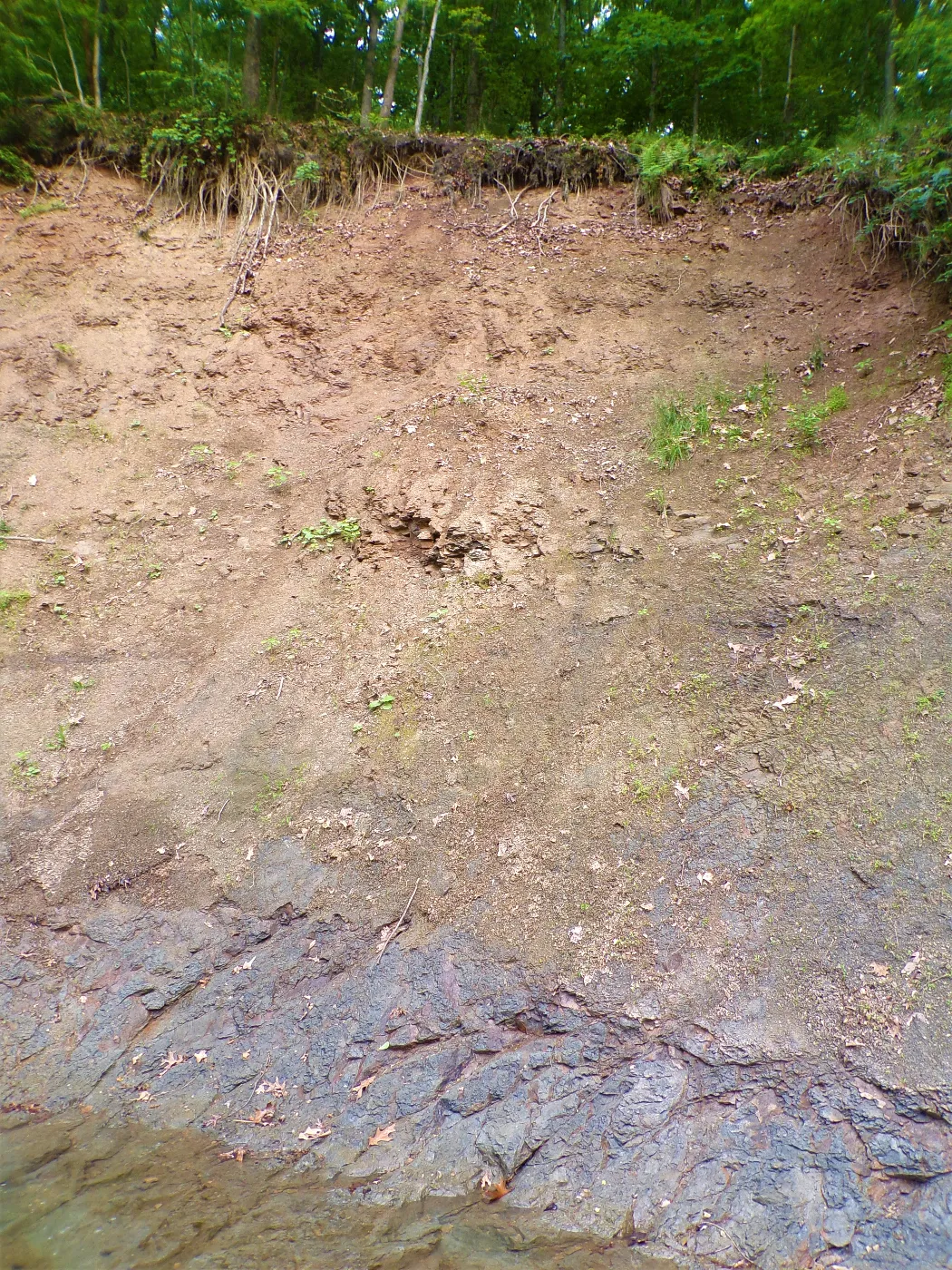
Soil profile of a slope with silt, loam, and clay.
Soil profile of an exposed hillslope demonstrating layers of silt, loam, and clay next to a creek. The photograph clearly shows the structure of the bank and the dense root system of plants in the upper soil layer.
2. Digging a soil profile.
Dig a pit 1–1.5 m deep. Examine the profile: are there dense layers, clay, gravel, signs of gleying (bluish or rusty spots), hydrogen sulfide odor, waterlogging. Roots of previous crops, compacted horizons, sharp textural transitions — all this is important. If the walls of the pit are smooth and "smeared," as if from a shovel, and water does not leave, drainage is poor (Longstroth & Perry, 1996; Potapov et al., 2000).
3. Determining texture "by feel."
Take a little moist soil, rub it between your fingers, and try to roll a cord-"ribbon." If the ribbon does not form or breaks before 2.5 cm, it is sandy or sandy loam soil; if the ribbon is 2.5–5 cm, it is loam; if more than 5 cm, it is clay soil. A smooth ribbon indicates a silt fraction, a rough one indicates sand (Long et al., 2021). Loams and well-drained heavy loams are best for sweet cherry.
4. Checking pH.
The simplest way is to use a garden pH meter or litmus paper. A more accurate result is given by laboratory analysis. Optimal for sweet cherry is 6.0–7.0. If pH is below 5.5, liming is required; if above 7.5–8.0, microelement deficiencies are possible (Neilsen et al., 2017; Longstroth & Perry, 1996).
5. Drainage test.
Dig a pit about 60×60×60 cm. Fill it with water and let it soak in completely. Then fill it again and time it. If water drains very slowly, more than a day, drainage is insufficient. If quickly, it is good. Conduct the test in several places, especially in depressions (Longstroth & Perry, 1996). You can also check groundwater depth by digging a pit in spring, when water stands highest.
6. Assessing salinity.
Visually, salinity manifests as white salt efflorescence on the surface, suppressed plant growth, and marginal leaf burn. The exact indicator is electrical conductivity (EC) of the soil extract. For sweet cherry, values above 1.5–1.7 dS/m are critical (Neilsen et al., 2017). Such analysis is best done in a laboratory.
7. Biological activity.
It is useful to assess the number of earthworms, presence of mycorrhiza, and smell of the soil. Healthy soil smells of "earth," not rot. If there are many earthworms, roots, and dark crumbly organic matter in the pit, this is a good sign. If the soil is dense, gray, with a putrid smell, biological activity is low.
8. Laboratory analysis.
If the site seems suitable, it is worth submitting soil samples to a laboratory. Usually pH, organic matter, available phosphorus and potassium, calcium, magnesium, sulfur, boron, zinc, manganese, iron, copper, electrical conductivity, carbonate content, and granulometric composition are determined. For sweet cherry, it is important to know not only total reserves but also available forms of elements, as well as pH, on which this availability depends (Neilsen et al., 2017; Potapov et al., 2000).
4.3. Practical Checklist for Soil Evaluation
1. Is there water on the site after rain or snowmelt?
2. How deep is groundwater in spring?
3. What is the thickness of the humus horizon?
4. Are there dense layers, plow pan, clay, gravel?
5. What is the soil pH?
6. What is the soil texture — sand, loam, clay?
7. Are there signs of salinity or carbonation?
8. How much organic matter is in the soil?
9. What indicator plants grow on the site?
10. What grew here in the last 5–10 years?
11. Is there an old stone fruit orchard or wild sweet cherry nearby?
12. How quickly does water leave the test pit?
13. Are there earthworms and roots in the soil profile?
14. Is it possible to cultivate the soil deep enough before planting?
If most answers are favorable, the site can be prepared for planting. If there are critical limitations — high groundwater level, dense layer, salinity, strongly acidic or strongly alkaline reaction — reclamation or choosing another place will be required (Potapov et al., 2000; Neilsen et al., 2017).
4.4. Conclusion
Sweet cherry prefers deep, well-drained, moisture-retentive loams with pH about 6.0–7.0 and organic matter content not below 2%. It does not tolerate waterlogging, compaction, salinity, or sharp fluctuations in moisture. Brief diagnosis — inspection of the site, soil profile, texture test, pH, and drainage — helps identify problems in time and plan soil preparation. Only after this does it make sense to proceed to preplant treatment, fertilization, and tree planting.

Solar Automatic Drip Irrigation Kit for Gardens
Automate watering for pots, gardens and small greenhouses. This solar-powered system features a timer to help schedule water delivery to your plants.
- Solar-powered
- 15 m irrigation hose
- Programmable watering
Affiliate link · Check included accessories.
5. Soil Preparation (Taking into Account Diagnosis of Condition)
After the site has been selected and evaluated, the most responsible stage begins — soil preparation. How quickly the trees establish, how they grow, and how they fruit in the first years depends on it. Sweet cherry is a long-lived crop, and mistakes made before planting are much harder to correct later than it seems (Potapov et al., 2000; Longstroth & Perry, 1996).
Soil preparation must be differentiated: what suits heavy loam will not suit sandy soil; what is necessary on a slope is not needed on a plain. Therefore, all measures are planned taking into account the diagnostic results discussed in the previous section.
5.1. General Principles
Preplant soil preparation solves several tasks:
- create a deep, loose, well-drained root-inhabited layer;
- improve structure and water-air regime;
- optimize pH and eliminate salinity;
- accumulate organic matter and available nutrients;
- destroy perennial weeds;
- eliminate compacted layers and plow pan;
- reduce the risk of soil fatigue and root infections (Potapov et al., 2000; Trunov et al., 2012; Neilsen et al., 2017).
Preparation is best started 1–2 years before planting, and on poor and heavy soils — 2–3 years. If the site is established in spring, the main treatment is carried out in autumn; if in autumn — in May–June, so that the soil has time to settle (Potapov et al., 2000).
5.2. Clearing and Grading
Clearing. The first step is to remove old trees, shrubs, stumps, large stones, boulders, and roots. On sites after grubbing an orchard, it is especially important to remove all root remains: their mass can reach 20–25 t/ha (Potapov et al., 2000). For clearing, tractors with brush cutters and root removers are used, as well as rotary tillers for chopping roots. If there are perennial weeds on the site, they are destroyed before the main treatment.
Grading. On uneven sites, grading is carried out — leveling the surface. Light grading (cutting up to 20–25 cm) is suitable for soils with a thick humus horizon. With significant unevenness, medium or capital grading is used with movement of the top fertile layer. It is important to preserve the humus horizon: if it is removed and mixed with subsoil, trees will grow poorly (Potapov et al., 2000; Longstroth & Perry, 1996).
On slopes steeper than 8–10°, continuous grading is not recommended: it increases erosion. In such cases, strip cultivation is carried out — treatment in strips along future rows (Potapov et al., 2000).
5.3. Reclamation Measures
Drainage. If diagnosis showed a high groundwater level or waterlogging, reclamation measures are necessary. Options:
- open drainage ditches;
- closed drainage from ceramic or plastic pipes;
- planting on ridges or berms 70–90 cm wide (Potapov et al., 2000; Longstroth & Perry, 1996).
Closed drainage is more effective but more expensive. On small plots, ridges or drainage ditches are often sufficient. It is important that water leaves the site and does not accumulate in depressions.
Irrigation. In arid regions, preparation includes installation of an irrigation network. For sweet cherry, drip irrigation and micro-sprinkling are most effective. If irrigation water is saline, this limits the choice of crop (Neilsen et al., 2017; Trunov et al., 2012).
5.4. Soil Cultivation: Deep Tillage
Deep tillage is a key technique. It breaks the plow pan, improves water permeability and aeration, and promotes root development.
Tillage depth depends on soil type:
- thick typical and ordinary chernozems — 50–60 cm;
- leached and podzolized chernozems, gray forest soils — 40–50 cm;
- soils with high sodium content (solonetzic) — not more than 30–35 cm;
- podzolic and sod-podzolic soils — 20–25 cm with loosening of the subarable layer to 45–50 cm (Potapov et al., 2000; Trunov et al., 2012).
Tools: plantation plows PPN-40, PPU-50, PPN-50. On heavy soils, two-tier plowing is used. On slopes steeper than 8°, continuous plantation plowing is not recommended — strip cultivation is carried out.
Timing: plantation plowing is carried out 3–5 months before planting so that the soil settles and restores capillarity. It is important to treat the soil at normal moisture: too dry or waterlogged soil is difficult to work (Potapov et al., 2000).
On slopes, contour treatment, across the slope, is used to combat erosion, and at gradients above 10–12° — terracing. Terraces reduce surface runoff, improve water-thermal regime, and increase yield by 30–50% (Potapov et al., 2000).
5.5. Application of Organic and Mineral Fertilizers
Organic fertilizers. Manure, humus, compost are applied under deep tillage. Doses depend on soil supply:
- high — 40–60 t/ha;
- medium — 60–80 t/ha;
- low — 80–100 t/ha (Potapov et al., 2000; Trunov et al., 2012).
On sandy and sandy loam soils, organic matter is better applied more often and in smaller doses — every other year at 15–20 t/ha. Manure is recommended to be incorporated to a depth of 18–20 cm, not deeper: when incorporated deeply under anaerobic conditions, decomposition is slow and harmful compounds may form (Potapov et al., 2000).
Mineral fertilizers. Doses are calculated based on soil analysis. Approximately, under plantation plowing, apply:
- phosphorus — 150–180 kg/ha a.i.;
- potassium — 90–120 kg/ha a.i.;
- nitrogen — depending on supply, often 20–60 kg/ha a.i. (Trunov et al., 2012).
On poor soils, doses are increased; on fertile soils, reduced. Phosphorus and potassium are applied under deep tillage, nitrogen — fractionally, in spring and during the growing season.
Microelements. If necessary, boron, zinc, manganese, and copper are applied. On alkaline soils, it is especially important to ensure the availability of iron and zinc (Neilsen et al., 2017).
5.6. Regulation of pH and Salinity
Liming. If pH is below 5.5, liming is carried out. The dose is calculated from hydrolytic acidity or by pH shift. Approximately:
- light low-humus soils at pH 4.0 — 2.0 t/ha; at pH 4.5 — 1.5 t/ha; at pH 5.0 — 1.0 t/ha;
- heavy humus soils at pH 4.0 — 12.0 t/ha; at pH 4.5 — 9.0 t/ha; at pH 5.0 — 6.0 t/ha (Trunov et al., 2012).
Lime is applied under deep tillage, evenly distributed over the site. The effectiveness of liming depends on the degree of soil saturation with bases: at saturation above 70–80%, plants may not respond to lime (Trunov et al., 2012).
Gypsuming. On solonetzic soils, gypsum is applied at the rate of replacing 80–90% of exchangeable sodium with exchangeable calcium (Trunov et al., 2012). This improves structure and reduces sodium toxicity.
Washing. On saline soils, leaching irrigations are sometimes used to displace salts from the root-inhabited layer. However, this technique requires good drainage and large volumes of water, so it is not applicable everywhere (Vdovtseva, Chernovalova, 1980).
5.7. Biological Preparation and Green Manures


Phacelia tanacetifolia as a green manure
Flowering sowing of Phacelia tanacetifolia, used as a cover crop and green manure.
Green manures are an important element of soil preparation. They improve structure, enrich with organic matter, suppress weeds, and reduce erosion risk.
Best green manures for preparing for sweet cherry:
- legumes: lupine, peas, vetch, clover, sainfoin;
- grasses: oats, rye, fescue, timothy;
- brassicas: mustard, rapeseed, oilseed radish;
- phacelia, buckwheat (Potapov et al., 2000; Trunov et al., 2012).
Legumes enrich the soil with nitrogen, grasses improve structure. Mixtures give the best effect. Green manures are sown 1–2 years before planting, and the green mass is plowed in at the flowering phase, when the green mass yield is greatest.
Biofumigation. On sites with risk of soil fatigue and nematodes, biofumigation is used: growing brassicas (mustard, radish) followed by incorporation into the soil. Isothiocyanates released during decomposition suppress pathogens (Neilsen et al., 2017). Marigolds (Tagetes) are also used to reduce nematode numbers.
Compost and biopreparations. Application of mature compost (with C/N about 12) at doses above 50 t/ha improves establishment and reduces nematode numbers (Neilsen et al., 2017). Biopreparations based on Trichoderma, Bacillus, Pseudomonas, and mycorrhizal fungi are also useful.
5.8. Soil Preparation on Slopes and Erosion-Prone Areas
On slopes, soil preparation should combine cultivation with anti-erosion measures:
- treatment across the slope;
- contour placement of rows;
- strip cultivation;
- terracing at gradients above 10–12°;
- sodding of inter-rows or sowing green manures;
- creation of water-absorbing ditches and berms (Potapov et al., 2000; Trunov et al., 2012).
On slopes up to 8°, continuous treatment can be used, but with mandatory cross-slope direction. On steeper ones — only strip or terrace treatment.
5.9. Features of Preparation for Replanting
If sweet cherry must be planted after an old stone fruit orchard, preparation must be especially thorough:
1. Grub out old trees, remove all roots.
2. Grow field crops or perennial grasses for 3–5 years.
3. Carry out deep tillage with turnover of the layer.
4. Apply increased doses of organic matter (not less than 100 t/ha) and phosphorus-potassium fertilizers.
5. If necessary — biofumigation, compost application, green manures.
6. Use resistant rootstocks and healthy planting material (Neilsen et al., 2017; Potapov et al., 2000).
If there is no opportunity to keep the site, it is better to look for another place. Soil fatigue and replant disease can nullify all efforts.
5.10. Practical Checklist
1. Have old trees, stumps, roots, stones been removed?
2. Has grading been carried out, has the humus layer been preserved?
3. Is there drainage if the groundwater level is high?
4. To what depth was the main treatment carried out?
5. Have organic fertilizers been applied in the required dose?
6. Have mineral fertilizer doses been calculated from analysis?
7. Has pH been adjusted (liming or gypsuming)?
8. Have green manures been sown and plowed in on time?
9. Have erosion risks on the slope been taken into account?
10. Has special preparation been carried out for replanting?
5.11. Conclusion
Soil preparation for sweet cherry is a complex of measures that begins long before planting and takes into account diagnostic results. Deep tillage, drainage, application of organic and mineral fertilizers, pH regulation, green manures, and anti-erosion measures create conditions for a strong root system and a healthy tree. On poor, heavy, saline, or erosion-prone sites, preparation requires more time and resources, but it is precisely this that determines how successful the orchard will be in the long term (Potapov et al., 2000; Trunov et al., 2012; Neilsen et al., 2017; Longstroth & Perry, 1996).
In the next section we will consider the main mistakes and answer frequently asked questions about soil preparation.
6. Main Mistakes and Questions (FAQ) on Soil Preparation
Soil preparation for sweet cherry is a stage where mistakes cost the most. A tree lives for decades, and some blunders are practically impossible to correct later. Below are the most common mistakes and answers to questions that arise among gardeners and small farmers.
6.1. Main Mistakes
1. Ignoring diagnosis.
The most common mistake is to begin preparation without soil analysis, assessment of drainage, and groundwater level. Externally, a site may look fine but have a dense subsoil layer, salinity, or an acidic reaction. Sweet cherry is sensitive to these factors, and without diagnosis it is easy to choose an unsuitable place (Potapov et al., 2000; Neilsen et al., 2017).
2. Underestimating drainage and high groundwater level.
Sweet cherry does not tolerate waterlogging. Even short-term flooding weakens the tree, and prolonged flooding leads to death. If groundwater is closer than 1.5–2 m and drainage is not arranged, planting will almost certainly be unsuccessful (Longstroth & Perry, 1996; Potapov et al., 2000).
3. Too shallow or unjustifiably deep tillage.
On podzolic soils, deep plowing without loosening the subarable layer does not give an effect, and on solonetzic soils it can harm. On chernozems, on the contrary, insufficient depth does not break the plow pan. Depth is chosen according to soil type and humus horizon thickness (Potapov et al., 2000; Trunov et al., 2012).
4. Incorporating manure too deeply.
Manure incorporated deeper than 18–20 cm decomposes under anaerobic conditions, slowly and with the formation of harmful compounds. It is better to apply it under ordinary plowing, not under plantation plowing (Potapov et al., 2000).
5. Neglecting pH and salinity.
On acidic soils, aluminum and manganese toxicity is possible; on alkaline soils, deficiency of iron, zinc, boron, and manganese. Salinity reduces growth already at 1.5–1.7 dS/m. Without pH correction and salt control, trees will get sick and bear poorly (Neilsen et al., 2017; Vdovtseva, Chernovalova, 1980).
6. Planting after stone fruits without a break.
Soil fatigue and replant disease are real problems. If sweet cherry is planted after sweet cherry, sour cherry, plum, or peach, young trees may establish poorly and lag in growth. A break of 3–5 years with another crop, removal of roots, and increased doses of organic matter are needed (Neilsen et al., 2017; Potapov et al., 2000).
7. Insufficient weed control.
Perennial rhizomatous weeds compete for water and nutrients, complicate cultivation, and can be a reservoir of pests. They must be destroyed before planting, not after (Potapov et al., 2000; Trunov et al., 2012).
8. Lack of green manures and organic matter.
Poor soils without organic matter and green manures hold moisture and nutrients poorly. Green manures improve structure, enrich the soil with nitrogen, and suppress weeds. This is especially important on sandy and depleted sites (Trunov et al., 2012; Neilsen et al., 2017).
9. Grading with loss of the humus layer.
If, during leveling of the site, the top fertile layer is removed and mixed with subsoil, trees grow poorly. The humus horizon must be preserved and returned to its former place (Potapov et al., 2000; Longstroth & Perry, 1996).
10. Treatment along the slope.
On slopes, treatment is carried out across the slope or along contours. Longitudinal treatment increases erosion and soil washout. At gradients above 8–10°, strip cultivation or terracing is recommended (Potapov et al., 2000).
11. Planting immediately after plantation plowing.
If a tree is planted in freshly plowed soil, it will settle and the root collar may become buried. The soil should be allowed to settle for 3–5 months, and sometimes longer (Potapov et al., 2000).
12. Failure to take into account irrigation water quality.
Even if the soil is not saline, irrigation with saline water can cause harm. Sweet cherry is sensitive to salts, so water quality is important to check in advance (Neilsen et al., 2017; Mandal et al., 2021).
6.2. Frequently Asked Questions (FAQ)
Can sweet cherry be planted after sour cherry, plum, or apricot?
Undesirable. This increases the risk of soil fatigue and replant disease. It is better to keep the site for 3–5 years under another crop, remove all roots, and apply increased doses of organic matter. If there is no other place, use resistant rootstocks and healthy planting material (Neilsen et al., 2017; Potapov et al., 2000).
How can I check whether the site is flooded?
Dig a pit 60×60×60 cm, fill it with water, and time it. If water drains very slowly, more than a day, drainage is insufficient. Check in spring, when groundwater stands highest. If water stands for a long time, drainage or another place is needed (Longstroth & Perry, 1996).
Is it necessary to lime the soil?
Only if pH is below 5.5. The dose is calculated from analysis. At pH 6.0–7.0, liming is usually not required. On alkaline soils, on the contrary, gypsuming or acidification may be needed (Trunov et al., 2012; Neilsen et al., 2017).
Can fresh manure be used?
It is better to use rotted manure or compost. Fresh manure is applied with caution, not deeper than 18–20 cm, otherwise it decomposes poorly and can damage roots. Doses depend on fertility: on poor soils — 60–80 t/ha and more (Potapov et al., 2000; Trunov et al., 2012).
What tillage depth is needed?
Depends on the soil. On thick chernozems — 50–60 cm, on gray forest soils — 40–50 cm, on podzolic soils — 20–25 cm with loosening of the subarable layer to 45–50 cm. On solonetzic soils — not more than 30–35 cm (Potapov et al., 2000; Trunov et al., 2012).
Are green manures obligatory?
Not obligatory, but extremely useful. They improve structure, enrich the soil with organic matter and nitrogen, and suppress weeds. Legume-grass mixtures are especially effective. They are plowed in at the flowering phase (Trunov et al., 2012; Potapov et al., 2000).
What to do with a high groundwater level?
There are several options: arrange drainage, plant on ridges or berms, choose another site. Sweet cherry does not tolerate close groundwater, so without drainage it is difficult to count on success (Longstroth & Perry, 1996; Potapov et al., 2000).
How to improve heavy clay soil?
Apply a lot of organic matter, arrange drainage, carry out deep tillage, sow green manures. If possible, choose a site with lighter soil. On heavy clay without drainage, sweet cherry suffers from root rots (Longstroth & Perry, 1996; Neilsen et al., 2017).
How to prepare sandy soil?
Apply compost, manure, mulch, water regularly, and use green manures. Sandy soils are poor and hold moisture poorly, so fertilizers are applied more often and in smaller doses (Potapov et al., 2000; Neilsen et al., 2017).
Can sweet cherry be planted on a slope?
Yes, if the slope is gentle, up to 5–8°, and treatment is across the slope. On steeper slopes, terraces or strip cultivation are needed. It is also important that the slope is not in a lowland where cold air accumulates (Potapov et al., 2000; Longstroth & Perry, 1996).
How long to wait after grubbing an old orchard?
Preferably 3–5 years, growing field crops or perennial grasses. During this time, the soil is cleared of roots and pathogens. If there is no opportunity to wait, increased doses of organic matter, biofumigation, and resistant rootstocks are needed (Neilsen et al., 2017; Potapov et al., 2000).
Is soil fumigation necessary?
In an amateur garden, it is better to do without chemical fumigation. Alternatives are biofumigation with brassicas, compost application, green manures, marigolds. Chemical fumigation is an extreme measure; it is expensive and not always effective (Neilsen et al., 2017).
What to do about salinity?
If salinity is moderate and there is drainage, leaching irrigations can be carried out. On solonetzic soils, gypsuming is used. If salinity is strong, it is better not to plant sweet cherry — it is sensitive to salts (Vdovtseva, Chernovalova, 1980; Neilsen et al., 2017).
Can sweet cherry be planted on the site of an old orchard if one really wants to?
Yes, but only after long preparation: grubbing, removal of roots, 3–5 years of another crop, deep tillage, increased doses of organic matter, biofumigation, resistant rootstocks. If the site is infected with Armillaria or severely fatigued, it is better to choose another place (Neilsen et al., 2017; Webster & Looney, 1996).
6.3. Summary
Soil preparation for sweet cherry requires attention to detail. The main mistakes are ignoring diagnosis, underestimating drainage, incorrect tillage depth, neglecting pH and salinity, planting after stone fruits, and lack of organic matter. Most problems can be prevented if preparation begins 1–2 years before planting and local conditions are taken into account. If the site has critical limitations — high groundwater level, strong salinity, Armillaria infection — it is safer to choose another place or another crop. Sweet cherry is a long-lived tree, and good soil preparation pays off with the health of the orchard for many years (Potapov et al., 2000; Trunov et al., 2012; Neilsen et al., 2017; Longstroth & Perry, 1996).

7-in-1 Wi-Fi Weather Station
Monitor local weather conditions with a wireless outdoor sensor. Track temperature, humidity, rainfall, wind speed and direction, and atmospheric pressure. Ideal for gardens, farms and greenhouses.
- Wireless outdoor sensor
- Solar-powered
- Wi-Fi connectivity
Affiliate link · Check regional compatibility.
References
- Blanke, M.M., Lang, G.A., Meland, M. (2017). ‘Orchard microclimate modification.’, in Cherries: botany, production and uses. Wallingford: CABI, 244-268. doi: 10.1079/9781780648378.0244
- Buckingham, Alan (2010). ‘Cherries’, in Grow Fruit. New York, NY: DK Publishing, pp. 121-136.
- Gonçalves, B., Aires, Alfredo, Oliveira, Ivo, Afonso, S., Morais, M.Cristina, Correia, Sofia, Martins, Sandra, Silva, A.Paula (2021). ‘Sweet Cherry’, in Mandal, Debashis, Wermund, Ursula, Phavaphutanon, Lop, Cronje, Regina (ed.) Temperate Fruits. Production, Processing, and Marketing. Burlington, Canada: Apple Academic Press, pp. 333-416.
- Hessayon, D.G. (1993). ‘Tree fruit’, in The Fruit Expert. London, UK: Expert Books, pp. 3-57.
- Hill, Lewis, Perry, Leonard (2011). ‘Cherries, Sweet and Sour’, in The Fruit Gardener’s Bible. North Adams, MA: Storey Publishing, pp. 181-198.
- Long, L.E., Lang, G.A., Kaiser, Clive (2021). ‘Managing the Orchard Environment’, in Sweet Cherries. Crop Production Science In Horticulture. Boston, MA: CABI Publishing, pp. 236-281.
- Longstroth, M., Perry, R.L. (1996). ‘Selecting the Orchard Site, Orchard Planning and Establishment’, in Webster, A.D., Looney, N.E. (ed.) Cherries. Crop Physiology, Production and Uses. Cambridge, MA: CABI Publishing, pp. 203-222.
- Neilsen, G.H., Neilsen, D., Forge, T. (2017). ‘Environmental limiting factors for cherry production.’, in Cherries: botany, production and uses. Wallingford: CABI, 189-222. doi: 10.1079/9781780648378.0189
- Phillips, Michael (2005). ‘The Orchard Site and Its Climate’, in The Apple Grower. A Guide for the Organic Orchardist. Vermont, USA: Chelsea Green Publishing, ch. 2.
- Westwood, M.Neil (1993). ‘General Environment’, in Temperate-zone. Pomology. Physiology and Culture. Portland, Oregon: Timber Press, pp. 29-47.
- Вдовцева, Т.А., Черновалова, В.П. (1980). Лучшие сорта и особенности агротехники черешни [The best varieties and features of cherry cultivation]. null Ташкент: НИИ НТИиТЭИ Госплана УзССР.
- Потапов, В.А., Фаустов, В.В., Пильщикова, Ф.Н. (2000). ‘Косточковые культуры [Stone fruits]’, in Плодоводство [Fruit growing]. Москва: Колос, pp. 386-408.
- Потапов, В.А., Фаустов, В.В., Пильщикова, Ф.Н. (2000). ‘Плодовый сад [Orchard]’, in Плодоводство [Fruit growing]. Москва: Колос, pp. 207-369.
- Трунов, Ю.В., Самощенков, Е.Г., Дорошенко, Т.Н. (2012). ‘Технология производства плодов [Fruit production technology]’, in Плодоводство [Fruit growing]. Москва: КолосС, pp. 212-328.
