
Sweet Cherry Pests: A Practical Guide for Gardeners
1. Why Sweet Cherries Are Affected by Pests
Sweet cherry is one of the most beloved and valuable stone fruit crops, but its cultivation involves a constant struggle against pests. Many gardeners find that the harvest suffers from insects, mites, birds, and even mammals. Why is sweet cherry so vulnerable?
First, sweet cherry has a set of traits attractive to pests. Its early flowering provides insects with pollen and nectar during a period when other food sources are still scarce (Quero-García et al., 2017). Juicy and sweet fruits are rich in sugars and are a delicacy for many species: from the cherry fruit fly to Drosophila and birds (Long et al., 2021). Leaves and young shoots serve as food for aphids, sawflies, and caterpillars, while wood serves for clearwing moths, bark beetles, and longhorn beetles (Webster & Looney, 1996).
Second, sweet cherry grows in a wide range of climatic zones, and each has its own pest complex. For example, in Europe and Western Asia the key pest is the cherry fruit fly (Rhagoletis cerasi); in North America, the western and black cherry fruit flies (Rhagoletis indifferens, R. fausta); and in recent years, the spotted-wing drosophila (Drosophila suzukii) has spread widely (Papadopoulos et al., 2017). Some pests, such as aphids and mites, occur almost everywhere (Mandal et al., 2021).
Third, many sweet cherry cultivars lack resistance to pests. Unlike some other crops, where breeding targets immunity, only a few sweet cherry cultivars show tolerance to individual pests (Rieger, 2006). This makes it easy prey.
Finally, agronomic mistakes worsen the situation. Dense crowns, lack of pruning, improper nutrition and irrigation create favorable conditions for pest reproduction (Potapov et al., 2000). For example, waterlogging promotes root rots that weaken trees, and weakened plants are more vulnerable to trunk pests.
Thus, protecting sweet cherry requires an integrated approach that takes into account the crop's biology, regional characteristics, and timely prevention. In the following sections, we will review the main pests and methods of controlling them.
2. Sucking Pests
Sucking pests extract sap from leaves, shoots, and fruits, weakening trees, reducing yield and fruit quality. They often become vectors of viral diseases and create favorable conditions for sooty molds. Let us consider the main representatives of this group.
Black Cherry Aphid (Myzus cerasi)
Description and damage. The black cherry aphid is one of the most dangerous pests of sweet and sour cherry worldwide (Quero-García et al., 2017). Aphid colonies consist of shiny black insects that feed on the underside of young leaves, causing severe curling and deformation. Damaged shoots lag in growth, and the honeydew secreted by aphids covers leaves and fruits with a sticky film, on which sooty molds develop. This reduces photosynthesis and the market quality of the crop (Rieger, 2006).


Symptoms of leaf damage on sour cherry by black cherry aphid (Myzus cerasi)
This is a classic symptom of damage by the black cherry aphid (Myzus cerasi). Feeding on cell sap on the underside of leaf blades, the aphid causes their pathological overgrowth and curling into dense clumps, which disrupts photosynthesis and growth of young shoots.


Colony of black cherry aphid (Myzus cerasi) on a leaf
The insects have a dark, glossy black-brown color. Among the living individuals, many white scales are clearly visible — these are cast skins (exuviae), which is typical for an actively reproducing colony. The aphid feeds on plant sap and secretes sticky honeydew.
Life cycle. Eggs overwinter on branches and at the base of buds. In spring, larvae hatch from them and give rise to several generations of wingless and winged individuals. Winged aphids migrate to secondary hosts (e.g., bedstraw, speedwell), and in autumn return to sweet cherry to lay overwintering eggs (Mikheev, 2004).
Control measures. It is important to protect natural enemies—ladybirds, lacewings, parasitic wasps. In case of severe infestation, insecticides are applied before flowering or immediately after it. In organic gardening, treatments with soap solutions and plant oils are effective (Quero-García et al., 2017).
Green Peach Aphid (Myzus persicae)
Description and damage. This is a polyphagous pest damaging many fruit and vegetable crops, including sweet cherry. The aphid is green or pinkish and feeds on the underside of leaves, causing curling and yellowing. It is especially dangerous as a virus vector (Rieger, 2006).


Colony of green peach aphid (Myzus persicae) on a curled leaf
As a result of insect feeding, the leaf became severely deformed and curled. The green peach aphid is a dangerous polyphagous pest and one of the main vectors of phytopathogenic viruses (for example, potato virus Y, cucumber mosaic virus). Feeding on plant sap, the aphid causes stunted crop growth and significant yield losses


Macro photograph of a colony of green peach aphid (Myzus persicae) on a leaf
The image clearly shows adults (light green) and nymphs, as well as many white scales — cast skins (exuviae) shed during molting.
Life cycle. It overwinters on secondary hosts (e.g., peach, brassicas), and in summer may move to sweet cherry. It reproduces very quickly, producing many generations per season.
Control measures. The same as for the black cherry aphid: maintaining populations of entomophages, timely pruning to improve air circulation, and application of insecticides when the economic threshold of harmfulness is exceeded.
San Jose Scale (Diaspidiotus perniciosus)
Description and damage. This is a dangerous quarantine pest common in warm regions. Scales cover branches, trunks, and fruits with grayish scales, sucking sap. Damaged bark areas crack, shoots dry out, fruits become covered with red spots and lose market appearance (Potapov et al., 2000).


California scale insect (Comstockaspis perniciosa) on tree bark
The photograph shows a section of a tree trunk infested with California scale insect (Comstockaspis perniciosa). At first glance, the bark surface appears merely rough and covered with a coating, but on closer examination many small, grayish-brown formations can be noticed. This is a dangerous quarantine pest of fruit crops that attaches to the bark and sucks out cell sap, leading to drying of branches and reduced yield.


Macro photograph of a colony of California scale insect (Comstockaspis perniciosa)
The image shows in detail individual pest specimens, which look like rounded, slightly convex shields of grayish-brown or yellowish color. Such high magnification allows examination of the structure of the insects' protective covering, which reliably protects them from unfavorable environmental conditions and contact insecticides.
Life cycle. Larvae overwinter on bark. In spring they resume feeding, and females lay eggs under the scale cover. The emerged crawlers disperse over the tree. There may be 2–3 generations per year.
Control measures. The main method is application of mineral oils during the dormant period (late winter–early spring), when the scales are most vulnerable. During the growing season, insecticides are used against crawlers. It is important to clean the bark and remove heavily infested branches (Quero-García et al., 2017).
European Fruit Lecanium Scale (Parthenolecanium corni)


European fruit lecanium (Parthenolecanium corni) on a branch
On the bark surface, characteristic rounded, strongly convex formations (shields) of red-brown color with a glossy sheen are clearly visible. These are adult females of the pest. European fruit lecanium is a widespread polyphagous pest damaging fruit, berry and ornamental shrubs and trees. Attaching to shoots, the insects suck plant sap, which leads to weakening of the plant, drying of branches and significant yield loss.
Description and damage. The lecanium scale infests many fruit crops, including sweet cherry. Adult females have a brown convex shield, attach to branches, and feed on sap. They secrete abundant honeydew, promoting sooty mold development. Severe infestation leads to drying of branches and reduced yield (Mandal et al., 2021).
Life cycle. Larvae overwinter on branches; in spring they turn into adult females, which lay eggs under the shield. Crawlers disperse and attach in new places. One generation per year.
Control measures. Similar to measures against San Jose scale: mineral oils during the dormant period, insecticides against crawlers, and support of natural enemies (parasitic wasps, predatory mites).
European Red Mite (Panonychus ulmi)


Overwintering Eggs of the European Red Mite (Panonychus ulmi) on Apple Bark
Overwintering (diapause) eggs have a characteristic spherical shape, bright red color, and a small stalk at the top, the length of which is approximately equal to the diameter of the egg itself. They are laid in groups in bark cracks, at the base of buds, and in branch forks. The pest survives the winter specifically at the egg stage. In spring, with the onset of warmth (upon reaching the accumulated effective temperatures), larvae hatch from these eggs and begin feeding on the sap of young leaves, which leads to their discoloration and suppression of the entire tree.
Description and damage. A small red or dark red mite feeds on the underside of leaves, sucking cell sap. Leaves become covered with light dots, then turn brown and fall. Severe infestation weakens the tree, reduces yield and winter hardiness (Quero-García et al., 2017).
Life cycle. Eggs overwinter on bark. In spring, larvae hatch and produce several generations per season. In hot, dry weather, reproduction accelerates.
Control measures. The most important method is preserving predatory mites (e.g., Typhlodromus spp.), which naturally regulate the pest population. If necessary, acaricides are used, but with caution so as not to destroy beneficial fauna. During the dormant period, mineral oils are effective (Rieger, 2006).
Two-Spotted Spider Mite (Tetranychus urticae)


Mass accumulation of spider mites (Tetranychus urticae) on a leaf
A dense colony of bright red mites (females, larvae and nymphs) is observed, enveloped in dense whitish webbing. Such a mass infestation leads to rapid stunting of the plant, the appearance of characteristic light spots (chlorosis) at the sites of cell punctures and premature leaf fall.
Description and damage. This mite also feeds on leaves, weaving them with fine webbing. Damaged leaves turn yellow, become covered with small dots, and dry out. Unlike the European red mite, it prefers more humid and warm conditions, and is often found in greenhouses and on young trees (Mandal et al., 2021).
Life cycle. Adult females overwinter in bark cracks and under plant debris. In summer, many generations develop.
Control measures. The same as for the European red mite: biological control with predatory mites, application of acaricides at high numbers, and maintenance of optimal irrigation (drying out promotes reproduction).
Brown Marmorated Stink Bug (Halyomorpha halys)


Brown marmorated stink bug (Halyomorpha halys)
The photo was taken close-up, allowing detailed examination of characteristic species features: the shield-shaped body, mottled ('marmorated') brownish-gray coloration, and distinctive white stripes on the antennae and dark-light bands along the edges of the abdomen. In agriculture, this species causes serious damage to fruit and vegetable crops by damaging fruits. In addition, in autumn the bugs often enter homes and buildings in search of shelter for overwintering, becoming a serious household problem.
Description and damage. The brown marmorated stink bug is an invasive species rapidly spreading in Europe and North America (Quero-García et al., 2017). Adults and nymphs suck sap from fruits, causing deformation, necrotic spots, and "cat-facing." Damaged fruits are unsuitable for sale.
Life cycle. Adults overwinter in shelters (buildings, leaf litter). In spring they emerge, mate, and lay eggs on the underside of leaves. One–two generations per year depending on climate.
Control measures. Pheromone traps are effective for monitoring and mass trapping. In small gardens, bugs can be collected by hand. Insecticides are used against younger nymphs. It is important to destroy weeds and plant debris where bugs may shelter.
All the listed pests require an integrated approach: a combination of agronomic practices, biological methods, and, when necessary, chemical treatments. Regular monitoring and maintaining tree health are the foundation of successful protection.


LCD 4-in-1 Soil Tester
Check essential growing conditions with one compact tool. Measure soil pH, moisture, temperature and light intensity — ideal for gardens, potted plants and greenhouses.
- 4-in-1 measurement
- Easy-to-read LCD display
- Portable design
Affiliate link · For indicative measurements only.
3. Chewing and Fruit-Damaging Pests
This group of pests is most dangerous for the crop, as insects damage fruits, leaves, buds, and flowers. Some species are key in certain regions, while others are widespread. Let us consider the main representatives.
Cherry Fruit Fly (Rhagoletis cerasi)
Description and damage. A key pest of sweet cherry in Europe and Western Asia. Adult flies are black with a yellow thorax and transparent wings with dark bands. Females lay eggs in ripening fruits. Larvae (white, up to 15 mm) feed on the flesh, causing rotting and fruit drop. Damaged fruits often remain externally normal but become unsuitable for consumption (Quero-García et al., 2017).


Close-up of an adult cherry fruit fly (Rhagoletis cerasi) on a green leaf
Characteristic features are clearly visible: a yellow scutellar spot on the thorax, a dark metallic shiny body, red eyes and dark transverse bands on transparent wings.


Cut cherry fruit with a visible white larva of the cherry fruit fly (Rhagoletis cerasi) inside
Life cycle. One generation per year. Pupae overwinter in the soil under the crown at a depth of 3–7 cm. Adult flies emerge 10–40 days after sweet cherry flowering, coinciding with the beginning of fruit growth. The fruit becomes attractive for oviposition when its color changes from green to yellowish-pink. Larvae pupate in the soil, entering diapause (Papadopoulos et al., 2017).
Control measures. The main method is application of insecticides during the flight period, which is determined using yellow sticky traps. It is important to observe pre-harvest intervals. Traps with attractants are also effective for mass trapping. In small gardens, mesh covers can be used (Quero-García et al., 2017).
Western Cherry Fruit Fly (Rhagoletis indifferens)


Western cherry fruit fly (Rhagoletis indifferens)
The photo allows examination of characteristic morphological features of the species: dark body with yellowish-white markings and a characteristic pattern of dark transverse bands on transparent wings. This is a dangerous pest of fruit crops (especially sour and sweet cherry), whose larvae develop inside fruits, making them unsuitable for consumption and sale.
Description and damage. Distributed in North America (USA, Canada). Biologically similar to the cherry fruit fly, but prefers later cultivars of sweet and sour cherry. Larvae damage the flesh, causing softening and rotting (Rieger, 2006).
Control measures. The same as for R. cerasi: flight monitoring, timely insecticide treatments, removal of fallen fruit.
Black Cherry Fruit Fly (Rhagoletis fausta)


Black cherry fruit fly (Rhagoletis fausta)
All key species features are clearly visible: black body, bright yellow scutellum on the thorax and a complex pattern of broad dark bands on the wings. This species is a serious pest of stone fruit crops, primarily sour cherry and bird cherry. Females lay eggs in ripening fruits, which leads to their rotting and dropping.
Description and damage. Occurs in North America. Unlike the western cherry fruit fly, it more often damages sour cherry than sweet cherry, but can also harm sweet cherry. Larvae develop in fruits, causing spoilage (Rieger, 2006).
Control measures. Similar to other cherry fruit flies.
Spotted-Wing Drosophila (Drosophila suzukii)
Description and damage. An invasive species that has spread rapidly worldwide. Adult flies are small (2–3 mm), with red eyes; males have a dark spot on the wings. Females lay eggs in healthy ripening fruits, piercing the skin with their ovipositor. Larvae feed on the flesh, causing rapid rotting. Unlike cherry fruit flies, Drosophila prefers later ripening stages and can produce several generations per season (Quero-García et al., 2017; Mandal et al., 2021).


Damage to cherry fruit by larvae of the spotted wing drosophila (Drosophila suzukii)
A dark spot and a hole are visible on the skin. Explanation from the original: hatched larvae of the spotted wing drosophila feed on the fruit flesh from the inside before gnawing through the skin to get out.


Signs of Drosophila oviposition on sweet cherry fruits
A sweet cherry fruit with characteristic signs of oviposition by Drosophila suzukii. The image shows external damage to the skin that may precede softening of the flesh and subsequent rotting of the fruit.
Control measures. Monitoring using traps with apple cider vinegar or wine. Application of insecticides (spinosyns, pyrethroids) during the flight period. Mesh covers with a mesh size of less than 1 mm are effective. It is important to remove fallen fruit and plant debris (Papadopoulos et al., 2017).
Cherry Fruitworm (Grapholita packardi)

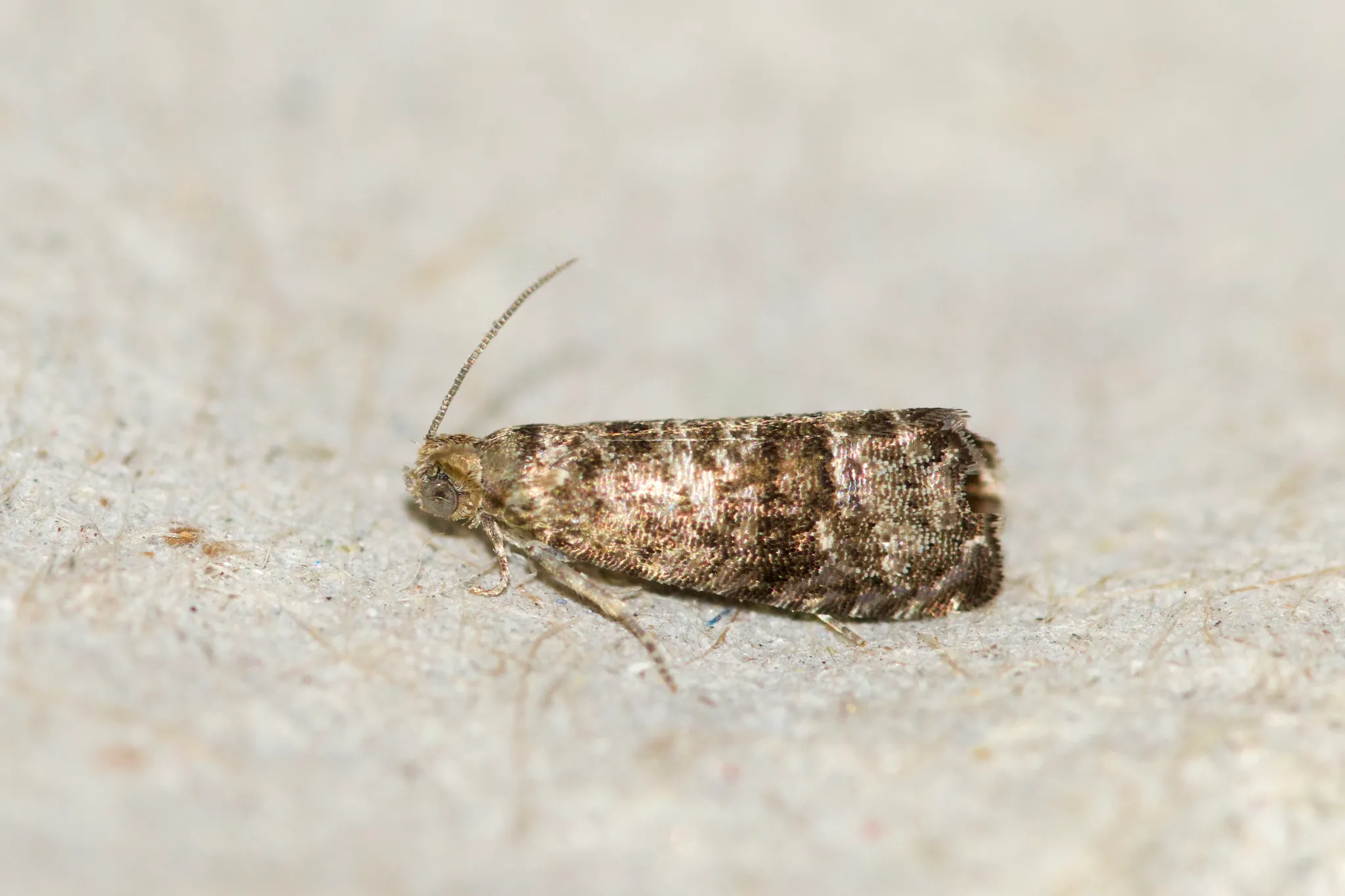
Cherry fruit moth (Aspila packardi)
The image clearly shows the mottled, mosaic brownish-gray wings with transverse streaks characteristic of the species, which in the folded state give the moth an elongated shape. This is a dangerous pest of fruit crops. Larvae of the cherry fruit moth develop inside the fruits of sour cherry, sweet cherry, as well as apples and blueberries, eating the flesh and causing premature fruit drop.
Description and damage. Distributed in North America. Caterpillars overwinter in cocoons in bark cracks; in spring they pupate, and moths lay eggs on leaves and fruits. Caterpillars bore into fruits, often near the stem, and feed on the flesh. Damaged fruits fall or rot (Rieger, 2006).
Control measures. Monitoring with pheromone traps. Insecticide treatments during caterpillar emergence. Collection and destruction of fallen fruit.
Oriental Fruit Moth (Grapholita molesta)


Oriental fruit moth (Aspila molesta, synonym Grapholita molesta) — a dangerous quarantine pest of fruit crops
The moth has a uniform grayish-brown coloration of the forewings with a fringe along the edges and a characteristic 'blunt' shape of the folded wings. Unlike the cherry fruit moth, larvae of the Oriental fruit moth damage not only fruits (peaches, plums, apricots, apples), but also young shoots, causing their wilting and drying (so-called 'tip wilting').
Description and damage. A cosmopolitan pest damaging many fruit crops, including sweet cherry. Caterpillars feed on shoots, causing wilting, and also on fruits. In fruits they make tunnels, often near the stem, leading to rotting (Quero-García et al., 2017).
Control measures. Pheromone traps for monitoring. Insecticides against young caterpillars. Pruning and removal of damaged shoots.
Plum Curculio (Conotrachelus nenuphar)
Description and damage. Distributed in North America east of the Rocky Mountains. Adult beetles (gray-brown, 4–6 mm) feed on buds, flowers, and young fruits, causing deformation ("cat-facing"). Larvae develop inside fruits, which drop prematurely (Rieger, 2006).

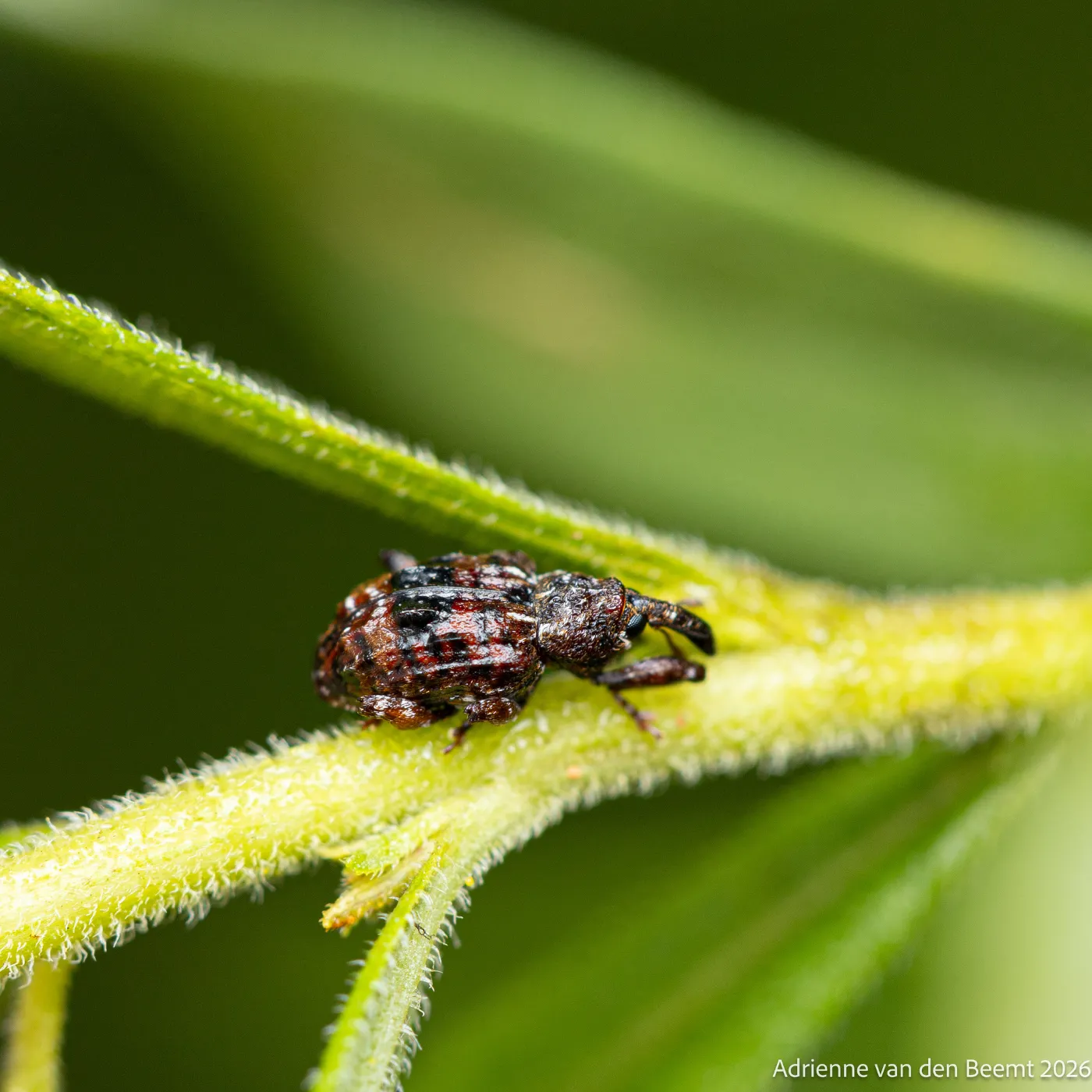
Imago of the plum curculio (Conotrachelus nenuphar)
The insect has an elongated curved snout (rostrum) characteristic of weevils and bumpy elytra with a mottled pattern of dark brown, black and reddish scales. This beetle is a serious pest of stone and pome fruit crops in North America.


Macro photograph of plum damage by the plum curculio (Conotrachelus nenuphar)
The characteristic crescent-shaped scar left by the pest during egg-laying or feeding is shown in detail. Around and from the damage, thick, sticky, amber-yellow gum (gummosis) is actively exuded, which is a protective reaction of the plant, but also serves as a diagnostic sign of the pest's presence.
Control measures. Shaking beetles onto sheets early in the morning (at temperatures below 10 °C they are sluggish). Insecticide treatments during mass flight. Collection and destruction of fallen fruit.
Cherry Slug Sawfly (Caliroa cerasi)


Larva of the Cherry Slug Sawfly (Caliroa cerasi) Feeding on Hawthorn
The larva has a characteristic shiny, slimy dark olive or black coloration that makes it look like a miniature slug. Its body is club-shaped, with a greatly enlarged front part and a narrowed rear end; the length of a mature larva is about 10–11 mm. The photograph clearly shows the characteristic damage caused by this pest: the larva scrapes off the epidermis and flesh from the upper side of the leaf, leaving the veins and lower skin intact, resulting in "skeletonized" areas that eventually dry out and acquire a brown tint. The cherry slug sawfly is a polyphagous pest damaging pear, cherry, plum, quince, hawthorn, and other Rosaceae crops. With severe infestation, trees lose a significant part of their leaf surface, which reduces their photosynthetic capacity and negatively affects yield and winter hardiness.
Description and damage. A cosmopolitan pest. Larvae (sluggish, greenish-black, resembling slugs) feed on the upper side of leaves, leaving veins untouched. Leaves dry out and fall, weakening the tree and reducing yield (Quero-García et al., 2017).
Control measures. Spraying insecticides (e.g., based on fenitrothion) when larvae appear. In small gardens, larvae can be collected by hand.
Winter Moth (Operophtera brumata)
Description and damage. Distributed in Europe, introduced to North America. Moths fly in late autumn; females are wingless. Caterpillars (green, with a dark stripe) feed on buds, flowers, and leaves, as well as young fruits, gnawing holes in them (Quero-García et al., 2017).


Winter Moth (Operophtera brumata) — Male
The male has well-developed wings with a wingspan of 20–25 mm; the wing color is light grayish-brown with dark wavy transverse lines. As with many geometer moths, this species exhibits strong sexual dimorphism: females are wingless and incapable of flight. Moth flight occurs in late autumn and early winter, often at temperatures close to zero. In this case, the male was recorded on January 1, which is a rather late flight date; however, in mild winters, moths can be found in January as well. The species is a dangerous pest of fruit and forest crops, as well as an invasive species in North America.


Caterpillar of the Winter Moth (Operophtera brumata) on a Rose Leaf
The caterpillar has the characteristic light green coloration of the species with a dark stripe along the back and three light lines on the sides. As in all members of the geometer moth family, it has only one pair of abdominal and anal prolegs, so it moves by characteristically "folding" and arching its body. The length of a mature caterpillar can reach 30 mm. The winter moth is an extremely polyphagous pest. The caterpillars feed on buds, flowers, and leaves of apple, pear, cherry, plum, as well as many forest species (oak, maple, birch, etc.). During mass reproduction, they can completely defoliate trees, causing serious damage to gardens and forest plantations.
Control measures. Sticky trapping belts on trunks, preventing females from climbing. Insecticide treatments during caterpillar emergence (before flowering).
Spongy Moth (Lymantria dispar)
Description and damage. Widely distributed in Europe, Asia, and North America. Caterpillars are very voracious and completely defoliate leaves, which can lead to total defoliation of the tree. Damaged trees weaken, yield and winter hardiness decrease (Mandal et al., 2021).


Male spongy moth (Lymantria dispar) — adult
It is easily recognized by the characteristic feathery (comb-like) antennae, which serve to detect female pheromones, and brownish wings with dark wavy bands. Unlike the larger and less mobile females, males actively fly in search of a mate. This species is a serious quarantine pest of forestry and agriculture.


Pupa of spongy moth (Lymantria dispar) on wood
The image captures the pupal stage of the spongy moth. The pupa is dark brown, with a segmented body and tapers toward the posterior end. Pupation usually occurs in sheltered places: in bark crevices, on stumps, under loose bark or in the forest litter. Around the pupa, remnants of silky threads and caterpillar hairs are visible. The pupal stage lasts about 10–15 days, after which the moth emerges.


Caterpillar of spongy moth (Lymantria dispar)
This is the most voracious and dangerous developmental stage of the pest. Its main identification feature is five pairs of blue warts on the anterior part of the back and six pairs of red warts on the posterior part, as well as dense hairs. Caterpillars are capable of completely defoliating more than 300 species of trees and shrubs, leading to large-scale forest defoliation and crop loss in orchards.
Control measures. Collection and destruction of egg masses (fuzzy clumps on bark). Use of biological preparations (Bacillus thuringiensis) against young caterpillars. Outbreaks are regulated by natural enemies.
Lackey Moth (Malacosoma neustria)
Description and damage. Distributed in Europe and Asia. Caterpillars live in colonies in silken nests and feed on leaves. Young caterpillars gnaw buds and flowers; older ones eat leaves (Potapov et al., 2000).


Adult lackey moth (Malacosoma neustria) — male
The species is easily recognizable by its yellowish-brown wings with two dark transverse bands and dense hair covering of the body. The feathery (comb-like) antennae visible in the photo indicate that the specimen is male and serve to locate females by pheromones. The lackey moth is a dangerous pest of orchards (especially apple and plum) and deciduous forests.


Pupae of lackey moth (Malacosoma neustria) on a leaf
The photograph shows two pupae of the lackey moth. They have a characteristic oval, slightly elongated shape and dark brown color with a bluish bloom. Pupation usually occurs in rolled leaves (as in the photo) or in bark crevices. The pupal stage is an important stage of metamorphosis, during which a complete reorganization of the organism occurs before adult emergence.


Caterpillar of lackey moth (Malacosoma neustria) on a blackberry leaf
This is the most voracious stage of the pest. The caterpillar has a bright and memorable coloration: longitudinal stripes of white, orange, and black along the back and broad blue stripes along the sides, as well as dense hairs. Caterpillars live in colonies in silken nests and are capable of completely defoliating fruit trees and shrubs, causing serious damage to agriculture.
Control measures. Cutting and burning silken nests together with caterpillars. Insecticide treatments at high numbers.
May Beetles (Melolontha spp.)


Adult cockchafer (Melolontha melolontha) on a leaf
It is easily recognized by its red-brown elytra with longitudinal ridges, dense hair covering of the pronotum, white triangular spots along the sides of the abdomen and characteristic lamellate (fan-shaped) antennae. Adults live openly and feed on leaves of trees and shrubs. However, the greatest damage to agriculture is caused by their larvae (thick white grubs), which develop in the soil for several years and gnaw the roots of cultivated plants, young saplings and lawn grasses. This species is a serious pest.
Description and damage. Distributed in Europe and Asia. Adult beetles (5–20 mm) feed on leaves, while larvae (chafer grubs) live in the soil and gnaw roots, especially of young trees. Damage from larvae can be significant in nurseries and young orchards (Potapov et al., 2000).
Control measures. Digging the soil to destroy larvae. Application of soil insecticides at high numbers. Collection of adult beetles by hand (shaking onto sheets early in the morning).
Japanese Beetle (Popillia japonica)


Adult Japanese beetle (Popillia japonica) on a clover flower
The species is easily identified by the characteristic metallic green coloration of the head and pronotum, coppery-brown elytra and conspicuous white tufts of hairs along the sides and at the end of the abdomen. The beetle is feeding on a clover inflorescence. This is an extremely dangerous invasive pest introduced to North America. Adults actively feed on leaves, flowers and fruits of more than 300 plant species (including fruit trees and shrubs), while larvae (white grubs) gnaw the roots of lawn grasses, causing serious damage to agriculture and landscaping.
Description and damage. An invasive species in North America, native to Japan. Adult beetles (green with a coppery sheen, 8–11 mm) feed on leaves, skeletonizing them. Larvae live in the soil and feed on grass roots (Quero-García et al., 2017).
Control measures. Pheromone traps (with caution so as not to attract beetles to the plot). Insecticide treatments during the flight period. Biological preparation based on Paenibacillus popilliae against larvae.
Hairy Beetle (Epicometis hirta)


Adult hairy rose beetle (Oxythyrea funesta)
The species is easily recognizable by its black body with characteristic white spots on the elytra and dense hairy pubescence. The beetle is sitting on a daisy inflorescence. Adults feed on pollen, nectar and often eat flower petals (especially Rosaceae). In horticulture and agriculture, the hairy rose beetle can be considered a secondary pest damaging flowers of fruit crops, but at the same time it plays an important role in plant pollination. Larvae develop in the soil and feed on decaying plant remains without damaging roots. Location: Ishim, Tyumen Oblast, Russia.
Description and damage. Distributed in Europe and Asia. Beetles (8–12 mm) are black with white spots, covered with hairs. They feed on buds, flowers, and ovaries, eating them completely. They are especially dangerous during flowering and can destroy a significant part of the crop (Mikheev, 2004).
Control measures. Shaking beetles onto sheets early in the morning (at low temperatures they are sluggish). Insecticide treatments during flowering (with caution so as not to kill bees). In small gardens, hand collection is effective.
All the listed pests require an integrated approach: a combination of agronomic methods (pruning, removal of plant debris, digging the soil), biological control (preserving natural enemies, using biopreparations), and, when necessary, chemical treatments. Regular monitoring and timely action will help preserve the harvest and tree health.
4. Stem-Boring Pests
Stem-boring pests are a hidden threat to sweet cherry. Their larvae develop inside shoots, branches, and trunks, feeding on wood and disrupting the vascular system. Damaged trees lag in growth, branches dry out, and with severe infestation the entire plant may die. Weakened trees and young plantings are especially vulnerable. Let us consider the main representatives of this group.
Peachtree Borer (Synanthedon exitiosa)


Peachtree borer (Synanthedon exitiosa)
The photograph clearly shows characteristic features: dark, almost black wings with a glassy sheen (for which the family is called clearwing moths) and a bright orange band on the abdomen. This is a dangerous pest of stone fruit crops (peach, cherry, plum, apricot). The caterpillars of this moth gnaw tunnels in the bark and wood at the base of the trunk, which leads to weakening and death of the trees.
Description and damage. Distributed in North America; damages stone fruit crops, including sweet cherry. Moths resemble wasps: body dark blue, with orange bands on the abdomen, wings transparent. Caterpillars (up to 25 mm) are white with a brown head and overwinter in cocoons in the soil at the base of the trunk. In spring they bore under the bark in the lower part of the trunk, gnawing tunnels. Damaged trees exude gum, bark peels away, growth slows, and with severe infestation the plant dies (Quero-García et al., 2017).
Life cycle. One generation per year. Moth flight is from June to September. Females lay eggs on the bark at the base of the trunk. Hatched caterpillars bore into the bark and feed on tissues. They overwinter in cocoons in the soil or under bark.
Control measures. Prevention: maintaining tree health, avoiding mechanical damage to bark. When tunnels and gum are detected—cleaning damaged areas and treating with insecticides. Pheromone traps for capturing males and external trunk treatments with insecticides during the flight period are effective (Papadopoulos et al., 2017).
Lesser Peachtree Borer (Synanthedon pictipes)


Adult lesser peachtree borer (Synanthedon pictipes)
This is a typical representative of the clearwing moth family, which outwardly mimics wasps due to transparent wings with a dark border and a dark body with yellowish/white transverse stripes. This species is a dangerous pest of fruit crops (especially peach, sour cherry, plum and sweet cherry). The damage is caused not by adults (they feed on nectar), but by their larvae, which bore into the bark and wood of branches, causing them to dry out and the tree to die.
Description and damage. Distributed in North America. Externally similar to the peachtree borer but smaller. Caterpillars damage branches and the upper part of the trunk, causing them to dry out. Unlike the peachtree borer, it more often attacks scaffold branches rather than the base of the trunk (Quero-García et al., 2017).
Life cycle. One generation per year. Moth flight is from May to July. Females lay eggs on the bark of branches. Caterpillars bore under the bark and feed on the cambium. They overwinter in tunnels.
Control measures. The same as for the peachtree borer: pruning and removal of damaged branches, insecticide treatment during the flight period, use of pheromone traps.
Goat Moth (Cossus cossus)


Goat moth caterpillar (Cossus cossus)
The caterpillar is easily recognizable by its large size, fleshy wine-red or pinkish-brown body with dark burgundy (almost black) dorsal plates and a dark brown head. It is a dangerous trunk pest of deciduous trees (willow, poplar, oak, ash, fruit crops). The caterpillars develop in wood for 3–4 years, boring long galleries and causing weakening and death of trees. This species is called "goat moth" because of the characteristic sharp, unpleasant odor emitted by the caterpillar (especially when disturbed).
Description and damage. Distributed in Europe, Asia, and North Africa. A large moth (wingspan up to 80 mm), gray-brown with a marbled pattern. Caterpillars (up to 100 mm) are pinkish-flesh colored, with a dark head and an unpleasant odor. They live in wood for 2–3 years, making wide tunnels. Damaged trees dry out, branches break, and the trunk becomes rotten (Potapov et al., 2000).
Life cycle. Two-year generation. Moth flight is from June to August. Females lay eggs in bark cracks. Caterpillars bore into wood, overwinter in tunnels, and pupate in the soil or under bark.
Control measures. Cleaning tunnels and introducing insecticides into the holes. Cutting out and burning heavily damaged branches. Whitewashing trunks to prevent oviposition. In small gardens, caterpillars can be removed from tunnels with wire (Mikheev, 2004).
Leopard Moth (Zeuzera pyrina)
Description and damage. Distributed in Europe, Asia, and North America. The moth is white with black dots, wingspan up to 70 mm. Caterpillars (up to 60 mm) are yellowish-white with a black head and live inside shoots and branches, making tunnels. Damaged shoots dry out and break easily. Young trees may die (Quero-García et al., 2017).


Adult leopard moth (Zeuzera pyrina)
It is easily recognized by its white wings with numerous dark blue or black spots resembling a leopard pattern, and its thick hairy body. The moth is sitting on tree bark. Adults do not feed and live only a few days. The damage is caused by their caterpillars, which bore into branches and trunks of trees, gnawing galleries and causing shoot dieback and tree death. This is a serious pest of orchards and forests.


Pupa of the leopard moth (Zeuzera pyrina)
The pupa has an elongated, segmented shape and a yellowish-brown color. The rudiments of future wings and limbs are visible on it. Pupation occurs in the galleries that the caterpillar has gnawed in the wood, or near the exit from the trunk. The pupal stage is an important stage of metamorphosis, during which a complete reorganization of the organism occurs before transformation into an adult moth.


Caterpillar of the leopard moth (Zeuzera pyrina)
This is the most voracious and dangerous stage of the pest. The caterpillar has a characteristic bright coloration: a yellowish-orange body with black dots (warts) on each segment and a dark brown head. The caterpillars develop in wood for 2–3 years, feeding on tissues of trunks and branches of more than 70 tree species (especially apple, pear, plum, ash and poplar). They gnaw long galleries, which leads to weakening, drying and death of the plant.
Life cycle. Two-year generation. Moth flight is from June to August. Females lay eggs singly on bark, leaves, and shoots. Caterpillars bore into shoots, overwinter in tunnels, and pupate there.
Control measures. Pruning and burning damaged shoots. Introducing insecticides into tunnels. Use of pheromone traps for capturing males. Whitewashing trunks and scaffold branches.
Bark Beetles (Scolytus spp.)
Description and damage. Small beetles (2–5 mm) dark brown. Adults and larvae feed on tissues under the bark, making characteristic tunnels. Damaged trees weaken, bark peels away, branches dry out. Bark beetles often attack weakened and diseased trees, accelerating their death (Quero-García et al., 2017).

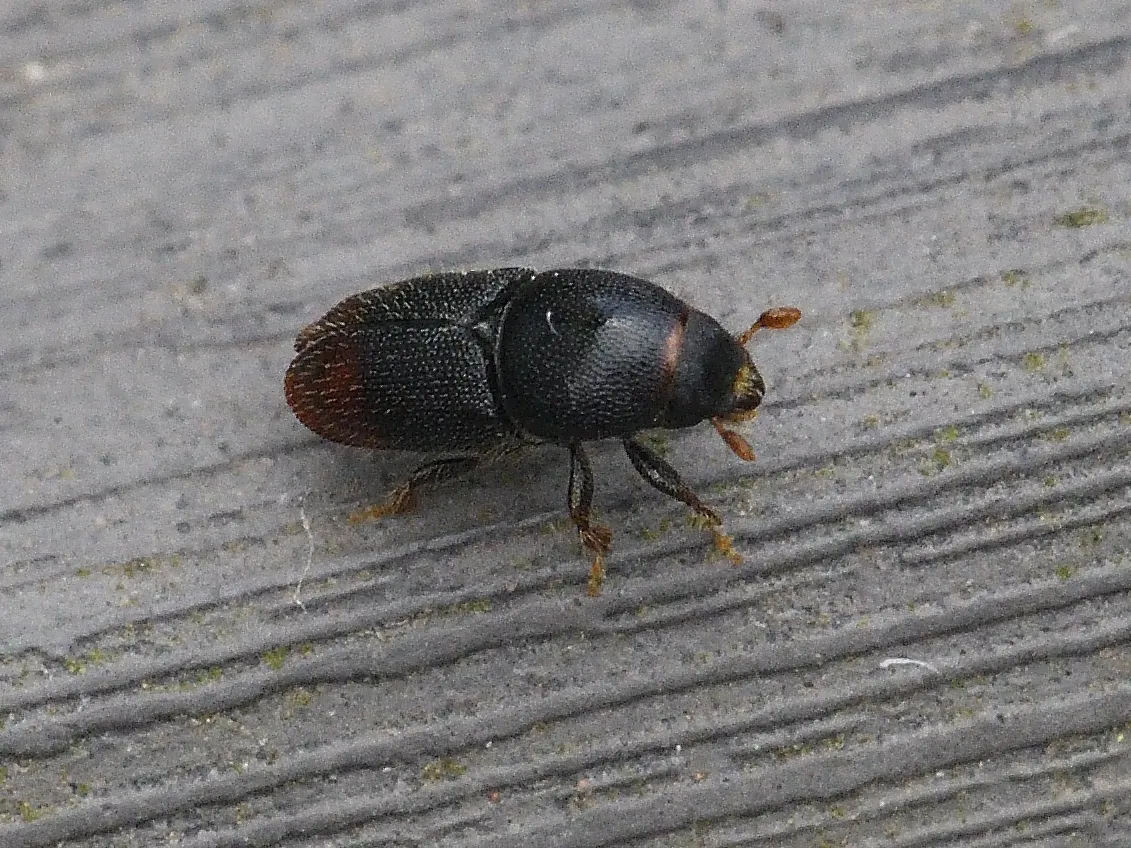
Imago of the shothole borer (Scolytus rugulosus)
The insect has a compact, cylindrical body of dark brown, almost black color. This is a dangerous pest of the bark of fruit trees (apple, plum, cherry, etc.), whose larvae tunnel under the bark, which leads to the dying off of affected branches.


Fossil bark of Lepidodendron
The surface clearly shows a characteristic diamond-shaped (scaly) pattern of leaf scars left after leaves fell off. Exhibit of the State Museum of Pennsylvania. Location: State Museum of Pennsylvania, Harrisburg, Pennsylvania, USA.
Life cycle. One–two generations per year. Larvae or adult beetles overwinter under bark. In spring beetles emerge, females lay eggs in tunnels under bark. Larvae feed, making tunnels, and pupate there.
Control measures. Maintaining tree health is the main prevention. Removal and burning of infested branches and trees. Application of insecticides against emerged beetles. Use of trap trees.
Longhorn Beetles (Cerambycidae)
Description and damage. A family of beetles with long antennae. On sweet cherry, species of the genera Cerambyx, Saperda, and others are more common. Larvae (up to 50 mm) are white, fleshy, with a brown head, live in wood for 2–3 years, making wide tunnels. Damaged trunks and branches become brittle, dry out, and trees die (Potapov et al., 2000).


Male great capricorn beetle (Cerambyx cerdo) on a leaf
Its main distinguishing feature is its extremely long antennae, which significantly exceed the body length (in females they are shorter). The beetle's body is black, glossy, with a characteristic red-brown tint at the tips of the elytra. This species is a dangerous trunk pest: its large larvae develop in the wood of old oaks for several years, gnawing wide galleries and destroying wood. At the same time, in many regions this species is rare and protected (listed in Red Data Books), which makes it an important object for study in the context of biodiversity conservation.


Adult linden borer (Saperda vestita) on a leaf
The photograph shows an adult linden borer beetle. It has an elongated, cylindrical body of grayish-brown or olive-brown color. Small dark dots scattered over the entire surface are clearly visible on the elytra. This species is a serious pest of deciduous plantings (primarily linden, less often elm and oak). The damage is caused by larvae that feed on cambium and wood, causing premature drying of branches and tree trunks. In cities and parks, this pest can cause significant damage to ornamental plantings.
Life cycle. Two–three-year generation. Beetle flight is from May to August. Females lay eggs in bark cracks. Larvae bore into wood, overwinter in tunnels, and pupate at the end of the tunnel.
Control measures. Cleaning tunnels and introducing insecticides. Cutting out and burning heavily damaged branches and trees. Whitewashing trunks to prevent oviposition. In small gardens, manual collection of beetles is possible.
Stem-boring pests require special attention, as their presence is often detected too late. Regular inspection of trees, timely pruning and removal of damaged parts, and maintaining the overall health of the planting are key preventive measures. When signs of infestation are detected, it is necessary to act quickly, combining mechanical and chemical control methods.

Solar Automatic Drip Irrigation Kit for Gardens
Automate watering for pots, gardens and small greenhouses. This solar-powered system features a timer to help schedule water delivery to your plants.
- Solar-powered
- 15 m irrigation hose
- Programmable watering
Affiliate link · Check included accessories.
5. Soil Pests
Soil pests damage the root system of sweet cherry, leading to growth suppression, reduced yield, and often death of young trees. Their presence often goes unnoticed until obvious symptoms appear—suppression, chlorosis, drying. They are especially dangerous for nurseries and young orchards. Let us consider the main representatives.
Chafer Grubs (Melolontha, Phyllophaga)
Adult cockchafer (Melolontha melolontha) on a leaf
It is easily recognized by its red-brown elytra with longitudinal ridges, dense hair covering of the pronotum, white triangular spots along the sides of the abdomen and characteristic lamellate (fan-shaped) antennae. Adults live openly and feed on leaves of trees and shrubs. However, the greatest damage to agriculture is caused by their larvae (thick white grubs), which develop in the soil for several years and gnaw the roots of cultivated plants, young saplings and lawn grasses. This species is a serious pest.
Description and damage. Chafers are May beetles (in Europe and Asia—Melolontha spp., in North America—Phyllophaga spp.). Adult beetles feed on leaves, but the main damage is caused by their larvae—thick, white, C-shaped, up to 5 cm long. They live in the soil for 2–4 years and feed on plant roots. Larvae gnaw the roots of sweet cherry, especially young trees, causing suppression, yellowing of leaves, drying, and death. On light sandy and sandy loam soils, damage is most noticeable (Potapov et al., 2000).
Control measures. Deep autumn digging of soil in tree trunk circles helps destroy larvae and pupae. Manual collection of larvae during digging. Application of soil insecticides (e.g., based on imidacloprid) when planting young trees. Biological method—use of entomopathogenic nematodes (Heterorhabditis spp.) and fungi (Beauveria bassiana). Maintaining clean fallow in inter-rows reduces the attractiveness of the plot for oviposition (Quero-García et al., 2017).
Wireworms (Agriotes spp.)


Larva of the lined click beetle (Agriotes lineatus) — wireworm
The larva has a characteristic cylindrical, segmented body with a hard, shiny chitinous covering of yellowish-brown or orange color. It moves over green moss. Wireworms live in the soil and are serious pests damaging the roots, tubers and seeds of many agricultural crops.
Description and damage. Wireworms are larvae of click beetles. They are yellow-brown, hard, cylindrical, 1–3 cm long. They live in the soil for 2–5 years. They feed on roots, seeds, and underground plant parts. Damaged sweet cherry roots become vulnerable to pathogens, the tree lags in growth, and yield decreases. Wireworms are especially dangerous in areas previously occupied by perennial grasses or fallow land (Rieger, 2006).
Control measures. Deep autumn digging and liming of soil (wireworms prefer acidic soils). Baits: buried pieces of potato, carrot, or beet, which are periodically checked and larvae destroyed. Crop rotation with legumes and cereals. At high numbers—application of soil insecticides (Potapov et al., 2000).
Mole Cricket (Gryllotalpa gryllotalpa)


Adult European mole cricket (Gryllotalpa gryllotalpa) on soil
This large insect is easily recognizable by its velvety brownish-brown body and powerful, modified forelimbs (claws), which serve as an excellent tool for digging soil. The mole cricket leads a predominantly underground lifestyle. This species is a dangerous polyphagous pest: it gnaws roots, damages tubers, root crops and young plant seedlings (like the small sprout visible on the left in the photo), causing serious damage to vegetable gardens, greenhouses and agricultural fields.
Description and damage. A large insect (3–5 cm) brown in color with burrowing front legs. It lives in the soil, making numerous tunnels. It feeds on roots, earthworms, and other insects. It damages the root system of young sweet cherries, causing suppression and death. Mole cricket tunnels disrupt soil structure and can mechanically damage roots (Mikheev, 2004).
Control measures. Autumn trapping pits: dig pits 50×50 cm, fill with manure; mole crickets climb there for wintering, and in spring the contents are destroyed. Flooding tunnels with water with added soap or kerosene. Application of soil insecticides. Biological method—entomopathogenic nematodes. Deep digging of soil in spring and autumn destroys nests and tunnels (Potapov et al., 2000).
Nematodes (Root-Knot—Meloidogyne, Lesion—Pratylenchus, Dagger—Xiphinema)
Description and damage. Nematodes are microscopic roundworms living in the soil and feeding on roots.
- Root-knot nematodes (Meloidogyne spp.) cause galls (swellings) on roots. Damaged roots cannot normally absorb water and nutrients; trees are suppressed, leaves turn yellow, and yield falls.
- Lesion nematodes (Pratylenchus spp.) penetrate roots and destroy tissues, causing necrosis. This leads to weakening of trees and increased susceptibility to other diseases.
- Dagger nematodes (Xiphinema spp.) are large nematodes feeding on roots. They are dangerous not only by direct damage but also because they transmit viruses, such as Cherry leaf roll virus.
Nematodes are especially harmful on light sandy soils and when sweet cherry is replanted in an old location (Quero-García et al., 2017; Mandal et al., 2021).
Control measures. Use of resistant rootstocks (e.g., Mazzard and Mahaleb have some resistance to nematodes). Pre-planting soil fumigation (e.g., with metam sodium or dazomet) is effective but requires caution and compliance with safety standards. Crop rotation with non-hosts (cereals, legumes, maize). Application of organic fertilizers and green manures (marigolds, ryegrass) reduces nematode numbers. Biological control with the fungus Paecilomyces lilacinus. Avoid replanting stone fruits on plots where sweet cherry, sour cherry, peach, or plum previously grew (Rieger, 2006; Potapov et al., 2000).
Soil pests require an integrated approach. Prevention includes proper site selection, deep soil cultivation, crop rotation, and use of healthy planting material. When pests are detected, mechanical, biological, and chemical methods are used. Healthy, well-growing trees are less susceptible to damage, so the most important measure is maintaining the overall health of the orchard.
6. Birds and Mammals
Birds and mammals are one of the most serious threats to the sweet cherry crop. Unlike insects, they act quickly and can destroy a significant part of the fruit in just a few days. In small gardens, where the use of chemicals is limited, vertebrates often become the gardener's main headache (Hill, 2011). Let us consider the main representatives and methods of protection.
Birds
Which species cause damage. The greatest damage to sweet cherry is caused by thrushes, starlings, sparrows, waxwings, bullfinches, jays, and crows (Quero-García et al., 2017; Hessayon, 1993). In Europe and Asia, bullfinches and sparrows are especially troublesome; in winter and early spring they peck out flower and growth buds, and in summer they switch to fruits (Hessayon, 1993). In North America, thrushes, starlings, and cedar waxwings cause serious damage (Rieger, 2006).
Nature of damage. Birds eat ripe fruits, peck buds and flowers, and also damage young shoots. Early and mid-season sweet cherry cultivars suffer especially, as they ripen during a period when other food is still scarce. Birds quickly get used to static scarecrows and can completely destroy the crop on small trees (Buckingham, 2010).


Tree sparrow (Passer montanus) feeding on sweet cherry fruits
The tree sparrow is easily distinguished from the house sparrow by the brown "cap" on its head and the black spot on its cheek. In agroecosystems, these birds play a dual role: in spring and summer they actively destroy insect pests, feeding them to their chicks, but during crop ripening they can cause noticeable damage to orchards by damaging berries and fruits. This image clearly demonstrates the feeding behavior of birds in a fruit orchard.


Fieldfare (Turdus pilaris) on a sweet cherry branch in a fruit orchard
It is easily recognized by its gray head and rump, chestnut back and mottled, speckled breast. Like all thrushes, fieldfares are fruit-eating birds (frugivores). In summer and autumn, flocks of these birds can raid orchards and berry plantations, causing significant damage to the harvest of sweet cherry, sour cherry and other crops. Therefore, for farmers and gardeners, this species is of interest as a potential crop pest requiring protective measures (for example, using nets or scarers).
Protection methods.
- Nets. The most effective and reliable method is covering trees with fine-mesh netting (mesh no larger than 20 mm). For small trees and bush forms, this is the optimal solution (Buckingham, 2010; Hill, 2011). The net is stretched over a frame or directly over the crown immediately after flowering and removed after harvest.
- Scarers. Shiny ribbons, balls with images of predatory bird eyes, and noise devices (firecrackers, rattles) give a temporary effect. Birds quickly adapt, so it is important to change their location and combine different methods (Mikheev, 2004).
- Repellents. Spraying fruits and leaves with substances based on methyl anthranilate or other repellent formulations can reduce damage, but requires repeated treatments after rain and is not always effective (Quero-García et al., 2017).
- Cultivar characteristics. Some gardeners try to trick birds by planting yellow or light-colored cultivars, assuming that birds wait for fruits to redden. However, experience shows that birds quickly recognize edible fruits regardless of color (Hill, 2011). It is more reliable to choose late-ripening cultivars, when natural food is more abundant in nature.
- Biological methods. Attracting birds of prey (kestrels, owls) with artificial nest boxes can reduce the number of passerines, but requires an integrated approach and is not always applicable in small gardens.
Mammals
Rodents (mice, voles, rats). In winter and early spring, rodents under the snow gnaw bark and roots of young trees, which often leads to death of seedlings. Sweet cherries on dwarf rootstocks with a shallow root system suffer especially (Potapov et al., 2000). Protection measures: keeping tree trunk circles clean (without weeds and mulch, where rodents make burrows), tying trunks with spruce branches, roofing felt, or special plastic spirals, laying out poisoned baits (with caution so as not to harm domestic animals and birds), and using ultrasonic repellents (Mikheev, 2004).
Hares and rabbits. They gnaw bark and shoots, especially in winter. Young trees can be completely destroyed. Protection: fencing the garden with netting at least 1.2 m high, tying trunks, repellents (Quero-García et al., 2017).


Trunk of a Yoshino cherry sapling after deer damage to the bark
Photograph of the trunk of a young Yoshino cherry sapling 2 years after the bark was almost completely eaten by deer. Deep healing wounds exposing the wood are visible on the trunk. In the background, a mesh fence and green lawn are visible. Location: Aquetong Lane, Mountainview area, Ewing Township, Mercer County, New Jersey, USA.
Deer. In regions with high deer numbers, they browse leaves, young shoots, and damage trunks, leading to suppression of trees and reduced yield (Hill, 2011). High fences (at least 2 m), repellents, and deterrence with dogs or special devices are effective.
Squirrels. They eat fruits, damage shoots and bark. In small gardens, installing feeders away from trees to distract squirrels, or using nets, can help (Mandal et al., 2021).
Wild boars, badgers, hedgehogs. In some regions they can cause damage by digging the soil and eating fallen fruit. Measures: fencing the plot, repellents.
Protection from birds and mammals requires an integrated approach. Physical barriers (nets, fences) are the most reliable, but they must be combined with repellents and proper garden care. Regular monitoring and timely action will help preserve the harvest and tree health.

7-in-1 Wi-Fi Weather Station
Monitor local weather conditions with a wireless outdoor sensor. Track temperature, humidity, rainfall, wind speed and direction, and atmospheric pressure. Ideal for gardens, farms and greenhouses.
- Wireless outdoor sensor
- Solar-powered
- Wi-Fi connectivity
Affiliate link · Check regional compatibility.
7. Pest Prevention System
Prevention is the foundation of protecting sweet cherry from pests. It is cheaper, more environmentally friendly, and more effective than combating insects that have already appeared. An integrated approach, including proper site selection, agronomic practices, and monitoring, can significantly reduce pest numbers and avoid crop losses. It is based on the concept of integrated pest management (IPM), which combines biological, agronomic, and, when necessary, chemical methods (Quero-García et al., 2017).
Site Selection and Soil Preparation
Sweet cherry requires well-drained, fertile soils with pH 6.0–7.0. Waterlogging promotes root rots and creates favorable conditions for soil pests (Potapov et al., 2000). The site should be protected from prevailing winds but at the same time well ventilated—this reduces the risk of fungal diseases and aphid reproduction. Before planting, deep plowing or digging is carried out, perennial weeds are removed, and organic fertilizers are applied. If stone fruit crops previously grew on the site, fumigation or a long crop rotation is necessary to reduce nematode and soil pathogen numbers (Rieger, 2006).
Choice of Cultivars and Rootstocks
Sweet cherry cultivars differ in resistance to pests and diseases. Although there are no absolutely immune cultivars, some show tolerance to cherry leaf spot, brown rot, and cherry fruit fly. For example, cultivars with dense fruit skin are less damaged by cherry fruit fly and Drosophila (Mandal et al., 2021). When choosing a rootstock, preference is given to those that provide good anchorage and resistance to nematodes (e.g., Mazzard, Mahaleb). Dwarf rootstocks require more careful irrigation and protection from soil pests (Quero-García et al., 2017).
Agronomic Practices
Regular pruning is a key element of prevention. It improves crown ventilation, reduces humidity, and creates unfavorable conditions for the development of aphids, mites, and fungal diseases. Removal of diseased, damaged, and thickening branches prevents accumulation of pests and pathogens. Timely cleaning of fallen leaves and fruit deprives many insects (cherry fruit fly, fruit moths, curculios) of wintering sites. Digging tree trunk circles in late autumn destroys pupae and larvae overwintering in the soil (Mikheev, 2004). Maintaining optimal water regime and balanced nutrition increase tree resistance to pests. Excess nitrogen causes vigorous shoot growth and attracts aphids, so nitrogen fertilizers are applied moderately (Potapov et al., 2000).
Monitoring
Regular inspection of trees allows pests to be detected at early stages, when control is most effective. Pheromone and colored sticky traps are used to track the flight of cherry fruit fly, fruit moths, and clearwing moths. Visual inspection of leaves, shoots, bark, and fruits helps identify aphids, mites, scales, and caterpillars. It is important to keep records of pest appearance in order to predict their development in subsequent seasons (Papadopoulos et al., 2017).
Conserving Beneficial Fauna
Natural enemies of pests—ladybirds, lacewings, hoverflies, predatory mites, parasitic wasps, and ichneumonids—play a huge role in limiting pest numbers. To attract them, nectar-bearing plants are sown in inter-rows (phacelia, dill, clover), wide use of broad-spectrum insecticides is avoided, and shelters are created (flowering shrubs, mulch). In organic gardens, biological control is often sufficient to maintain balance (Quero-García et al., 2017).
Sanitary Measures
Removal and burning of plant debris, diseased fruits, and cut branches is a mandatory procedure. This prevents the spread of disease pathogens and deprives pests of overwintering shelters. Whitewashing trunks and scaffold branches protects against sunburn, frost cracks, and some pests (clearwing moths, bark beetles). Installing trapping belts on trunks in spring and autumn prevents winter moth and other insects from climbing (Hessayon, 1993).
Conclusion
The prevention system must be regular and comprehensive. Only a combination of agronomic practices, monitoring, biological methods, and reasonable use of chemicals allows maintaining orchard health and obtaining stable sweet cherry harvests. Remember: it is better to prevent pests than to deal with their consequences.
8. Control Methods
Pest control on sweet cherry must be integrated: only a combination of different methods gives a sustainable result and avoids insect resistance. In this section, we will consider the main approaches that can be used in a home garden and in small-scale farming.
Agronomic Methods
This is the foundation of prevention and control. Regular pruning improves crown ventilation and reduces humidity, which is unfavorable for aphids, mites, and fungal diseases (Quero-García et al., 2017). Removal of diseased, damaged, and thickening branches prevents pest accumulation. Timely cleaning of fallen leaves and fruit deprives many insects (cherry fruit fly, fruit moths, curculios) of wintering sites. Digging tree trunk circles in late autumn destroys pupae and larvae overwintering in the soil (Mikheev, 2004). Maintaining optimal water regime and balanced nutrition increase tree resistance. Excess nitrogen causes vigorous shoot growth and attracts aphids, so nitrogen fertilizers are applied moderately (Potapov et al., 2000).
Mechanical Methods
Manual collection and destruction of pests is effective in small plots. Shaking beetles (curculios, hairy beetles, May beetles) onto sheets early in the morning, when they are sluggish, allows their numbers to be quickly reduced (Mikheev, 2004). Cutting and burning silken nests of the lackey moth and removing egg masses of the spongy moth are mandatory procedures. Trapping belts on trunks (sticky or made of corrugated paper) prevent winter moth, ants, and other insects from climbing (Hessayon, 1993). To protect against birds, fine-mesh nets (mesh no larger than 20 mm) are used, stretched over the crown immediately after flowering (Buckingham, 2010; Hill, 2011). Fences at least 1.2 m high protect against hares and rabbits.
Biological Methods
Conserving and attracting natural enemies—ladybirds, lacewings, hoverflies, predatory mites, parasitic wasps, and ichneumonids—is the most important element of integrated protection (Quero-García et al., 2017). To attract them, nectar-bearing plants are sown in inter-rows (phacelia, dill, clover), wide use of broad-spectrum insecticides is avoided, and shelters are created. Biopreparations based on Bacillus thuringiensis are effective against young caterpillars (fruit moths, geometrid moths, silk moths). Entomopathogenic nematodes (Heterorhabditis spp.) and fungi (Beauveria bassiana) are used against soil pests (chafer grubs, wireworms, mole crickets). In organic gardens, biological control is often sufficient to maintain balance (Mandal et al., 2021).
Chemical Methods
The use of insecticides and acaricides is justified only when the economic threshold of harmfulness is exceeded, when other methods do not give results. It is important to choose the preparation correctly, observe the dosage and timing of treatment, and take into account the pre-harvest interval. For aphid control, systemic and contact insecticides are used (e.g., based on acetamiprid, thiacloprid); for mites—acaricides (spirodiclofen, clofentezine); for fruit moths and flies—pyrethroids, neonicotinoids, spinosyns (Papadopoulos et al., 2017). Against scales, mineral oils during the dormant period and insecticides against crawlers are effective. To avoid resistance, preparations with different mechanisms of action are alternated. In different countries, pesticide registration differs, so before use it is necessary to familiarize yourself with local approvals (Quero-García et al., 2017). Treatments are carried out in calm weather, early in the morning or in the evening, so as not to harm bees and other pollinators.
Pheromone and Colored Traps


Pheromone trap for monitoring codling moth
The trap is placed on a fruit tree. One can examine the design with a sticky plate and a pheromone dispenser attracting male codling moths.
Pheromone traps are used for monitoring and mass trapping of males of fruit moths, clearwing moths, and bark beetles. This allows precise timing of treatments and reduces pest numbers without chemicals (Papadopoulos et al., 2017). Yellow sticky traps are effective for tracking the flight of cherry fruit fly, aphids, and whiteflies. Traps with attractants (apple cider vinegar, wine) are used against spotted-wing drosophila. It is important to check and replace traps regularly.
Specific Features for Different Pest Groups
- Sucking pests (aphids, mites, scales): emphasis on biological control (predatory mites, parasitic wasps), mineral oils, and, if necessary, insecticides and acaricides.
- Fruit-damaging pests (flies, fruit moths, curculios): flight monitoring, timely treatments, collection of fallen fruit, trapping belts, nets.
- Stem-boring pests (clearwing moths, bark beetles, longhorn beetles): cleaning tunnels, introducing insecticides, cutting out and burning damaged branches, whitewashing trunks.
- Soil pests (chafer grubs, wireworms, mole crickets, nematodes): digging, application of biopreparations, crop rotation, resistant rootstocks, fumigation in case of severe infestation.
- Birds and mammals: nets, fences, scarers, repellents.
Conclusion
Integrated protection of sweet cherry is based on a combination of agronomic practices, biological methods, monitoring, and reasonable use of chemicals. Only an integrated approach allows preserving the harvest, tree health, and the environment. Remember: it is better to prevent pests than to deal with their consequences.

40W Full Spectrum LED Grow Light
Support healthy plant growth with full-spectrum LED lighting. Ideal for seedlings, indoor plants and small growing spaces. A practical solution for indoor gardening and year-round cultivation.
- Full-spectrum LED
- Energy-efficient design
- Indoor plant growing
Affiliate link · Check actual power and light coverage.
9. Main Mistakes and FAQ
Main Mistakes
1. Incorrect pest identification. Gardeners often confuse symptoms of damage by different insects and apply unsuitable preparations. For example, leaf curling can be caused not only by aphids but also by viral diseases or nutrient deficiency. Before treating the garden, it is necessary to accurately determine the cause (Quero-García et al., 2017).
2. Untimely treatment. The effectiveness of many insecticides depends on precise timing. For example, against the cherry fruit fly, spraying must be carried out during the flight period of adults, which is determined using traps. If you are late, the larvae will already be inside the fruits, and treatment will become useless (Papadopoulos et al., 2017).
3. Using the same preparation. Constant use of one active ingredient leads to pest resistance. It is necessary to alternate preparations with different mechanisms of action (Rieger, 2006).
4. Ignoring prevention. Many gardeners begin control only when pests appear, forgetting about cleaning fallen leaves, digging tree trunk circles, and pruning. These measures drastically reduce pest numbers the following year (Potapov et al., 2000).
5. Excessive use of chemicals. Wide use of broad-spectrum insecticides destroys not only pests but also beneficial insects (pollinators, predators), which leads to outbreaks of aphids and mites (Mandal et al., 2021).
6. Failure to observe dosage and pre-harvest intervals. Exceeding the concentration can cause plant burns, and too short a pre-harvest interval can lead to pesticide accumulation in fruits. Always follow the instructions on the package (Quero-García et al., 2017).
7. Lack of monitoring. Without regular inspection of trees and use of traps, it is impossible to notice the beginning of pest flight in time and take measures (Hessayon, 1993).
8. Failure to take regional characteristics into account. The species composition of pests differs by region. For example, the western cherry fruit fly is dangerous in North America, while in Europe it is the cherry fruit fly. Universal recommendations without taking local specifics into account may be ineffective (Papadopoulos et al., 2017).
Frequently Asked Questions
How often should trees be inspected?
It is recommended to conduct a visual inspection at least once a week from bud break to harvest. In hot, dry weather favorable for reproduction of mites and aphids, inspections are more frequent (Quero-García et al., 2017).
Which traps are most effective?
For cherry fruit fly—yellow sticky traps with attractant. For fruit moths and clearwing moths—pheromone traps. For Drosophila—traps with apple cider vinegar or wine. It is important to check and replace them regularly (Papadopoulos et al., 2017).
Can one do without chemicals?
In small gardens with low pest numbers—yes. A complex of agronomic, mechanical, and biological methods is often sufficient. However, during mass reproduction (e.g., an outbreak of aphids or cherry fruit fly), without insecticides you can lose the crop (Mandal et al., 2021).
What to do if a tree is infested with clearwing moth?
It is necessary to clean the tunnels, introduce an insecticide into them (e.g., based on chlorpyrifos), and cover with garden putty. Heavily damaged branches are cut out and burned. For prevention, pheromone traps and whitewashing of trunks are used (Potapov et al., 2000).
How to protect the crop from birds?
The most reliable way is to stretch fine-mesh netting over the crown immediately after flowering. Scarers (shiny ribbons, eye balls) give a temporary effect. Combine methods and change their location (Buckingham, 2010).
Are pesticides dangerous for bees?
Many insecticides (especially neonicotinoids and pyrethroids) are toxic to bees. Treatments are carried out early in the morning or late in the evening, when bees are not active. If possible, choose preparations with low toxicity for pollinators (Quero-García et al., 2017).
How to control ants that spread aphids?
Ants protect aphids from predators and carry them to new shoots. Trapping belts with glue on trunks are effective, as is treating anthills with insecticides. Boric acid in baits can be used (Mikheev, 2004).
What to do with fallen fruit?
Fallen fruit must be regularly collected and destroyed (burned, buried deeply). Larvae of cherry fruit fly, fruit moths, and curculios develop in it. Fallen fruit left on the ground becomes a source of infestation the following year (Hessayon, 1993).
How to alternate preparations?
Use preparations with different active ingredients and mechanisms of action. For example, for aphids alternate acetamiprid and thiacloprid; for mites—spirodiclofen and clofentezine. This prevents resistance development (Rieger, 2006).
Does cultivar affect resistance to pests?
Yes, some cultivars are less damaged by cherry fruit fly and Drosophila due to dense fruit skin. Late-ripening cultivars suffer less from birds. When choosing a cultivar, take regional recommendations into account (Mandal et al., 2021).
Following these simple rules and attention to detail will help preserve the sweet cherry harvest and orchard health for many years.
References
- Blanke, M.M., Lang, G.A., Meland, M. (2017). ‘Orchard microclimate modification.’, in Cherries: botany, production and uses. Wallingford: CABI, 244-268. doi: 10.1079/9781780648378.0244
- Buckingham, Alan (2010). ‘Cherries’, in Grow Fruit. New York, NY: DK Publishing, pp. 121-136.
- Gonçalves, B., Aires, Alfredo, Oliveira, Ivo, Afonso, S., Morais, M.Cristina, Correia, Sofia, Martins, Sandra, Silva, A.Paula (2021). ‘Sweet Cherry’, in Mandal, Debashis, Wermund, Ursula, Phavaphutanon, Lop, Cronje, Regina (ed.) Temperate Fruits. Production, Processing, and Marketing. Burlington, Canada: Apple Academic Press, pp. 333-416.
- Hessayon, D.G. (1993). ‘Tree fruit’, in The Fruit Expert. London, UK: Expert Books, pp. 3-57.
- Hill, Lewis, Perry, Leonard (2011). ‘Cherries, Sweet and Sour’, in The Fruit Gardener’s Bible. North Adams, MA: Storey Publishing, pp. 181-198.
- Long, L.E., Lang, G.A., Kaiser, Clive (2021). ‘Managing the Orchard Environment’, in Sweet Cherries. Crop Production Science In Horticulture. Boston, MA: CABI Publishing, pp. 236-281.
- Longstroth, M., Perry, R.L. (1996). ‘Selecting the Orchard Site, Orchard Planning and Establishment’, in Webster, A.D., Looney, N.E. (ed.) Cherries. Crop Physiology, Production and Uses. Cambridge, MA: CABI Publishing, pp. 203-222.
- Looney, N.E., Webster, A.D., Kupferman, E.M. (1996). ‘Harvest and Handling Sweet Cherries for the Fresh Market’, in Webster, A.D., Looney, N.E. (ed.) Cherries. Crop Physiology, Production and Uses. Cambridge, MA: CABI Publishing, pp. 411-442.
- Papadopoulos, N.T., Lux, S.A., Köppler, K., Beliën, T. (2017). ‘Invertebrate and vertebrate pests: biology and management.’, in Cherries: botany, production and uses. Wallingford: CABI, 305-337. doi: 10.1079/9781780648378.0305
- Rieger, Mark (2010). ‘Cherry (Prunus avium, Prunus cerasus)’, in Introduction to Fruit Crops. New York, NY: Food Products Press, pp. 143-156.
- Михеев, А.М., Ревякина, Н.Т. (2004). ‘Сорта, рекомендуемые для выращивания в центральных районах России, Поволжье, на Урале, в Сибири и наДальнем Востоке [Varieties recommended for cultivation in central Russia, the Volga region, the Urals, Siberia, and the Far East]’, in Вишня, черешня [Cherry, sweet cherry]. Москва: Издательский Дом МСП, pp. 57-100.
- Потапов, В.А., Фаустов, В.В., Пильщикова, Ф.Н. (2000). ‘Косточковые культуры [Stone fruits]’, in Плодоводство [Fruit growing]. Москва: Колос, pp. 386-408.
