
Physiological Disorders of Sweet Cherry: A Practical Guide for the Gardener


Macro photograph of branches of wild cherry (Prunus avium) with clusters of ripe dark red (almost black) fruits
Sweet cherry is highly productive only when growing conditions match its biology. A significant part of the problems — small fruits, cracking, double fruits, winter injury, gummosis — is associated not with pests and diseases, but with physiological disorders. They are caused by weather, soil, water, light, and mechanical factors, as well as internal characteristics of the plant: rootstock–scion incompatibility, pollination problems, and tissue aging. Such disorders are called abiotic, or non-infectious: they are not transmitted from tree to tree by pathogens, but they can weaken the plant and open the way for pathogens (Long et al., 2021; Quero-García et al., 2017; Webster, 1996).
1. Classification of Physiological Disorders
1.1. What Is Considered a Physiological Disorder
A physiological disorder is a deviation in growth, development, fruit quality, or tissue condition caused not by a pathogen but by a mismatch between environmental conditions and the plant’s needs. It can be reversible — for example, temporary wilting of leaves during a short drought — or irreversible: death of flower buds after frost, freezing of roots, or graft incompatibility (Longstroth & Perry, 1996; Wenden et al., 2017).
For the gardener, it is important that external symptoms often resemble diseases or nutrient deficiencies. Yellowing of leaves may result from iron deficiency, waterlogging, soil compaction, or herbicide stress. Gum on the trunk may appear due to mechanical injury, winter injury, bacterial canker, or rootstock–scion incompatibility. Therefore, diagnosis always begins with an analysis of the site’s conditions and history, not only with an examination of an individual leaf or fruit (Neilsen et al., 2017; Webster, 1996).
1.2. Classification by Leading Factor
It is most convenient to divide physiological disorders of sweet cherry into several groups.
Temperature disorders.
These include winter injury and freezing of roots, trunk, scaffold branches, and flower buds; spring frosts during bloom; sunscald of bark and leaves; summer heat stress; and formation of double fruits due to high temperature during flower bud differentiation (Wenden et al., 2017; Longstroth & Perry, 1996). In sweet cherry, flower buds can be damaged at about −24…−25 °C, and opened flowers already at −2…−4 °C (Vdovtseva, Chernovalova, 1980; Proebsting & Mills, 1978).
Water disorders.
The best-known is fruit cracking under the influence of rain and uneven water supply. Drought, water stress during fruit swelling, waterlogging and root asphyxiation, high groundwater levels, and sharp fluctuations in soil moisture are also distinguished. Cracking can be associated both with water on the fruit surface and with excessive water uptake through the roots (Quero-García et al., 2017; Long et al., 2021; Neilsen et al., 2017).
Light disorders.
Insufficient light inside a dense canopy reduces flower bud initiation, worsens fruit color and taste, and decreases sugar content. Excessive solar radiation combined with high temperature causes sunscald of bark, leaves, and fruits, especially after summer pruning or when previously shaded areas are suddenly exposed (Long et al., 2021; Neilsen et al., 2017).
Soil and root disorders.
These include soil compaction, soil crusting, salinization, unfavorable pH, high groundwater levels, oxygen deficiency in the root zone, and nutrient imbalance. Sweet cherry is especially sensitive to poor drainage and water stagnation: even short-term flooding can weaken the tree for a long time (Longstroth & Perry, 1996; Neilsen et al., 2017).
Chemical disorders.
These are root and leaf burns from excess fertilizer, herbicide phytotoxicity, damage from improper use of plant protection products, and salinization from irrigation water. Herbicide damage often manifests as curling, thread-like growth, or deformation of leaves, while excess fertilizer causes leaf-edge burns and growth suppression (Long et al., 2021; Neilsen et al., 2017).
Mechanical disorders.
Hail, strong wind, snow load, damage during pruning, soil cultivation, harvest, and transport. Mechanical impacts lead to bruises, pitting damage, skin tears, and subsequent rotting. In sweet cherry, impacts during fruit picking and falling into containers are especially dangerous (Zoffoli et al., 2017; Long et al., 2021).
Internal physiological disorders.
Rootstock–scion incompatibility, gummosis, pollination and fertilization problems, physiological drop of ovaries, double fruits, deep suture of the fruit, and tissue aging. These disorders may be related to genetics, tree age, weather during bloom, and the quality of planting material (Mandal, 2021; Webster, 1996; Wenden et al., 2017).
Complex stresses.
In practice, a combination of several factors is more common: drought and heat, waterlogging and soil compaction, frost and subsequent disease infection, insufficient light and high crop load. Complex stress is more difficult to diagnose, but it often causes the strongest reduction in yield and quality (Long et al., 2021; Neilsen et al., 2017).
1.3. Classification by Localization
By location of manifestation, disorders are distinguished in:
- fruits — cracking, double fruits, deep suture, small size, poor color, pitting, pebbling, sunscald;
- leaves — chlorosis, necrosis, burns, deformation, premature fall;
- bark and wood — frost cracks, sunscald, gummosis, cracks, incompatibility at the graft union;
- roots — freezing, asphyxiation, compaction, salinization, damage by nematodes and soil pathogens, but already as a secondary process;
- generative buds — winter injury, underdevelopment, double primordia, weak differentiation;
- the entire canopy — growth suppression, premature aging, reduced productivity.
1.4. Classification by Time and Reversibility
By time of manifestation, disorders of winter, spring, summer, autumn, and postharvest periods are distinguished. For example, bud winter injury is winter–spring, fruit cracking is summer, and pitting and pebbling are often postharvest. By reversibility, reversible disorders are distinguished, when the tree recovers after the stress is removed, and irreversible ones, when tissues have died or incompatibility makes further use of the tree impossible (Long et al., 2021; Zoffoli et al., 2017).
1.5. Practical Significance of Classification
Classification is needed not for its own sake, but for quickly finding the cause. If fruits crack after rain, it is important to understand whether surface wetting or excess water in the root zone predominates: the measures will differ — rain cover, drainage, irrigation regulation, calcium application. If double fruits appear, the cause is sought not in the current season, but in the hot period of the previous summer, when flower buds were initiated. If a tree is suppressed, check not only nutrition but also drainage, soil compaction, planting depth, and scion–rootstock compatibility (Quero-García et al., 2017; Wenden et al., 2017; Mandal, 2021).
Understanding the group of the disorder helps choose prevention: selection of cultivar and rootstock, drainage, irrigation, frost protection, canopy training, careful harvest. In the following sections of the article, these groups will be discussed in more detail — from fruit cracking and insufficient pollination to gummosis, rootstock–scion incompatibility, and complex stresses.
2. Fruit Cracking
Fruit cracking is one of the most serious problems in sweet cherry cultivation. In many regions of the world, this factor determines whether the crop will be marketable or will go for processing. If more than 25% of fruits crack, harvesting often becomes economically unprofitable: the costs of sorting and removing damaged fruits exceed the revenue from selling the remaining part of the crop (Looney, 1985; Knoche & Winkler, 2017).


Fruit cracking in sweet cherry (Prunus avium L.)
The illustration shows fruits with cracks at different ripening stages. It well complements the account of skin damage, especially under moist conditions before harvest.


Fruit cracking in sweet cherry and their infection by phytopathogens
The collage shows sweet cherry (Latin: Prunus avium) fruits on tree branches with pronounced physiological cracking of the skin. This problem often arises from sharp fluctuations in moisture (for example, heavy precipitation after a dry period), when fruits take up water faster than the skin stretches. As stated in the description, deep cracks serve as 'open gates' for the entry of pathogenic microorganisms (fungi and bacteria). The photo clearly shows signs of secondary infection and tissue necrosis at the rupture sites, which leads to rotting and makes the crop unsuitable for sale.
2.1. How Cracking Manifests
Cracks on sweet cherry fruits can be microscopic and macroscopic. Microcracks affect only the cuticle — the thin waxy layer on the skin surface — and are not visible to the naked eye. They do not affect the appearance of the fruit at harvest, but sharply reduce its storability: pathogens of rots penetrate through microcracks, moisture loss increases, and the fruit faster loses turgor and gloss (Peschel & Knoche, 2005; Knoche & Peschel, 2006).
Macrocracks are visible to the naked eye. They pass through the cuticle, epidermis, and can reach the flesh and even the stone. By location on the fruit, three main types of macrocracks are distinguished (Christensen, 1996; Quero-García et al., 2017):
- Cracks in the pedicel area (in the “cup” of the fruit, at the base of the pedicel). This is one of the most common types. Water accumulates in the depression around the pedicel and remains on the surface for a long time, causing local swelling of tissues.
- Cracks at the fruit apex (in the area of the stigma scar, at the end opposite the pedicel). A drop of water often collects here, and the tissue in this zone is less elastic.
- Side cracks (on the “cheeks” of the fruit, on the sides). They are more often associated with excessive water uptake through the root system rather than with surface wetting.
Less common are ring cracks around the pedicel and deep ruptures reaching the stone.
2.2. Why Fruits Crack
The mechanism of cracking is complex and not fully understood, but the practical model is as follows. A sweet cherry fruit is fleshy tissue surrounded by skin with a thin cuticle. During fruit swelling, the flesh cells rapidly increase in volume. If more water enters the fruit than it can hold without tissue rupture, the skin cannot withstand it and cracks (Knoche & Winkler, 2017; Quero-García et al., 2017).
Water enters the fruit by two main pathways:
The first pathway — through the fruit surface. Rainwater or water from overhead irrigation remains on the skin, especially in the depression near the pedicel and at the apex. Through micropores and microcracks in the cuticle, water is absorbed inside. The longer the fruit surface remains wet, the more water penetrates. This pathway is especially significant during prolonged but not very heavy rains (Knoche & Peschel, 2006; Knoche & Winkler, 2017).
The second pathway — through the root system. If the soil is saturated with moisture after heavy rain or excessive irrigation, roots begin to actively absorb water. It enters the fruits through the vessels, creating excessive pressure. In this case, cracks more often appear on the sides of the fruit. This mechanism can operate even under rain cover if water has entered the root zone (Measham et al., 2010; Knoche & Winkler, 2017).
In practice, both pathways often act simultaneously. Therefore, protection only from rain on the fruit surface without regulating soil moisture may not give a full effect.
2.3. Factors That Increase Cracking
Cultivar. Susceptibility to cracking varies greatly among cultivars. Cultivars with a thin cuticle and large fruits are usually more prone to cracking. Among widely known cultivars, Bing, Brooks, Skeena, and Early Burlat are highly susceptible; Regina, Black Pearl, and Lapins are relatively resistant (Quero-García et al., 2017; Long et al., 2021). However, resistance is not absolute: even relatively resistant cultivars can crack under extreme conditions.
Stage of fruit development. Fruits are most vulnerable in the third stage of growth, when the color begins to change from green to yellow and then to red. During this period, the skin stretches, the cuticle thins, and micropores become more permeable. A few weeks before harvest, susceptibility to cracking increases sharply (Knoche & Winkler, 2017; Long et al., 2021).
Calcium in fruits. Calcium strengthens cell walls and increases skin elasticity. Fruits with low calcium content crack more. Calcium moves poorly in the plant to the fruits, so even with sufficient content in the soil, it may be lacking in the fruits themselves. The greatest effect is given by foliar calcium feeding during the period from pit hardening to harvest (Wang et al., 2014; Long et al., 2021).
Potassium. High potassium content in leaves and fruits often correlates with increased susceptibility to cracking. Potassium competes with calcium for uptake into the plant, so excess potassium fertilizers can indirectly weaken the skin (Quero-García et al., 2017; Long et al., 2021).
Soil moisture. Sharp fluctuations in moisture — from drying out to waterlogging — increase the risk of cracking. If the soil has been dry for a long time and then heavy rain or abundant irrigation occurs, fruits quickly take up water and may crack. Maintaining stable soil moisture within 80–90% of field capacity during fruit swelling reduces the risk (Long et al., 2021; Neilsen et al., 2017).
Temperature and air humidity. Warm rainy weather during ripening is the worst scenario. High temperature increases transpiration and water movement, while rain adds surface wetting. Windy weather after rain helps dry the fruits faster and reduces risk, while calm and humid weather increases it (Knoche & Winkler, 2017).
Rootstock. Rootstock affects tree vigor and water regime. Studies show that trees on Mahaleb rootstock are more prone to cracking than those on Gisela 5, Gisela 6, or Krymsk (Quero-García et al., 2017; Long et al., 2021).
Crop load. Overloaded trees with small fruits crack less than trees with moderate load and large fruits. However, overloading is harmful for other reasons — it reduces quality and weakens the tree. Optimal is a balanced load, at which fruits reach cultivar size but do not become excessively large (Long et al., 2021).
2.4. Prevention and Protection Measures
Selection of cultivar and rootstock. In areas where rain during ripening is common, choose relatively resistant cultivars: Regina, Lapins, Black Pearl, Sweetheart. Use rootstocks that provide a stable water regime and moderate vigor, for example Gisela 5 or Gisela 6 (Quero-García et al., 2017; Long et al., 2021).
Rain cover. The most reliable way to protect fruits from surface wetting is covering. This can be simple plastic-film canopies or special structures with a row of fabrics stretched over the trees. Covering is effective against cracking caused by water on the fruit surface, but does not protect against excess water in the root zone. Therefore, at the same time, drainage and irrigation must be monitored (Knoche & Winkler, 2017; Long et al., 2021).
For small gardens, individual covers over separate trees or rows are suitable. It is important that the cover does not create a greenhouse effect or overheat the fruits.
Irrigation regulation. During fruit swelling, irrigate moderately and regularly, avoiding both drying out and waterlogging. Sharp changes in soil moisture are more dangerous than stably moderate moisture. If rain is approaching and the soil is dry, it is better to carry out a small preliminary irrigation so that the tree does not absorb too much water immediately after rain (Neilsen et al., 2017; Long et al., 2021).
Drainage. Water stagnation in the root zone sharply increases the risk of cracking. If the site is located in a lowland or on heavy clay soil, ensure water removal: drainage ditches, ridges, raised rows. On small plots, trees can be planted on mounds 30–50 cm high (Longstroth & Perry, 1996).
Foliar calcium feeding. Spraying fruits with calcium solutions (for example, calcium chelate or calcium chloride in weak concentration) during the period from pit hardening to harvest increases skin strength and reduces cracking. Usually several treatments are carried out at intervals of 7–10 days. Clarify concentration and application rate according to the fertilizer manufacturer’s instructions. Calcium does not replace other measures but serves as a useful supplement (Wang et al., 2014; Long et al., 2021).
Balanced nutrition. Avoid excess potassium fertilizers, especially during fruit swelling. Potassium is necessary for the plant, but its excess can worsen calcium uptake into fruits and increase susceptibility to cracking. Be guided by the results of leaf and soil analysis (Neilsen et al., 2017; Long et al., 2021).
Timely harvest. If fruits have begun to crack and rains continue, it is better to harvest earlier than the optimal date than to lose the crop completely. Fruits harvested before cracking store longer and tolerate transport better. If cracked fruits remain on the tree, they become a source of infection for healthy fruits (Long et al., 2021; Zoffoli et al., 2017).
Reducing surface wetting. After rain, you can help fruits dry faster if air movement can be created. In commercial orchards, helicopters or powerful fans are used for this, but in a amateur garden this technique is hardly available. However, even simply shaking branches after rain helps remove droplets and reduce the time of water contact with the skin (Knoche & Winkler, 2017).
2.5. What Is Important to Remember
Cracking is not a disease but a physiological response of the fruit to excess water. Fighting it only with sprays or only with covers is insufficient. The most effective is an integrated strategy: resistant cultivar, suitable rootstock, stable water regime, drainage, calcium nutrition, and timely harvest. In regions with frequent rains during ripening, covering fruits remains the most reliable way to preserve the crop, but it must be combined with regulation of soil moisture (Quero-García et al., 2017; Long et al., 2021; Knoche & Winkler, 2017).
If cracking has already occurred, damaged fruits must be quickly removed and processed or disposed of so that they do not become a source of rots. Healthy fruits harvested on time and cooled retain quality even in an unfavorable season.


LCD 4-in-1 Soil Tester
Check essential growing conditions with one compact tool. Measure soil pH, moisture, temperature and light intensity — ideal for gardens, potted plants and greenhouses.
- 4-in-1 measurement
- Easy-to-read LCD display
- Portable design
Affiliate link · For indicative measurements only.
3. Insufficient Pollination
Insufficient pollination is one of the most common causes of low sweet cherry yield. A tree may bloom abundantly, but if suitable pollen does not reach the flowers, fruits will not set or there will be very few. Unlike many other fruit crops, sweet cherry often needs not just pollination, but cross-pollination with a specific pollinator cultivar. Without this, even a well-cared-for tree can produce only single fruits for years (Webster, 1996; Long et al., 2021).
3.1. Why Sweet Cherry Needs Pollination
For fruit formation, pollen must land on the stigma of the pistil, germinate, and the pollen tube must reach the ovule. Only after fertilization does the ovary begin to develop into a fruit. If fertilization does not occur, the flower falls, and there will be no crop. In sweet cherry, this process has features that are important to consider when establishing an orchard (Webster, 1996).
Self-unfruitfulness. Most sweet cherry cultivars are self-unfruitful: their pollen cannot fertilize their own flowers. This is a genetically determined mechanism that prevents self-pollination and promotes cross-pollination. If pollen lands on the stigma of a flower of the same cultivar, the pollen tube stops in the pistil style and does not reach the ovule. Therefore, a single tree of a self-unfruitful cultivar, even with abundant bloom, practically does not produce fruits (Webster, 1996; Mandal, 2021).
Self-fertility. Some cultivars are capable of setting fruits from their own pollen. Such cultivars are called self-fertile. They can grow alone and produce a crop without a pollinator cultivar. However, even self-fertile cultivars often produce a higher yield with cross-pollination, so the presence of a second cultivar is useful in any case (Buckingham, 2010; Long et al., 2021).
Self-fertile sweet cherry cultivars. Among modern cultivars, there are many self-fertile ones. Widely known are Stella, Lapins, Sweetheart, Sunburst, Skeena, Sweet Early, BlackGold, WhiteGold. Cultivars Stella and Lapins became the first commercial self-fertile cultivars and are still popular. For a small garden where there is no room for several trees, a self-fertile cultivar is the optimal solution (Buckingham, 2010; Long et al., 2021; Mandal, 2021).
Self-unfruitful cultivars. Classic cultivars such as Bing, Napoleon (Royal Ann), Lambert, Van, Rainier, Burlat, and Hedelfingen require the mandatory presence of a pollinator cultivar. Without it, they will not set fruits or will produce a minimal crop (Buckingham, 2010; Webster, 1996).
Sour cherry and sweet cherry. Sour cherry (Prunus cerasus) is mostly self-fertile and cannot serve as a reliable pollinator for sweet cherry, since their bloom times often do not coincide. Sweet cherry also does not pollinate sour cherry. These are different species, and their pollen is incompatible or compatible only to a very limited extent (Buckingham, 2010; Webster, 1996).
3.2. Compatibility Groups and Bloom Times
If you plant a self-unfruitful cultivar, you need to select a compatible pollinator cultivar for it. Two conditions are important: compatibility by genetic groups and coincidence of bloom times (Buckingham, 2010; Webster, 1996).
Compatibility groups. In sweet cherry, self-unfruitfulness is controlled by genes designated by the letter S with numbers: S₁, S₂, S₃, and so on. Each cultivar has two such genes. If two cultivars have at least one common gene, their pollen cannot fertilize each other. Such cultivars are incompatible. If there are no common genes, they are compatible and can be pollinators for each other (Webster, 1996).
In practice, cultivars are combined into compatibility groups. All cultivars within one group cannot pollinate each other. Cultivars from different groups are compatible. For example, if cultivar Bing belongs to group S₃S₄, then cultivars from groups where there is neither S₃ nor S₄ are suitable for it (Buckingham, 2010; Webster, 1996).
Bloom times. Even compatible cultivars will not pollinate each other if they bloom at different times. Pollen must land on the stigma during the period when it is receptive, and insects must transfer it from one tree to another. If one cultivar blooms early and another late, their bloom periods may not overlap (Buckingham, 2010; Webster, 1996).
For convenience, cultivars are divided into groups by bloom time:
- Group A — very early bloom;
- Group B — early;
- Group C — mid;
- Group D — late.
Cultivars from adjacent groups often overlap in bloom time and can pollinate each other. Cultivars from groups A and D are most likely not to bloom simultaneously. It is optimal to select a pollinator from the same group or from an adjacent one (Buckingham, 2010).
Examples of cultivars by bloom group (Buckingham, 2010):
- Group B: Early Rivers, Mermat, Noir de Guben, May Duke, Merchant, Merton Favourite, Napoleon, Rainier, Starkrimson, Van, Vega, WhiteGold.
- Group C: Bing, Hertford, Hedelfingen, Lapins (Cherokee), Montmorency, Regina, Stella, Sunburst.
- Group D: Hudson, Morello, North Star, Surefire, Sweetheart.
Incompatibility. Even within one compatibility group, there are pairs that cannot pollinate each other. For example, cultivars Emperor Francis and Bing are incompatible. Therefore, when selecting a pollinator, it is better to rely on proven recommendations for specific cultivars or consult a specialist (Buckingham, 2010; Webster, 1996).
3.3. Role of Insect Pollinators


Pollination of sweet cherry flowers (Prunus avium)
Bees visit sweet cherry (Prunus avium) flowers during flowering. Pollinating insects ensure pollen transfer, which is necessary for successful fertilization and fruit set.
Sweet cherry is an entomophilous plant, that is, it is pollinated by insects. Pollen is heavy and sticky; it is almost not carried by wind. The main pollinators are honey bees, bumblebees, and solitary bees. Without a sufficient number of insects, even with a compatible cultivar, fruit set will be low (Webster, 1996; Mandal, 2021).
Honey bees. These are the main pollinators in most orchards. One strong colony contains 20–30 thousand adult bees. For effective pollination, 3–5 strong colonies per 1 hectare are recommended. Hives are placed evenly throughout the orchard so that bees work over the entire area. If hives stand in large groups in one place, distant trees may remain unpollinated (Webster, 1996).
Bumblebees. Bumblebees are more resistant to cool and cloudy weather than honey bees. They can work at temperatures from 10–12 °C, whereas honey bees become active only at 15–18 °C. In regions with a cool spring, bumblebees may be more important than honey bees. In some countries, bumblebee colonies are specially purchased for sweet cherry pollination (Webster, 1996; Mandal, 2021).
Solitary bees. Wild solitary bees also participate in pollination. Their numbers can be maintained by creating shelters and sowing nectar-bearing plants in inter-rows. However, relying only on wild insects is risky, especially in intensive orchards (Webster, 1996).
Conditions for insect flight. Bees do not fly in bad weather. Activity drops sharply at:
- temperature below 12 °C;
- wind stronger than 25 km/h;
- rain;
- low light (less than 6000 foot-candles, approximately 1200 μmol/m²/s).
On such days, pollination may not occur even if the trees are in full bloom. That is why it is important that the bloom period coincides with warm, sunny, and windless weather (Webster, 1996).
Competing plants. If other plants bloom in or near the garden, bees may switch to them. Weeds and abundantly blooming trees of other species are especially dangerous. Mowing grass and removing flowering weeds during sweet cherry bloom helps direct insects to the desired crop (Webster, 1996).
3.4. Effective Pollination Period
It is not enough simply to have a compatible cultivar and bees. Pollination must occur at the right time. In sweet cherry, there is the concept of the “effective pollination period” (EPP). This is the interval after flower opening during which the stigma is receptive and the ovule is capable of fertilization. If pollen lands later, fertilization will not occur, and the flower falls (Webster, 1996).
Duration of EPP. In sweet cherry, the EPP averages 4–7 days depending on cultivar and weather. In hot weather it is shorter, in cool weather longer. At a temperature of about 20 °C, ovules begin to age already 1–2 days after flower opening. At 5 °C, they remain viable for up to 5 days (Webster, 1996).
Pollen tube growth. The pollen tube grows through the pistil style at a rate depending on temperature. At 13–14 °C, it reaches the ovule in 4 days; at 10–11 °C, in 6 days. At lower temperatures, growth slows, and the pollen tube may not reach the ovule before it ages. Therefore, in a cold spring, fruit set is often low (Webster, 1996).
Practical conclusion. Pollen must land on the flower in the first days after it opens. If bloom is extended and the weather is cold, bees fly poorly, and pollination may not occur. In such conditions, it is especially important to have a sufficient number of hives and a compatible pollinator cultivar blooming simultaneously with the main cultivar (Webster, 1996).
3.5. Signs of Insufficient Pollination
One can understand that the cause of low yield is precisely pollination by a number of signs:
- the tree blooms abundantly, but there are few or no ovaries;
- fruits set unevenly: many on some branches, none on others;
- ovaries fall soon after bloom, before they reach the size of a pea;
- yield is low throughout the orchard, but especially on trees distant from the pollinator cultivar;
- in a cold or rainy spring, fruit set is noticeably worse than in a warm and sunny one (Webster, 1996; Long et al., 2021).
If in doubt, you can conduct a simple test: hand-pollinate several branches and compare fruit set with branches pollinated naturally. If after hand pollination there are more ovaries, then the problem is a lack of pollinators or poor bee activity (Webster, 1996).
3.6. Measures to Improve Pollination
Selection of pollinator cultivar. If you are just establishing an orchard, choose a self-fertile cultivar or plant two compatible cultivars that bloom at the same time. For a self-unfruitful cultivar, select a pollinator from the same or adjacent bloom group, necessarily checking compatibility. For example, for Bing (group C), Lapins, Stella, Sunburst, Regina are suitable (if bloom times coincide) (Buckingham, 2010; Webster, 1996).
Placement of pollinator. Bees usually work on the nearest trees. If the pollinator is planted in the far corner of the garden, bees may not visit it. It is optimal to place the pollinator in every third row and in every third tree in the row, so that each tree of the main cultivar is near a pollinator. In a small garden, it is enough to plant a pollinator every other tree or in the center of the plot (Webster, 1996).
Hives and bumblebee colonies. If there is no apiary in the garden, you can attract bees by installing 2–3 hives on a small plot. Hives are placed in a wind-protected place, preferably on the sunny side, not far from the trees. If possible, use bumblebee colonies — they are more effective in cool weather. Do not place hives in lowlands where cold air accumulates (Webster, 1996).
Attracting wild pollinators. Sowing nectar-bearing plants in inter-rows (clover, phacelia, mustard) attracts wild bees and other insects. However, make sure these plants do not bloom simultaneously with sweet cherry and do not distract insects. It is better to sow them so that their bloom occurs before or after sweet cherry bloom (Webster, 1996).
Hand pollination. In a small garden, flowers can be pollinated by hand. For this, use a soft brush or cotton swab: carefully pass it over the flowers of one cultivar, then over the flowers of another, transferring pollen. Hand pollination is carried out in dry weather, preferably in the morning, when stigmas are most receptive. This method is labor-intensive but effective for several trees (Buckingham, 2010; Webster, 1996).
Frost protection. Frosts during bloom kill pistils and pollen, making pollination impossible. If there is a risk of frost, use smudging, overhead irrigation, or cover material. More details on this are in the section on temperature disorders (Webster, 1996; Longstroth & Perry, 1996).
Mowing weeds. During sweet cherry bloom, mow the grass and remove flowering weeds in and near the garden. This will force bees to switch to sweet cherry. Do not apply insecticides during bloom — they will destroy pollinators (Webster, 1996; Long et al., 2021).
3.7. What Is Important to Remember
Pollination is a key stage on which the yield depends. Most sweet cherry cultivars are self-unfruitful, so there must be at least two compatible cultivars blooming at the same time in the garden. Self-fertile cultivars simplify the task, but they also benefit from cross-pollination. Bees and bumblebees are the main helpers, but they work only in good weather. If bloom occurs in cold or rain, fruit set will be low, and no agronomic techniques can compensate for this. Therefore, when choosing a cultivar and a place for the garden, always consider bloom times and provide conditions for pollinators to work (Webster, 1996; Buckingham, 2010; Long et al., 2021).
4. Nutrient Disorders
Nutrient disorders are non-infectious deviations caused by deficiency, excess, or imbalance of elements. They often masquerade as diseases: chlorosis, necrosis, leaf deformation, weak growth, small fruits. However, unlike infections, they are not transmitted from tree to tree and are not treated with fungicides. It is important to understand that diagnosis by external signs is approximate: an accurate picture is provided by combined analysis of soil and leaves (Neilsen et al., 2017; Long et al., 2021).
Nitrogen (N). Deficiency: pale green, then yellow leaves, starting from the lower ones; weak growth, small fruits, early leaf fall. Excess: dark green foliage, vigorous shoots, delayed ripening, soft fruits, weak frost resistance and susceptibility to diseases (Neilsen et al., 2017; Long et al., 2021).
Phosphorus (P). Deficiency: small, dark green leaves with a reddish or purple tint, weak growth, delayed bloom. Occurs rarely, more often on acidic or poor soils (Neilsen et al., 2017).
Potassium (K). Deficiency: yellowing and necrosis of leaf edges, starting from the lower ones; leaves curl, fruits are small and poorly colored. Excess potassium interferes with calcium and magnesium uptake, increases the risk of cracking and fruit softening (Neilsen et al., 2017; Long et al., 2021).
Calcium (Ca). Deficiency: apical rot of fruits, cracking, poor storability, weak growth. Calcium moves poorly to fruits, so even with sufficient soil content it may be lacking in fruits. Foliar feeding is more effective than soil application (Wang et al., 2014; Long et al., 2021).
Magnesium (Mg). Deficiency: interveinal chlorosis on old leaves, edges turn yellow and brown, leaves fall. More often on sandy and acidic soils, as well as with excess potassium (Neilsen et al., 2017).
Boron (B). Deficiency: bud death, small deformed leaves, poor fruit set. Excess is toxic: marginal necrosis, gummosis, growth suppression. Very narrow range between deficiency and excess (Neilsen et al., 2017; Long et al., 2021).
Zinc (Zn). Deficiency: small leaves, rosetting of shoots, interveinal chlorosis. More often at high pH (Neilsen et al., 2017).
Iron (Fe). Deficiency: chlorosis of young leaves, green veins on a yellow background. Associated with high pH and waterlogging (Neilsen et al., 2017).
Manganese (Mn). Deficiency: interveinal chlorosis, starting from the edges, gray-green spots. More often on alkaline and waterlogged soils (Neilsen et al., 2017).
General principles. Most disorders are associated with pH outside the optimal range (6.0–7.0), compaction, waterlogging, or drought. Excess of one element often blocks the uptake of another. Diagnosis should be based on analyses, not only on symptoms. Details on rates, timing, and methods of fertilizer application are in a separate article on fertilization and top dressing (Neilsen et al., 2017; Long et al., 2021).

Solar Automatic Drip Irrigation Kit for Gardens
Automate watering for pots, gardens and small greenhouses. This solar-powered system features a timer to help schedule water delivery to your plants.
- Solar-powered
- 15 m irrigation hose
- Programmable watering
Affiliate link · Check included accessories.
5. Temperature Regime Disorders
Temperature disorders are one of the main causes of sweet cherry crop loss and tree weakening. Sweet cherry is a temperate-climate crop, but its demands on temperature conditions are higher than those of many other fruit crops. It suffers from winter frosts, spring frosts, and summer heat. Unlike many other disorders, temperature damage often has a delayed effect: the tree may look healthy in spring but die in summer due to damage received in winter (Wenden et al., 2017; Longstroth & Perry, 1996).
5.1. Sunscald of Bark and Leaves
Sunscald is tissue damage caused by a combination of high temperature and solar radiation. In sweet cherry, it manifests on the bark of the trunk and scaffold branches, as well as on leaves and fruits.
Winter–spring sunscald of bark. Most dangerous in late winter and early spring. During the day, sunlight heats the bark on the south and southwest sides of the trunk to a temperature significantly higher than air temperature. At night, the temperature drops sharply, and the bark experiences a strong difference. This leads to tissue cracking, cambium death, and formation of frost cracks. Subsequently, such areas become gates for infection, primarily bacterial canker (Pseudomonas syringae) (Wenden et al., 2017; Long et al., 2021).
Young trees with thin bark, as well as cultivars whose bark is prone to damage, suffer especially. In Uzbekistan, European sweet cherry cultivars often suffer from sunscald, while cultivars Chernaya Goshe, Kara geles, Francis, Zolotaya, Sary geles, and Volovye serdtse show practical resistance to this damage (Vdovtseva, Chernovalova, 1980).
Protection measures. Whitewashing the trunk and bases of scaffold branches with lime with added copper sulfate or special garden paints. Whitewashing is carried out in late autumn and repeated in late winter–early spring. Young trees can be wrapped with a light-reflecting material. It is also important to maintain tree health: weakened plants are damaged more severely (Vdovtseva, Chernovalova, 1980; Long et al., 2021).
Summer sunscald of leaves and fruits. Occurs with a sharp increase in temperature and intense solar radiation. Leaves can receive burns in the form of light necrotic spots, especially if the tree previously grew in shade and was then suddenly exposed (for example, after severe pruning). Fruits on the sunny side can heat up to a temperature causing skin damage: light, sunken spots appear, which then turn brown. Fruits not protected by foliage are especially susceptible (Long et al., 2021; Mandal, 2021).
Protection measures. Canopy training that ensures shading of fruits by leaves. Moderate pruning without sudden exposure of scaffold branches. In hot regions — irrigation or fine overhead sprinkling to reduce leaf and fruit temperature. Whitewashing also helps protect the trunk from summer overheating (Long et al., 2021).
5.2. Winter Injury and Freezing
Winter damage to sweet cherry is divided into winter injury (partial tissue damage) and freezing (complete death of tissues or the whole tree). Sweet cherry is generally less winter-hardy than sour cherry and inferior in frost resistance to apple and pear. At the same time, different organs have different resistance (Wenden et al., 2017; Potapov et al., 2000).
Roots. The root system of sweet cherry is damaged at higher temperatures than the aboveground part, since roots do not undergo deep hardening. Mazzard roots die at temperatures below −11 °C; Mahaleb roots at −15 °C. The Colt hybrid is less frost-resistant than Mazzard and Mahaleb (Longstroth & Perry, 1996; Webster, 1996). Therefore, in regions with severe winters, snow cover is important: it protects roots from freezing. In the absence of snow, the soil around trees can be mulched to retain heat.
Trunk and scaffold branches. Damaged during severe frosts, especially if they came after a thaw. The tree loses hardening during warm weather faster than it acquires it during cooling. Therefore, sharp temperature fluctuations are more dangerous than stable frosts (Longstroth & Perry, 1996; Wenden et al., 2017).
Flower buds. Most vulnerable. In sweet cherry, they are injured at about −24…−25 °C (Vdovtseva, Chernovalova, 1980). However, even after the severe winter of 1968/1969 in Uzbekistan, when air temperature dropped to −28 °C and soil temperature to −34 °C, flower buds survived in all cultivars, and some cultivars bloomed and fruited. The most winter-hardy were late-blooming cultivars: Drogona zheltaya, Chernaya Goshe, Zolotaya, Sary geles, Denissena zheltaya. The least hardy were early-blooming ones: Savry Surkhony, Gin mayakaya chernaya, Ramon Oliva (Vdovtseva, Chernovalova, 1980).
Wood. Less sensitive than buds, but can be damaged during severe frosts. A characteristic sign of damage is dark coloration of the cambium and wood on a cross-section. After a severe winter, drying of scaffold branches and the whole tree can be observed (Wenden et al., 2017).
Factors that increase damage. Weakened trees, overloaded with crop, that finished growth late, damaged by diseases and pests, as well as trees on less frost-resistant rootstocks, are damaged more severely. Excess nitrogen fertilizers in the second half of summer delays tissue maturation and reduces frost resistance (Potapov et al., 2000; Longstroth & Perry, 1996).
Protection measures. Selection of frost-resistant cultivars and rootstocks for a specific region. Timely completion of vegetation: limiting irrigation and nitrogen fertilizing in the second half of summer. Protecting the trunk from sunscald and frost cracks. Mulching trunk circles to protect roots. In severe winters — covering trunks with snow or special materials (Longstroth & Perry, 1996; Potapov et al., 2000).
5.3. Spring Frosts


Damage to sweet cherry flowers by spring frosts
Extensive damage is observed to all flowers, including petals, which have turned brown and dried up. Crop losses from this damage are estimated at more than 70%.
Spring frosts are the most common cause of sweet cherry crop loss in temperate regions. Unlike winter frosts, they damage already opened flowers and ovaries, which are significantly less resistant to cold (Wenden et al., 2017; Webster, 1996).
Types of frosts. Two types are distinguished:
- Radiation frosts occur on clear, windless nights when the earth radiates heat into the atmosphere. Cold air accumulates in lowlands, forming “frost pockets.” They are most dangerous for trees in the lower part of the canopy and in depressions of the relief (Longstroth & Perry, 1996).
- Advective frosts are associated with the arrival of cold air masses. They cover large areas and are accompanied by wind. Fighting them is practically impossible (Longstroth & Perry, 1996).
Critical temperatures. In sweet cherry, the resistance of flowers and ovaries to cold drops sharply as they develop. The table shows critical temperatures for cultivar Bing (Proebsting & Mills, 1978; Webster, 1996):
| Stage of development | 10% damage | 50% damage | 90% damage |
|---|---|---|---|
| Dormancy | −35…−14 °C | — | — |
| Bud swell | −11.1 °C | −14.3 °C | −17.2 °C |
| Green tip | −5.8 °C | −9.9 °C | −13.4 °C |
| Green bud | −3.7 °C | −5.9 °C | −10.3 °C |
| Tight cluster | −3.1 °C | −4.3 °C | −7.9 °C |
| Open cluster | −2.7 °C | −4.2 °C | −6.2 °C |
| First white | −2.7 °C | −3.6 °C | −4.9 °C |
| Beginning of bloom | −2.8 °C | −3.4 °C | −4.1 °C |
| Full bloom | −2.4 °C | −3.2 °C | −3.9 °C |
| After bloom | −2.1 °C | −2.7 °C | −3.6 °C |
For sour cherry cultivar Montmorency, critical temperatures are close: at full bloom, 50% of flowers are damaged at −3.5 °C, and 90% at −3.5…−4 °C (Webster, 1996). In Hungary, at −2.5 °C during full bloom, 82–100% of sweet cherry flowers were damaged, whereas at the “balloon” stage there was almost no damage (Wenden et al., 2017).
Duration of frost. Not only the minimum temperature but also its duration is important. The longer the temperature remains below critical, the more flowers die. A short frost may damage only part of the flowers; a long one may destroy the entire crop (Webster, 1996).
Differences between cultivars. Late-blooming cultivars suffer less from spring frosts because they bloom later, when the probability of frost decreases. Early-blooming cultivars, on the contrary, often lose their crop. Therefore, in regions with frequent spring frosts, cultivars with late bloom are preferable (Wenden et al., 2017; Vdovtseva, Chernovalova, 1980).
Protection measures.
- Site selection. The most reliable is planting in areas where frosts are unlikely: on elevations, slopes with good air drainage, near large water bodies. Avoid lowlands and closed basins (Longstroth & Perry, 1996).
- Smudging. Burning smoke piles or special smoke bombs creates a screen that reduces heat radiation from the soil surface. Effective during radiation frosts, but requires materials and labor (Longstroth & Perry, 1996).
- Overhead irrigation. Sprinkling water over trees at the moment of frost. When water freezes, heat is released, which protects flowers. The method is effective but requires a large amount of water and can lead to waterlogging of the soil. In addition, in wind its effectiveness decreases (Longstroth & Perry, 1996; Long et al., 2021).
- Wind machines. Mix the air, pulling warm air from above downward. Effective during radiation frosts with temperature inversion. In a amateur garden they are hardly applicable (Long et al., 2021).
- Cover materials. For small trees and bushes, nonwoven materials, burlap, or film can be used. It is important that the cover does not touch the flowers (Buckingham, 2010).
- Delaying bloom. Some techniques (late-summer pruning, ethephon treatment) can delay bloom by several days, reducing the risk of frost. However, these methods require caution and are not always available to amateurs (Webster, 1996; Looney, 1996).
Assessing damage. After frost, you can assess the condition of flowers by cutting several of them lengthwise. If the pistil and ovule are dark, the flower has died. If they are green and elastic, the flower is viable and can produce a fruit. Damaged flowers fall, and the crop is formed only from surviving ones (Webster, 1996).
5.4. What Is Important to Remember
Temperature disorders are diverse and dangerous at all stages — from winter dormancy to fruit ripening. Winter damage often remains unnoticed until spring, and spring frosts can destroy the crop in one night. Summer heat causes burns and reduces fruit quality. The most effective strategy is prevention: correct choice of site and cultivar, trunk protection, regulation of nutrition and irrigation, and readiness for operational measures when frost threatens (Wenden et al., 2017; Longstroth & Perry, 1996; Webster, 1996).
Remember that a healthy, well-prepared tree tolerates unfavorable temperatures more easily than a weakened one. Therefore, general care — balanced nutrition, timely pruning, protection from diseases and pests — is the basis of resistance to temperature stresses.
6. Water Regime Disorders
Sweet cherry is a crop sensitive to both lack and excess moisture. Unlike many other fruit crops, it tolerates waterlogging poorly, but at the same time requires a stable water supply during fruit swelling. Water regime disorders affect not only the current year’s crop but also the condition of the tree in subsequent seasons. They are closely related to fruit cracking, discussed above, but also have independent significance (Neilsen et al., 2017; Longstroth & Perry, 1996).
6.1. How Sweet Cherry Responds to Water
The root system of sweet cherry is shallow; the bulk of roots lies in the upper 30–60 cm of soil. This makes the tree vulnerable both to drying of the top layer and to water stagnation. Sweet cherry consumes about 100 cm of precipitation per season, but this figure varies greatly by month: in May — about 10 cm, in July — up to 20 cm, in September — again about 10 cm (Neilsen et al., 2017; Long et al., 2021).
Water is needed for shoot growth, fruit formation, and initiation of flower buds for the next year. But if there is too much water, roots suffocate, and fruits crack. If too little, the tree drops ovaries, fruits become small, and winter hardiness falls (Neilsen et al., 2017; Potapov et al., 2000).
6.2. Lack of Moisture (Drought)
Signs. With a lack of water, leaves lose turgor, wilt, and edges may dry out. Shoot growth slows, fruits become small. In hot weather, leaves may curl to reduce evaporation. Prolonged drought leads to premature leaf fall and weakening of the tree (Neilsen et al., 2017).
Effect on yield. Two periods are most critical: bloom and fruit set, as well as fruit swelling after pit hardening. In the first case, lack of water reduces fruit set. In the second, fruits do not reach cultivar size and lose juiciness and sugar content (Neilsen et al., 2017; Long et al., 2021).
Effect on winter hardiness. Trees that have endured drought tolerate winter frosts worse. This is because, with a lack of water, hardening processes and accumulation of reserve substances are disrupted (Potapov et al., 2000; Longstroth & Perry, 1996).
Measures. Regular irrigation during dry periods. Mulching trunk circles to preserve moisture. Selection of drought-resistant rootstocks, for example Mahaleb, which tolerates lack of water better than Mazzard (Longstroth & Perry, 1996). In regions with dry summers, without irrigation, a stable sweet cherry crop is impossible.
6.3. Excess Moisture and Waterlogging
This is one of the most dangerous disorders for sweet cherry. Unlike apple or plum, sweet cherry tolerates even short-term flooding of the root zone very poorly. The reason is the sensitivity of roots to oxygen deficiency: in waterlogged soil, pores are filled with water, there is no air, and roots cannot breathe (Longstroth & Perry, 1996; Neilsen et al., 2017).
Signs. Externally, the tree may look normal, but growth slows, leaves become small and pale, fruits become small. In severe cases, leaves wilt and fall, branches dry out. On a cross-section of roots, darkening and tissue death are visible (Longstroth & Perry, 1996).
Duration of flooding. Studies on sour cherry Montmorency on Mahaleb rootstock showed: after 2 days of flooding, growth recovered after 24 days; after 4 days — after 40 days; and after 8 days or more, trees did not recover at all (Longstroth & Perry, 1996). This means that even a short but heavy downpour on heavy soil can cause irreparable harm.
Effect on diseases. Waterlogging promotes the development of root and crown rots, especially Phytophthora (Phytophthora spp.). Water stagnation also increases the risk of bacterial canker (Longstroth & Perry, 1996; Neilsen et al., 2017).
Measures. Drainage is the main solution. On heavy clay soils without drainage, sweet cherry cannot be planted. If the site is located in a lowland, drainage ditches or closed drainage are needed. Planting on ridges or mounds 30–50 cm high improves water outflow from roots (Longstroth & Perry, 1996). In regions with high groundwater levels, without drainage, sweet cherry cultivation is practically impossible.
6.4. Uneven Moistening
Sharp fluctuations in soil moisture — from drying out to waterlogging — are dangerous in themselves, even if the extreme values do not reach critical levels. The reason is that sweet cherry fruits react to changes in water regime by swelling and shrinking. This increases the number of microcracks in the skin and increases susceptibility to cracking (Quero-García et al., 2017; Long et al., 2021).
Practical conclusion. Irrigation should be regular and moderate, not rare and abundant. During fruit swelling, it is better to maintain soil moisture at a stable level close to 80–90% of field capacity, avoiding both drying out and waterlogging (Long et al., 2021; Neilsen et al., 2017).
6.5. High Groundwater Level
A close groundwater level (less than 1.5–2 m from the surface) creates a constant threat to sweet cherry roots. Even if water does not come to the surface, the capillary fringe can saturate the lower soil layers, causing root asphyxiation and death. In such conditions, the tree grows poorly, enters fruiting early, but quickly ages and dies (Longstroth & Perry, 1996; Neilsen et al., 2017).
Measures. Drainage, planting on elevations or ridges. In some regions, planting on mounds up to 70 cm high is practiced, allowing roots to develop above the groundwater level. However, such trees require regular irrigation, since mound soil dries out quickly (Longstroth & Perry, 1996).
6.6. Water Stress and Fruit Quality
Even moderate but prolonged water stress reduces fruit quality. Fruits become smaller, less juicy, and color worse. Sugar content falls, acidity may change unpredictably. After harvest, such fruits store worse, faster lose density and taste (Neilsen et al., 2017; Long et al., 2021).
It is especially important to avoid water stress during the period from pit hardening to harvest. It is during this time that fruits gain their main mass and accumulate sugars. Any disruption of water supply during this period reduces the potential yield and its market quality (Long et al., 2021).
6.7. Measures for Regulating the Water Regime
Drainage. Mandatory on heavy, clayey, water-stagnation-prone soils. This can be an open ditch along the perimeter of the plot or closed drainage pipes. On small plots, it is enough to plant trees on mounds or ridges (Longstroth & Perry, 1996).
Irrigation. In arid regions, without irrigation, sweet cherry does not produce a stable crop. The optimal method is drip irrigation or micro-sprinkling, allowing water to be supplied in small portions regularly. Overhead sprinkling over the canopy during ripening is undesirable, as it increases the risk of fruit cracking (Neilsen et al., 2017; Long et al., 2021).
Mulching. A layer of organic mulch (straw, compost, mown grass) under the canopy reduces evaporation from the soil surface and stabilizes moisture. Mulch also suppresses weeds that compete for water (Neilsen et al., 2017; Long et al., 2021).
Rootstock. The choice of rootstock affects resistance to drought and waterlogging. Mahaleb is more drought-resistant but tolerates waterlogging poorly. Mazzard and Mazzard × Mahaleb hybrids tolerate temporary excess moisture better. Gisela 5 and Gisela 6 require stable irrigation and good drainage (Longstroth & Perry, 1996; Long et al., 2021).
Plot layout. Rows should be oriented taking water runoff into account. On slopes, rows are directed across the slope or with a slight incline so that water does not stagnate. Sweet cherry is not recommended for planting in lowlands (Longstroth & Perry, 1996).
6.8. What Is Important to Remember
Sweet cherry requires a “golden mean” in water regime: neither drought nor water stagnation. Short-term waterlogging can kill roots, and prolonged drought weakens the tree and reduces fruit quality. Stability is more important than absolute values: sharp changes in soil moisture increase the risk of cracking and worsen storability. Drainage, regular irrigation, mulching, and correct rootstock selection are the basis of water regime management. In regions with high groundwater levels, without drainage, sweet cherry cultivation is practically impossible (Neilsen et al., 2017; Longstroth & Perry, 1996; Long et al., 2021).

7-in-1 Wi-Fi Weather Station
Monitor local weather conditions with a wireless outdoor sensor. Track temperature, humidity, rainfall, wind speed and direction, and atmospheric pressure. Ideal for gardens, farms and greenhouses.
- Wireless outdoor sensor
- Solar-powered
- Wi-Fi connectivity
Affiliate link · Check regional compatibility.
7. Light Disorders
Light is one of the main factors determining sweet cherry productivity. It is needed for photosynthesis, flower bud initiation, sugar accumulation in fruits, and tissue maturation before winter. Unlike heat or water, light cannot be “added” by irrigation or covering. Its quantity and quality depend on the location of the plot, planting scheme, canopy training, and pruning. Lack of light inside a dense canopy, or conversely, sudden excessive lighting after severe pruning, are equally harmful to the tree (Long et al., 2021; Neilsen et al., 2017).
7.1. Role of Light in Sweet Cherry Life
Sweet cherry is a light-loving crop. For normal growth and fruiting, it needs at least 6–8 hours of direct sunlight per day during the growing season. Good illumination inside the canopy is especially important: leaves in shade cannot provide fruits with sufficient assimilates, and fruits in the shaded part of the canopy form smaller, color worse, and contain less sugar (Long et al., 2021; Webster, 1996).
Light also affects flower bud initiation for the next year. Shoots and spurs in shade initiate fewer flower buds or none at all. Therefore, dense trees with a thick canopy bear fruit irregularly and poorly, even if they look healthy externally (Neilsen et al., 2017; Potapov et al., 2000).
7.2. Lack of Light
Causes. The main causes of lack of light:
- dense canopy caused by weak pruning or improper training;
- too dense planting of trees when they shade each other;
- strong shoot growth in the upper part of the canopy, which shades lower branches;
- shading from buildings, tall trees, shelterbelts, or slopes;
- overgrowth of trunk circles with weeds and grass, which compete for light, water, and nutrients (Long et al., 2021; Webster, 1996).
Symptoms. With a lack of light:
- shoots stretch, become thin and long;
- leaves become smaller and pale green;
- lower and inner branches gradually die, the canopy becomes bare inside;
- flower buds are initiated poorly, especially on shaded areas;
- fruits become smaller, color worse, sugar content falls;
- tree winter hardiness decreases, since tissues do not mature in time (Long et al., 2021; Neilsen et al., 2017; Webster, 1996).
Consequences. The tree gradually shifts to fruiting only on the periphery of the canopy. Yield falls, fruit quality worsens. In neglected cases, the tree becomes susceptible to diseases and pests, and its productive life is shortened (Potapov et al., 2000).
7.3. Excess Light
Causes. Excess light occurs when previously shaded parts of the canopy are suddenly exposed: after severe pruning, removal of large branches, as well as when growing in open, unprotected areas in a hot climate. Combinations of high temperature and intense solar radiation are especially dangerous (Long et al., 2021; Wenden et al., 2017).
Symptoms. Excess light manifests as:
- sunscald of bark on the trunk and scaffold branches, especially on the south and southwest side;
- leaf burns in the form of light necrotic spots;
- fruit burns on the sunny side: the skin lightens, becomes covered with sunken spots that then turn brown;
- bark cracking and formation of frost cracks in the winter–spring period (Vdovtseva, Chernovalova, 1980; Long et al., 2021).
Consequences. Bark burns open gates for infections, primarily bacterial canker. Fruit burns reduce the market quality of the crop. Sudden lighting after pruning can cause stress, growth arrest, and even death of part of the branches (Long et al., 2021; Wenden et al., 2017).
7.4. Effect of Light on Flower Bud Initiation
Light is a key factor in flower bud differentiation. Branches well illuminated during the season initiate more flower buds and form better-quality fruits the following year. Shaded branches, on the contrary, initiate mainly vegetative buds or no flower buds at all (Neilsen et al., 2017; Webster, 1996).
Practical conclusion: for regular fruiting, light must penetrate all parts of the canopy. This is achieved by training and pruning, not only by irrigation and fertilizer.
7.5. Effect of Light on Fruit Quality
Light directly affects the accumulation of sugars and anthocyanins in fruits. Fruits growing in well-lit areas are larger, sweeter, more brightly colored, and store better. In shaded parts of the canopy, fruits are smaller, paler, and have lower dry matter content (Long et al., 2021; Neilsen et al., 2017).
For cultivars with dark fruit color (Bing, Lapins, Sweetheart), good lighting is necessary for the formation of intense dark red or almost black color. For yellow and bicolored cultivars (Rainier, WhiteGold), light promotes the formation of a red blush on the illuminated side of the fruit (Long et al., 2021; Zoffoli et al., 2017).
7.6. Measures for Regulating the Light Regime
Site selection. The plot should be open and well lit throughout the day. Avoid lowlands where cold air accumulates and places shaded by buildings or tall trees. In the Northern Hemisphere, the best slope is southern or southwestern (Longstroth & Perry, 1996).
Planting scheme. Do not plant too densely. The distance between trees should correspond to the vigor of the rootstock and cultivar. For vigorous cultivars on Mazzard or Mahaleb, 5–7 m between trees and 6–7 m between rows are recommended. For dwarfing rootstocks (Gisela 5, Gisela 6), distances are smaller: 2–3 m between trees and 4–5 m between rows (Longstroth & Perry, 1996; Long et al., 2021).
Row orientation. In regions with sufficient moisture, rows are best placed north to south to ensure uniform illumination of the canopy during the day. On slopes, rows are directed across the slope or with a slight incline for water runoff (Longstroth & Perry, 1996; Neilsen et al., 2017).
Canopy training. Open-center, spindle, vase, and other training systems that provide an open canopy with good light access inside. Avoid dense forms where inner branches are shaded (Potapov et al., 2000; Long et al., 2021).
Pruning. Regular thinning pruning is the main tool for managing light. Remove shading, crossing, diseased, and weak branches. Shorten overly long shoots to stimulate branching and prevent shading. Summer pruning (in June–July) helps restrain growth and improve light inside the canopy. However, avoid too severe pruning, which causes vigorous water sprout growth and can lead to sunscald (Long et al., 2021; Webster, 1996).
Weed control. Weeds and grass in trunk circles compete with the tree for light, water, and nutrients. Keep trunk circles clean or use mulch. Mow grass in inter-rows, preventing it from overgrowing (Neilsen et al., 2017; Long et al., 2021).
Reflective mulches. In intensive orchards, reflective films or fabrics are laid on the soil in inter-rows. They reflect sunlight into the lower part of the canopy, improving fruit color and sugar content. In a amateur garden this technique is hardly available, but if desired, white or silver materials can be used (Long et al., 2021).
Protection from sunscald. Whitewashing the trunk and bases of scaffold branches with lime or special paints. Young trees can be wrapped with light material. Avoid severe pruning that exposes previously shaded bark areas (Vdovtseva, Chernovalova, 1980; Long et al., 2021).
7.7. What Is Important to Remember
Light is an indispensable factor for sweet cherry. Its lack leads to weak fruiting, small and tasteless fruits, and weakening of the tree. Excess light combined with heat causes burns of bark, leaves, and fruits. Regulation of the light regime is achieved by correct site selection, planting scheme, training, and regular pruning. A well-lit canopy is the basis of a stable harvest and high fruit quality (Long et al., 2021; Neilsen et al., 2017; Webster, 1996).
8. Mechanical Damage
Mechanical damage is injury to tree tissues and fruits caused by physical impact: hail, wind, snow, tools, machinery, as well as careless harvest. Unlike physiological disorders, here the cause is external and often obvious. However, the consequences can be no less serious: wounds on bark open the way for infections, broken branches disrupt canopy architecture, and damaged fruits lose market appearance and quickly spoil. In a amateur garden, mechanical damage is often underestimated, but it is precisely this that not infrequently becomes the cause of death of young trees or loss of a significant part of the crop (Long et al., 2021; Webster, 1996).
8.1. Hail
Hail is one of the most destructive weather phenomena for sweet cherry. It damages leaves, shoots, bark, and fruits. Hail during ripening is especially dangerous: large hailstones pierce the skin of fruits, causing wounds that quickly rot. Even small hail can make the crop unsuitable for the fresh market (Long et al., 2021; Mandal, 2021).
Signs. Torn holes and ruptures appear on leaves. On shoots — dents and torn bark. On fruits — sunken spots, punctures, cracks. Damaged fruits quickly shrivel and rot, especially in wet weather.
Consequences. Direct crop losses. Wounds on bark and shoots become gates for bacterial canker, Cytospora, and other infections. Severely damaged young trees may die. Even if the tree survives, it loses part of the canopy and weakens (Long et al., 2021).
Protection measures. In commercial orchards, hail nets stretched over trees are used. In a amateur garden this is expensive and difficult, but for small plots, mesh covers can be used. If hail has already occurred, it is necessary to remove damaged fruits as quickly as possible so that they do not become a source of rots, and treat wounds on bark with garden varnish or a special paste (Long et al., 2021; Webster, 1996).
8.2. Wind Load
Wind causes diverse damage to sweet cherry. It can be constant (prevailing winds) or gusty (squalls, thunderstorms). Strong gusts are most dangerous during the period when the tree bears a crop or has young, unhardened shoots (Longstroth & Perry, 1996; Webster, 1996).
Types of damage. Wind load causes:
- Friction of fruits and leaves against branches. In strong wind, fruits rub against bark and each other, and abrasions and microcracks appear on the skin. This is especially dangerous for yellow and bicolored cultivars, in which damage is clearly visible (Long et al., 2021; Zoffoli et al., 2017).
- Branch breakage. Strong gusts can break large scaffold branches, especially if they are overloaded with crop or weakened by diseases. The break point is an open wound that heals slowly and is easily infected (Webster, 1996).
- Tilting and uprooting of young trees. Young saplings with insufficiently developed root systems can tilt or even be uprooted. This is especially characteristic of trees on dwarfing rootstocks, which require support (Longstroth & Perry, 1996).
- Crop loss. Wind can shake off part of the fruits, especially overripe or damaged ones. For sweet cherry, which ripens in mid-summer, this is a real threat (Webster, 1996).
Protection measures. Planting in wind-protected places. Creating windbreak strips of trees or shrubs that do not compete with sweet cherry for light and water. Using artificial windbreak screens made of plastic mesh. Installing supports for young trees and trees on dwarfing rootstocks. Timely pruning so that the canopy is not too dense and sail-like. Tying up branches with crop to reduce the risk of breakage (Longstroth & Perry, 1996; Webster, 1996).
8.3. Snow Load
Snow is dangerous for sweet cherry in two respects: as a physical load on the canopy and as a factor damaging roots and trunk during prolonged lying.
Snow breakage. Wet, heavy snow sticking to branches can break them or split the canopy. Trees with a wide, spreading canopy and thin branches suffer especially. In regions with abundant snowfall, this is a serious problem (Webster, 1996; Potapov et al., 2000).
Measures. Timely shaking of snow from branches after heavy snowfalls. Training a canopy resistant to snow load: not too wide, with strong scaffold branches. Removal of shading branches that accumulate more snow.
Snow cover and roots. On the one hand, snow protects roots from freezing. On the other hand, prolonged lying of snow on unfrozen soil can lead to damping-off of the root crown and bark at the base of the trunk. This phenomenon is called “damping-off.” Trees on heavy, wet soils, as well as cultivars prone to damping-off, are especially susceptible (Potapov et al., 2000; Longstroth & Perry, 1996).
Measures. In regions with prolonged snow cover and frequent thaws, planting in lowlands where snow remains longer should be avoided. Hilling trunks for winter and timely removal of snow from the base of the tree in spring help reduce the risk of damping-off.
8.4. Damage During Soil Cultivation and Care
A significant part of mechanical damage in the garden is caused by the gardener himself during ordinary work: digging, loosening, mowing grass, pruning, spraying.
Root damage during digging. The root system of sweet cherry is shallow; the bulk of roots is in the upper 30–60 cm of soil. Deep digging of trunk circles can damage roots, which weakens the tree and opens the way for root rots. Loosening to a depth of more than 10–12 cm near the trunk is especially dangerous (Longstroth & Perry, 1996; Neilsen et al., 2017).
Measures. In trunk circles, it is better to use mulch or very shallow loosening. Remove weeds by hand or with directed herbicides, without affecting roots.
Damage to trunk and bark. Mechanical damage to bark can be caused by a hoe, shovel, grass trimmer, or string trimmer line. Even a small wound on the trunk is a gate for infection. Bacterial canker, Cytospora, and other diseases often develop precisely after such injuries (Long et al., 2021; Webster, 1996).
Measures. Work with tools carefully, prevent trimmer line from contacting the trunk. Use protective covers or wrapping for young trees. Clean large wounds and coat them with garden varnish or a special paste.
Damage during pruning. An incorrect cut, too large diameter of the removed branch, or a ragged wound all slow healing and increase the risk of infection. Pruning in wet weather, when disease pathogens actively spread, is especially dangerous (Webster, 1996; Long et al., 2021).
Measures. Use sharp and clean tools. Make cuts correctly: without stubs, but also without too deep a cut. Treat large cuts with protective agents. Do not prune in rain or immediately after it.
Damage during grass mowing. String trimmers and mowers often damage bark at the base of the trunk. This is one of the most common causes of mechanical wounds in amateur gardens.
Measures. Leave an unmown strip 10–15 cm wide around the trunk or use protective guards. Mow grass so that the line does not touch the trunk.
8.5. Damage During Harvest and Transport
Sweet cherry is a delicate crop. Fruits are damaged by careless picking, falling into containers, pouring, and transport over uneven roads. Mechanical damage manifests as bruises, pitting (point depressions), skin tears, and pedicel damage (Zoffoli et al., 2017; Long et al., 2021).
Signs. Bruises and darkening on the skin that appear several days after harvest. Pitting — small point depressions, especially noticeable after storage. Damaged fruits faster lose moisture, store worse, and rot more easily (Zoffoli et al., 2017).
Causes. Picking fruits without pedicels, squeezing with fingers, fruits falling into a bucket from a height of more than 15–20 cm, pouring from one container to another, shaking during transport.
Measures. Pick fruits only by the pedicel, carefully, without squeezing. Use soft containers with padding. Do not allow fruits to fall more than 15–20 cm. Transport in protected containers, without shaking. Rapid cooling after harvest to reduce sensitivity to damage (Zoffoli et al., 2017; Long et al., 2021).
8.6. Prevention and Protection Measures
Hail protection. Hail nets are the most reliable method, but expensive. For small gardens, temporary mesh covers during ripening can be used.
Wind protection. Windbreak strips, artificial screens, supports for young trees, training a resistant canopy.
Snow protection. Timely shaking of snow, resistant training, hilling trunks, drainage to prevent damping-off.
Careful care. Careful work with tools, trunk protection, correct pruning, shallow loosening, mulching.
Careful harvest. Picking by the pedicel, soft containers, minimizing pouring, rapid transport and cooling.
Wound healing. Clean large wounds on bark and treat them with garden varnish or special pastes. Do not leave open cuts and damage unprotected.
8.7. What Is Important to Remember
Mechanical damage is the result of external forces, but its severity largely depends on the gardener. Correct training, protection from wind and hail, careful care, and gentle harvest allow losses to be minimized. Wounds on a tree are not just “scratches”: they weaken the plant and open the way for diseases. Damaged fruits lose quality and do not store. Therefore, prevention of mechanical damage is not an additional option but a mandatory part of sweet cherry care in any region (Long et al., 2021; Webster, 1996; Longstroth & Perry, 1996).

40W Full Spectrum LED Grow Light
Support healthy plant growth with full-spectrum LED lighting. Ideal for seedlings, indoor plants and small growing spaces. A practical solution for indoor gardening and year-round cultivation.
- Full-spectrum LED
- Energy-efficient design
- Indoor plant growing
Affiliate link · Check actual power and light coverage.
9. Chemical Disorders (Fertilizer Burns, Herbicide Damage)
Chemical disorders are plant damage caused by improper use of fertilizers, herbicides, insecticides, fungicides, and other chemical agents. Unlike diseases, they are not associated with pathogens, but their symptoms often resemble infectious or physiological disorders. In a amateur garden, chemical disorders occur less often than in commercial ones, but they can be very dangerous, especially for young trees. Incorrect dosage, violation of treatment timing, drift of the preparation by wind, herbicide residues in the soil — all this leads to growth suppression, burns, leaf deformation, and even tree death (Long et al., 2021; Neilsen et al., 2017).
9.1. Fertilizer Burns
Fertilizers are necessary for sweet cherry, but their excess is harmful. Nitrogen, potassium, and chlorine-containing fertilizers, as well as concentrated solutions for foliar feeding, are most dangerous (Neilsen et al., 2017; Long et al., 2021).
Causes. Burns occur when:
- applying too high a dose of fertilizer to dry soil or near roots;
- a concentrated solution gets on leaves, especially in hot weather;
- using chlorine-containing fertilizers (potassium chloride) on sensitive cultivars;
- uneven distribution of fertilizer, when part of the roots receives excess and part deficiency;
- mixing incompatible fertilizers, causing precipitation or heat release.
Symptoms. Fertilizer burns manifest differently depending on the type and method of application:
- Leaf burns — light, brown, or necrotic spots, more often along edges and between veins. Leaves may curl, dry out, and fall.
- Root burns — browning and death of young roots, growth suppression, wilting in hot weather. In severe cases, the tree dies.
- Soil salinization — with excess fertilizer, salts accumulate in the soil, disrupting water uptake by roots. Externally this resembles drought: leaves wilt, growth stops (Neilsen et al., 2017; Long et al., 2021).
Prevention measures. Apply fertilizers based on soil and leaf analysis. Do not exceed recommended doses. For foliar feeding, use only recommended concentrations, spray early in the morning or evening when there is no heat. Do not mix fertilizers without checking compatibility. After applying fertilizers, especially to dry soil, irrigate to dissolve and distribute nutrients (Neilsen et al., 2017; Long et al., 2021).
If a burn has already occurred, abundantly irrigate the soil to reduce salt concentration. Remove affected leaves and do not fertilize the tree until it recovers. More details on proper nutrition are in a separate article on fertilization and top dressing.
9.2. Herbicide Damage
Herbicides are chemical agents for weed control. They can cause serious harm to sweet cherry, even if applied nearby rather than directly under the tree. Sweet cherry is especially sensitive to herbicides due to its shallow root system and thin bark (Long et al., 2021; Neilsen et al., 2017).
Types of herbicides and their action.
- Glyphosate (Roundup and analogs). A systemic non-selective herbicide. Penetrates through leaves and young bark and moves throughout the plant. Symptoms: yellowing and browning of leaves, thread-like growth and curling of young shoots, “witch’s brooms,” general suppression. Even a small drift onto sweet cherry leaves can cause damage. Glyphosate can also be absorbed through trunk bark if it is green or damaged (Long et al., 2021).
- 2,4-D and other auxin-like herbicides. Used against dicotyledonous weeds. Very volatile and easily drift by wind. Symptoms: curling and deformation of leaves, bending of shoots, tissue fragility. Even small doses cause deformities that persist throughout the season (Long et al., 2021).
- Paraquat and diquat. Contact herbicides. Cause rapid burns of leaves and young bark. If they get on the trunk, deep lesions and subsequent development of bacterial canker are possible (Long et al., 2021).
- Soil herbicides (simazine, diuron, terbacil, etc.). Persist in soil for a long time, can suppress roots and cause chlorosis, weak growth, and death of young trees. Especially dangerous on light sandy soils, where they are easily leached to roots (Neilsen et al., 2017; Long et al., 2021).
Routes of entry. Herbicides can damage sweet cherry:
- by direct contact of the working solution with leaves, shoots, or bark;
- through drift of droplets and vapors by wind from neighboring plots;
- through roots when applied to soil or during irrigation;
- through improper disposal of solution residues or containers.
Symptoms. Depending on the type of herbicide:
- chlorosis, necrosis, leaf burns;
- curling, thread-like growth, deformation of young leaves and shoots;
- growth arrest, shortening of internodes;
- bark death, gummosis;
- general suppression, drying of branches.
Prevention and protection measures.
- Do not apply herbicides in windy weather, especially volatile forms (2,4-D).
- Use directed spraying, protecting the trunk and canopy.
- For young trees, use protective covers, wrapping, or whitewash trunks.
- Observe recommended doses and timing.
- Do not use soil herbicides in young orchards and on light soils.
- Store and prepare solutions away from trees, do not pour residues into soil.
- If symptoms appear, urgently irrigate the tree, remove damaged parts, and do not feed with nitrogen.
9.3. Other Chemical Disorders
Besides fertilizers and herbicides, damage can be caused by:
- Insecticides and fungicides when overdosed or when incompatible preparations are mixed. Symptoms: leaf burns, suppression, death of beneficial insects.
- Growth regulators when used improperly. For example, an overdose of gibberellins can cause excessive shoot elongation, while retardants can stop growth.
- Chemical residues in soil from previous crops, especially long-acting herbicides.
- Salinization from irrigation water with high salt content. Sweet cherry is sensitive to salinization: growth suppression, chlorosis, marginal leaf burns (Neilsen et al., 2017).
9.4. Prevention of Chemical Disorders
The main principle is precision and caution. Chemicals must be used strictly according to instructions, taking into account sweet cherry sensitivity, weather conditions, and tree development stage. It is better to avoid unnecessary treatments, giving preference to agronomic and biological methods. Regular soil and leaf analysis helps apply fertilizers wisely, not “by eye.” Protecting the trunk and canopy from herbicide contact is a mandatory element of care. If there are doubts about the quality of water or soil, conduct an analysis (Neilsen et al., 2017; Long et al., 2021).
9.5. What Is Important to Remember
Chemical disorders are the result of human actions. They can be acute (burn from overdose) or chronic (salt accumulation, herbicide residues). Sweet cherry is especially sensitive to herbicides and excess fertilizers. Prevention is simple: accurate doses, correct timing, tree protection, caution during treatment. If symptoms appear, measures must be taken quickly: wash the soil, remove damaged parts, and do not aggravate stress with new fertilizing. A healthy tree receiving balanced nutrition is less susceptible to accidental chemical impacts (Long et al., 2021; Neilsen et al., 2017).
10. Soil-Related Disorders
Soil is not just a substrate in which roots grow. Its physical, chemical, and biological properties determine how well sweet cherry absorbs water and nutrients, how it tolerates drought and waterlogging, and how long and productively the tree lives. Soil-related disorders often act unnoticed: the tree may look normal but gradually lose strength, produce small fruits, and eventually die. This section discusses four most common soil problems: compaction, soil crusting, salinization, and high groundwater level (Longstroth & Perry, 1996; Neilsen et al., 2017).
10.1. Soil Compaction
Compaction is the loss of natural soil structure, when particles come closer together and pore space decreases. In compacted soil, there is less air, water penetrates poorly into depth and stagnates, roots cannot breathe and grow normally. For sweet cherry, whose bulk of roots lies in the upper 30–60 cm, compaction is especially dangerous (Longstroth & Perry, 1996; Neilsen et al., 2017).
Causes. Compaction occurs due to:
- frequent walking on the same place, especially on wet soil;
- passage of machinery, even light, over trunk circles;
- tillage to the same depth (formation of a “plow pan”);
- lack of organic matter and mulch;
- heavy mechanical composition of soil (clay, loam).
Symptoms. Compacted soil may look normal externally, but after rain or irrigation water stagnates on the surface, and roots when dug out are crowded in the upper layer and do not penetrate deeper. The tree grows weakly, leaves become small, fruits do not reach size. During drought, such trees suffer more, since roots cannot use moisture from lower horizons (Longstroth & Perry, 1996; Neilsen et al., 2017).
Consequences. Compaction reduces yield, worsens fruit quality, increases susceptibility to diseases and pests, and shortens tree life. In compacted soil, root rots work worse, but conditions are created for their development (Neilsen et al., 2017).
Control and prevention measures. Regular application of organic matter (compost, humus, mulch) improves soil structure. Mulching trunk circles reduces pressure on soil and keeps it loose. Do not walk or place heavy objects in trunk circles. If compaction is already severe, deep loosening (slotting) to a depth of 30–40 cm is carried out, but carefully so as not to damage roots. On heavy soils, sowing green manure with a deep root system (lupine, phacelia, oil radish) helps (Longstroth & Perry, 1996; Neilsen et al., 2017).
10.2. Soil Crusting
Soil crusting is a dense surface layer that forms after heavy rain or irrigation, especially on soils with low organic matter and high silt content. The crust blocks air access to roots, hinders water infiltration, and can lead to drowning of young plants (Potapov et al., 2000).
Causes. The main causes are the impact of raindrops or irrigation jets on unprotected soil surface, lack of mulch, low organic matter content, and excess sodium in the soil.
Symptoms. After drying, the soil surface becomes hard and cracks. Water during irrigation rolls off without being absorbed. Young weed and crop seedlings have difficulty breaking through the crust. Sweet cherry roots in the crust zone experience oxygen deficiency.
Consequences. Growth slowdown, root suppression, increased moisture loss from lower layers through cracks. The crust also contributes to erosion.
Control and prevention measures. Mulching is the best way to prevent crust formation. If the crust has already appeared, it is carefully broken by surface loosening (not deeper than 5–7 cm) so as not to damage roots. Regular application of compost and sowing green manure improve soil structure and reduce the likelihood of crust formation (Potapov et al., 2000; Neilsen et al., 2017).
10.3. Soil Salinization
Salinization is the accumulation in soil of water-soluble salts (chlorides, sulfates, carbonates of sodium, calcium, magnesium) in amounts harmful to plants. Sweet cherry is among crops sensitive to salinization, especially to sodium chloride (Neilsen et al., 2017; Vdovtseva, Chernovalova, 1980).
Causes. Salinization occurs with:
- irrigation with water high in salts;
- application of excess fertilizers, especially chlorine-containing;
- close occurrence of mineralized groundwater;
- insufficient drainage, when salts are not washed out of the root zone;
- use of wastewater or water from saline sources for irrigation.
Symptoms. In sweet cherry, salinization manifests as growth suppression, small leaves, marginal necrosis (burns) of leaves, and chlorosis. Fruits become small and lose taste. In severe cases, trees dry out. Externally, symptoms resemble drought or nutrient deficiency, but the cause is the toxic effect of salts and disruption of water balance (Neilsen et al., 2017).
Thresholds. For sweet cherry, a 10–50% yield reduction is observed at soil salinity of 1.9–3.1 dS/m (Kotuby-Amacher et al., 2000, cited in Neilsen et al., 2017). Chlorine is especially dangerous; it accumulates in leaves and causes burns.
Control and prevention measures. Regular drainage and washing of soil with clean water to leach salts. Use only quality irrigation water. Do not exceed fertilizer doses; avoid chlorine-containing forms. Application of organic matter improves structure and promotes salt leaching. On saline soils, sweet cherry is better not planted, or more resistant rootstocks are chosen (for example, Mahaleb) (Neilsen et al., 2017; Vdovtseva, Chernovalova, 1980).
10.4. High Groundwater Level
A close groundwater level (less than 1.5–2 m from the surface) creates a constant threat to sweet cherry roots. Even if water does not come to the surface, the capillary fringe saturates the lower soil layers, causing root asphyxiation and death (Longstroth & Perry, 1996; Neilsen et al., 2017).
Causes. High groundwater level can be natural (lowlands, proximity to water bodies) or caused by human activity (flooding due to improper drainage, construction, irrigation).
Symptoms. The tree grows weakly, leaves are pale, small, and fall prematurely. Fruits become small. Roots when dug out are dark and rot. In hot weather, rapid wilting is possible, since roots cannot provide water supply. Root and crown rots (Phytophthora) often develop (Longstroth & Perry, 1996).
Consequences. Gradual weakening and death of the tree. Sweet cherry on Mahaleb rootstock is especially sensitive to high groundwater level; Mazzard is slightly more resistant but also suffers.
Control and prevention measures. The main thing is drainage. This can be an open ditch along the perimeter of the plot, closed pipe drainage, or planting on ridges or mounds 30–70 cm high. In some cases, lowering the groundwater level with pumps is required. On plots with high groundwater level, without drainage, sweet cherry cannot be grown (Longstroth & Perry, 1996; Neilsen et al., 2017).
10.5. What Is Important to Remember
Soil disorders often remain unnoticed until the tree begins to clearly suffer. Compaction, crusting, salinization, and high groundwater level act on roots, and through them on the entire aboveground part. The best prevention is creating and maintaining healthy soil: applying organic matter, mulching, drainage, proper irrigation, and balanced nutrition. If a tree is suppressed, do not rush to fertilize it — first check whether the roots suffer from compaction, water stagnation, or salts. Healthy soil is the basis of a long and productive life for sweet cherry (Longstroth & Perry, 1996; Neilsen et al., 2017; Potapov et al., 2000).
11. Gummosis
Gummosis is the release on the bark, branches, trunk, or roots of sweet cherry of a thick, sticky, transparent or amber liquid that hardens in air, forming glassy accretions. This is not an independent disease but a symptom: this is how the tree reacts to tissue damage, stress, or infection. In sweet cherry, gummosis occurs frequently and can be caused by both physiological causes and pathogens. It is important to correctly determine the source, because control measures differ in each case (Long et al., 2021; Webster, 1996; Mandal, 2021).
11.1. How Gummosis Manifests
Gum is released from cracks, wounds, frost cracks, sites of mechanical damage, as well as from tissues affected by infection. It can appear as individual drops or cover significant areas of bark. Over time, gum hardens, forming bumpy accretions of white, amber, or brown color. Under the accretion, bark often dies, exposing wood (Long et al., 2021).
Gummosis can be local (on one area) or widespread (throughout the tree). Local is more often associated with mechanical damage or frost crack. Widespread is associated with infection, root problems, or general stress (Webster, 1996).

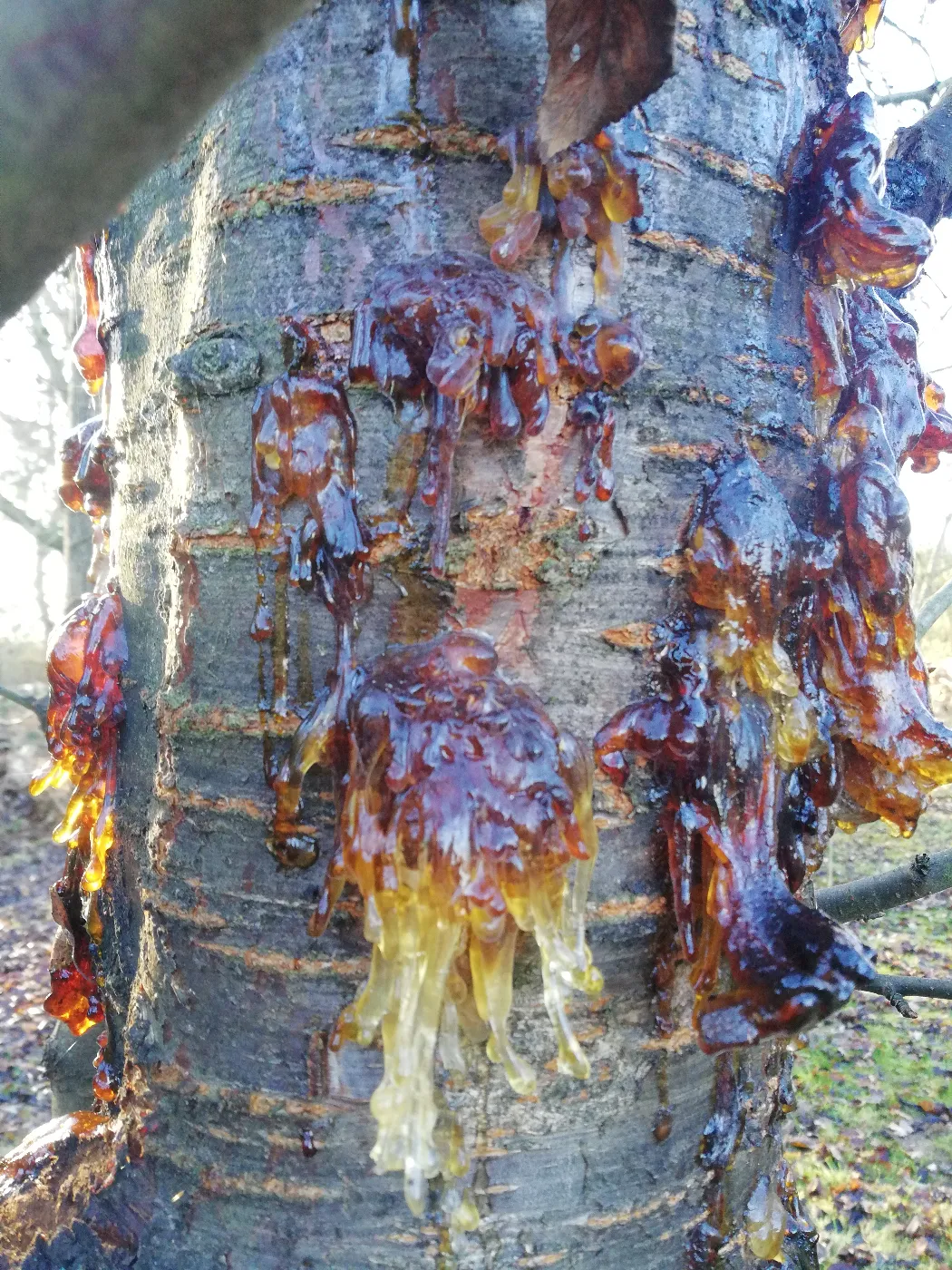
Abundant gumming (gummosis) on a sweet cherry trunk
The photograph shows a sweet cherry trunk (Prunus avium) with a strongly pronounced symptom — abundant exudation of amber-brown hardening gum. In common parlance, this phenomenon is often called a "bleeding tree," and in scientific circles — gummosis or gumming. This sign indicates a general weakening of the tree, which may be caused by mechanical damage, unfavorable environmental conditions or pathogens. Location: Hemmingen-Westerfeld, near the Ihme River, Germany.


Gummosis on the trunk of a fruit tree
Large amber gum exudations on the bark surface of a cherry tree. The image well conveys the appearance of the symptom, but the author does not indicate its cause and does not specify the plant species.
11.2. Physiological Gummosis
Physiological gummosis is not associated with pathogens. It occurs as a reaction to stress or damage. Main causes (Long et al., 2021; Webster, 1996; Longstroth & Perry, 1996; Vdovtseva, Chernovalova, 1980):
- Mechanical damage. Wounds from tools, machinery, hail, wind, snow breakage, careless pruning.
- Frost cracks and sunscald. Sharp temperature fluctuations in winter and early spring cause bark cracking, and gum exudes from the cracks.
- Waterlogging and poor drainage. Water stagnation in the root zone disrupts metabolism, weakens tissues, and the tree begins to release gum. In Uzbekistan, sweet cherry “suffers greatly from gummosis” precisely on soils with close occurrence of gravel and poor drainage (Vdovtseva, Chernovalova, 1980).
- Soil salinization. Excess salts disrupt water balance and cause tissue necrosis accompanied by gummosis.
- Unbalanced nutrition. Excess nitrogen, lack of calcium and potassium weaken cell walls, increasing tissue fragility.
- Severe pruning. Strong removal of branches causes stress and can provoke gummosis.
- Rootstock–scion incompatibility. At the graft union, tissues may die, and gum is released from them.
Physiological gummosis usually does not spread to healthy tissues if the cause is eliminated. However, if stress repeats, the tree weakens, and secondary infection can penetrate the wounds.
11.3. Infectious Gummosis

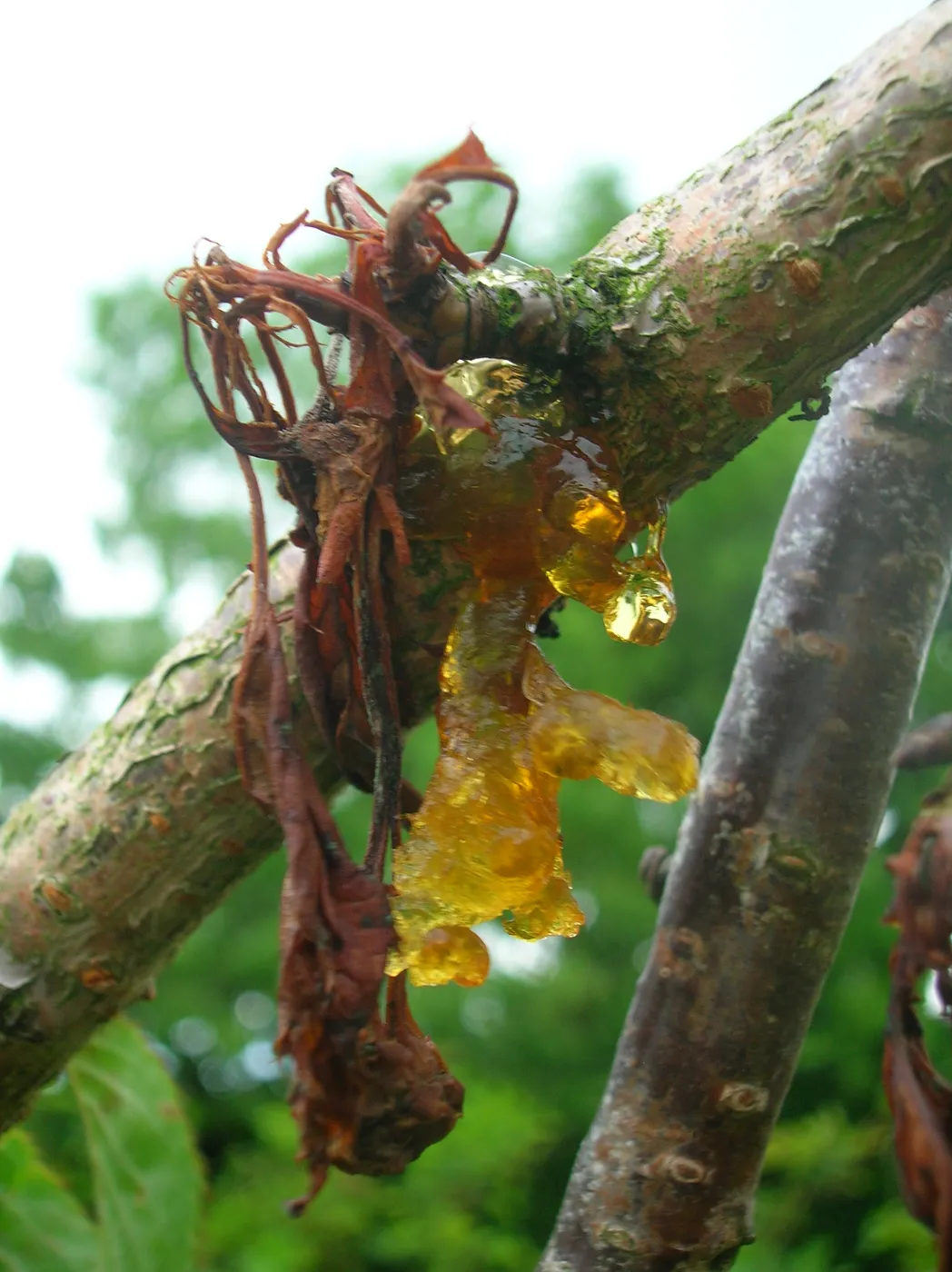
Bacterial canker (Pseudomonas syringae) on sweet cherry: gummosis and leaf dieback
The photo clearly shows two characteristic symptoms of the disease: abundant exudation of amber-yellow gum that hardens in the air (gummosis) from the affected bark tissues, as well as completely dried, necrotized leaves attached to the branch. Location: Chapeltoun, North Ayrshire, Scotland.
Infectious gummosis is caused by pathogens, most often bacteria or fungi. The most dangerous and widespread pathogen is bacterial canker (Pseudomonas syringae). In bacterial canker, gum is released from flat, sunken areas of bark, often with a characteristic odor. Under the affected area, bark dies, and wood darkens. Wounds can enlarge, covering new areas. Bacterial canker often begins after frost cracks, sunscald, or mechanical damage (Long et al., 2021; Mandal, 2021; Webster, 1996).
Other possible causes of infectious gummosis (Mandal, 2021; Webster, 1996):
- Cytospora canker (Cytospora spp.) — a fungal disease causing bark necrosis and gummosis.
- Phytophthora (Phytophthora spp.) — root and crown rots, in which gum appears at the base of the trunk.
- Verticillium wilt (Verticillium dahliae) — a fungal disease affecting the vascular system.
- Crown gall (Agrobacterium tumefaciens) — a bacterial disease causing galls on roots and crown.
Infectious gummosis is usually accompanied by other symptoms: wilting, yellowing of leaves, drying of branches, poor growth. Without treatment, the tree gradually dies.
11.4. How to Distinguish Physiological Gummosis from Infectious
Only a specialist can make an accurate diagnosis by tissue analysis. However, some signs help suggest the cause (Long et al., 2021; Webster, 1996):
| Sign | Physiological | Infectious (bacterial canker) |
|---|---|---|
| Location | More often on trunk, scaffold branches, at damage sites | On branches, trunk, often on the south side |
| Nature of exudate | Transparent or amber gum, odorless | Turbid, with unpleasant odor |
| Condition of bark under gum | Bark may be healthy or slightly damaged | Bark dies, wood darkens |
| Spread | Local, does not enlarge without new damage | Slowly expands, covers new tissues |
| Accompanying symptoms | Usually absent, if there is no severe stress | Wilting, drying of branches, poor growth |
If gum is released from a fresh wound after hail or pruning, it is most likely a physiological reaction. If gum appears on unchanged bark without visible cause, is accompanied by tissue death and drying, infection is likely.
11.5. Consequences of Gummosis
By itself, gum release does not kill the tree. The causes and consequences are dangerous (Long et al., 2021; Webster, 1996):
- Loss of tissues. Under the gum, bark and cambium die, disrupting water and nutrient conduction.
- Gates for infection. Wounds and cracks from which gum is released become entry gates for bacteria and fungi.
- Weakening of the tree. Chronic gummosis exhausts the tree, reduces yield and winter hardiness.
- Death of branches and tree. With severe damage by bacterial canker or root rots, the tree may die.
11.6. Control and Prevention Measures
Eliminating the cause. If gummosis is caused by waterlogging, provide drainage. If by salinization, wash the soil and reduce fertilizer application. If by mechanical damage, protect the tree from further injury (Longstroth & Perry, 1996; Neilsen et al., 2017).
Cleaning and treating wounds. Affected bark areas are carefully cleaned to healthy tissue, disinfected (for example, with 1% copper sulfate solution or special pastes), and coated with garden varnish or a specialized paste. Tools are disinfected between cuts so as not to transfer infection (Long et al., 2021; Webster, 1996).
Removal of severely affected branches. If a branch is affected by bacterial canker or Cytospora, it is removed, capturing 15–20 cm of healthy tissue below the affected area. Cuts are treated. Removed branches are burned (Long et al., 2021; Mandal, 2021).
Protection from frost cracks and sunscald. Whitewashing the trunk and bases of scaffold branches in late autumn and at the end of winter. Young trees are wrapped with light material (Vdovtseva, Chernovalova, 1980; Long et al., 2021).
Balanced nutrition. Avoid excess nitrogen, especially in the second half of summer. Ensure sufficient calcium and potassium supply. Calcium strengthens cell walls and increases tissue resistance to cracking and infections (Neilsen et al., 2017; Long et al., 2021).
Drainage and irrigation regulation. Do not allow water stagnation in the root zone. A stable water regime reduces the risk of physiological gummosis (Longstroth & Perry, 1996).
Prevention of bacterial canker. Use healthy planting material, resistant rootstocks (for example, Gisela 5 and Gisela 6 are more resistant than Mazzard and Colt), avoid pruning in wet weather, and protect from frost cracks. Copper-containing preparations are used during autumn leaf fall and early spring to reduce the infectious background (Long et al., 2021; Mandal, 2021).
Rootstock selection. Some rootstocks are more resistant to root rots and bacterial canker. For example, Gisela 5 and Gisela 6 are less susceptible than Mazzard and Colt (Long et al., 2021; Mandal, 2021).
11.7. What Is Important to Remember
Gummosis is a signal of trouble. It does not arise by itself: either the tree received mechanical damage or endured stress, or an infection penetrated the tissues. Physiological gummosis passes when the cause is eliminated; infectious gummosis requires active treatment. The best prevention is healthy conditions: good drainage, balanced nutrition, protection from frost cracks and mechanical damage, careful pruning. If gum appears, do not leave it unattended: clean the wound, treat it, and eliminate the cause. Advanced gummosis can lead to tree death (Long et al., 2021; Webster, 1996; Mandal, 2021).
12. Rootstock–Scion Incompatibility
Grafting is the main method of sweet cherry propagation. A cultivar (scion) is grafted onto a rootstock, which provides adaptation to soil, vigor, and disease resistance. Ideally, rootstock and scion form a single organism working in coordination. But this is not always the case. Sometimes tissues at the graft union do not fuse or fuse incompletely, and the tree suffers from incompatibility. This is one of the most insidious problems, because symptoms may appear not immediately, but several years after planting, when the tree has already entered fruiting (Long et al., 2021; Webster, 1996; Mandal, 2021).
12.1. What Is Incompatibility


Grafting a fruit tree: union of rootstock and scion
An example of grafting a sweet cherry tree by cleft grafting. The union site of the components, the binding and the protective coating of the graft are visible.
Incompatibility is the inability of rootstock and scion to form a strong, durable, and functionally complete union. Two main types are distinguished (Webster, 1996; Quero-García et al., 2017):
Local incompatibility. Manifests at the graft union: the union is fragile, tissue fuses poorly, and vascular system vessels do not connect properly. Externally, this may look like swelling, bending, or rupture at the graft union.
Translocated incompatibility. Scion and rootstock may be compatible at the union site but physiologically incompatible at the level of metabolism. The tree may grow but gradually weakens, loses productivity, and dies prematurely. Such incompatibility is more difficult to diagnose.
There is also complete incompatibility, when the union does not form at all or the tree dies in the first year after grafting, and partial, when the tree grows but with abnormalities (Quero-García et al., 2017; Mandal, 2021).
12.2. Causes of Incompatibility
Incompatibility is caused by genetic, anatomical, and physiological differences between rootstock and scion. The further apart the grafted components are systematically, the higher the risk of incompatibility. Sweet cherry (Prunus avium) and sour cherry (Prunus cerasus) are different species, and although they can be grafted onto each other, compatibility is not always complete (Webster, 1996; Potapov et al., 2000).
Genetic differences. Different species and cultivars have different sets of genes controlling growth, metabolism, and resistance. In incompatibility, the synthesis of proteins, hormones, and other signaling molecules necessary for coordinated development is disrupted (Quero-García et al., 2017).
Anatomical differences. Differences in vessel structure, cambium thickness, and callus formation rate can prevent normal connection of conductive tissues. At the graft union, incomplete tissue may form that does not provide sufficient transport of water and nutrients (Webster, 1996).
Physiological differences. Different growth rates, different times of beginning and end of vegetation, different needs for nutrients and water. If rootstock and scion are “not synchronized,” the tree works unbalanced (Mandal, 2021).
Viral infection. Some viruses can enhance manifestations of incompatibility or themselves cause its symptoms. For example, cherry leaf roll virus can disrupt compatibility (Webster, 1996; Mandal, 2021).
Unfavorable conditions. Stress — waterlogging, drought, salinization, nutrient deficiency — can provoke the manifestation of hidden incompatibility. A tree that would grow normally under ideal conditions begins to show signs of incompatibility under stress (Quero-García et al., 2017).
12.3. Symptoms of Incompatibility
Symptoms of incompatibility are diverse and can manifest both at the graft union and throughout the tree (Quero-García et al., 2017; Webster, 1996; Long et al., 2021):
Symptoms at the graft union:
- Swelling or bulge. The graft union looks abnormally thick, sometimes with a burr.
- Bending or curvature. The trunk or branch bends at the graft union.
- Rupture or crack. Bark at the graft union cracks, and gum may be released.
- Diameter mismatch. Rootstock and scion grow at different rates, leading to a “step” at the union.
- Breakage. Under strong load (wind, crop), the tree may break precisely at the graft union.
Symptoms on the aboveground part:
- Growth suppression. The tree grows weakly, shoots are short, leaves are small.
- Chlorosis. Leaves turn yellow, starting from veins or interveinal space.
- Premature reddening and fall of leaves in autumn.
- Poor fruiting. The tree blooms early, but fruits are small and yield is low.
- Early aging. The tree ages prematurely, branches dry out.
- Gummosis. Gum appears at the graft union or on the trunk.
- Poor establishment. The sapling establishes poorly after planting despite good care.
Symptoms on the root system:
- Weak root development. Roots grow poorly, especially at the connection with the scion.
- Root death. Gradual death of the root system.
- Poor anchorage. The tree holds poorly in the soil and may tilt.
Delayed symptoms. Incompatibility can manifest 3–5, sometimes 10–15 years after planting. The tree grows normally, then begins to weaken sharply, lose yield, and die. This is often because the incomplete union cannot withstand the load with age (Webster, 1996; Mandal, 2021).
12.4. Most Problematic Combinations
For sweet cherry, the most reliable combinations are considered “sweet cherry on sweet cherry” (for example, a cultivar on Mazzard or Colt rootstock) and “sweet cherry on sour cherry” (for example, on Mahaleb rootstock). However, there are nuances here too (Webster, 1996; Long et al., 2021; Quero-García et al., 2017).
Sweet cherry on Mazzard (Prunus avium). Good compatibility with most cultivars. Mazzard is a vigorous rootstock and provides good anchorage and longevity. Disadvantage — late entry into fruiting and large tree size.
Sweet cherry on Mahaleb (Prunus mahaleb). Good compatibility, but trees are less long-lived than on Mazzard. Mahaleb is drought-resistant but tolerates waterlogging poorly. Some sweet cherry cultivars may show incompatibility with Mahaleb.
Sweet cherry on Colt (Prunus avium × Prunus pseudocerasus). Good compatibility with most cultivars. Semi-dwarfing rootstock, but less winter-hardy than Mazzard.
Sweet cherry on Gisela (Prunus cerasus × Prunus canescens). Widely used for dwarfing orchards. Compatibility with most cultivars is good, but there are data on differences in compatibility between individual cultivars and Gisela clones. Gisela 5 and Gisela 6 require good conditions and irrigation.
Sweet cherry on sour cherry (Prunus cerasus). Possible, but compatibility is not always complete. Sour cherry is less long-lived than sweet cherry and can transmit its characteristics to the scion — for example, a tendency to gummosis.
Interspecific hybrids. Some hybrids (for example, Krymsk 5, Krymsk 6) have good compatibility with sweet cherry, but their behavior may differ depending on cultivar and conditions.
Incompatible combinations. Some sweet cherry cultivars are poorly compatible with certain rootstocks. For example, cultivar Bing may show incompatibility with some Gisela clones. Cultivar Regina may grow poorly on Mahaleb. Therefore, when choosing a rootstock, it is important to consider not only its characteristics but also compatibility with the specific cultivar (Long et al., 2021; Quero-García et al., 2017).
12.5. How to Distinguish Incompatibility from Other Problems
Symptoms of incompatibility resemble those of nutrient deficiency, waterlogging, viral infections, or poor drainage. They can be distinguished by the following signs (Webster, 1996; Mandal, 2021):
- Localization of symptoms. In incompatibility, problems are often concentrated at the graft union or manifest uniformly throughout the tree. In nutrient deficiency, symptoms are more often on leaves of a certain age. In waterlogging — on lower leaves and roots.
- Age of manifestation. Incompatibility often manifests several years after planting, when the tree has already grown normally. Other problems may appear in the first year.
- Lack of response to treatment. If the tree does not respond to improved nutrition, drainage, or irrigation, incompatibility is likely.
- Characteristic signs at the graft union. Swelling, bending, cracks, gum at the union site are a strong argument for incompatibility.
12.6. Prevention and Management Measures
Correct rootstock selection. Select a rootstock compatible with your cultivar and suitable for your soil and climatic conditions. Use proven combinations recommended for your region. When buying a sapling, specify on which rootstock it is grafted (Long et al., 2021; Webster, 1996).
Correct planting. Planting depth affects compatibility. The graft union should be 3–5 cm above the soil level after it settles. If the graft is buried, the scion may produce its own roots, and the tree will switch to its own root system, which can lead to loss of rootstock advantages and increased incompatibility (Longstroth & Perry, 1996; Webster, 1996).
Protection from stresses. A tree with good nutrition, stable irrigation, and disease protection tolerates hidden incompatibility more easily. Stress can provoke its manifestation, so it is important to maintain tree health (Neilsen et al., 2017).
Use of an interstock. In some cases, incompatibility can be overcome by grafting a compatible “intermediary” cultivar between rootstock and scion. This technique is used in nurseries but requires special knowledge (Webster, 1996).
Removal of problematic trees. If incompatibility is severe and the tree clearly suffers, it is better to remove it and plant a new one with a proven combination. Fighting incompatibility is impossible: it is a genetically determined limitation (Mandal, 2021).
Selection of reliable nurseries. Buy saplings from reliable producers who guarantee rootstock–scion compatibility and use certified material. Cheap saplings of unknown origin are a risk of incompatibility and viral infections (Long et al., 2021; Webster, 1996).
12.7. What Is Important to Remember
Rootstock–scion incompatibility is not a disease but a genetically determined limitation. It cannot be cured, only prevented. Correct rootstock selection, proven combinations, quality planting material, and correct planting are the basis of prevention. If a tree grows poorly, does not respond to care, and has characteristic signs at the graft union, incompatibility is likely. In this case, it is better not to waste time and effort on fighting but to replace the tree with a compatible combination. A healthy tree on a suitable rootstock is the key to a long and productive life of sweet cherry in the garden (Long et al., 2021; Webster, 1996; Mandal, 2021; Quero-García et al., 2017).
13. Complex Stresses
In a real garden, a single problem is rarely found. Much more often, the tree is exposed to several stress factors simultaneously or sequentially. Drought is accompanied by heat, waterlogging by soil compaction, frost by subsequent disease infection, and severe pruning by sudden lighting and sunscald. When stresses overlap, their influence does not add up but is multiplied. A tree that could cope with each factor separately may die from their combination. Understanding complex stresses helps the gardener set priorities correctly and not treat the consequence but eliminate the cause (Long et al., 2021; Neilsen et al., 2017; Wenden et al., 2017).
13.1. Why Complex Stresses Are More Dangerous
Each stress factor by itself weakens the tree. But when there are several, mechanisms are activated that make damage deeper and more irreversible (Neilsen et al., 2017; Wenden et al., 2017).
Depletion of reserves. The tree spends reserve substances fighting each stress. If there are several stresses, reserves are quickly exhausted, and there are no resources left for recovery.
Disruption of protective mechanisms. For example, drought reduces the production of protective proteins, and the tree becomes more vulnerable to diseases. Waterlogging disrupts root function, and they stop absorbing nutrients, which weakens resistance to cold.
Vicious circle effect. One stress causes another. For example, soil compaction leads to water stagnation, water stagnation to root death, root death to nutrient deficiency, nutrient deficiency to weak growth and even greater vulnerability.
Reduced damage threshold. A tree weakened by one stress is damaged by the second under milder conditions. For example, a hardened tree withstands −25 °C, while one weakened by drought only −15 °C.
13.2. Typical Combinations of Stresses
Drought and heat. One of the most common combinations in southern regions. High temperature increases transpiration, and lack of water in the soil does not allow losses to be replenished. Leaves wilt, stomata close, photosynthesis falls. Fruits become small, lose sugar content, and may receive sunscald. The tree weakens and becomes susceptible to diseases (Neilsen et al., 2017; Long et al., 2021).
Waterlogging and soil compaction. Compacted soil does not pass water, and even moderate rain causes stagnation. Roots suffocate, die, and root rots develop. Externally, this may look like drought: leaves wilt, although there is plenty of water in the soil. The tree dies from root asphyxiation, not from lack of moisture (Longstroth & Perry, 1996).
Frost and diseases. Tissues damaged by frost are easy prey for bacterial canker, Cytospora, and other infections. A tree that has endured frost often dies not from cold but from subsequent infection. It is especially dangerous if frost is accompanied by rain or high humidity (Wenden et al., 2017; Long et al., 2021).
Severe pruning and sunscald. Sudden removal of branches exposes previously shaded bark areas. In hot weather, this leads to sunscald, bark cracking, and gummosis. A tree that was pruned too severely may die from burns, not from pruning itself (Long et al., 2021; Vdovtseva, Chernovalova, 1980).
Crop overload and exhaustion. A tree with excessive crop spends all reserves on fruits. If drought or nutrient deficiency is added, the tree does not initiate flower buds for the next year, loses winter hardiness, and may die in winter (Long et al., 2021; Webster, 1996).
Salinization and waterlogging. Saline soil drains poorly, and water stagnation increases salt accumulation. Roots suffer simultaneously from salt toxicity and oxygen deficiency. The tree is suppressed, turns yellow, and loses yield (Neilsen et al., 2017).
Lack of light and density. A dense canopy creates shade, so inner branches do not initiate flower buds. At the same time, shaded leaves do not photosynthesize, and the tree starves. If crop overload on the periphery is added, the tree is exhausted (Long et al., 2021; Webster, 1996).
13.3. How to Diagnose Complex Stress
Diagnosis is difficult because symptoms of one stress mask or imitate symptoms of another. Basic principles (Neilsen et al., 2017; Long et al., 2021):
Analysis of plot history. Recall what happened in the garden over the last 1–2 years: whether there were frosts, drought, waterlogging, severe pruning, crop overload. Often the cause of today’s problems is events of the past season.
Assessment of several factors simultaneously. Do not limit yourself to examining leaves. Check soil moisture, density, drainage, groundwater level, and salt content. Assess canopy illumination, crop load, and condition of bark and roots.
Comparison with neighboring trees. If the problem manifests equally on all trees, a common cause is likely — weather, soil, water. If differently on different trees, look for local factors: compaction, water stagnation, damage.
Soil and leaf analysis. Laboratory analysis helps exclude or confirm nutrient deficiency and salinization. But remember that under complex stress, symptoms may be nonspecific.
Observation over time. Complex stress often develops gradually. The tree may look normal in spring but sharply worsen in summer. Observe the condition during the season and note when symptoms appear.
13.4. Strategy for Managing Complex Stresses
The main principle is not to fight symptoms but to eliminate causes and increase the overall resistance of the tree. Complex stress cannot be cured with one technique. A system of measures is needed (Long et al., 2021; Neilsen et al., 2017; Longstroth & Perry, 1996).
Priority — roots and soil. Healthy roots are the basis of resistance to any stresses. Provide drainage, soil looseness, and sufficient organic matter. Mulching trunk circles stabilizes moisture and temperature. Do not allow compaction and water stagnation.
Stable water regime. Irrigate regularly and moderately, avoiding both drought and waterlogging. In arid regions, without irrigation, sweet cherry does not produce a stable crop. In waterlogged ones, without drainage, the tree dies.
Balanced nutrition. Do not overuse nitrogen. Ensure sufficient calcium, potassium, magnesium, and micronutrients. Calcium strengthens tissues and increases resistance to cracking and infections. Regularly conduct leaf and soil analysis.
Protection from temperature extremes. Whitewashing the trunk, covering young trees, smudging during frosts, shading in heat. Choose cultivars suited to the climate.
Training and pruning. Maintain an open canopy with good illumination. Do not prune too severely, especially in hot weather. Remove diseased and damaged branches, but do not bare the canopy at once.
Regulation of crop load. Do not allow overload. If flowering and fruit set are too abundant, thin the ovaries. This preserves the tree’s reserves and improves the quality of the remaining fruits.
Protection from diseases and pests. A weakened tree is more vulnerable. Timely prevention helps reduce additional load on the immune system.
Observation and early intervention. The earlier you notice signs of stress, the easier it is to correct the situation. Do not wait until the tree begins to die. Regularly inspect the garden, especially after weather anomalies.
13.5. Examples of Complex Stresses and Their Solutions
Example 1. Drought + heat + crop overload.
A tree with an abundant crop suffers from lack of water and high temperature. Fruits become small, leaves wilt, the tree is exhausted.
Solution: thin the ovaries, provide irrigation, mulch the soil, and if necessary, shade. The next year, do not allow overload.
Example 2. Waterlogging + compaction + root rots.
After heavy rains on compacted soil, water stagnates, roots suffocate, and Phytophthora develops. The tree wilts, although there is plenty of water.
Solution: urgent drainage, loosening, removal of diseased roots, treatment with fungicides. In the long term — planting on ridges, applying organic matter.
Example 3. Frost + bacterial canker.
Spring frost damaged flowers and young shoots. A few weeks later, signs of bacterial canker appear on damaged tissues.
Solution: remove affected branches, treat cuts, conduct preventive copper treatments. In the future — protection from frost and frost cracks.
Example 4. Severe pruning + sunscald + gummosis.
The tree was severely pruned in hot weather. Bark on exposed areas received burns, and gummosis appeared.
Solution: clean wounds, treat them, whitewash the trunk and scaffold branches. In the future — moderate pruning, bark protection.
13.6. What Is Important to Remember
Complex stresses are not a rarity but rather the rule. A tree in a garden almost always experiences several factors simultaneously. Their influence is enhanced, and consequences can be irreversible. The main strategy is prevention and increasing overall resistance: healthy roots, stable water regime, balanced nutrition, protection from temperature extremes and diseases. Do not try to treat one disorder while ignoring the rest. Diagnose the whole system: soil, water, light, nutrition, load. And remember that a healthy, well-prepared tree copes with stresses much more easily than a weakened one (Long et al., 2021; Neilsen et al., 2017; Wenden et al., 2017; Longstroth & Perry, 1996).
14. Prevention of Physiological Disorders
Physiological disorders are easier to prevent than to correct. When a tree has already lost its crop, dropped leaves, or received a frost crack, it is rarely possible to restore it completely. Prevention requires an integrated approach: it is not enough just to irrigate or just to fertilize. It is necessary to manage the entire system “soil — water — nutrition — light — temperature — load.” The more stable the conditions, the lower the probability of stresses and the higher the resistance of the tree (Long et al., 2021; Neilsen et al., 2017).
14.1. General Principles of Prevention
Complexity. There is no single measure that will protect against all disorders. Drainage will not replace irrigation, and whitewashing will not save from drought. Only a combination of agronomic techniques gives results (Longstroth & Perry, 1996).
Priority of roots and soil. Healthy roots are the basis of resistance to any stresses. If the soil is compacted, waterlogged, or saline, no fertilizing or spraying will help (Neilsen et al., 2017).
Stability is more important than maximum. Sharp fluctuations in moisture, temperature, and nutrition are more harmful than moderate but constant conditions. This is especially important during fruit swelling (Long et al., 2021).
Observation and early intervention. The earlier signs of stress are noticed, the easier it is to correct the situation. Regular inspection of the garden, soil and leaf analysis, and a diary of observations help take measures in time (Neilsen et al., 2017).
Eliminating the cause, not the symptom. Yellowing of leaves may result from waterlogging, salinization, iron deficiency, or herbicide stress. Before spraying, you need to understand the cause (Long et al., 2021).
14.2. Site Selection and Layout
Correct site selection is the most reliable way to avoid many problems. Sweet cherry requires a sunny, wind-protected plot with good air drainage. Lowlands, closed basins, and places with a high groundwater level (less than 1.5–2 m) are unsuitable without drainage (Longstroth & Perry, 1996).
Rows should be oriented north to south for uniform illumination; on slopes — across the slope or with a slight incline for water runoff. Windbreak strips of non-competing species reduce the risk of windbreak and fruit abrasions (Longstroth & Perry, 1996; Neilsen et al., 2017).
14.3. Selection of Cultivar and Rootstock
The cultivar must correspond to the climate. In regions with frequent spring frosts, late-blooming cultivars are chosen. Where rains during ripening are common, cultivars resistant to cracking are preferable: Regina, Lapins, Black Pearl, Sweetheart (Quero-García et al., 2017; Long et al., 2021).
The rootstock is selected according to soil conditions: Mahaleb — for arid, light soils; Mazzard and Mazzard × Mahaleb hybrids — for temporary waterlogging; Gisela 5 and Gisela 6 — for intensive orchards, but they require stable irrigation and good drainage (Longstroth & Perry, 1996; Long et al., 2021). It is important to check the compatibility of the specific cultivar with the rootstock (Webster, 1996).
14.4. Healthy Planting Material and Correct Planting
Buy saplings from reliable nurseries, certified, virus-free. Viral infections weaken the tree and enhance the manifestation of other disorders (Webster, 1996; Mandal, 2021).
When planting, the graft union should remain 3–5 cm above the soil level after it settles. Burying leads to the formation of the scion’s own roots, loss of rootstock advantages, and increased incompatibility. Young trees on dwarfing rootstocks need supports (Longstroth & Perry, 1996; Webster, 1996).
14.5. Soil and Root System
The main measures: regular application of organic matter (compost, humus), mulching trunk circles, avoiding deep digging, preventing compaction. Green manure with a deep root system (lupine, phacelia, oil radish) improves soil structure (Neilsen et al., 2017; Longstroth & Perry, 1996).
On heavy soils and in lowlands, drainage is mandatory: ditches, closed pipes, planting on ridges or mounds 30–70 cm high. Without drainage, sweet cherry does not live long on such plots (Longstroth & Perry, 1996).
14.6. Water Regime
Irrigation should be regular and moderate. Sharp changes from drought to waterlogging increase the risk of cracking and root rots. Drip irrigation or micro-sprinkling is optimal, allowing stable moisture to be maintained (Neilsen et al., 2017; Long et al., 2021).
During fruit swelling, soil moisture is maintained at 80–90% of field capacity, avoiding both drying out and water stagnation. If there is a risk of rain during ripening, covers are used, but drainage is monitored at the same time (Long et al., 2021; Quero-García et al., 2017).
14.7. Balanced Nutrition
Nutrition is planned based on soil and leaf analysis, not “by eye.” Avoid excess nitrogen, especially in the second half of summer: it delays tissue maturation and reduces winter hardiness. Excess potassium interferes with calcium and magnesium uptake and increases the risk of cracking. Chlorine-containing fertilizers on sensitive soils are better not used (Neilsen et al., 2017; Long et al., 2021).
Calcium strengthens cell walls and increases resistance to cracking and infections. Foliar calcium feeding from pit hardening to harvest is effective (Wang et al., 2014; Long et al., 2021). Details are in a separate article on fertilization and top dressing.
14.8. Protection from Temperature Extremes
In winter and early spring: whitewashing the trunk and bases of scaffold branches, covering young trees, snow retention, mulching roots. Do not allow excess nitrogen in autumn so that the tree hardens well (Vdovtseva, Chernovalova, 1980; Wenden et al., 2017).
In spring during frosts: smudging, overhead irrigation, wind machines, cover materials. The most reliable is planting in areas where frosts are unlikely and choosing late-blooming cultivars (Longstroth & Perry, 1996; Webster, 1996).
In summer: shading in heat, irrigation, mulch. Whitewashing protects the trunk from sunscald. Do not carry out severe pruning in hot weather so as not to expose the bark (Long et al., 2021).
14.9. Light and Training
The canopy should be open and well lit. Regular thinning pruning removes shading, crossing, and diseased branches. Summer pruning restrains growth and improves light inside the canopy. However, avoid too severe one-time pruning: it causes vigorous water sprout growth and sunscald (Long et al., 2021; Webster, 1996).
Weeds in trunk circles compete for light, water, and nutrients. They are removed or mulched (Neilsen et al., 2017).
14.10. Regulation of Crop Load
Overload exhausts the tree, reduces fruit quality and winter hardiness. With abundant fruit set, thinning of ovaries is carried out. This preserves the tree’s reserves and improves the size of the remaining fruits. Underloading is also undesirable: large fruits crack more strongly (Long et al., 2021; Webster, 1996).
14.11. Mechanical and Chemical Factors
Careful work with tools, protection of the trunk from trimmer and machinery, correct pruning without ragged wounds. Large cuts are treated with garden varnish. Herbicides are applied directed, in windless weather, protecting bark and leaves. Fertilizers are applied according to the norm, incompatible preparations are not mixed (Long et al., 2021; Neilsen et al., 2017).
14.12. Monitoring and Early Intervention
Keep a diary: dates of bloom, frosts, rains, treatments, appearance of symptoms. This helps identify patterns. Regularly check soil moisture and density, condition of bark, leaves, and fruits. At the first signs of stress, find out the cause and act promptly (Neilsen et al., 2017; Long et al., 2021).
14.13. Example of Seasonal Prevention
Winter: whitewashing, snow retention, pruning in warm windows, repair of drainage.
Spring: protection from frost, irrigation if soil is dry, fertilizer application according to analysis, installation of hives, mulching.
Summer: regular irrigation, crop regulation, protection from hail and heat, summer pruning if necessary.
Autumn: removal of leaves, drainage, application of organic and phosphorus–potassium fertilizers, without nitrogen, whitewashing after leaf fall (Long et al., 2021; Neilsen et al., 2017; Longstroth & Perry, 1996).
14.14. What Is Important to Remember
Prevention of physiological disorders is not a separate event but a way of caring for the garden. A healthy tree growing in suitable conditions resists most stresses by itself. The main components of success: correct plot, suitable cultivar and rootstock, healthy soil, stable water regime, balanced nutrition, protection from temperature extremes, good illumination, and moderate load. If a tree has already suffered, do not try to treat one symptom — assess the whole system and eliminate the cause. Then sweet cherry will delight with a harvest for many years even in an unstable climate (Long et al., 2021; Neilsen et al., 2017; Webster, 1996).
15. Common Mistakes and Questions (FAQ)
This section collects the most common gardener mistakes and answers to questions that arise when growing sweet cherry. Many problems repeat year after year, and they can be avoided if you know typical misconceptions and take measures in time.
15.1. Common Mistakes
Mistake 1. Treating a physiological disorder as a disease.
The gardener sees spots on leaves, gum on bark, or rot on fruits and immediately reaches for fungicides. But if the cause is waterlogging, salinization, frost, or herbicide drift, spraying will not help. It will only add stress and waste time. Before treating, you need to make a diagnosis (Long et al., 2021; Neilsen et al., 2017).
Mistake 2. Ignoring drainage.
Sweet cherry is one of the most sensitive fruit crops to waterlogging. Even short-term flooding of roots can weaken the tree for a long time, and prolonged flooding can kill it. Planting on heavy clay soil without drainage is one of the main causes of sweet cherry death in amateur gardens (Longstroth & Perry, 1996).
Mistake 3. Overfeeding with nitrogen.
Nitrogen is needed for growth, but its excess, especially in the second half of summer, delays tissue maturation, reduces winter hardiness, causes vigorous growth, worsens fruit quality, and increases susceptibility to diseases. Sweet cherry responds better to moderate, balanced nutrition than to “shock” doses (Neilsen et al., 2017; Long et al., 2021).
Mistake 4. Irrigating rarely and abundantly.
Sharp changes in soil moisture — from drying out to waterlogging — increase the risk of fruit cracking and root rots. It is better to irrigate often and little by little, maintaining stable moisture, especially during fruit swelling (Long et al., 2021; Quero-García et al., 2017).
Mistake 5. Planting a self-unfruitful cultivar without a pollinator.
Many classic cultivars (Bing, Napoleon, Van, Lambert) do not set fruits without a compatible pollinator cultivar blooming at the same time. A single tree may bloom abundantly but will not produce a crop. If there is little space, choose self-fertile cultivars: Stella, Lapins, Sweetheart, Sunburst (Buckingham, 2010; Webster, 1996).
Mistake 6. Severe pruning in hot weather.
Sudden removal of a large number of branches exposes bark and leaves to direct sunlight. This leads to sunscald, bark cracking, gummosis, and stress. Pruning is better done moderately, in cool weather, and large cuts should be treated (Long et al., 2021; Vdovtseva, Chernovalova, 1980).
Mistake 7. Underestimating calcium.
Calcium strengthens cell walls and increases fruit resistance to cracking. Even with sufficient calcium content in the soil, it may be lacking in fruits because it moves poorly to them. Foliar calcium feeding during fruit swelling is an effective technique (Wang et al., 2014; Long et al., 2021).
Mistake 8. Planting in a lowland or on a slope with poor air drainage.
Cold air accumulates in lowlands, which increases the risk of spring frosts and root damping-off. On plots with poor air drainage, flowers are damaged more often, and the crop is lost even with slight cooling (Longstroth & Perry, 1996; Wenden et al., 2017).
Mistake 9. Not protecting the trunk from sun and frost.
Young trees with thin bark are especially vulnerable. Whitewashing the trunk and bases of scaffold branches is a simple and effective technique that protects from winter–spring sunscald and frost cracks (Vdovtseva, Chernovalova, 1980; Long et al., 2021).
Mistake 10. Overloading the tree with crop.
Abundant flowering and fruit set do not always mean that the tree can handle the crop. Overload exhausts reserves, fruits become small, the tree loses winter hardiness and initiates fewer flower buds for the next year. Thinning ovaries helps preserve quality and tree health (Long et al., 2021; Webster, 1996).
Mistake 11. Not checking rootstock–scion compatibility.
Even if the sapling looks healthy, incompatibility may manifest several years later. Buy saplings from reliable nurseries and specify on which rootstock the cultivar is grafted. Proven combinations are the basis of tree longevity (Webster, 1996; Long et al., 2021).
Mistake 12. Ignoring symptoms of stress.
Yellowing of leaves, gum, weak growth are signals. If you do not find out the cause and take measures, the tree will weaken, and when symptoms become obvious, it will be difficult to save it (Neilsen et al., 2017; Long et al., 2021).
15.2. Frequently Asked Questions
Question 1. Why does sweet cherry bloom abundantly but not produce fruits?
The most likely cause is insufficient pollination. Most cultivars are self-unfruitful and need a compatible pollinator blooming at the same time. Also possible: frosts during bloom, lack of bees, bad weather, nutrient deficiency, or viral infection. Check whether there is a compatible cultivar nearby, whether there are enough insects, and whether there were frosts (Webster, 1996; Buckingham, 2010).
Question 2. Why do fruits crack?
The main cause is water. Rain on the fruit surface or excess water in the root zone causes tissue swelling and skin rupture. Cultivars differ in resistance: Regina and Lapins are more resistant than Bing, Brooks, Skeena. Measures: rain cover, drainage, stable irrigation, calcium feeding, timely harvest (Quero-García et al., 2017; Long et al., 2021).
Question 3. Why do leaves turn yellow?
There are many causes: deficiency of nitrogen, iron, magnesium, manganese; waterlogging; soil compaction; salinization; high pH; herbicide stress; root rots. An accurate diagnosis is made by soil and leaf analysis. Do not rush to spray — first find out the cause (Neilsen et al., 2017; Long et al., 2021).


Fused fruits — doubles
Two fused fruits sharing a common pedicel. The photograph clearly demonstrates one of the unusual forms of twin fruits.
Question 4. Why do double or deformed fruits appear?
Double fruits form due to high temperature (above 30 °C) during flower bud differentiation, that is, in the summer of the previous year. Cultivars differ in tendency: Bing, Napoleon, Early Burlat are more susceptible; Regina, Kordia less. Measures: shading, cooling, selection of resistant cultivars (Wenden et al., 2017; Beppu & Kataoka, 2011).
Question 5. Why does gum appear on the bark?
Gummosis is a symptom, not a disease. Causes: mechanical damage, frost cracks, sunscald, waterlogging, salinization, bacterial canker, Cytospora, rootstock–scion incompatibility. The cause must be determined. If it is infection, wounds are cleaned and treated. If stress, the cause is eliminated (Long et al., 2021; Webster, 1996).
Question 6. Why does a young tree grow poorly and not develop?
Possible causes: poor drainage, soil compaction, rootstock–scion incompatibility, buried planting, nutrient deficiency, viral infection, root damage. Check planting conditions and root condition. If the tree does not respond to improved care, incompatibility is likely (Longstroth & Perry, 1996; Webster, 1996).
Question 7. How to protect sweet cherry from spring frosts?
The most reliable way is to choose a plot where frosts are unlikely and plant late-blooming cultivars. When frost threatens, use smudging, overhead irrigation, wind machines, and cover materials. Overhead irrigation is effective but requires a large amount of water and can waterlog the soil (Longstroth & Perry, 1996; Webster, 1996).
Question 8. Why are fruits small?
Causes: crop overload, lack of water during swelling, nutrient deficiency (especially potassium), shading inside the canopy, viral infections, rootstock incompatibility. Crop regulation, irrigation, balanced nutrition, and good illumination help obtain large fruits (Long et al., 2021; Neilsen et al., 2017).
Question 9. What to do with clay soil?
Clay soil passes water and air poorly. Without drainage, sweet cherry cannot be planted. Options: planting on mounds or ridges 30–70 cm high, arranging drainage ditches, applying a large amount of organic matter (compost, humus) to improve structure. Regular mulching also helps (Longstroth & Perry, 1996; Neilsen et al., 2017).
Question 10. How to understand that a tree suffers from waterlogging?
Signs: growth suppression, small pale leaves, wilting in hot weather, yellowing and falling of leaves, dark rotted roots, gum at the base of the trunk. The soil is wet, and water stagnates after rain. If in doubt, dig a small hole near the tree and check the condition of roots and moisture level (Longstroth & Perry, 1996).
Question 11. Why do branches dry out?
Causes: bacterial canker, Cytospora, root rots, winter injury, rootstock incompatibility, drought, salinization. Inspect the bark: if there are dark sunken areas with gum, infection is likely. If the wood on a cut is dark, winter injury is possible. Check drainage and root condition (Long et al., 2021; Mandal, 2021).
Question 12. Should ovaries be thinned?
Yes, if the tree has set too many fruits. Overload exhausts the tree, fruits become small, and winter hardiness worsens. Thinning is done manually or with special tools, removing part of the ovaries soon after bloom. This preserves the tree’s reserves and improves the quality of the remaining fruits (Long et al., 2021; Webster, 1996).
Question 13. Why are herbicides dangerous for sweet cherry?
Sweet cherry is very sensitive to herbicides, especially glyphosate and 2,4-D. They can get on leaves and bark through wind drift, cause burns, leaf deformation, growth suppression, gummosis, and even tree death. Apply herbicides directed, in windless weather, protecting the trunk and canopy (Long et al., 2021; Neilsen et al., 2017).
Question 14. How often should sweet cherry be irrigated?
It depends on soil, climate, and tree age. During dry periods — regularly, maintaining stable moisture. During fruit swelling — especially carefully, avoiding both drought and waterlogging. Drip irrigation or micro-sprinkling is preferable to rare abundant irrigations (Neilsen et al., 2017; Long et al., 2021).
Question 15. What to do if the tree has died?
Do not plant a new tree in the same place without preparation. Pathogens of root rots, nematodes, and toxins may remain in the soil. If the tree died from waterlogging — first provide drainage. If from incompatibility — choose a proven rootstock–scion combination. If from infection — remove and burn all residues and treat the soil. It is better to wait 2–3 years or plant in a new place (Longstroth & Perry, 1996; Webster, 1996).
15.3. What Is Important to Remember
Most physiological disorders of sweet cherry are the result not of one factor but of a combination of mistakes and unfavorable conditions. A healthy tree growing in a suitable place, with good drainage, stable irrigation, balanced nutrition, and protection from stresses, resists most problems. If something goes wrong, do not rush with chemicals — first find out the cause. Observe, analyze, eliminate the cause, not the symptom. Then sweet cherry will delight with a harvest for many years, even in an unstable climate (Long et al., 2021; Neilsen et al., 2017; Webster, 1996; Longstroth & Perry, 1996).
References
- Buckingham, Alan (2010). ‘Cherries’, in Grow Fruit. New York, NY: DK Publishing, pp. 121-136.
- Gonçalves, B., Aires, Alfredo, Oliveira, Ivo, Afonso, S., Morais, M.Cristina, Correia, Sofia, Martins, Sandra, Silva, A.Paula (2021). ‘Sweet Cherry’, in Mandal, Debashis, Wermund, Ursula, Phavaphutanon, Lop, Cronje, Regina (ed.) Temperate Fruits. Production, Processing, and Marketing. Burlington, Canada: Apple Academic Press, pp. 333-416.
- Hessayon, D.G. (1993). ‘Tree fruit’, in The Fruit Expert. London, UK: Expert Books, pp. 3-57.
- Hill, Lewis, Perry, Leonard (2011). ‘Cherries, Sweet and Sour’, in The Fruit Gardener’s Bible. North Adams, MA: Storey Publishing, pp. 181-198.
- Knoche, M., Winkler, A. (2017). ‘Rain-induced cracking of sweet cherries.’, in Cherries: botany, production and uses. Wallingford: CABI, 140-165. doi: 10.1079/9781780648378.0140
- Long, L.E., Lang, G.A., Kaiser, Clive (2021). ‘Fruit Ripening and Harvest’, in Sweet Cherries. Crop Production Science In Horticulture. Boston, MA: CABI Publishing, pp. 282-303.
- Long, L.E., Lang, G.A., Kaiser, Clive (2021). ‘Managing the Orchard Environment’, in Sweet Cherries. Crop Production Science In Horticulture. Boston, MA: CABI Publishing, pp. 236-281.
- Longstroth, M., Perry, R.L. (1996). ‘Selecting the Orchard Site, Orchard Planning and Establishment’, in Webster, A.D., Looney, N.E. (ed.) Cherries. Crop Physiology, Production and Uses. Cambridge, MA: CABI Publishing, pp. 203-222.
- Looney, N.E. (1996). ‘Principles and Practice of Plant Bioregulator Usage in Cherry Production’, in Webster, A.D., Looney, N.E. (ed.) Cherries. Crop Physiology, Production and Uses. Cambridge, MA: CABI Publishing, pp. 279-296.
- Looney, N.E., Webster, A.D., Kupferman, E.M. (1996). ‘Harvest and Handling Sweet Cherries for the Fresh Market’, in Webster, A.D., Looney, N.E. (ed.) Cherries. Crop Physiology, Production and Uses. Cambridge, MA: CABI Publishing, pp. 411-442.
- Neilsen, G.H., Neilsen, D., Forge, T. (2017). ‘Environmental limiting factors for cherry production.’, in Cherries: botany, production and uses. Wallingford: CABI, 189-222. doi: 10.1079/9781780648378.0189
- Thompson, M. (1996). ‘Flowering, Pollination and Fruit Set’, in Webster, A.D., Looney, N.E. (ed.) Cherries. Crop Physiology, Production and Uses. Cambridge, MA: CABI Publishing, pp. 223-242.
- Wenden, B., Campoy, J.A., Jensen, M., López-Ortega, G. (2017). ‘Climatic limiting factors: temperature.’, in Cherries: botany, production and uses. Wallingford: CABI, 166-188. doi: 10.1079/9781780648378.0166
- Zoffoli, J.P., Toivonen, P., Yan, W.YanW. (2017). ‘Postharvest biology and handling for fresh markets.’, in Cherries: botany, production and uses. Wallingford: CABI, 460-484. doi: 10.1079/9781780648378.0460
- Вдовцева, Т.А., Черновалова, В.П. (1980). Лучшие сорта и особенности агротехники черешни [The best varieties and features of cherry cultivation]. null Ташкент: НИИ НТИиТЭИ Госплана УзССР.
- Потапов, В.А., Фаустов, В.В., Пильщикова, Ф.Н. (2000). ‘Косточковые культуры [Stone fruits]’, in Плодоводство [Fruit growing]. Москва: Колос, pp. 386-408.
