
Forms of Gardening and Vegetable Growing
Gardening and vegetable growing is not a single “correct” system but a set of approaches. They can be compared to tools: one is convenient on a small plot, another in a dry climate, a third where product certification matters. Below is a brief review of the main forms. What matters is not the name but the result: healthy plants, acceptable costs, and pleasure from the work.
1. Traditional: How Grandmothers and Grandfathers Did It
Traditional gardening and vegetable growing is the most widespread and historically the most mass approach. Its foundation is long-standing local experience: what and when to plant, how to care for it, how to store the harvest. In Russia and many post-Soviet countries, this form took hold in the form of dachas, homestead plots, and personal subsidiary plots. According to an institutional analysis, in post-Soviet Russia household farms accounted for more than 80% of potato production, about 80% of vegetables, fruits, and berries, and almost 94% of honey (Rozmainsky et al. 2017). This means that traditional plots are not just a hobby but a real food resource.

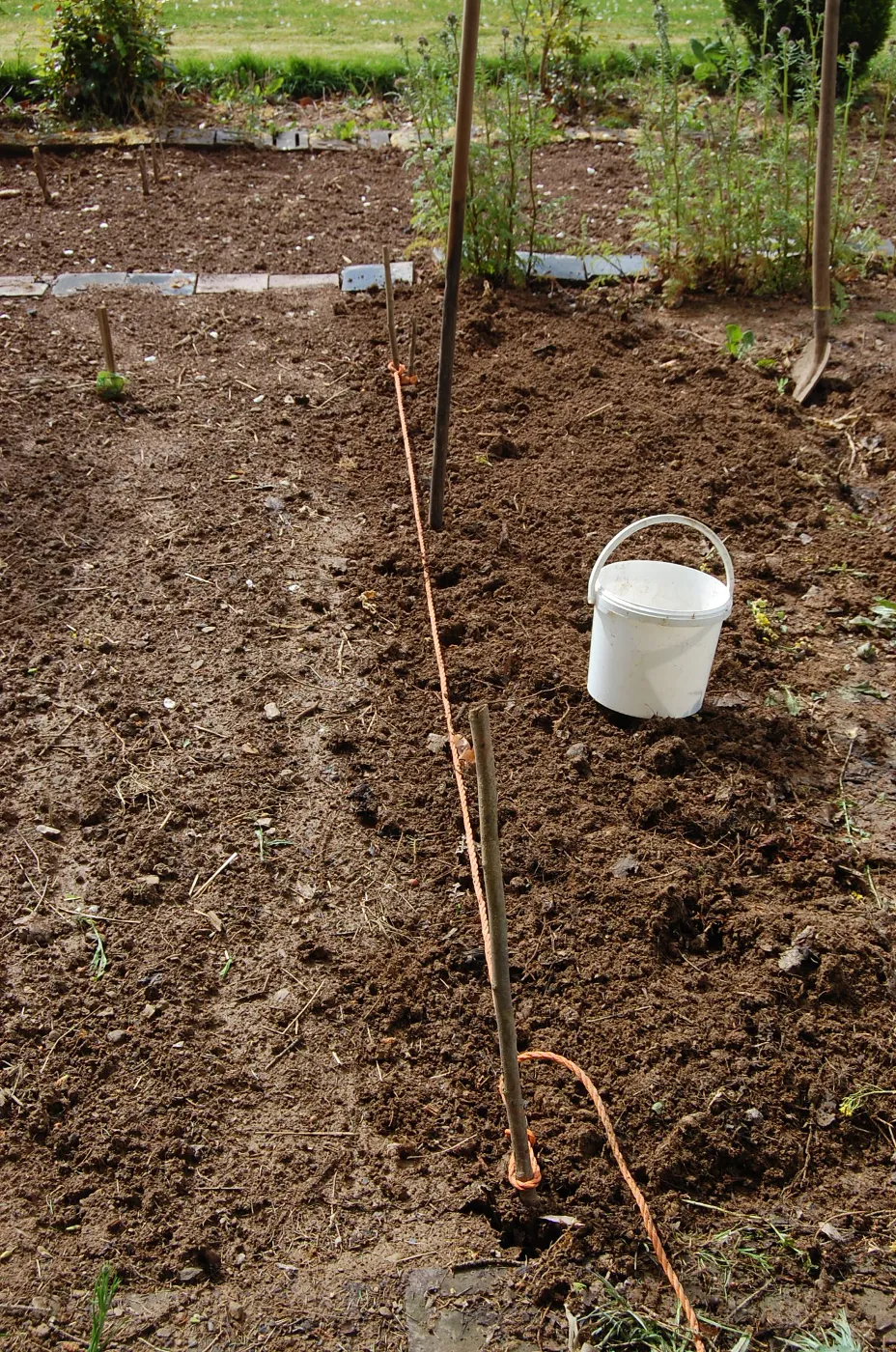
Marking a bed with string
Soil preparation and marking of future rows for sowing or planting using stretched string (garden line). An example of a traditional method of garden layout for obtaining even beds.
The main features of the traditional approach:
- emphasis on self-sufficiency and seasonality;
- manual labor and simple tools;
- use of local varieties and one’s own seeds;
- manure, compost, ash, and green manure as the main sources of fertility;
- crop rotation and companion planting;
- gradual accumulation of knowledge “from neighbor to neighbor.”
In agronomic literature, such techniques are well described: for example, textbooks on fruit growing and vegetable growing emphasize the role of crop rotation, organic fertilizers, and choosing the right variety for a specific zone (Kurennoy et al. 1985; Mukhortov, Nozdracheva 2017). The “Practical Course in Fruit Growing” separately discusses schemes for growing seedlings, crown formation, and care of berry plantings—many of these techniques are still used in small holdings (Tarasov 1981).
Advantages of the traditional approach: low dependence on purchased inputs, good adaptation to local conditions, resilience in unfavorable years, and family continuity. Limitations: high labor intensity, yields often lower than with intensive methods, weak mechanization, and dependence on weather. At the same time, a traditional holding is not necessarily “organic” by certification: it may use mineral fertilizers and plant protection products if that is how it has historically developed.
Note. Tradition is not a frozen set of rules. Even old dachas gradually acquire drip irrigation, covering material, and new varieties. Therefore, traditional gardening should be viewed as a foundation that can be improved, not as a museum exhibit.
2. Intensive: Maximum Yield per Meter
Intensive gardening and vegetable growing aims to obtain as much produce as possible per unit of area and time. This is not necessarily “chemicals,” and it is not necessarily large fields. A small vegetable garden can also be intensive if plantings are properly densified, vertical space is used, and greenhouses, raised beds, and succession sowings are employed.
Main techniques:
- Dense plantings. Plants are placed closer than in traditional schemes, but taking their biology into account. “Producing Vegetable Crops” shows that even a plot of 25 × 25 feet (about 7.6 × 7.6 m) can provide a significant supply of vegetables if succession plantings and intercropping are used (Swiader, Ware 1992).
- Intercropping and densification. Early crops (lettuce, radishes, beans) are planted between rows of later crops (tomatoes, corn). By the time the later crops grow large, the early ones have already been harvested (Swiader, Ware 1992).
- Succession sowings. Leaf lettuce, radishes, dill, and other fast-maturing crops are sown in waves every 2–4 weeks to obtain fresh produce continuously (Swiader, Ware 1992).
- Raised beds. They warm up faster and drain better, but in summer they can dry out and serve as shelter for slugs (Morgan 2021). Therefore, a mulch layer and regular watering are important.
- Vertical use of space. Trellises, arches, pergolas, and containers make it possible to occupy not only the ground but also the air (Hemenway 2009).
- Greenhouses and covers. They extend the season, protect against frosts, and allow heat-loving crops to be grown in regions with short summers.
- Intensive orchards. In fruit growing, these are dense planting schemes, dwarfing rootstocks, palmettes, cordons, and “meadow orchards.” They provide early entry into bearing and high yields but require watering, feeding, pruning, and skill (Kurennoy et al. 1985).
The intensive approach can be very effective, but it has a price. First, it requires more knowledge and attention: a mistake with watering or nutrition quickly reduces yield. Second, high yields remove many nutrients from the soil, so organic matter must be returned and fertility maintained. Third, intensity does not equal sustainability: monoculture and overloading the soil increase the risk of diseases and pests. Permaculture literature notes that biointensive methods give high yields, but producing compost may require 3–4 times more land than the crops themselves (Hemenway 2009). This is an important reminder about the ecological footprint.
Note. An intensive holding does not have to be chemical. Dense plantings can be combined with compost, mulch, biological protection methods, and precise irrigation. Conversely, “intensity” without organic matter quickly turns into soil depletion.
Key idea. Traditional gardening provides resilience and a foundation in local experience. Intensive gardening provides record yields from a small area but requires resources and management. The name of the method does not matter. What matters is that it works for you: in your climate, on your soil, with your time and energy.


LCD 4-in-1 Soil Tester
Check essential growing conditions with one compact tool. Measure soil pH, moisture, temperature and light intensity — ideal for gardens, potted plants and greenhouses.
- 4-in-1 measurement
- Easy-to-read LCD display
- Portable design
Affiliate link · For indicative measurements only.
3. Ecological: Minimum Chemicals, Maximum Nature
Ecological gardening is an approach in which the garden is viewed as an ecosystem, not as a collection of separate beds. The main idea: if the right conditions are created, nature itself will do most of the work. An ecological garden is not just “without chemicals”; it is a garden where the connections among plants, soil, insects, and animals work toward the result (Hemenway 2009).
Key principles

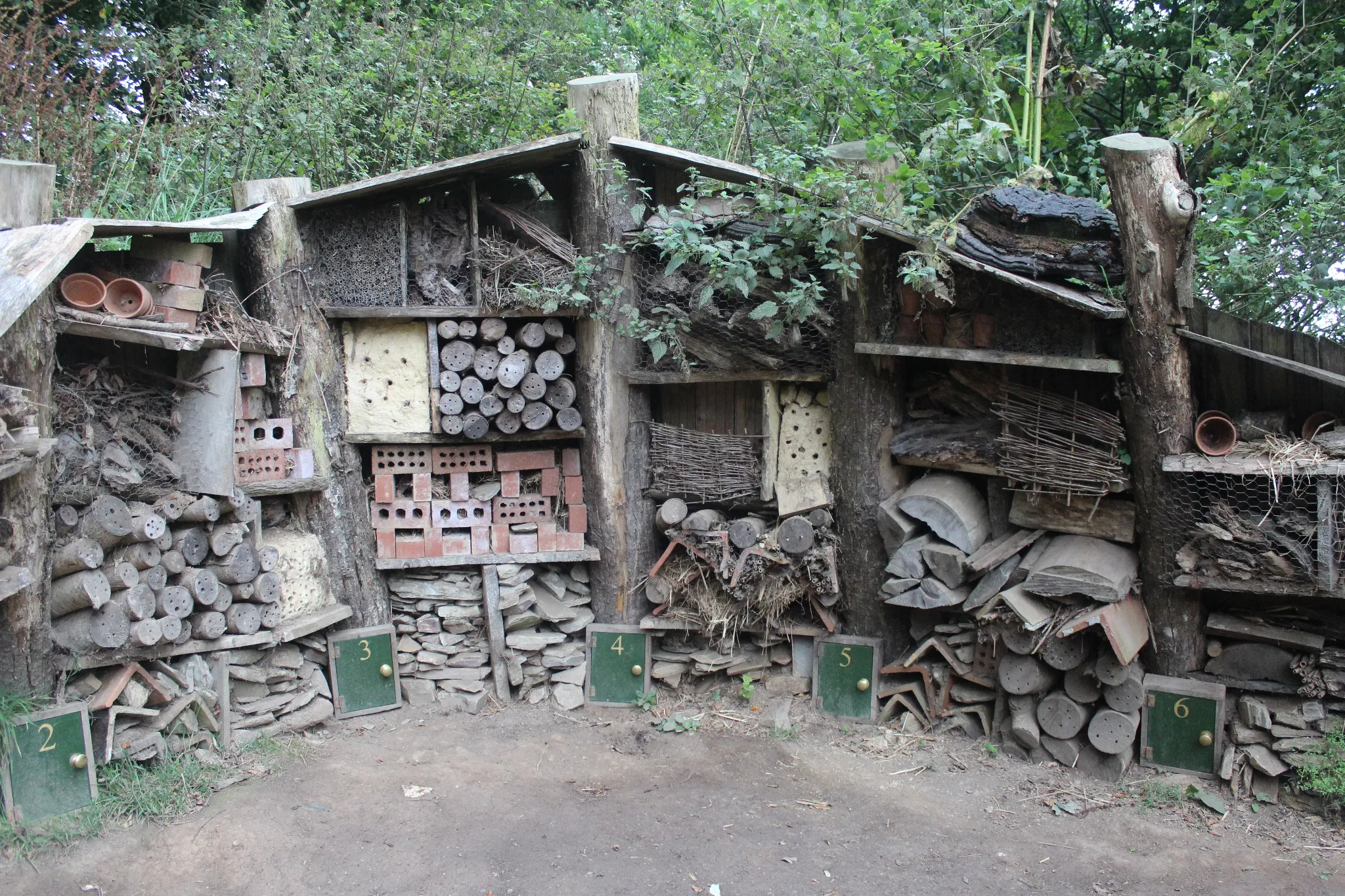
Insect hotel at the Heligan Gardens
A large-scale insect hotel located in the Lost Gardens of Heligan (Cornwall, UK). The structure is assembled from a variety of natural and artificial materials (wood, stone, brick, straw), which creates conditions for various insect species to live. It is a working device for maintaining biodiversity.
- Soil health is the foundation of everything. In the ecological approach, soil is a living system. Fungi, bacteria, protozoa, nematodes, earthworms, and other organisms process organic matter and make nutrients available to plants. Deep mulching, compost, green manure, and refusal of deep digging support this system (Lowenfels, Lewis 2010).
- Biodiversity. The more different plants there are, the more resilient the garden. Different species attract different beneficial insects, birds, and microorganisms. In an ecological garden there are no “empty” areas: every corner performs several functions (Hemenway 2009).
- Minimal intervention. Instead of fighting nature, work with it. Instead of spraying against pests, create conditions for their natural enemies. Instead of digging, use mulch and green manure.
- Multifunctional plants. Each plant in an ecological garden performs not one but several tasks: it yields a harvest, attracts beneficial insects, improves the soil, and creates shade or shelter for wildlife (Hemenway 2009).
- Closed cycles. Waste from one element becomes a resource for another. Mown grass becomes mulch, kitchen waste becomes compost, pruned branches become shelter for insects.
What it looks like in practice
An ecological garden can be small or large. On a small plot, it may be several beds with dense plantings, a compost heap, rain barrels, and a corner with wild plants. On a larger plot, it may be a fruit orchard with an understory of berry plants, a hedge, a pond, and a wildlife area. Studies show that even an ordinary garden can support more than 2,000 species of plants and animals (Owen, cited in Pratt 2005). In one study of an urban garden in Leicester, about 2,200 species were recorded over 15 years (Pratt 2005).
Why it works

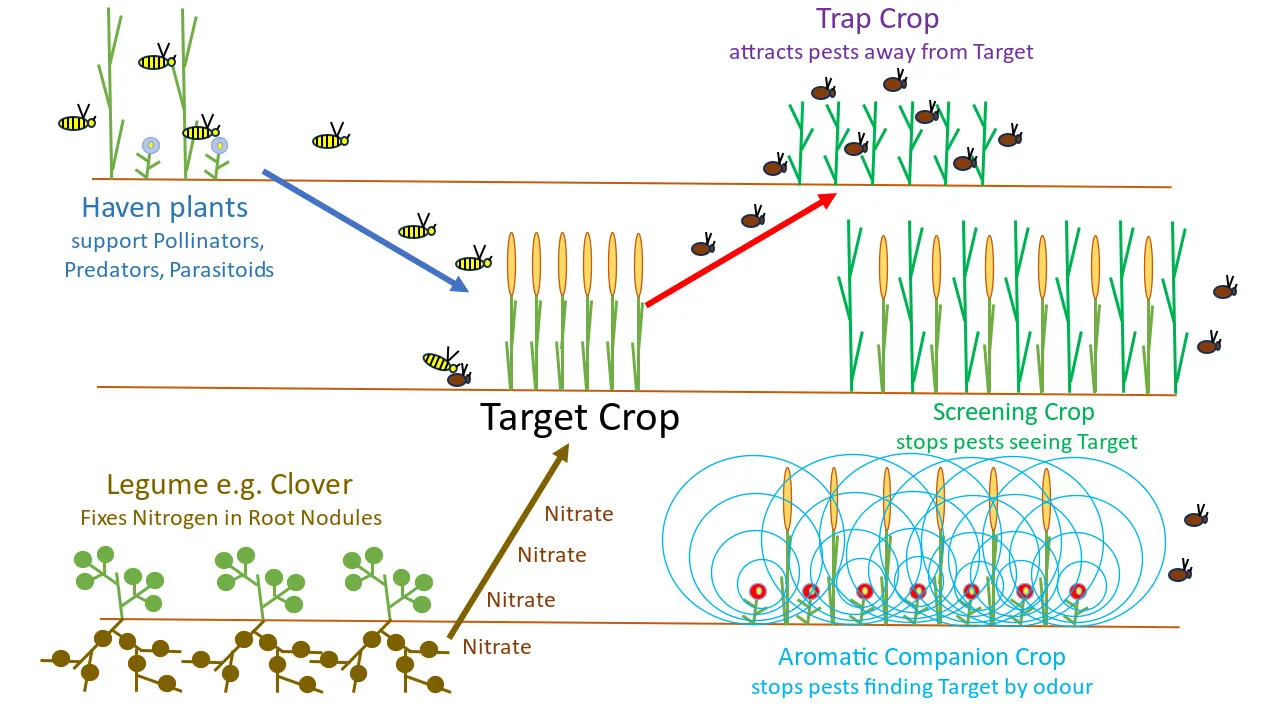
Mechanisms of companion planting (companion cropping)
A diagram demonstrating various agronomic techniques for protecting target crops (Target Crop) and attracting beneficial fauna. It shows mechanisms such as the use of haven plants to support pollinators and predators, trap crops to divert pests, screening crops that block the visual search of pests, and aromatic companion plants that mask the scent of the target. The role of legumes (clover) in nitrogen fixation is also shown.
The ecological approach relies on scientific data. Studies show that diversity of plants and soil life reduces the risk of pest and disease outbreaks. In ecosystems with high biodiversity, predators and parasites control the numbers of herbivorous insects. In a garden with diverse flowers, herbs, and shrubs, beneficial insects find food and shelter all year round (Hemenway 2009).
The diagram below shows how different types of plants (trap, screening, and aromatic crops) interact with pests and beneficial fauna to protect the main crop.
Note. Ecological gardening is not synonymous with a “neglected” garden. It requires observation and planning. It is important to understand which plants suit your climate and soil and how they interact with each other. This is not a refusal of care but a different type of care—more attentive and less costly.
4. Organic: Certification, Rules, Philosophy
Organic gardening and vegetable growing is a system that has not only practical but also legal framework. Unlike the ecological approach, organic farming often implies compliance with certain standards and obtaining a certificate. However, for a home gardener, organic farming is primarily a philosophy and a set of rules that can be applied without certification.
What organic farming is
According to the definition of IFOAM — Organics International, organic agriculture is a production system that sustains the health of soils, ecosystems, and people. It relies on ecological processes, biodiversity, and cycles adapted to local conditions, rather than on inputs with side effects (Morgan 2021). In organic farming, synthetic fertilizers, pesticides, herbicides, and GMOs are prohibited. Instead, compost, manure, green manure, biological plant protection methods, mechanical cultivation, and crop rotation are used.
Basic rules of organic farming

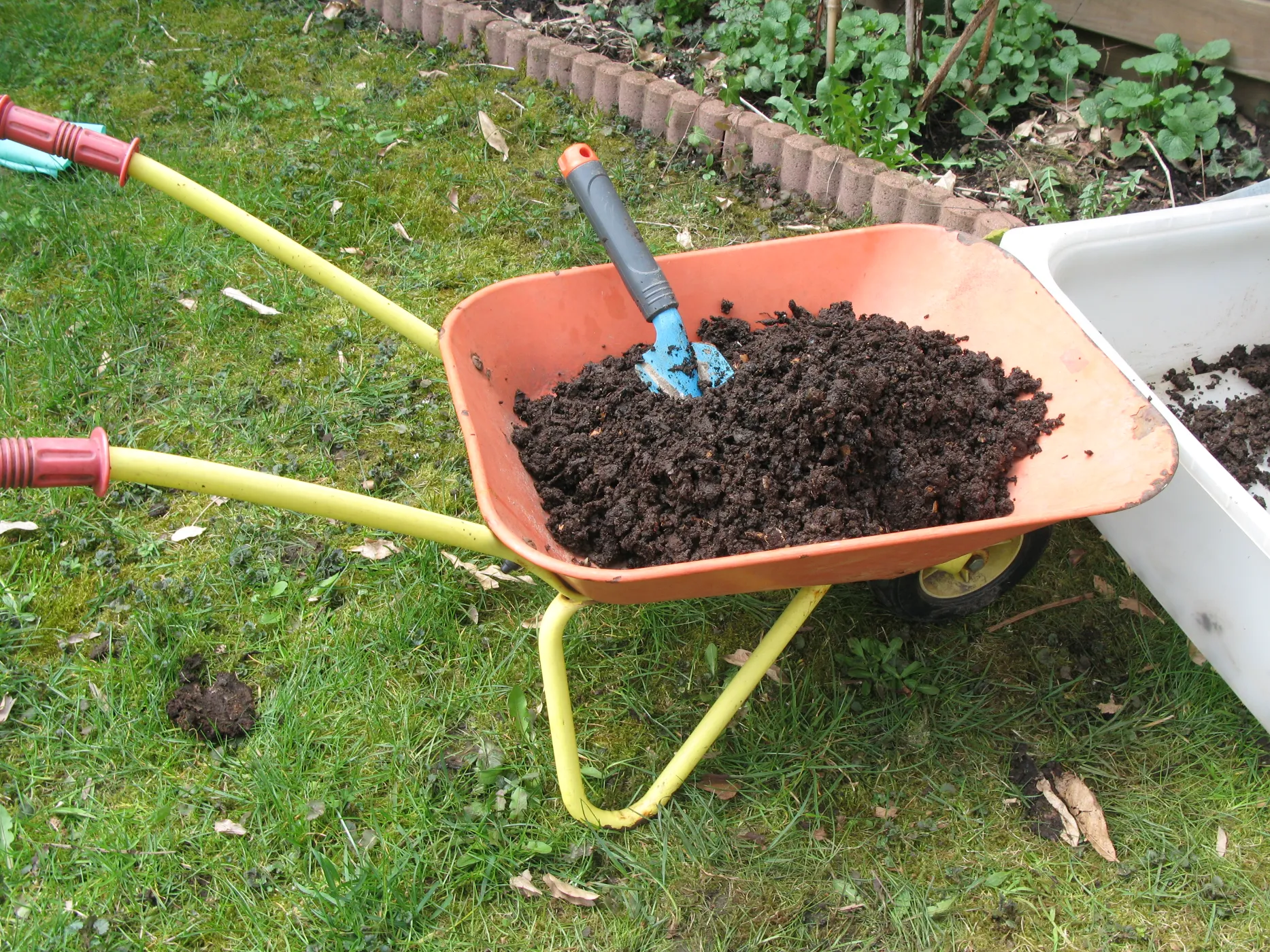
Sifted compost in a garden wheelbarrow
A garden wheelbarrow filled with finished compost after sifting. Sifting allows large undecomposed fractions to be removed and a uniform organic fertilizer ready for application to be obtained.
- Soil fertility is maintained through organic matter: compost, manure, green manure, mulch, and vermicompost.
- Plant protection is built on prevention: proper crop rotation, resistant varieties, attraction of beneficial insects, and biological preparations.
- Weeds are controlled by mulching, hand weeding, and green manure, not by herbicides.
- Animals are kept in conditions that meet their behavioral needs and receive organic feed.
- Certification is required to sell products as organic. For a personal garden, it is enough to follow the principles.
How organic differs from ecological
The boundaries between these approaches are blurred. Ecological gardening is more about design and connections in the ecosystem. Organic farming is about specific permitted and prohibited materials and methods. One can run an ecological holding without undergoing certification, and one can be certified organic but not pay much attention to ecosystem connections. In practice, the best results come from those who combine both approaches: build an ecosystem and follow organic rules (Morgan 2021).
Why it matters
Organic farming is not only safer for health but often produces higher-quality products. Studies show that organic vegetables and fruits contain more vitamins and minerals than those grown by intensive methods (Morgan 2021). In addition, organic methods improve the soil: it retains water better, erodes less, and contains more carbon. This is a contribution to combating climate change.
Note. Organic farming is not just “without chemicals.” It is a system in which every decision is made taking into account its impact on soil, water, air, and biodiversity. For a home gardener, this means: do not rush to treatments; first understand the cause of the problem, and then look for a solution that does not destroy the ecosystem.
Key idea. Ecological gardening is about creating a resilient system where nature works for you. Organic gardening is about following rules that make this system safe and certifiable. Both approaches lead to healthy soil, clean produce, and a sustainable garden. Choose not the name but what suits your plot and your goals.

Solar Automatic Drip Irrigation Kit for Gardens
Automate watering for pots, gardens and small greenhouses. This solar-powered system features a timer to help schedule water delivery to your plants.
- Solar-powered
- 15 m irrigation hose
- Programmable watering
Affiliate link · Check included accessories.
5. Natural: No-Dig, Mulch, Minimal Intervention
Natural gardening is an approach in which the gardener tries to interfere as little as possible in the life of the soil and plants. The main principle: do not dig, do not turn over the soil layer, do not destroy what nature has built over years. In English-language literature this approach is called no-dig or no-till. In Russia and CIS countries it is known as “natural farming” or “minimum tillage.”
Where this approach came from
The idea is not new. Back in the mid-20th century, the American gardener Ruth Stout proposed the “no-work, deep mulch” method—a thick layer of mulch all year round, without digging (Morgan 2021). In Great Britain, Charles Dowding developed and popularized the no-dig system for vegetable growing. The essence is simple: instead of digging the soil, you simply add compost or mulch on top, and soil life does all the work itself (Morgan 2021).
Why it works
When soil is dug, its structure is destroyed. Fungal threads (hyphae) that run through the soil and help plants obtain water and nutrients are torn. Earthworms die or migrate. Carbon stored in the soil oxidizes and escapes into the atmosphere. With no-dig, none of this happens. The soil remains alive, porous, and able to hold water and air (Lowenfels, Lewis 2010).
Studies show that soil managed on the no-dig principle contains more organic carbon, retains moisture better, and is less prone to erosion. In addition, it has greater diversity of soil microorganisms (Morgan 2021). In the book “Teaming with Microbes,” the authors emphasize: soil health is determined not by the amount of fertilizer applied but by the diversity and activity of soil life (Lowenfels, Lewis 2010).
Mulch is the main tool

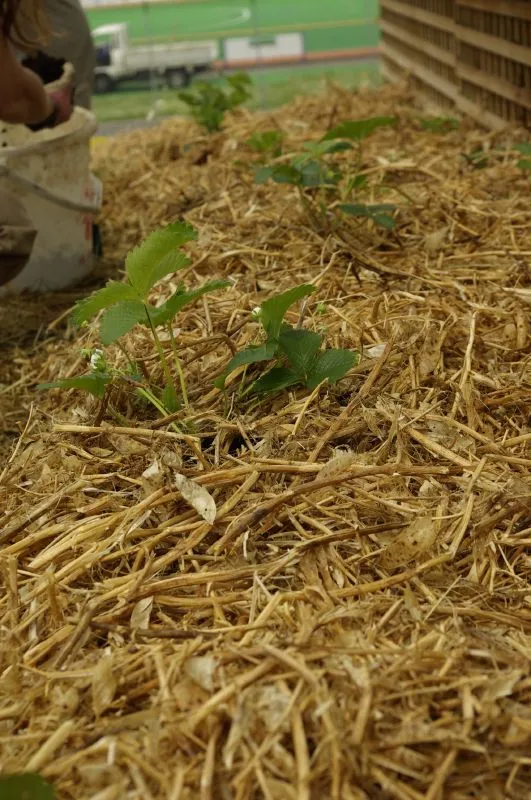
Mulched bed using the "no dig" method (No dig garden)
Close-up of a bed managed according to the "no dig" principle (no dig garden). Young strawberry bushes grow directly from a thick layer of straw mulch. The "no dig" technology aims to preserve soil structure and its microbiota by avoiding mechanical tillage.
Mulch is a layer of organic material on the soil surface. It performs several functions:
- preserves moisture by reducing evaporation;
- suppresses weeds;
- protects the soil from overheating and overcooling;
- gradually decomposes and feeds soil organisms;
- improves soil structure.
Suitable materials for mulching include compost, leaf mold, straw, mown grass, wood chips, bark, and wood shavings. The layer is usually 5–10 cm thick. It is important not to mulch right up to trunks and stems to avoid rotting (Morgan 2021).
Hügelkultur and controversial methods
Hügelkultur is a raised bed whose base consists of woody residues (branches, logs) covered with compost and soil. It is believed that such a bed holds moisture and gradually releases nutrients. However, scientific data on this method are limited. In “The Science of Gardening,” Linda Chalker-Scott notes that some permaculture and natural practices do not have a rigorous scientific basis and may be counterproductive (Chalker-Scott 2018). For example, lasagna beds (layers of cardboard and compost) can impede the movement of water and air in the soil (Chalker-Scott 2018). This does not mean the method does not work—it means it should be used with caution and the results observed.
Who natural gardening suits
No-dig is convenient for busy gardeners, people with physical limitations, and those who want to preserve soil and reduce labor. It works well on small plots, in greenhouses, and on raised beds. But there are also limitations: on heavy clay soils, improving structure without digging may take more time. In a dry climate, mulch helps preserve moisture but requires regular replenishment.
Note. Natural gardening is not a refusal of care. It is a different type of care: observation, mulching, adding compost, maintaining living soil cover. The main thing is not to interfere with the soil’s work.
6. Permaculture: Design, Resilience, Self-Maintenance
Permaculture is a design system that combines agriculture, ecology, architecture, and social practices. The term was proposed by Australians Bill Mollison and David Holmgren in the 1970s. It was originally a contraction of “permanent agriculture,” but later the meaning expanded to “permanent culture”—a sustainable culture in the broad sense (Hemenway 2009).
Main idea
Permaculture is not a set of ready-made recipes but a way of thinking. It is based on observing natural systems and transferring their principles to the garden, vegetable plot, and homestead. The goal is to create a system that maintains itself, requires minimal external resources, and provides maximum benefit (Hemenway 2009).
Key principles

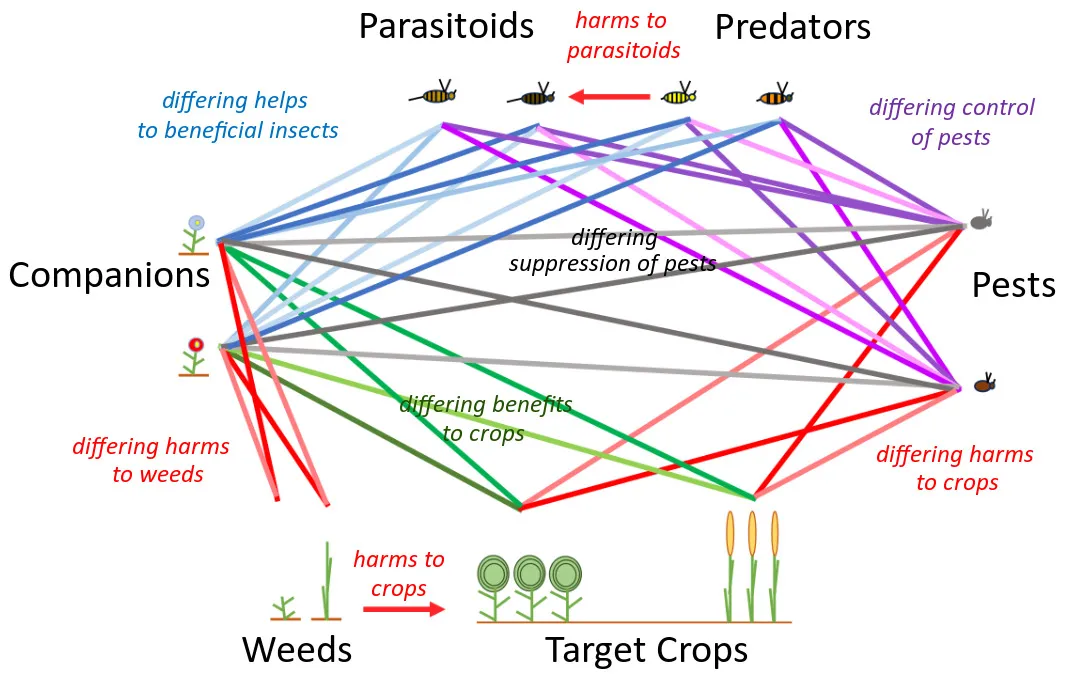
Complex network of interactions in a companion planting system
A diagram showing the multiple ecological relationships between companion plants, target crops, weeds, pests, and beneficial insects (parasitoids and predators). Multicolored lines illustrate various effects: from helping beneficial insects and suppressing pests to various harm caused to crops or weeds. The diagram explains why scientific evaluation of companion cropping is a complex and slow process due to the many variables.
In “Gaia’s Garden,” Toby Hemenway formulates the principles of ecological design that underlie permaculture:
- Observation. Before changing anything, study the site: relief, soil, water, sun, wind, existing plants and animals.
- Connections. What matters is not the number of elements but the connections between them. A garden is a network, not a collection of separate beds.
- Each element performs several functions. For example, a hedge can be a windbreak, a source of berries, shelter for birds, and material for mulch.
- Each function is supported by several elements. If one source of food or shelter disappears, others will replace it.
- Use of biological resources. Instead of purchased fertilizers and pesticides—compost, green manure, beneficial insects, animals.
- Minimization of waste. Everything produced in the garden should find a use.
- Design from large to small. First zones and sectors, then beds and plants (Hemenway 2009).
This diagram illustrates the complexity of ecological connections in permaculture design: from attracting beneficial insects to weed suppression.
Zones and sectors
Permaculture offers a convenient planning scheme—zones and sectors. Zones are concentric circles around the house that determine how often you visit a given place. Zone 1 is closest to the house; there grow things that require constant attention: greens, culinary herbs, berries. Zone 2 is the vegetable garden and fruit bushes. Zone 3 is the fruit orchard and field. Zone 4 is pasture and forest. Zone 5 is wild nature, untouched territory (Hemenway 2009).
Sectors are external influences: sun, wind, water, view, neighbors. They are taken into account in planning to use advantages and mitigate disadvantages.
Guilds and food forest
One of the most famous elements of permaculture is guilds, or plant communities. A guild is a group of plants that help each other. For example, around an apple tree, one can plant green manure that fixes nitrogen, herbs that attract beneficial insects, and groundcovers that mulch the soil. Together they create a resilient system (Hemenway 2009).
A food forest is a multi-layered system that imitates the structure of a natural forest. The upper layer is tall trees; below are medium trees, shrubs, herbaceous plants, groundcovers, root crops, and vines. Each layer yields a harvest and performs ecological functions (Hemenway 2009).
Criticism and reality
Permaculture is not only a practice but also a philosophy. In “The Science of Gardening,” Linda Chalker-Scott notes that some permaculture claims lack scientific confirmation, and certain practices are outdated (Chalker-Scott 2018). This is important to take into account: not everything called permaculture is equally effective. But the idea of design based on observation and connections remains valuable.
Who permaculture suits
Permaculture works well on large plots where one can create a food forest, pond, hedges, and wildlife areas. But its principles are also applicable on a small plot: containers, vertical beds, compost, rainwater. What matters is not scale but approach.
Note. Permaculture is not a religion or a dogma. It is a set of tools and principles. You can take from it what suits your plot and not follow all recommendations blindly. The best permaculture design is the one that works for you.
Key idea. Natural gardening teaches us not to interfere with the soil. Permaculture teaches us to design connections. Both approaches lead to sustainability but by different paths. Choose what corresponds to your conditions, goals, and time.

7-in-1 Wi-Fi Weather Station
Monitor local weather conditions with a wireless outdoor sensor. Track temperature, humidity, rainfall, wind speed and direction, and atmospheric pressure. Ideal for gardens, farms and greenhouses.
- Wireless outdoor sensor
- Solar-powered
- Wi-Fi connectivity
Affiliate link · Check regional compatibility.
7. Biodynamic: Philosophy, Preparations, Rhythms
Biodynamic farming is a movement that arose in the 1920s based on lectures by the Austrian philosopher Rudolf Steiner. It is one of the first forms of the organic movement, but with its own special philosophy. Biodynamics views the holding as a single living organism in which soil, plants, animals, and cosmic rhythms are connected into a whole.
Key features
- Preparations. Biodynamics uses special preparations made from natural materials: cow manure, silica, yarrow, chamomile, dandelion, valerian, nettle, and other herbs. They are applied to the soil or plants in homeopathic doses. They are believed to stimulate the life forces of soil and plants.
- Rhythms. Great attention is paid to the lunar and stellar calendar. Sowing, planting, and harvesting are planned taking into account the phases of the Moon and the positions of constellations. Proponents claim this affects the taste, storability, and nutritional value of produce.
- Closed cycle. The holding must be self-sufficient: feed and fertilizers are produced within it, not purchased from outside. This echoes the principles of organic and permaculture approaches.
What science says
Scientific studies of biodynamic preparations and lunar calendars give contradictory results. Some experiments show a positive effect on soil fertility and yield, but it is often difficult to separate it from the overall influence of organic methods. In academic literature, biodynamics is more often considered a philosophical and social system rather than a strictly proven agrotechnology. Nevertheless, many practices—composting, green manure, crop rotation, refusal of synthetic inputs—coincide with organic and ecological approaches and have proven effective (Morgan 2021).
Who it suits
Biodynamics attracts those who seek not only a practical result but also a spiritual connection with the land. It requires time to prepare preparations, attention to rhythms, and willingness to follow certain rules. For a home gardener, it can be an interesting experience, but not necessarily the only path to a healthy garden.
Note. Biodynamics is not just “organic farming with preparations.” It is a holistic worldview. If you do not share the philosophy but want to use individual techniques (for example, compost preparations), that is also possible. The main thing is that the method works in your conditions.
8. Hydroponics and Aeroponics: Without Soil
Hydroponics and aeroponics are methods of growing plants without soil. Instead of soil, the roots receive a nutrient solution containing all necessary elements. This makes it possible to control conditions and obtain high yields in limited areas, even in cities.
Hydroponics
In hydroponics, plant roots are in a nutrient solution or in an inert substrate (mineral wool, expanded clay, perlite, coconut fiber) that is regularly moistened with the solution. Plants receive nutrition directly, so they grow faster and often produce more fruit than in soil. In protected ground, hydroponics is widely used for cucumbers, tomatoes, lettuce, and greens. According to Mukhortov and Nozdracheva (2017), in greenhouse complexes in Russia and abroad, low-volume technologies on mineral wool make it possible to obtain up to 30 kg/m2 of cucumbers and up to 26 kg/m2 of tomatoes. In Great Britain by 1995, 80% of greenhouse cucumbers and 50% of tomatoes were grown hydroponically.
Aeroponics
Aeroponics is a type of hydroponics in which roots hang in the air and are periodically sprayed with nutrient mist. It is an even more water-efficient method, but it requires complex equipment and constant monitoring. Aeroponics is still less often used in amateur gardening but finds application in commercial greenhouses and research projects. An example of underwater plant cultivation is the Nemo’s Garden project in Italy, where plants grow in underwater biospheres (Hobhouse 2004).
Advantages and limitations
Pros of hydroponics and aeroponics:
- no soil is needed; can be grown indoors, on roofs, in containers;
- water savings (the solution circulates);
- no weeds and many soil-borne diseases;
- high yield per small area;
- possibility of year-round production.
Cons:
- nutrient solutions, equipment, and electricity are required;
- mistakes in solution concentration quickly kill plants;
- high initial investment cost;
- not all crops are suitable for hydroponics (root crops, for example, are more difficult);
- taste and quality of produce may differ from that grown in soil.
Who it suits
Hydroponics is a good choice for urban conditions, for those who want to grow greens and vegetables year-round, and for commercial greenhouses. For a traditional gardener with good soil, it may be excessive. But as a supplement—for example, for winter greens on a windowsill—it is quite justified.
Note. Hydroponics does not make soil unnecessary. It is an alternative for specific conditions. If you have a healthy plot, soil-based methods are often simpler and cheaper. If space is limited or the climate does not allow it, hydroponics can be a solution.
Key idea. Biodynamics is philosophy and rhythms; hydroponics is technology and control. Both approaches have a right to exist. Choose the one that corresponds to your goals, resources, and beliefs.

40W Full Spectrum LED Grow Light
Support healthy plant growth with full-spectrum LED lighting. Ideal for seedlings, indoor plants and small growing spaces. A practical solution for indoor gardening and year-round cultivation.
- Full-spectrum LED
- Energy-efficient design
- Indoor plant growing
Affiliate link · Check actual power and light coverage.
9. Mixed Forms: Most Often That Is How It Is
In real life, pure forms are almost never found. A gardener who started with traditional beds gradually adds mulch, compost, green manure, drip irrigation, raised beds, and elements of permaculture. A vegetable grower enthusiastic about natural farming may still use a greenhouse, mineral fertilizers during the seedling period, or hydroponics for winter greens. This is normal.
Mixed forms arise for several reasons. First, the plot is heterogeneous: in some places heavy clay, in others sand, in some shade, in others sun. Second, goals change: today you need to feed the family, tomorrow to sell surplus, the day after tomorrow to rest in the garden. Third, knowledge and possibilities change. What worked ten years ago may not work now.
This is clearly visible in the literature. Ecological design uses zones and sectors to link different elements into a single system (Hemenway 2009). Organic rules set a framework but do not prohibit combining methods (Morgan 2021). Intensive techniques—densification, intercropping, succession sowings—combine perfectly with mulch and compost (Swiader, Ware 1992). Natural farming can be part of a permaculture project, and hydroponics can be a supplement to a greenhouse (Lowenfels, Lewis 2010; Mukhortov, Nozdracheva 2017).
What matters is something else: a mixed form does not mean “everything at once.” It is a conscious choice. If you use a preparation or technique, it is useful to understand why it is needed and how to verify its effectiveness. In “The Science of Gardening,” it is emphasized: the burden of proof lies with the one who recommends a method, not with the one who doubts it (Chalker-Scott 2018). So mixing is allowed, but better with observation and verification.
Note. The name of a form is needed not for self-identification but for communication. It helps explain to a neighbor what you are doing and find like-minded people. But if the name gets in the way of working, you can abandon it.
10. How to Choose Your Form
Choosing a form is not choosing a religion. It is choosing a tool for a specific task. To avoid mistakes, it is useful to answer several questions for yourself.
1. What is your goal?
If you need to feed a family, traditional, intensive, ecological, and natural approaches will work. If you plan to sell produce, certification is important: organic farming requires compliance with standards (Morgan 2021). If the main thing is relaxation and beauty, you can think less about yield records.
2. How much time and energy do you have?
Intensive and biodynamic gardening require attention. Natural farming and mulching save effort but require time for preparation. For people with limited mobility, raised beds, containers, and no-dig are suitable (Morgan 2021).
3. What are your climate and soil like?
In a dry climate, mulch, drip irrigation, and drought-resistant crops are important. In a cold one—greenhouses, covers, early varieties. On heavy clay, compost, green manure, and a gradual transition to no-dig help. On sand—organic matter and regular watering.
4. What is your experience?
It is better to start small. In permaculture this is called “growing by chunking”: first a small plot, then expansion (Hemenway 2009). In the book “The Garden and Vegetable Plot in Drawings and Comics,” they advise in the first season to remove sod, create beds, plant annuals, and keep areas for perennials under black fallow (Trannua 2018). This is a reasonable start.
5. What are you ready to do regularly?
One method requires daily watering, another weekly pruning, a third preparing preparations. Choose what will not become a burden.
6. Do you have a market or community?
If there is a farmers’ market, cooperative, or neighbors ready to exchange produce nearby, this influences the choice. A certified organic holding pays off better when selling (Morgan 2021).
7. Are you ready to observe and change?
The best method is the one you have tested on your own plot. Start small, record results, compare. In a season or two it will become clear what works.
Note. Do not be afraid to change form. A garden is a living system. What suited you five years ago may not suit you today. Flexibility is not weakness but an advantage.
Key idea. Form is a tool, not a religion. It does not matter what your method is called. What matters is that it works for you: gives a harvest, preserves soil, pleases you, and does not exhaust your strength. Choose what corresponds to your goals, conditions, and values. The rest are details.
11. Regional Aspect: Different Forms Prevail in Different Climates and Cultures
The form of gardening never exists in a vacuum. It is determined by climate, soil, history, economy, and culture. What works in some conditions may be completely unsuitable in others. Therefore, when choosing an approach, it is important to take regional context into account.
Climate and natural conditions
In regions with cold winters and short summers, greenhouses, covers, early varieties, and the seedling method prevail. In “Grow Fruit,” it is emphasized: apples and pears grow well wherever there is a sufficient period of winter dormancy, while citrus fruits grow only in warm regions or in containers (Buckingham 2010). In arid zones such as the southwestern United States, Australia, or the Mediterranean, mulch, drip irrigation, drought-resistant plants, and water-saving technologies become key (Johnson 2023). In the tropics and subtropics, moisture retention, drainage, erosion protection, and rapid decomposition of organic matter are important.
Cultural traditions
Different forms have historically developed in different countries. In Russia and post-Soviet countries, dachas and personal subsidiary plots play a huge role. According to Rozmainsky et al. (2017), household farms account for more than 80% of potato production, about 80% of vegetables, fruits, and berries, and almost 94% of honey. The dacha is not just a vegetable plot but a social institution, a place of rest, production, and communication (Rozmainsky et al. 2017).

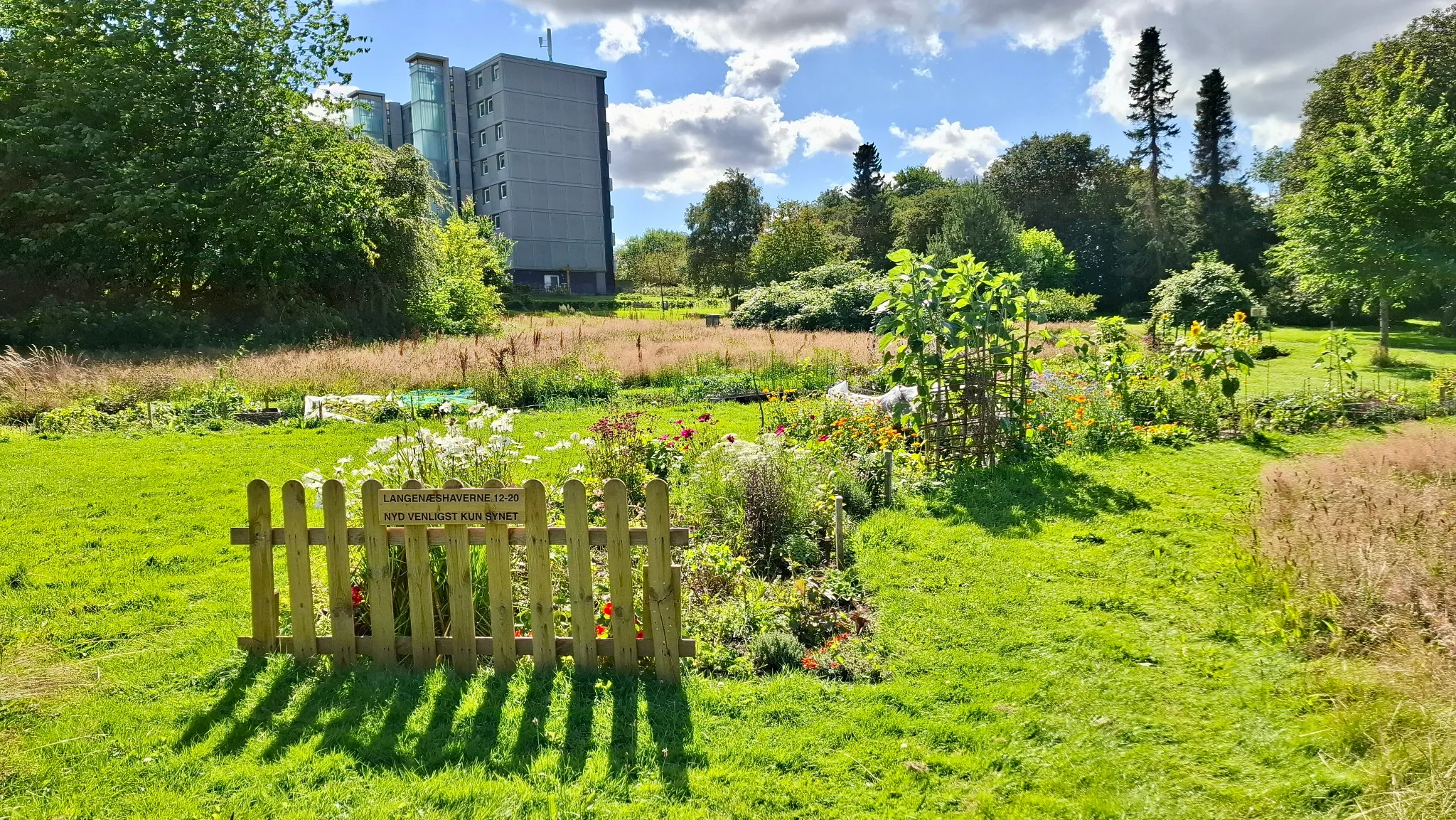
Community vegetable garden in Langenæs Park: flowering beds (Aarhus, Denmark)
A view of the community urban vegetable gardens in Langenæs Park, the city of Aarhus, Denmark. In the foreground is a wooden fence with a sign "LANGENÆSHAVERNE 12-20" enclosing a plot with various flowers and plants. In the distance, residential buildings, park plantings, and plots of other gardeners are visible. The sign reminds that the harvest is grown by local residents and is intended for visual enjoyment only.
In Japan, where 90% of the population lives in cities, urban farming is developing as a way to connect with nature and provide fresh produce. A study in Okinawa showed that most urban residents garden around their homes and on balconies rather than in community gardens (Chen et al. 2024). In Europe and North America, community gardens are widespread—public gardens that perform not only a food-producing but also a social function (Hume et al. 2022).
In India and other countries with ancient gardening traditions, forms associated with religious and cultural practices are preserved. Mughal gardens, for example, were built on the principle of four terraces with water in the center, symbolizing paradise (Randhawa 1981). These traditions influence modern gardening and landscape design.
Economy and resource availability
In developed countries with high land and labor costs, intensive methods, hydroponics, and container growing prevail. In regions with cheap land and labor, traditional methods may be more economically advantageous. In low-income countries, personal subsidiary plots are often the foundation of food security (Hume et al. 2022).
Historical context
History also influences the choice of form. In the USSR, collective gardening and dachas were a way to alleviate food shortages. In the post-Soviet period, the economic role of dachas not only persisted but strengthened. As researchers note, “dachaization” became a form of deurbanization and adaptation to market conditions (Rozmainsky et al. 2017). At the same time, in Western Europe and North America, community gardens developed as part of urban planning and the environmental movement (Hume et al. 2022).
Note. The regional aspect does not mean that one should blindly follow traditions. It means that local conditions should be taken into account. If it is customary in your region to grow certain crops and use certain methods, this often has practical sense. But tradition does not cancel experimentation.
12. Conclusion: Form Is a Tool, Not a Religion
We have examined twelve forms of gardening and vegetable growing. Each has its strengths, limitations, and area of application. Traditional gardening provides resilience and a foundation in local experience. Intensive gardening provides high yields from a small area. Ecological gardening provides a resilient system where nature works for you. Organic gardening provides rules and certification. Natural gardening provides minimal intervention and healthy soil. Permaculture provides design and connections. Biodynamics provides philosophy and rhythms. Hydroponics provides technology and control. Mixed forms provide flexibility and adaptation.
Key idea
It does not matter what your method is called. What matters is that it works for you. Form is a tool, not a religion. It is needed not for self-identification but for solving specific tasks: obtaining a harvest, preserving soil, saving time, and realizing values.
What really matters
- Soil health. Any form that depletes the soil will sooner or later lead to problems. Compost, mulch, green manure, and crop rotation are universal principles that work in any system (Lowenfels, Lewis 2010; Morgan 2021).
- Observation. Before changing anything, study the plot. Understand what grows where, where the shade is, where water flows, and what pests and beneficial insects are present. Observation is the foundation of any successful garden (Hemenway 2009).
- Flexibility. A garden is a living system. What worked last year may not work this year. Be ready to change methods, try new things, and abandon what does not produce results.
- Realism. There is no ideal form. Any method requires time, knowledge, and effort. Expecting a “magic pill” leads to disappointment. A realistic approach is gradual improvement, not instant results.
- Pleasure. The garden should bring joy. If a method becomes a burden, if it takes all your strength and brings no satisfaction, it is worth reconsidering the approach. Gardening is not only production but also rest, creativity, and connection with nature.
Note. In “The Science of Gardening,” Linda Chalker-Scott reminds us: many popular recommendations lack scientific confirmation. The burden of proof lies with the one who recommends, not with the one who doubts (Chalker-Scott 2018). This does not mean that everything new should be rejected. It means that one should test on one’s own plot and trust observations.
What to do next
Start small. Choose a form that corresponds to your goals, conditions, and resources. Apply it on a small plot. Observe. Record results. In a season or two it will become clear what works and what does not. Then expand what produces results and abandon what did not meet expectations.
Remember: a garden is a process, not a product. It changes together with you, with the climate, with circumstances. The best garden is the one that grows together with you and brings joy every season.
Final thought. Form is a tool, not a religion. Choose what works for you. Do not be afraid to mix, change, and experiment. And do not forget: the main thing in gardening is not the method but the result: healthy plants, fertile soil, pleasure from work, and a harvest that pleases you and your loved ones.
References
- (2015). ‘Garden ecology’, in Ingram, D.S., Vince-Prue, Daphne, Gregory, P.J. (ed.) Science and the Garden. The scientific basis of horticultural practice. West Sussex, UK: Royal Horticulture Society. Wiley Blackwell, pp. 278-291.
- (2015). ‘Garden wildlife and conservation’, in Ingram, D.S., Vince-Prue, Daphne, Gregory, P.J. (ed.) Science and the Garden. The scientific basis of horticultural practice. West Sussex, UK: Royal Horticulture Society. Wiley Blackwell, pp. 292-298.
- (2022). ‘Innovators and Influencers’, in Gardens of the World. Munich, Germany: DK Eyewitness, .
- Athearn, Kevin, Wooten, Hannah, Felter, Liz, Campbell, C.G., Ryals, J.E., Lollar, M.C., Popenoe, Juanita, Bravo, Lorna, Duncan, L., Court, Christa, Wilber, Wendy (2021). ‘Costs and Benefits of Vegetable Gardening’, EDIS, 2021(2), 10. doi: 10.32473/edis-fe1092-2021
- Buckingham, Alan (2010). ‘The Fruit Gardener’, in Grow Fruit. New York, NY: DK Publishing, pp. 10-40.
- Chalker-Scott, Linda (2018). ‘Garden Science: Weeding Out the Myths’, in The Science of Gardening. Course Guidebook. Chantilly, Virginia: The Great Courses, pp. 5-13.
- Chen, Bixia, Miyagi, Kazuna, Namihira, Tomoyuki, Kayano, Daiki, Aragaki, Mika, Suzuki, Shiori (2024). ‘What Motivates Urban Dwellers to Engage in Urban Farming?’, Sustainability, 16(16), 6876. doi: 10.3390/su16166876
- Gershuny, Grace, Smillie, Joe (1999). ‘Introduction’, in The Soul of Soil. A Soil-Building Guide for Master Gardeners and Farmers. Vermont: Chelsea Green Publishing, .
- Hemenway, Toby (2009). ‘A Gardener’s Ecology’, in Gaia's Garden. A Guide To Home-Scale Permaculture. : Chelsea Green Publishing, .
- Hemenway, Toby (2009). ‘Introducing the Ecological Garden’, in Gaia's Garden. A Guide To Home-Scale Permaculture. : Chelsea Green Publishing, .
- Hemenway, Toby (2009). ‘Permaculture Gardening in the City’, in Gaia's Garden. A Guide To Home-Scale Permaculture. : Chelsea Green Publishing, .
- Hemenway, Toby (2009). ‘Pop Goes the Garden’, in Gaia's Garden. A Guide To Home-Scale Permaculture. : Chelsea Green Publishing, .
- Hobhouse, Penelope (2004). ‘A Time of Change: from Naturalism to Modernism 1870-1950’, in The story of gardening. London, UK: DK, pp. 380-419.
- Hobhouse, Penelope (2004). ‘Today and Tomorrow: a World of Opportunities’, in The story of gardening. London, UK: DK, pp. 420-453.
- Hume, Clare, Grieger, J.A., Kalamkarian, Anna, D’Onise, K., Smithers, L.G. (2022). ‘Community gardens and their effects on diet, health, psychosocial and community outcomes: a systematic review’, BMC Public Health, 22(1), null. doi: 10.1186/s12889-022-13591-1 (PubMed)
- Johnson, Noelle (2023). ‘Choosing the Right Plants for Hot, Arid Regions’, in Dry Climate Gardening. Beverly, MA: Cool Springs Press, .
- Kessler, Rebecca (2013). ‘Urban Gardening: Managing the Risks of Contaminated Soil’, Environmental Health Perspectives, 121(0), A326-A333. doi: 10.1289/ehp.121-A326 (PubMed)
- Kim, H., Oh, W., Kim, J., Shin, W. (2023). ‘The Influence of Urban Gardening Activities on Participants’ Perceived Restorativeness, Resilience, Sense of Community and Stress’, Healthcare, 11(12), 1664. doi: 10.3390/healthcare11121664 (PubMed)
- Littlewood, Michael (2007). ‘The Basics’, in The organic gardener's handbook. Ramsbury, Wiltshire: The Crowood Press, pp. 15-22.
- Lowenfels, Jeff (2013). ‘Introduction’, in Teaming with nutrients: The Organic Gardener's Guide to Optimizing Plant Nutrition. Portland, London, UK: Timber Press, pp. 11-19.
- Lowenfels, Jeff, Lewis, Wayne (2010). ‘How the Soil Food Web Applies to Gardening’, in Teaming with Microbes. The Organic Gardener’s Guide to the Soil Food Web. Portland, Oregon: Timber Press, .
- Lowenfels, Jeff, Lewis, Wayne (2010). ‘Tools for Restoration and Maintenance’, in Teaming with Microbes. The Organic Gardener’s Guide to the Soil Food Web. Portland, Oregon: Timber Press, .
- Lu, Shan, Liu, Jianjiao, Xu, Meijing, Xu, Feng (2023). ‘Horticultural therapy for stress reduction: A systematic review and meta-analysis’, Frontiers in Psychology, 14(0), null. doi: 10.3389/fpsyg.2023.1086121 (PubMed)
- Mayer, Dale (2011). ‘Getting Started’, in The complete guide to companion planting: everything you need to know to make your garden successful. Ocala, Florida: Atlantic Publishing Group, pp. 15-44.
- Morgan, Sally (2021). ‘Building a healthy soil’, in The Healthy Vegetable Garden: A natural, chemical-free approach to soil, biodiversity and managing pests and diseases. Vermont, London, UK: Chelsea Green Publishing, .
- Morgan, Sally (2021). ‘Pests and predators’, in The Healthy Vegetable Garden: A natural, chemical-free approach to soil, biodiversity and managing pests and diseases. Vermont, London, UK: Chelsea Green Publishing, .
- Peter, Robinson (1999). ‘Saving Water in the Garden’, in Water-wise gardening. New York, NY: DK Publishing, pp. 7-16.
- Pratt, M.M. (2005). ‘Biodiversity in the Garden – Encouraging Wildlife’, in Practical Science for Gardeners. Portland, Oregon: Timber Press, pp. 100-128.
- Rees-Warren, Matt (2021). ‘Design’, in The Ecological Gardener. Vermont, London, UK: Chelsea Green Publishing, .
- Rozmainsky, I.V., Lozhnikova, A.V., Kichko, N.I., Khloptsov, D.M. (2017). ‘Dacha in Post-Soviet Russia: Institutional Analysis’, Journal of Institutional Studies, 9(2), null. doi: 10.17835/2076-6297.2017.9.2.063-079
- Swiader, J.M., Ware, G.W., McCollum, J.P. (1992). ‘Home Vegetable Gardening’, in Producing Vegetable Crops. Danville, Illinois: Interstate Publishers, pp. 575-588.
- Куренной, Н.М. (1985). ‘Экономические основы промышленного производства [Economic foundations of industrial production]’, in Плодоводство [Fruit growing]. Москва: Агропромиздат, pp. 2-26.
- Мухортов, С.Я., Ноздрачева, Р.Г. (2017). ‘Развитие плодоводства и овощеводства после Великой отечественной войны [The Development of Fruit and Vegetable Growing After the Great Patriotic War]’, in История садоводства. Учебное пособие [History of Horticulture: A Study Guide]. Воронеж, Россия: ФГБОУ ВО «Воронежский государственный аграрный университет имени императора Петра I», pp. 104-170.
- Мухортов, С.Я., Ноздрачева, Р.Г. (2017). ‘Тенденции развития овощеводства в мире [Global trends in vegetable growing]’, in История садоводства. Учебное пособие [History of Horticulture: A Study Guide]. Воронеж, Россия: ФГБОУ ВО «Воронежский государственный аграрный университет имени императора Петра I», pp. 170-200.
- Рандхава, М. (1981). ‘Планировка могольских садов’, in Сады через века. Москва: Знание, pp. 151-156.
- Тарасов, В.М., Фаустов, В.В., Никиточкина, Т.Д. (1981). ‘Основные работы в третьем поле школы саженцев [Main work in the third field of the seedling school]’, in Практикум по плодоводству [Fruit growing workshop]. Москва: Колос, pp. 180-183.
- Траннуа, Павел (2018). ‘Овощные культуры, огород [Vegetable crops, vegetable garden]’, in Сад и огород в рисунках и комиксах: полная наглядная энциклопедия [The Garden and Vegetable Patch in Drawings and Comics: A Comprehensive Visual Encyclopedia]. Москва: Издательство «Э», pp. 50-53.
- Траннуа, Павел (2018). ‘Планировка участка и посадок [Site and planting layout]’, in Сад и огород в рисунках и комиксах: полная наглядная энциклопедия [The Garden and Vegetable Patch in Drawings and Comics: A Comprehensive Visual Encyclopedia]. Москва: Издательство «Э», pp. 9-15.
