
Humus: the gold of the soil that saves the gardener effort
1. What humus is: decomposed organic matter
Humus is the dark, loose, biologically processed part of soil organic matter. In classical soil science, it is defined as a relatively stable fraction of organic matter that remains after the decomposition of plant and animal residues and the activity of soil microorganisms (Foth, 1990; Troeh and Thompson, 1993). In the Russian-language tradition, humus is often described as specific organic substances of soil-genetic origin that are not inherited directly from parent material but are formed in the process of humus formation (Valkov et al., 2004).
Simply put, everything that was once alive—leaves, roots, straw, manure, insect remains—gradually turns into humus under the action of soil biota (Gershuny and Smillie, 1999; Lowenfels and Lewis, 2010). But humus is not just “rotted organic matter.” It is a stable product of complex processing, in which organic compounds have been repeatedly transformed by bacteria, fungi, and other organisms (Gliessman, 2015; Connor et al., 2011).
It is important not to confuse humus with raw organic matter. Fresh mulch, compost, cover crops, and manure are not yet humus. They are the material from which it forms. Humus is the final or relatively stable stage of processing. It has no fixed chemical formula: it is a mixture of complex organic compounds, and different soils contain different humus (Gershuny and Smillie, 1999; Connor et al., 2011). Scientific literature adds a clarification: humus is not a separate “substance” that can be isolated and bought in a bag; it is rather a collection of stable organic fractions and the products of their constant transformation (Pavlis, 2020). For practice, what matters is different: humus is a sign of active, living soil and the main bank of nutrients and water.
Chemically, humus is rich in carbon. It usually contains about 50–60% carbon, and the carbon-to-nitrogen ratio is close to 10–12:1 (Foth, 1990; Connor et al., 2011; Troeh and Thompson, 1993). This is much narrower than in straw, sawdust, or dry leaves. Therefore, humus is not “empty” organic matter but a reserve of nitrogen, phosphorus, sulfur, and other elements. But these elements are released slowly, as mineralization proceeds. That is why humus works as a long-term reserve rather than a fast-acting fertilizer (Foth, 1990; Pavlis, 2020).
Humus has colloidal properties. Its particles are very small, have a huge total surface area, and carry a negative charge. Because of this, they retain positively charged nutrient ions—calcium, magnesium, potassium, ammonium—and prevent them from being washed out by rain. This is called cation exchange capacity. In humus it is several times higher than in clay (Foth, 1990; Gershuny and Smillie, 1999; Lowenfels and Lewis, 2010). In addition, organic matter, including humus, holds water: by some estimates, up to six times its own mass (Pavlis, 2020). Therefore, soil with humus suffers less from drought and requires less irrigation.
Humus is not a living being. But it is created by the living community of the soil: bacteria, fungi, protozoa, nematodes, arthropods, and earthworms (Lowenfels and Lewis, 2010; Pavlis, 2020). The more diverse and active this community, the faster and better organic matter is converted into stable organic matter. In this sense, humus is not just “rotted organic matter” but the result of the work of the soil ecosystem (Gliessman, 2015; Gershuny and Smillie, 1999).
In brief:
- Humus is the dark, relatively stable part of soil organic matter.
- It forms from plant and animal residues through soil biota.
- It is not a fast-acting fertilizer but a long-term reserve of nutrients and water.
- It increases cation exchange capacity, water-holding capacity, and soil structure.
- It cannot be bought as a separate “powder”; you can only create conditions for its accumulation (Pavlis, 2020).
Key idea: humus is the “gold” of soil not because there is a lot of it, but because even a small share of it strongly changes soil behavior. The higher the humus reserve, the less effort is required for irrigation, fertilizing, and combating compaction (Hemenway, 2009; Morgan, 2021; Gliessman, 2015).
2. How it forms: plants → microbes → humus
Humus does not appear by itself and is not added to soil in finished form. It is the result of a constant cycle: plants create organic matter, soil organisms process it, and part of the carbon and nutrients is locked into stable humic compounds (Foth, 1990; Gershuny and Smillie, 1999). The process goes on continuously, but at different rates depending on climate, soil type, and how the gardener manages the plot (Connor et al., 2011; Valkov et al., 2004).
Step 1. Plants provide the material
The source of organic matter is roots, leaves, stems, fruits, and residues after harvest. Even living plants constantly give part of themselves to the soil: root hairs and cells slough off, and roots exude sugars, amino acids, and organic acids (Lowenfels and Lewis, 2010; Pavlis, 2020). These exudates are food for microbes. The more plants there are and the longer the soil remains covered, the more stable the inflow of organic material (Hemenway, 2009; Morgan, 2021).
Step 2. Microbes and soil animals process it

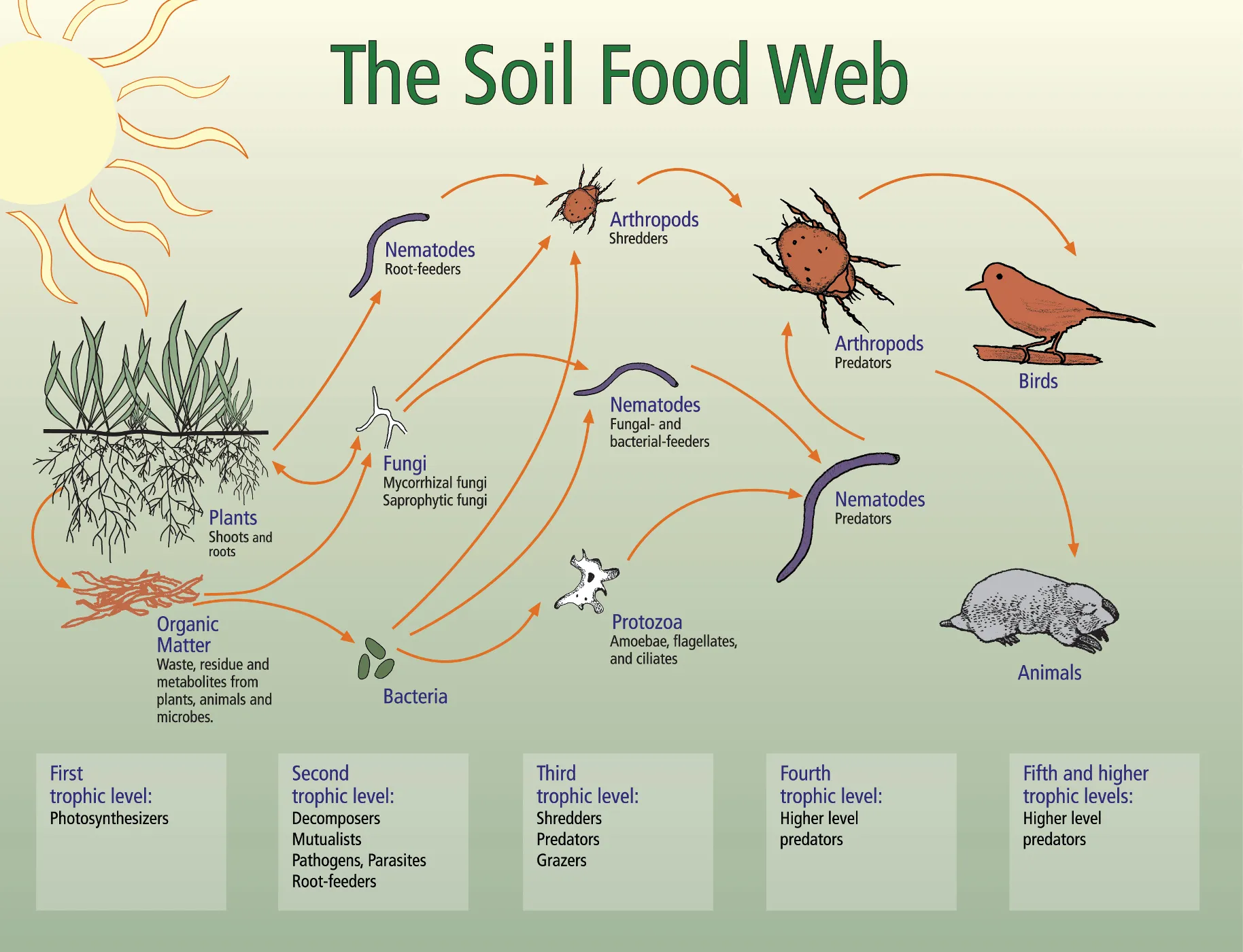
Soil food web
Diagram of relationships between soil organisms: bacteria, fungi, worms, insects, and other participants in the soil ecosystem. It shows that humus formation is linked to the activity of an entire community of organisms.
Organic matter enters the soil and becomes food for bacteria, fungi, protozoa, nematodes, arthropods, and earthworms. This is called the soil food web (Lowenfels and Lewis, 2010). Bacteria and fungi release enzymes that break down complex molecules—cellulose, proteins, lignin—into simpler compounds. Part of the carbon is oxidized to carbon dioxide and escapes into the atmosphere, while nitrogen, phosphorus, sulfur, and other elements are released in forms available to plants (Foth, 1990; Troeh and Thompson, 1993). This process is called mineralization.
Step 3. Part of the organic matter becomes humus
Not all organic matter decomposes completely. Part of the breakdown products and microbial bodies enters synthesis reactions and turns into stable organic compounds—humus (Gershuny and Smillie, 1999; Valkov et al., 2004). Bacteria, fungi, and enzymes participate in this process. Humus accumulates because it is resistant to further decomposition: microorganisms have a harder time “digesting” it than fresh plant residues (Foth, 1990; Connor et al., 2011). That is why humus can persist in soil for decades and even centuries (Pavlis, 2020).
Step 4. Balance between inputs and losses
The level of humus in soil is the balance between organic matter input and its decomposition. If more organic matter enters than mineralizes, the humus reserve grows. If less, it falls (Connor et al., 2011; Troeh and Thompson, 1993). In natural ecosystems this balance establishes itself: for example, under perennial grasses humus accumulates, while under intensive tillage it is lost (Foth, 1990; Gliessman, 2015). The gardener can influence both sides of the balance: add organic matter and reduce losses.
Practical takeaway
Humus does not form in one season. It is a slow but manageable process. To speed it up, you need to:
- constantly return organic residues to the soil;
- support soil life (do not disrupt it with excessive digging);
- use compost, mulch, cover crops, and manure;
- where possible, avoid deep plowing and bare soil (Hemenway, 2009; Morgan, 2021; Pavlis, 2020).
The more active the soil biota and the more stable the inflow of organic matter, the faster the humus layer grows—and the less effort the gardener will need in the future.


LCD 4-in-1 Soil Tester
Check essential growing conditions with one compact tool. Measure soil pH, moisture, temperature and light intensity — ideal for gardens, potted plants and greenhouses.
- 4-in-1 measurement
- Easy-to-read LCD display
- Portable design
Affiliate link · For indicative measurements only.
3. Why humus is dark
Dark color is one of the most recognizable properties of humus. It is by this that gardeners often determine that soil is rich in organic matter. But why is humus dark? The answer lies in its chemical structure.
The chemistry of color
Humus is a mixture of complex organic compounds. Its composition includes aromatic rings (benzene-like structures), phenolic and carboxyl groups (Troeh and Thompson, 1993; Foth, 1990). These groups and the bonds between them form large, branched molecules. The more complex and “dense” such a molecule is, the more strongly it absorbs light—and the darker the substance appears (Gershuny and Smillie, 1999; Valkov et al., 2004).
Simply put, dark color is the result of repeated transformation of organic matter. Fresh leaves or straw are light because they consist of relatively simple compounds—cellulose, sugars, proteins. When microbes process them, simple molecules break down, and new, stable, dark-colored compounds are synthesized from the breakdown products. This is humus (Foth, 1990; Connor et al., 2011).
Different fractions—different shades
Humus is not uniform. Several fractions are distinguished within it, and they differ in color (Valkov et al., 2004; Gershuny and Smillie, 1999):
- Humic acids—the darkest fraction. In chernozems they are almost black; in brown forest soils, dark brown. They are what give soil its rich dark color.
- Fulvic acids—a lighter fraction, from straw-yellow to orange. They are more mobile and are more easily leached down the profile.
- Humins—the most stable and darkest part. They are tightly bound to clay particles and almost do not decompose.
The ratio of these fractions depends on soil type, climate, and vegetation. For example, chernozems are dominated by humic acids, so the soil is almost black. Podzolic soils have more fulvic acids, and their color is lighter—gray or brownish (Valkov et al., 2004; Foth, 1990).
How much humus is needed for dark color
An interesting fact: for soil to become visually dark, not that much humus is needed. By some estimates, only 4–5% organic matter is enough to give mineral soil a black or dark gray color (Troeh and Thompson, 1993). That is why dark color is a convenient but not absolutely accurate indicator. Soil may be dark because of humus, or it may be dark because of minerals (for example, iron or manganese oxides) or moisture (Foth, 1990; Pavlis, 2020). But in most cases, dark color still indicates a high content of organic matter.
Practical significance of dark color
Dark color is not just “cosmetics.” It affects the thermal regime of the soil. Dark surfaces absorb more solar energy and warm faster in spring (Pavlis, 2020; Foth, 1990). For cold regions this is an important advantage: soil with high humus content thaws earlier and becomes suitable for sowing faster. In hot regions, on the contrary, dark soil can overheat—so light-colored mulch is sometimes used there to reflect sunlight (Gliessman, 2015).
In brief:
- Humus is dark because of complex aromatic compounds and large organic molecules.
- The darkest fraction is humic acids and humins; fulvic acids are lighter.
- 4–5% humus is enough for soil to look black.
- Dark color helps soil warm faster in spring.
- But color is not the only indicator: you cannot rely on it alone (Pavlis, 2020; Foth, 1990).
The dark color of humus is the visible result of the invisible work of soil biota. The darker the soil (other things being equal), the more stable organic matter it contains and the better it holds water and nutrients.
4. What humus provides: structure, water-holding capacity, nutrition, buffering
Humus is not just “organic matter in soil.” It is the functional center of the soil ecosystem, determining its physical, chemical, and biological properties. The higher the humus reserve, the less effort the gardener needs: the soil itself holds water, feeds plants, and resists compaction. Let us consider the four main areas in which humus works.
1. Structure: humus glues soil into aggregates

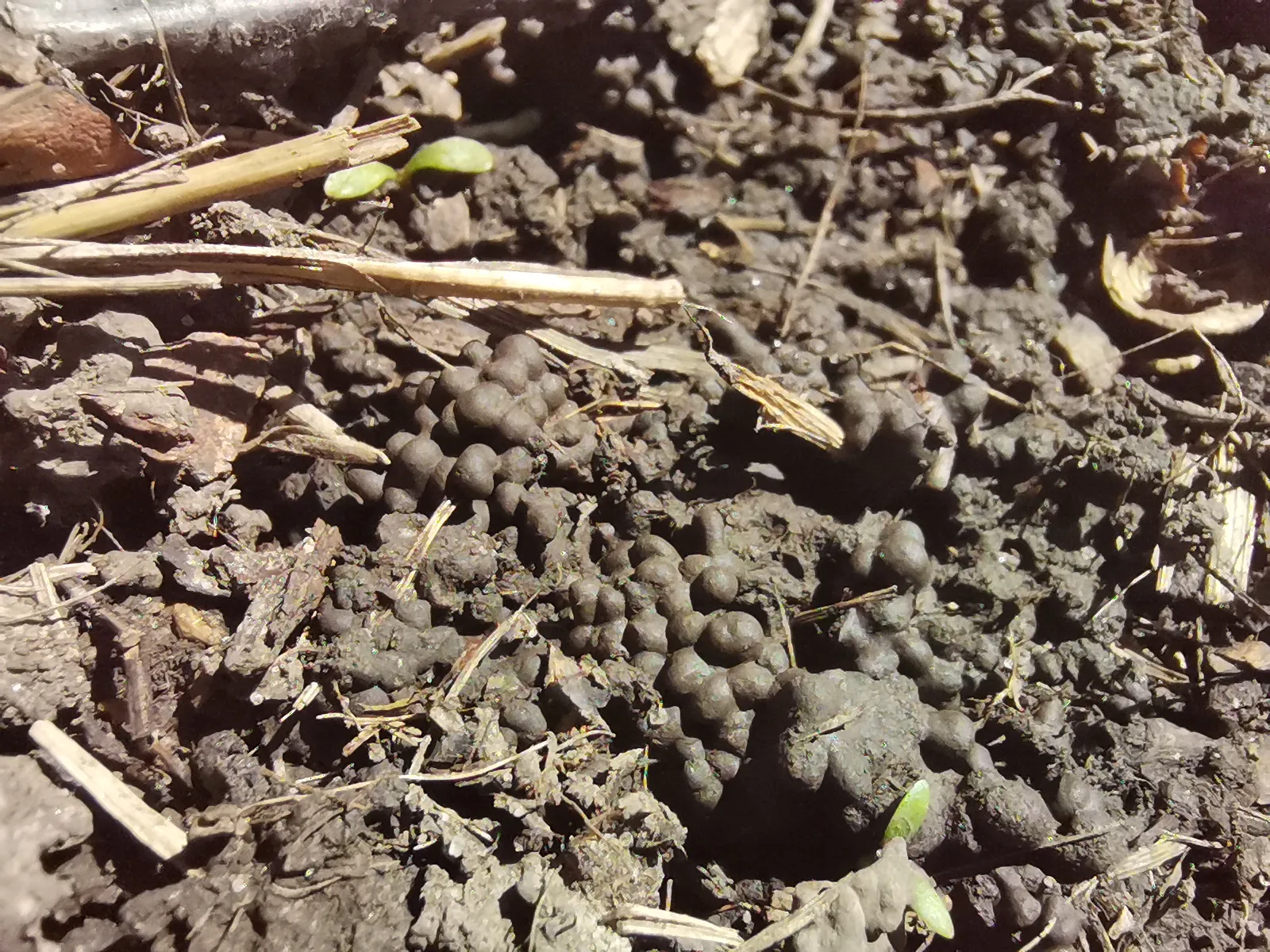
Earthworm casts (excrement)
Earthworm casts are nutrient-rich biogenic aggregates that improve soil structure and fertility.
Good soil is not dust and not a monolith. It is a crumbly, loose mass consisting of aggregates—small “crumbs” with pores between them for air and water (Foth, 1990; Gershuny and Smillie, 1999). Humus is one of the main “glues” that create these aggregates.
The mechanism is twofold. First, humus is a colloid: its particles carry an electric charge and attract clay particles, gluing them into stable crumbs (Troeh and Thompson, 1993; Valkov et al., 2004). Second, soil microbes—bacteria and fungi—release mucilages, polysaccharides, and glomalin, which work as natural glue. Humus serves them as both food and habitat (Lowenfels and Lewis, 2010; Pavlis, 2020). The more humus, the stronger the aggregates and the better the structure.
Practical result: soil with good structure does not run together after rain, does not form a crust, and does not turn into “concrete” when dry. Roots penetrate freely into the depth, and air and water move through pores. Such soil is easier to cultivate and requires less irrigation (Connor et al., 2011; Morgan, 2021).
2. Water-holding capacity: humus holds water
Humus is a sponge. Its particles have a huge internal surface area and hold water through adsorption and capillary forces. By some estimates, humus can hold an amount of water six times greater than its own mass (Pavlis, 2020; Gershuny and Smillie, 1999). This means that even a small increase in organic matter content noticeably increases the water-holding capacity of soil.
This is especially important for sandy soils, which hold water poorly, and for clayey soils, which release it poorly. Humus softens both extremes: in sandy soil it fills large pores and holds moisture; in clayey soil it loosens the dense mass and improves drainage (Foth, 1990; Connor et al., 2011).
Practical result: soil with high humus content requires irrigation less often and tolerates drought more easily. In arid regions this is often more important than additional fertilizers (Gliessman, 2015; Hemenway, 2009).
3. Nutrition: humus is a bank of elements
Humus is a reserve of nutrients. It contains about 95% of all soil nitrogen, a significant part of phosphorus and sulfur, and also micronutrients (Foth, 1990; Troeh and Thompson, 1993). But these elements do not lie there as dead weight. They are gradually released as mineralization proceeds—the slow decomposition of humus by microbes.
The key mechanism is cation exchange capacity (CEC). Humus, like clay, carries a negative charge and retains positively charged ions—calcium, magnesium, potassium, ammonium. But humus has a CEC several times higher than clay: from 250 to 400 meq/100 g versus 10–100 for different clays (Pavlis, 2020; Troeh and Thompson, 1993). This means that humus keeps nutrients from being leached away and releases them to roots as needed.
In addition, humus forms chelates—complexes with metals (iron, zinc, copper, manganese) that protect them from precipitation and make them available to plants (Troeh and Thompson, 1993; Pavlis, 2020). Without humus, these micronutrients often become unavailable, especially in alkaline soils.
Practical result: soil with humus requires less fertilizer. Nutrition arrives gradually, without “spikes,” and plants receive it in a balanced form. This is especially important for perennial crops and for those striving for organic farming (Gershuny and Smillie, 1999; Morgan, 2021).
4. Buffering: humus softens extremes
Buffering is the ability of soil to resist sharp changes. Humus works as a buffer in several directions at once.
pH buffering. Humus contains carboxyl and phenolic groups that can bind and release hydrogen ions. This allows soil to maintain a relatively stable acidity level even when fertilizers are applied or acid rain falls (Gershuny and Smillie, 1999; Valkov et al., 2004). Soil with high humus content is less prone to sharp pH fluctuations.
Temperature buffering. The dark color of humus helps soil warm faster in spring, and its porous structure softens overheating in summer (Pavlis, 2020; Foth, 1990). This creates a more stable thermal regime for roots.
Protection from toxins. Humus can bind heavy metals, pesticide residues, and other pollutants, reducing their toxicity to plants and soil biota (Troeh and Thompson, 1993; Gershuny and Smillie, 1999). This is especially important in cities and on plots with contaminated soil.
Practical result: soil with humus is more resilient. It tolerates drought, waterlogging, temperature fluctuations, and unsuccessful agronomic decisions more easily. This is “insurance” for the gardener (Gliessman, 2015; Hemenway, 2009).
5. Biological function: humus feeds soil life
Humus is the foundation of the soil food web. It serves as a source of carbon and energy for bacteria, fungi, protozoa, nematodes, and earthworms (Lowenfels and Lewis, 2010; Pavlis, 2020). The more humus, the more diverse and active the soil community. And the more active the biota, the faster fresh organic matter decomposes, the more nutrients are released, and the more resistant the soil is to disease.
Practical result: healthy soil with humus suppresses pathogens, decomposes pollutants, and supports plant growth without constant human intervention (Lowenfels and Lewis, 2010; Morgan, 2021).
In brief: what humus provides
| Function | What happens | Practical effect |
|---|---|---|
| Structure | Glues particles into aggregates, improves porosity | Loose, air-permeable soil, easy cultivation |
| Water-holding capacity | Holds water (up to 6× its mass) | Less need for irrigation, better drought tolerance |
| Nutrition | High CEC, chelation, slow release | Less fertilizer, balanced nutrition |
| Buffering | Stabilizes pH, temperature, binds toxins | Resistance to stress and pollution |
| Biology | Feeds soil biota | Healthy soil, disease suppression |
Humus is not one function but a whole system. It works simultaneously as a structural framework, a water reservoir, a nutrient warehouse, a buffer, and a food base for soil life. That is why it is called the “gold” of soil: the more humus, the less effort is needed for a harvest (Hemenway, 2009; Gliessman, 2015; Pavlis, 2020).

Solar Automatic Drip Irrigation Kit for Gardens
Automate watering for pots, gardens and small greenhouses. This solar-powered system features a timer to help schedule water delivery to your plants.
- Solar-powered
- 15 m irrigation hose
- Programmable watering
Affiliate link · Check included accessories.
5. How much humus is needed: little in sandy soils, much in chernozem
There is no single “norm” for humus. The optimal content depends on soil type, climate, and which crops are grown. But there are practical guidelines that help understand what to expect and what to aim for.
General ranges
In mineral soils, organic matter content (which includes humus) usually ranges from 1 to 6% (Foth, 1990; Connor et al., 2011). Anything above 6% is rare for ordinary garden soils. Soils with more than 20% organic matter are considered organic (peat, bog) soils, but this is a separate category (Troeh and Thompson, 1993; Pavlis, 2020).
By soil type

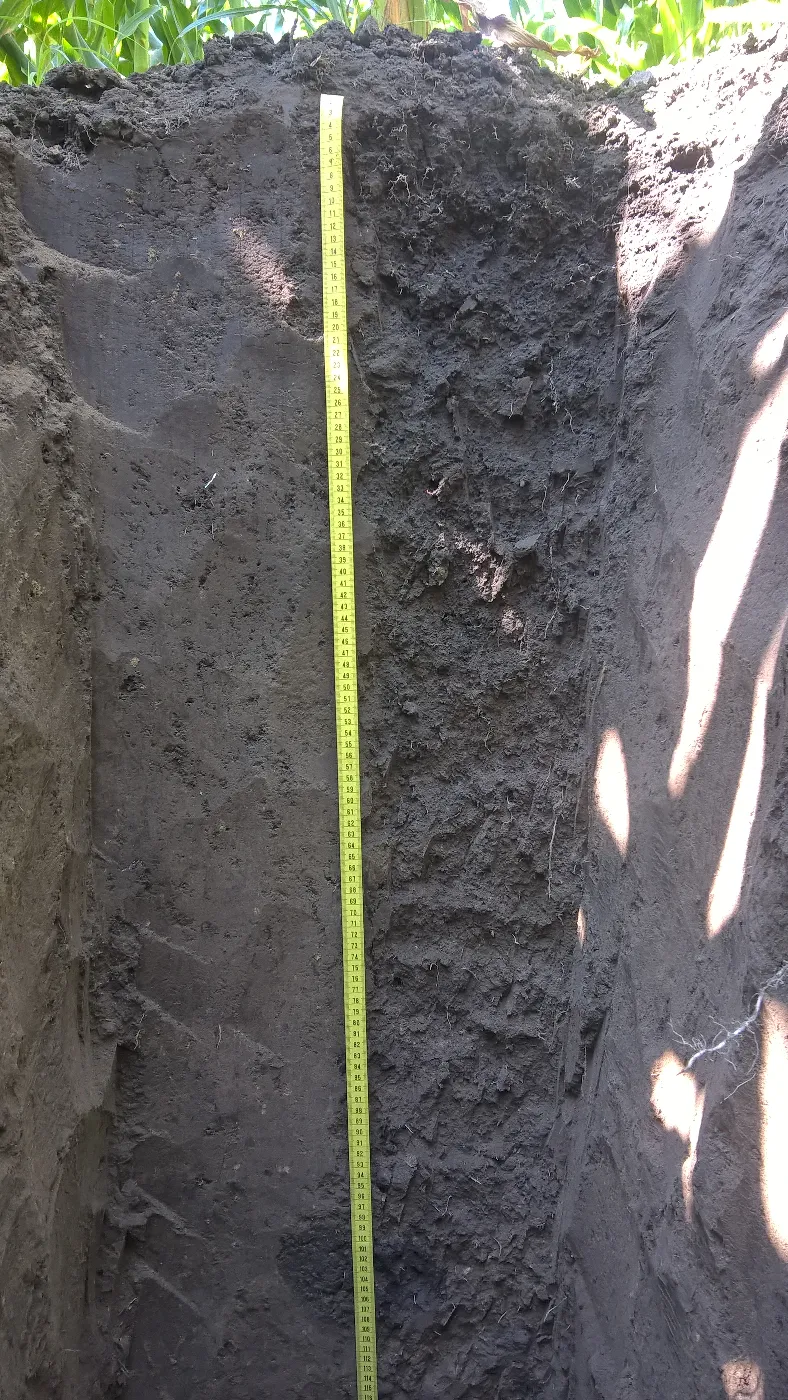
Profile of a typical chernozem
Soil profile of a typical chernozem (Calcic Voronic Chernozem). The original caption gives exactly this soil name.
- Sandy and loamy sand: even 1–2% organic matter is already good. Sand loses humus quickly because of good aeration and rapid mineralization. Holding more than 2% on sand is difficult, but those 2% produce a huge effect: water-holding capacity and nutrition noticeably improve (Pavlis, 2020; Morgan, 2021).
- Loamy and clayey: here the goals are higher. 2% is low, 4–5% is good, and 6–9% is excellent for heavy soils with high clay content. Clay protects humus from decomposition, so it accumulates better (Morgan, 2021; Foth, 1990).
- Chernozems: these are the benchmark. In typical chernozems, humus content reaches 6–10%, and sometimes more. That is why they are considered among the most fertile soils in the world (Valkov et al., 2004; Troeh and Thompson, 1993).
- Temperate forest soils: usually 1–3% in the top layer. Podzolic and sod-podzolic soils are poor in humus but can be productive with proper management (Valkov et al., 2004; Foth, 1990).
- Tropical soils: often contain little humus—1–2% or less. High temperatures and humidity accelerate decomposition, and organic matter does not have time to accumulate (Gliessman, 2015; Connor et al., 2011).
Regional differences
In cold regions humus accumulates slowly, but it also decomposes more slowly. In warm regions, formation is faster, but losses are also higher. In the tropics humus almost does not persist: mineralization is very rapid (Connor et al., 2011; Valkov et al., 2004). Therefore, the “norm” is different for each region. In central Russia or the US Midwest, 3–5% is a good level. In the Mediterranean or tropics, the same 3% can be an excellent result.
How to find out humus content on your plot
The most accurate way is a laboratory soil test. It will show the percentage of organic matter. But there are also indirect signs:
- Color: dark, almost black—lots of humus; light, gray, or yellowish—little (Foth, 1990).
- Structure: crumbly, loose, friable—humus is present; dusty, cloddy, or running together—little (Gershuny and Smillie, 1999).
- Water-holding capacity: after rain the soil stays moist for a long time—humus helps hold water; it dries quickly—little humus (Pavlis, 2020).
- Worms: many earthworms—a sign of active organic matter and humus (Lowenfels and Lewis, 2010).
Practical takeaway
Do not chase absolute numbers. Dynamics are much more important: if humus content grows from year to year, the soil is getting better. Even a 0.5% increase noticeably improves water-holding capacity and nutrition. In sandy soil, 2% is already a success. In clayey soil, 2% is only the beginning. The main thing is to constantly return organic matter and support soil life (Hemenway, 2009; Morgan, 2021; Pavlis, 2020).
In brief:
- Mineral soils usually contain 1–6% organic matter.
- Sandy: 1–2% is good; clayey: 4–6% is good; chernozems: 6–10% is excellent.
- Tropics and cold regions have their own characteristics.
- A laboratory gives the exact answer, but color, structure, and water-holding capacity are good clues.
- Aim not for a number but for gradual improvement.
6. How to increase humus: compost, manure, mulch, cover crops, no-dig
You can increase the humus reserve in two ways: return more organic matter and lose less of it. In practice, this means constantly adding organic materials and reducing everything that accelerates humus decomposition. Let us consider the main techniques that work in any region.
1. Compost: a finished product and a source of microbes

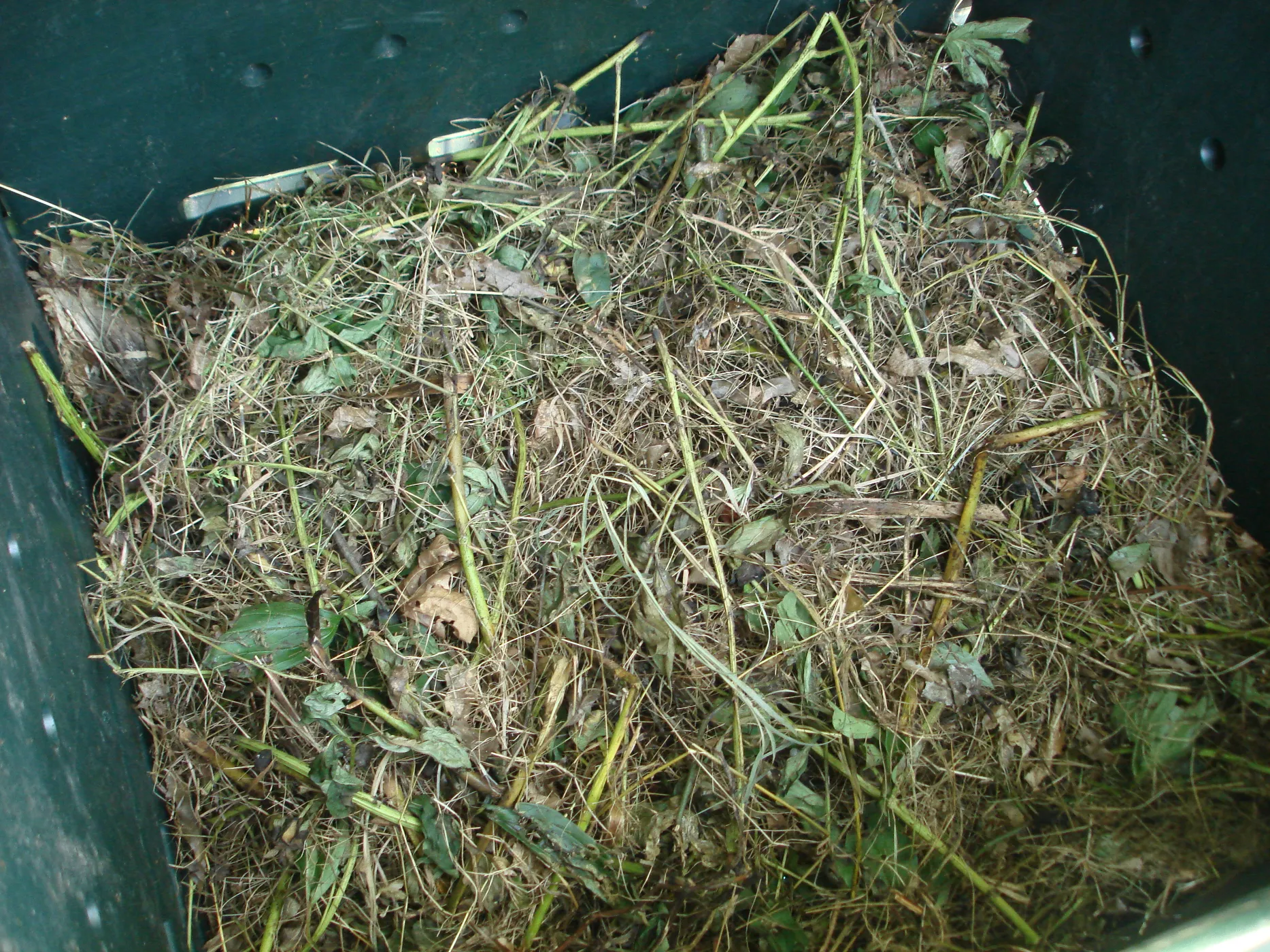
Compost heap in a container
Image of organic materials in a compost container. The caption states that these are materials in a green compost bin.
Compost is partially decomposed organic matter that is applied to the soil or its surface. It produces several effects at once: it adds organic matter, supplies nutrients, inoculates the soil with beneficial microorganisms, and improves structure (Gershuny and Smillie, 1999; Lowenfels and Lewis, 2010).
For humus accumulation, not only volume but also quality matters. Compost from a mix of green and brown materials (grass, leaves, kitchen waste, straw) provides more diverse microbial life than single-component compost (Morgan, 2021; Pavlis, 2020). It is better to apply compost on the surface, without burying it deep: this way it works as mulch and is gradually incorporated into the soil by earthworms and microorganisms (Hemenway, 2009; Lowenfels and Lewis, 2010).
Important note: compost does not replace humus, but it is the best “building material” for it. Regular application of compost even in small amounts (1–2 cm per year) gradually increases organic matter content (Gershuny and Smillie, 1999; Pavlis, 2020).
2. Manure: a fast source of nutrition and organic matter
Manure is a classic fertilizer and source of organic matter. It is rich in nitrogen, phosphorus, potassium, and micronutrients, and also contains large numbers of microbes that accelerate the decomposition of other materials (Gershuny and Smillie, 1999; Littlewood, 2007).
From the point of view of humus accumulation, manure works in two ways: it feeds soil biota and adds organic matter. But there are nuances. Fresh manure can “burn” plants and contains weed seeds. It is better to use rotted or composted manure (Morgan, 2021; Littlewood, 2007). In addition, manure with high nitrogen content mineralizes faster, so for long-term humus accumulation it is better to combine it with carbon-rich materials—straw, sawdust, leaves (Gershuny and Smillie, 1999; Pavlis, 2020).
Important note: manure is not “humus in a bag.” It starts processes, but sustainable humus accumulation requires a constant inflow of diverse organic matter (Gershuny and Smillie, 1999; Troeh and Thompson, 1993).
3. Mulch: protection and gradual enrichment

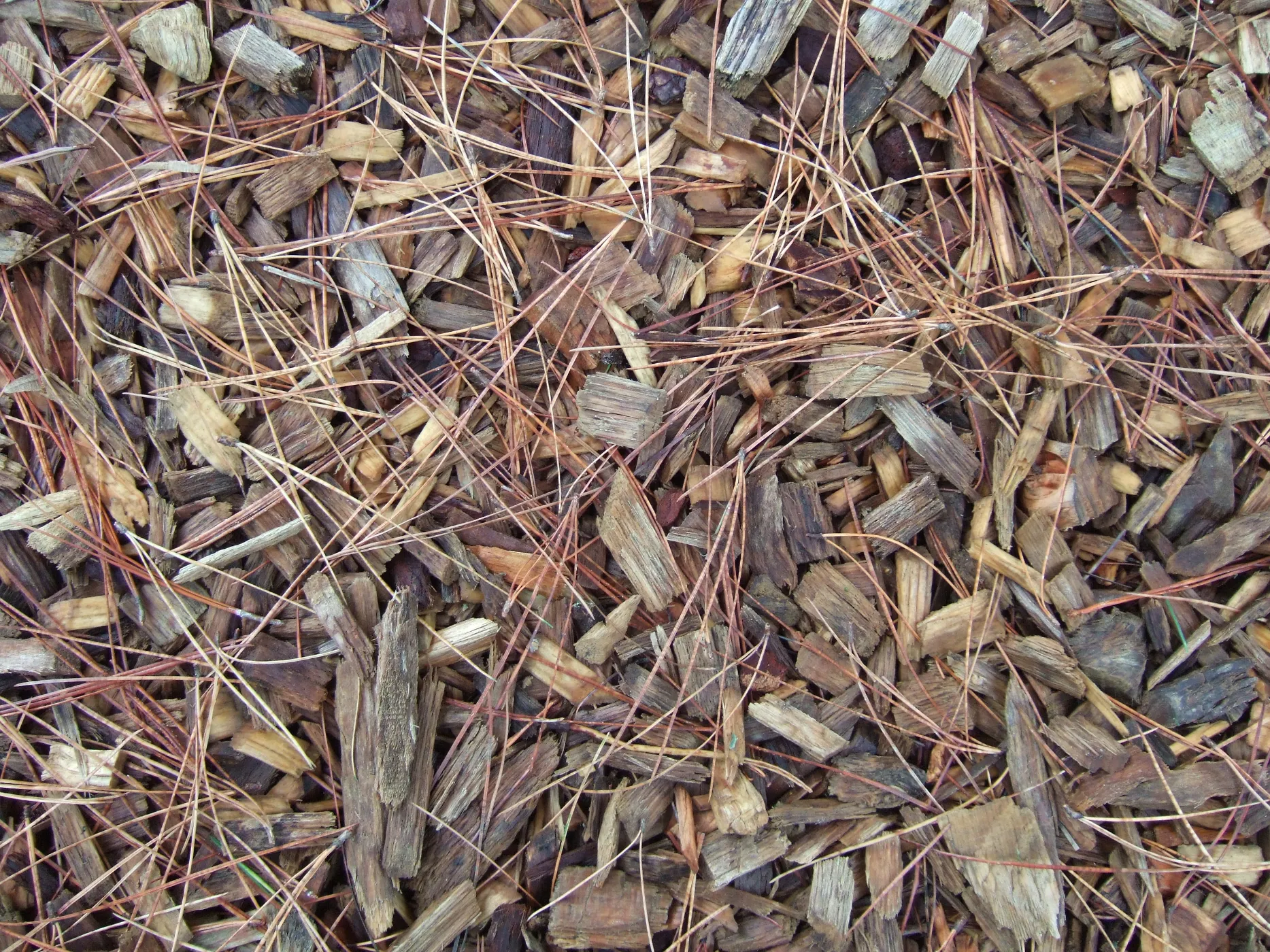
Wood chip mulch at Wisley (Wood chip mulch at Wisley)
Wood chip mulch protecting the soil in the garden of the Royal Horticultural Society (Royal Horticultural Society) at Wisley (Wisley), Surrey (Surrey). It is used to improve and protect the soil.
Mulch is a layer of organic material on the soil surface. It performs several functions: it protects soil from erosion, conserves moisture, suppresses weeds, moderates temperature, and gradually decomposes, feeding soil biota (Hemenway, 2009; Morgan, 2021).
From the point of view of humus, mulch works as a “slow fertilizer.” Unlike compost, which is applied at once, mulch decomposes gradually, and organic matter is incorporated into the soil by earthworms and microorganisms. Coarse, carbon-rich materials are especially effective: straw, wood chips, leaves, bark (Pavlis, 2020; Lowenfels and Lewis, 2010).
Important note: mulch from fresh sawdust or wood chips can temporarily “tie up” nitrogen at the boundary with the soil. This is not a dangerous phenomenon, but it should be taken into account: it is better to use rotted wood chips or add nitrogen-rich materials (Morgan, 2021; Pavlis, 2020).
4. Cover crops: humus from air and roots

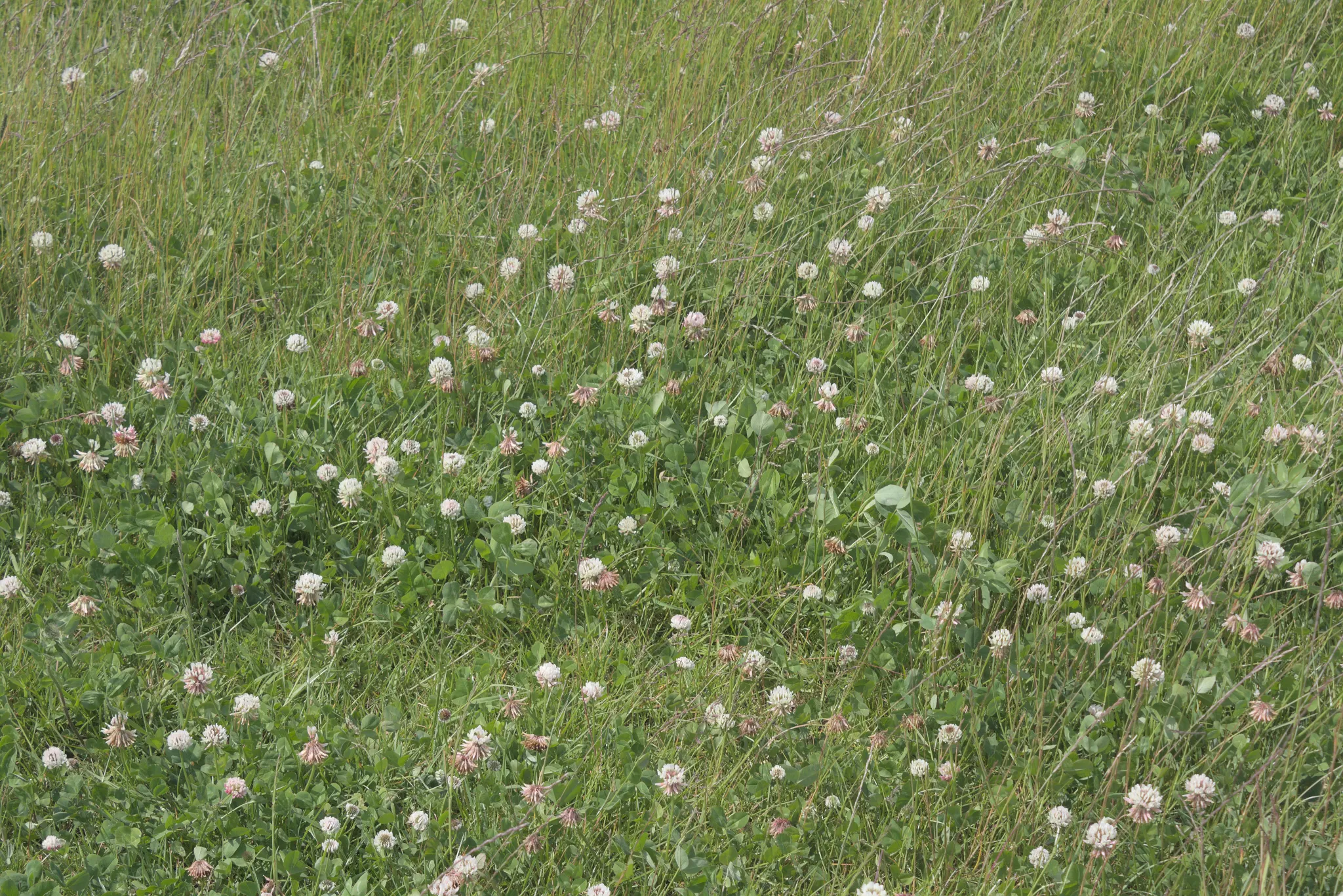
White clover as a green manure and cover crop
A field of white clover (Trifolium repens) with dense plant cover. Leguminous plants are used as green manure due to symbiosis with nitrogen-fixing bacteria, and they also help protect the soil surface and maintain its biological activity. Shooting location: Peak District National Park, United Kingdom.
Cover crops (green manures) are plants grown not for harvest but to improve the soil. They are mowed and left on the surface or incorporated into the top layer (Gershuny and Smillie, 1999; Littlewood, 2007).
Cover crops produce several effects at once:
- Organic matter accumulation. Roots and aboveground mass decompose and turn into humus.
- Nitrogen fixation. Legumes (clover, vetch, lupine, peas) in symbiosis with bacteria fix atmospheric nitrogen and enrich the soil with it (Pavlis, 2020; Littlewood, 2007).
- Soil loosening. Deep roots (radish, alfalfa, sweet clover) penetrate compacted layers and improve structure (Walliser, 2020; Gershuny and Smillie, 1999).
- Erosion protection. Cover crops cover the soil and prevent it from being washed away and blown away.
For humus accumulation, mixes are especially important: legumes + grasses. Legumes provide nitrogen, grasses provide a lot of carbon-rich mass. Together they create balanced material for humus formation (Gershuny and Smillie, 1999; Walliser, 2020).
Important note: cover crops should be mowed before flowering or at the beginning of flowering, while the stems have not become coarse. Then they will decompose faster and will not take nitrogen from the soil (Littlewood, 2007; Gershuny and Smillie, 1999).
5. No-dig: less disturbance—more humus
No-dig (no-till, “without digging”) is an approach in which the soil is not dug or inverted. Instead, organic matter is applied on the surface, and the soil biota processes it itself (Morgan, 2021; Hemenway, 2009).
Why this works for humus:
- Structure is preserved. Digging destroys aggregates and fungal networks that hold organic matter.
- Less oxidation. When digging, organic matter contacts air and decomposes faster to CO2 (Pavlis, 2020; Connor et al., 2011).
- More active biota. Without disturbance, fungi and worms build stable systems that accumulate humus (Lowenfels and Lewis, 2010; Morgan, 2021).
In practice, no-dig means: mulch, apply compost on the surface, do not dig, and only loosen if necessary. This not only preserves humus but also gradually increases it (Hemenway, 2009; Morgan, 2021).
Important note: no-dig does not mean “do nothing.” You need to regularly add organic matter, otherwise the soil gradually loses humus (Pavlis, 2020; Morgan, 2021).
6. Additional techniques
Biochar. Charcoal added to soil is not humus, but it improves structure, holds water and nutrients, and creates shelters for microbes. Biochar is very stable and can persist in soil for hundreds of years (Morgan, 2021; Pavlis, 2020).
Vermicompost. The product of earthworm processing of organic matter. Rich in nutrients and microbes, excellent for improving soil and seedlings (Morgan, 2021; Lowenfels and Lewis, 2010).
Leaf mold. Rotted leaves are an excellent material for mulch and compost. They decompose slowly and gradually turn into humus (Morgan, 2021; Hemenway, 2009).
Crop residues. Leave roots and stems after harvest. They will decompose and become part of humus (Gliessman, 2015; Pavlis, 2020).
In brief: how to increase humus
| Technique | What it does | How to use |
|---|---|---|
| Compost | Adds organic matter and microbes | Apply 1–2 cm per year on the surface |
| Manure | Feeds biota and adds organic matter | Rotted, combined with carbon-rich materials |
| Mulch | Protects and gradually enriches | Straw, wood chips, leaves, bark |
| Cover crops | Accumulate organic matter and nitrogen | Legumes + grasses, mow before flowering |
| No-dig | Preserves and accumulates humus | Do not dig, mulch |
| Biochar | Improves structure and retains nutrients | Apply with compost |
| Vermicompost | Rich in nutrients and microbes | For seedlings and soil improvement |
The main principle: humus grows where organic matter is constantly returned and the soil is not destroyed. The more diverse the materials and the more active the soil life, the faster humus accumulates (Hemenway, 2009; Morgan, 2021; Pavlis, 2020).

7-in-1 Wi-Fi Weather Station
Monitor local weather conditions with a wireless outdoor sensor. Track temperature, humidity, rainfall, wind speed and direction, and atmospheric pressure. Ideal for gardens, farms and greenhouses.
- Wireless outdoor sensor
- Solar-powered
- Wi-Fi connectivity
Affiliate link · Check regional compatibility.
7. What destroys humus: the main enemies of soil fertility
Humus accumulates slowly and is lost quickly. In natural ecosystems the humus reserve is stable because organic matter input and decomposition are balanced. But as soon as humans begin to intervene actively—plowing, fertilizing with “chemicals,” leaving soil bare—the balance shifts toward losses. Let us consider the main factors that destroy humus and how to avoid them.
1. Digging and intensive tillage
This is perhaps the most powerful destroyer of humus. When soil is dug, inverted, or rotary-tilled, three things happen:
- Structure is destroyed. Aggregates glued by humus and microbial mucilages are broken. Organic matter that was protected inside crumbs ends up on the surface (Foth, 1990; Gershuny and Smillie, 1999).
- Oxidation accelerates. Oxygen gains access to organic matter, and microorganisms begin to decompose it faster. Carbon escapes into the atmosphere as CO2 (Connor et al., 2011; Pavlis, 2020).
- Fungal networks are destroyed. Mycorrhizal fungi and hyphae that permeate the soil and hold organic matter are torn. After digging, they need time to recover (Lowenfels and Lewis, 2010; Morgan, 2021).
Studies show that under intensive tillage soil loses organic matter faster than under minimal tillage. For example, in long-term experiments on chernozems and gray forest soils, humus content decreased by 20–40% over several decades of plowing (Valkov et al., 2004; Troeh and Thompson, 1993). Therefore, no-dig and minimal tillage are key techniques for preserving humus (Hemenway, 2009; Morgan, 2021).
What to do: do not dig unnecessarily, loosen only the top layer, use mulch and cover crops for loosening.
2. Mineral fertilizers without organic matter
Mineral fertilizers by themselves do not “kill” humus, but they change the behavior of soil biota. When plants receive ready-made nutrients from fertilizer, they stop “cooperating” with mycorrhizal fungi and other microbes. The soil food web becomes simplified, microbial diversity falls, and humus formation slows (Pavlis, 2020; Morgan, 2021).
In addition, many mineral fertilizers acidify the soil. For example, ammoniacal forms of nitrogen release hydrogen ions during nitrification, lowering pH. And at low pH, many microorganisms responsible for organic matter decomposition work worse (Gershuny and Smillie, 1999; Troeh and Thompson, 1993).
Important note: this is not about completely banning mineral fertilizers. But if they are used without compensating with organic matter, the soil gradually loses humus. The optimal approach is to combine moderate mineral fertilization with regular application of compost, manure, mulch, and cover crops (Pavlis, 2020; Gershuny and Smillie, 1999).
What to do: if you use mineral fertilizers, be sure to add organic matter. Do not rely only on “chemicals.”
3. Erosion: water and wind carry away humus

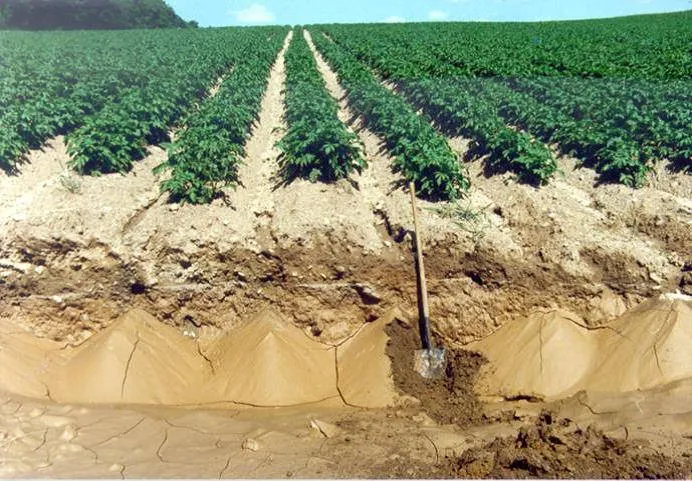
Soil erosion on a potato field
Agricultural field where loss of the fertile topsoil occurs due to erosion. Repeated tillage contributes to the destruction of soil structure and the removal of soil particles.
The topsoil is the richest in humus. It is the layer washed away by rain and blown away by wind if the soil is bare. Erosion is one of the main factors of humus loss worldwide (Troeh and Thompson, 1993; Foth, 1990).
Water erosion is especially dangerous on slopes: water flows carry organic matter down into rivers and lakes. Wind erosion is a problem in dry regions and on light sandy soils: dry aggregates break down, and wind carries fine particles together with humus (Morgan, 2021; Valkov et al., 2004).
What to do: do not leave soil bare. Mulch, cover crops, sod cover, and contour tillage on slopes all protect the top layer.
4. High temperatures and drying
Organic matter decomposition accelerates with rising temperature. In warm regions humus mineralizes faster than in cold regions. In the tropics organic matter almost does not persist: high temperature and humidity promote rapid microbial activity (Connor et al., 2011; Gliessman, 2015).
But in temperate latitudes too, heat and drought can cause harm. If the soil dries out, microbial activity falls, but at the first moistening the remaining organic matter decomposes quickly. In addition, the dark surface of soil without mulch heats strongly, accelerating humus losses (Pavlis, 2020; Valkov et al., 2004).
What to do: mulch the soil to reduce temperature and conserve moisture. Do not leave it open to the sun.
5. Bare soil
Soil without plant cover or mulch is an invitation to erosion, overheating, and drying. In addition, on bare soil fungi and other organisms involved in humus formation work worse. Without an inflow of fresh organic matter (root exudates, litter), soil life becomes poorer (Hemenway, 2009; Morgan, 2021).
What to do: keep the soil constantly under mulch or plants. Even mown grass or cover crops left on the surface work better than “clean” bare ground.
6. Compaction and waterlogging
When soil compacts (from heavy machinery, walking, grazing), it has fewer pores. Aeration suffers, and roots and microbes suffocate. In anaerobic conditions organic matter decomposes more slowly and incompletely, and humus does not form (Troeh and Thompson, 1993; Pavlis, 2020).
Waterlogging is also harmful: in waterlogged soils decomposition follows an anaerobic pathway, producing toxic substances. Humus there may accumulate as peat, but it is not the loose humus that garden crops need (Valkov et al., 2004; Foth, 1990).
What to do: do not walk on beds unnecessarily, do not use heavy machinery on wet soil, and ensure drainage.
7. Burning plant residues
Burning straw, leaves, and tops is a direct path to organic matter loss. Carbon and nitrogen escape into the atmosphere, and only ash remains in place. Although ash contains mineral elements, it does not replace humus (Gershuny and Smillie, 1999; Littlewood, 2007). The exception is biochar production, but that is a separate technology.
What to do: compost residues or leave them on the surface as mulch. Do not burn.
8. Regional features
In cold regions humus accumulates slowly but also decomposes more slowly. However, when bogs are drained and intensive plowing occurs, it is lost quickly (Valkov et al., 2004; Connor et al., 2011). In warm and tropical regions humus decomposes very quickly, so it is especially important there to constantly return organic matter and not leave soil bare (Gliessman, 2015; Connor et al., 2011).
In brief: what destroys humus
| Factor | How it acts | What to do |
|---|---|---|
| Digging | Destroys structure, accelerates oxidation | No-dig, minimal tillage |
| Mineral fertilizers without organic matter | Simplifies the food web, acidifies | Combine with organic matter |
| Erosion | Washes and blows away the top layer | Mulch, cover crops, cover |
| Heat and drought | Accelerate decomposition, dry out | Mulch, irrigate |
| Bare soil | No organic matter inflow, overheating | Permanent cover |
| Compaction | Deprives soil of air | Do not walk on beds, drainage |
| Burning residues | Direct carbon loss | Compost |
Humus is a resource that is easy to lose and hard to restore. But if you avoid these destructive practices and constantly return organic matter, the humus reserve will grow—and with it soil fertility and the ease of gardening (Hemenway, 2009; Morgan, 2021; Pavlis, 2020).
8. Regional aspect: how climate determines the fate of humus
Humus is a product of climate no less than of soil biota activity. Temperature and moisture determine how fast plants grow, how actively microbes work, and how long organic matter remains in the soil. Therefore, strategies for humus accumulation differ in different regions of the world. There is no universal recipe, but understanding climatic patterns helps choose the right techniques.
Cold zones: slowly accumulates, slowly lost
In cold regions—taiga, northern forests, tundra, high mountains—biological processes are slowed. Plants grow slowly, microbes work sluggishly, and organic matter decomposes for a long time. That is why such zones often form thick litter layers and peat horizons (Connor et al., 2011; Valkov et al., 2004).
On the one hand, this is a plus: humus persists for a long time. On the other, a minus: to accumulate it takes decades. The increment of organic matter per season is small, and the short summer does not allow microbes to quickly process material into humus (Troeh and Thompson, 1993; Foth, 1990).
What this means in practice:
- Compost and manure decompose slowly. Do not expect a quick effect.
- Mulch from leaves and wood chips may lie for years, gradually becoming incorporated into the soil.
- Cover crops manage to produce modest biomass, but their roots still work for structure and humus.
- The main threat is drainage and plowing. Drained peat mineralizes quickly, and humus is lost irreversibly (Valkov et al., 2004; Connor et al., 2011).
Tip: in cold zones it is more important not to “accelerate” humus formation but not to lose what already exists. Minimal tillage, mulch, and permanent plant cover are key techniques.
Temperate zones: a balance that can be managed
In the temperate belt—much of Europe, North America, Russia, China, Japan—the climate is most favorable for humus formation. There is enough warmth for active microbial work, but it is not so hot that organic matter decomposes instantly. It is in these zones that the world's most fertile soils formed—chernozems, dark gray forest soils, brown soils (Valkov et al., 2004; Troeh and Thompson, 1993).
In temperate zones humus can accumulate if organic matter input exceeds its decomposition. But under intensive plowing the balance shifts toward losses. Studies show that with long-term plowing, chernozems lose 20–40% of humus over several decades (Valkov et al., 2004; Connor et al., 2011).
What this means in practice:
- There is a real opportunity to increase humus: compost, manure, cover crops, and mulch work effectively.
- No-dig and minimal tillage give a quick and noticeable result.
- Crop rotation with perennial grasses and legumes restores humus.
- The main threat is erosion and compaction. On slopes and heavy soils, special measures are needed (Morgan, 2021; Gershuny and Smillie, 1999).
Tip: in temperate zones humus is a manageable resource. Regular application of organic matter and avoiding deep plowing allow it to be increased year after year.
Warm and subtropical zones: decomposes quickly
In warm regions—the Mediterranean, southern US, subtropics—temperatures are high, and microbes are active year-round. Organic matter decomposes quickly, and humus does not have time to accumulate in large amounts. Soils here are often poor in organic matter even if plants grow intensively (Connor et al., 2011; Gliessman, 2015).
But this does not mean humus is impossible. With sufficient moisture and a constant inflow of organic matter, it accumulates—it simply requires more effort. It is important not to leave soil bare: sun and heat quickly destroy organic matter on the surface (Pavlis, 2020; Morgan, 2021).
What this means in practice:
- Mulch is mandatory. It protects soil from overheating and conserves moisture.
- Compost and manure are applied more often than in temperate zones because they decompose faster.
- Cover crops should be sown in the cool season or under cover so they do not burn up.
- Irrigation and shading help preserve organic matter.
- The main threat is erosion during rare but heavy rains. Mulch and cover crops protect the soil (Gliessman, 2015; Hemenway, 2009).
Tip: in warm zones humus must be “fed” constantly. Do not expect it to accumulate by itself. Mulch, compost, and irrigation are the three pillars.
Tropics: humus almost does not persist
In the tropics—humid equatorial forests, savannas, monsoon zones—organic matter decomposes at enormous speed. High temperature and humidity create ideal conditions for microbes. Litter decomposes in weeks, not months. If humus accumulates at all, it is in a thin top layer, and not for long (Gliessman, 2015; Connor et al., 2011; Valkov et al., 2004).
That is why tropical soils, despite lush vegetation, are often poor in nutrients. All organic matter mineralizes quickly, and elements are either taken up by plants or leached by rains. Fertility in the tropics rests not on humus but on the living cycle: plants → litter → decomposition → plants (Gliessman, 2015; Connor et al., 2011).
What this means in practice:
- Accumulating humus in the tropics is very difficult. The real goal is to maintain a constant inflow of organic matter and not lose it.
- Mulch is mandatory, but it decomposes quickly. New layers must be added constantly.
- Compost and manure are applied often and in small portions.
- Cover crops work, but they must be mowed early before they overgrow.
- Agroforestry and multi-tier systems help retain organic matter and nutrients.
- The main threat is nutrient leaching and erosion. Without cover, soil degrades quickly (Gliessman, 2015; Hemenway, 2009).
Tip: in the tropics humus is not a “warehouse” but a “flow.” It is important not to accumulate but to constantly return. Living soil and permanent cover are more important than a high percentage of humus.
Arid zones: little water—little organic matter
In arid and semiarid regions—steppes, semi-deserts, deserts—the main limiting factor is not temperature but water. Plants grow slowly, biomass is small, and little organic matter enters the soil. Decomposition is also slowed by dryness, but accumulation almost does not occur (Valkov et al., 2004; Troeh and Thompson, 1993).
With irrigation, such soils can become fertile, but there is a risk of salinization. In addition, irrigation accelerates organic matter decomposition, so humus must be maintained constantly (Connor et al., 2011; Valkov et al., 2004).
What this means in practice:
- Mulch is critically important: it conserves moisture and protects from the sun.
- Compost and manure are applied locally to avoid nutrient loss.
- Cover crops are possible only with sufficient irrigation.
- Salinization is the main threat. Drainage and leaching are needed.
- The main goal is not to accumulate maximum humus but to support moisture and structure (Pavlis, 2020; Morgan, 2021).
Tip: in arid zones humus is a luxury, but even a small amount of it dramatically improves water-holding capacity. Mulch and drip irrigation are your best friends.
Summary table: regional features
| Zone | Rate of humus accumulation | Rate of decomposition | Main strategy |
|---|---|---|---|
| Cold | Very slow | Very slow | Preserve what exists; no-dig, mulch |
| Temperate | Moderate | Moderate | Increase: compost, cover crops, rotation |
| Warm/subtropics | Fast but unstable | Fast | Constantly add: mulch, compost, irrigation |
| Tropics | Very fast, but humus does not persist | Very fast | Maintain flow: mulch, agroforestry |
| Arid | Slow | Slow (due to dryness) | Conserve moisture: mulch, local application |
Main takeaway
Climate sets the framework but does not dictate the result. In cold zones humus accumulates slowly, but it is also lost slowly. In warm zones it decomposes quickly, but it also forms quickly with sufficient organic matter input. In the tropics humus almost does not persist, and there it is more important to maintain a living cycle than to chase percentages. In arid zones humus is a rare resource, but even small amounts produce a huge effect (Connor et al., 2011; Gliessman, 2015; Valkov et al., 2004).
For the gardener, it is important not to compare your numbers with someone else's but to assess dynamics: is humus growing on the plot, is structure improving, is it becoming easier to water and cultivate? If yes, the strategy is correct regardless of climate (Hemenway, 2009; Morgan, 2021; Pavlis, 2020).

40W Full Spectrum LED Grow Light
Support healthy plant growth with full-spectrum LED lighting. Ideal for seedlings, indoor plants and small growing spaces. A practical solution for indoor gardening and year-round cultivation.
- Full-spectrum LED
- Energy-efficient design
- Indoor plant growing
Affiliate link · Check actual power and light coverage.
9. Conclusion: humus is the main indicator of soil health
Humus is not just “rotted organic matter” and not a line in an agrochemical analysis. It is an integral indicator of how alive, healthy, and capable of working for the gardener the soil is. Everything said above comes down to one simple idea: the more humus, the less effort is needed for a harvest.
Why is that? Because humus simultaneously:
- structures the soil, making it loose and permeable to air and roots;
- holds water, reducing the need for irrigation;
- accumulates and releases nutrients, reducing the need for fertilizing;
- buffers pH, temperature, and toxins, protecting plants from stress;
- feeds soil biota, which in turn suppresses disease and decomposes organic matter (Foth, 1990; Gershuny and Smillie, 1999; Lowenfels and Lewis, 2010; Pavlis, 2020).
Humus is the “gold” of soil not because it can be bought or quickly created. It cannot be applied as a powder. It can only be grown—slowly, patiently, through the constant return of organic matter and care for soil life. And this is the main practical conclusion: fertility is a process, not a product (Hemenway, 2009; Morgan, 2021).
Regional differences matter, but they do not change the principles. In cold zones humus accumulates slowly, but it is also lost slowly. In warm zones it decomposes quickly, but it also forms quickly with sufficient organic matter input. In the tropics it almost does not persist, and there it is more important to maintain a living cycle. In arid zones even small amounts of humus produce a huge effect. Everywhere one rule works: do not leave soil bare, return organic matter, do not destroy its structure (Connor et al., 2011; Gliessman, 2015; Valkov et al., 2004).
What destroys humus? Digging, erosion, heat, mineral fertilizers without organic matter, compaction, burning residues. What creates it? Compost, manure, mulch, cover crops, no-dig, permanent plant cover (Gershuny and Smillie, 1999; Pavlis, 2020; Morgan, 2021).
The gardener does not need to chase absolute numbers. Do not compare your 3% with someone else's 8%. Dynamics matter: is the soil becoming darker, looser, moister? Is it easier to cultivate? Is there less need to water and fertilize? If yes, humus is growing, and the soil responds with gratitude (Pavlis, 2020; Hemenway, 2009).
Ultimately, humus is a measure of our partnership with the soil. We do not “feed” plants directly—we create conditions in which soil life does this work for us. And the more humus, the less we have to intervene. The soil structures itself, holds water itself, and supplies plants with nutrients itself. All that remains is not to interfere (Lowenfels and Lewis, 2010; Gliessman, 2015).
Humus is not a goal but a path. A path to soil that works for you, not you for it. And this path can be started from any plot, in any climate, at any time of year. The main thing is to start returning organic matter and stop destroying what has already been created.
In brief: key points of the article
- Humus is the stable part of organic matter created by soil biota.
- It forms from plant residues through microbes and animals.
- Dark color is the result of complex aromatic compounds.
- Humus provides structure, water-holding capacity, nutrition, buffering, and life.
- Norms depend on soil type and climate, but dynamics are more important than numbers.
- Humus can be increased through compost, manure, mulch, cover crops, and no-dig.
- It is destroyed by digging, erosion, heat, and “chemicals” without organic matter.
- In cold zones it accumulates slowly; in warm zones it is lost quickly; in the tropics it almost does not persist.
- Humus is the main indicator of soil health and the key to an easy harvest.
If soil is rich in humus, it does most of the work itself. The gardener's task is not to interfere and to add organic matter little by little. Then the harvest becomes not the result of struggle but the natural consequence of healthy soil (Hemenway, 2009; Morgan, 2021; Pavlis, 2020; Gershuny and Smillie, 1999).
References
- (2014). ‘Soil’, in Agroecology. : CRC Press, 108-123. doi: 10.1201/b17881-13
- (2015). ‘Soil cultivation and fertility’, in Ingram, D.S., Vince-Prue, Daphne, Gregory, P.J. (ed.) Science and the Garden. The scientific basis of horticultural practice. West Sussex, UK: Royal Horticulture Society. Wiley Blackwell, pp. 86-101.
- Chalker-Scott, Linda (2015). ‘The Underground Railroad’, in How Plants Work. Portland, London: Timber Press, pp. 38-59.
- Chalker-Scott, Linda (2018). ‘Soil Analysis: What Makes Soil Great?’, in The Science of Gardening. Course Guidebook. Chantilly, Virginia: The Great Courses, pp. 25-36.
- Chalker-Scott, Linda (2018). ‘Soil Preparation and Protection’, in The Science of Gardening. Course Guidebook. Chantilly, Virginia: The Great Courses, pp. 73-80.
- Chalker-Scott, Linda (2018). ‘The Truth about Mulch’, in The Science of Gardening. Course Guidebook. Chantilly, Virginia: The Great Courses, pp. 81-89.
- Connor, D.J., Loomis, R.S., Cassman, K.G. (2011). ‘Soil resources’, in Crop Ecology. Productivity and Management in Agricultural Systems. Cambridge, UK: Cambridge University Press, pp. 159-194.
- Foth, H.D. (1990). ‘Soil Organic Matter’, in Fundamentals of Soil Science. New York: John Wiley & Sons, pp. 133-147.
- Gershuny, Grace, Smillie, Joe (1999). ‘Soil Management Practices’, in The Soul of Soil. A Soil-Building Guide for Master Gardeners and Farmers. Vermont: Chelsea Green Publishing, .
- Gershuny, Grace, Smillie, Joe (1999). ‘Understanding the Soil Ecosystem’, in The Soul of Soil. A Soil-Building Guide for Master Gardeners and Farmers. Vermont: Chelsea Green Publishing, .
- Hemenway, Toby (2009). ‘Bringing the Soil to Life’, in Gaia's Garden. A Guide To Home-Scale Permaculture. : Chelsea Green Publishing, .
- Littlewood, Michael (2007). ‘The Ground’, in The organic gardener's handbook. Ramsbury, Wiltshire: The Crowood Press, pp. 59-102.
- Lowenfels, Jeff, Lewis, Wayne (2010). ‘Classic Soil Science’, in Teaming with Microbes. The Organic Gardener’s Guide to the Soil Food Web. Portland, Oregon: Timber Press, .
- Lowenfels, Jeff, Lewis, Wayne (2010). ‘Compost’, in Teaming with Microbes. The Organic Gardener’s Guide to the Soil Food Web. Portland, Oregon: Timber Press, .
- Lowenfels, Jeff, Lewis, Wayne (2010). ‘Earthworms’, in Teaming with Microbes. The Organic Gardener’s Guide to the Soil Food Web. Portland, Oregon: Timber Press, .
- Lowenfels, Jeff, Lewis, Wayne (2010). ‘Fungi’, in Teaming with Microbes. The Organic Gardener’s Guide to the Soil Food Web. Portland, Oregon: Timber Press, .
- Morgan, Sally (2021). ‘Building a healthy soil’, in The Healthy Vegetable Garden: A natural, chemical-free approach to soil, biodiversity and managing pests and diseases. Vermont, London, UK: Chelsea Green Publishing, .
- Pavlis, Robert (2020). ‘Understanding Soil’, in Soil Science for Gardeners. Working with Nature to Build Soil Health. Gabriola Island, BC, Canada: New Society Publishers, pp. 9-96.
- Pratt, M.M. (2005). ‘Looking After the Soil – the Balanced Approach’, in Practical Science for Gardeners. Portland, Oregon: Timber Press, pp. 61-80.
- Rees-Warren, Matt (2021). ‘Soil’, in The Ecological Gardener. Vermont, London, UK: Chelsea Green Publishing, .
- Troeh, F.R., Thompson, L.M. (1993). ‘Soil Organic Matter’, in Soil and Soil Fertility. New York, NY: Oxford University Press, pp. 89-110.
- Walliser, Jessica (2020). ‘Soil Preparation & Conditioning’, in Plant Partners. North Adams, MA: Storey Publishing, pp. 27-48.
- Вальков, В.Ф., Казеев, К.Ш., Колесников, С.И. (2004). ‘Состав и свойства почв [Soil composition and properties]’, in Почвоведение [Soil science]. Москва - Ростов-на-Дону: МарТ, pp. 9-170.
- Траннуа, Павел (2018). ‘Компост [Compost]’, in Сад и огород в рисунках и комиксах: полная наглядная энциклопедия [The Garden and Vegetable Patch in Drawings and Comics: A Comprehensive Visual Encyclopedia]. Москва: Издательство «Э», pp. 95-98.
