
Liming and Acidification: How to Adjust Soil pH Without Harming Plants
1. Why Change pH: Nutrient Availability
Soil pH is perhaps the most important chemical indicator that determines whether plants can obtain everything they need from the soil. Many gardeners wonder: “I apply fertilizers, so why are my plants starving?” The answer often lies precisely in pH.
What pH Is and Why It Matters So Much

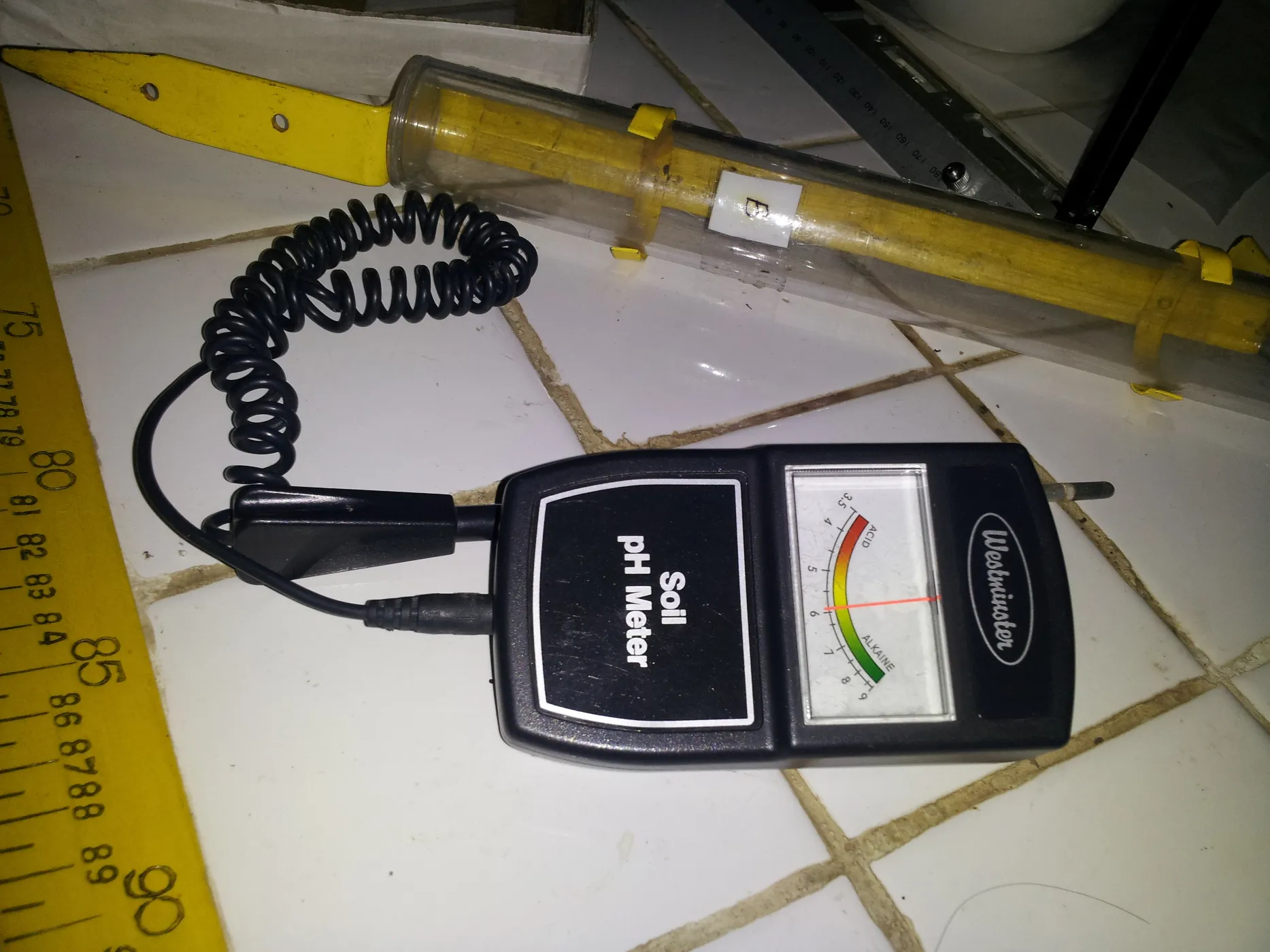
Soil pH meter.
Soil pH meter. The photograph shows a device for determining soil acidity, used in agriculture and horticulture to monitor soil condition.
pH is a measure of the acidity or alkalinity of the soil solution on a scale from 0 to 14. A value of 7 is neutral, below 7 is acidic, and above 7 is alkaline. The scale is logarithmic: a change in pH by one unit means a tenfold change in the concentration of hydrogen ions (Pavlis 2020; Weil 2017).
The key point: pH does not affect plants directly (except at extreme values). It affects nutrient availability (Pavlis 2020). Even if the soil contains plenty of phosphorus or iron, at an unsuitable pH these elements become chemically bound and unavailable to roots.
How pH Controls Nutrition
Here is how different pH values affect nutrient availability (Weil 2017; Marschner 2012; Welbaum 2015):
| Element | Best available at pH | Problems when deviating |
|---|---|---|
| Nitrogen (N) | 6.0–8.0 | At low pH, nitrification decreases |
| Phosphorus (P) | 6.0–7.0 | At pH < 6, binds with iron and aluminum; at pH > 7.5 — with calcium |
| Potassium (K) | 6.0–7.5 | Leaches at low pH |
| Calcium (Ca) | 6.5–8.5 | Deficiency at low pH |
| Magnesium (Mg) | 6.5–8.5 | Leaches at low pH |
| Iron (Fe) | 5.0–6.5 | Chlorosis at high pH |
| Manganese (Mn) | 5.0–6.5 | Deficiency at high pH; toxicity at low pH |
| Zinc (Zn) | 5.5–7.0 | Deficiency at high pH |
| Copper (Cu) | 5.5–7.0 | Deficiency at high pH |
| Boron (B) | 5.0–7.0 | Deficiency at high pH |
| Molybdenum (Mo) | 7.0–9.0 | Deficiency at low pH |
Note: in organic soils (peat, forest litter), the optimal pH range for nutrient availability is about one unit lower than in mineral soils (Weil 2017).
What Happens with a Strong pH Deviation
Under strongly acidic conditions (pH < 5.0):
- Soluble forms of aluminum (Al3+) enter the soil solution and become toxic to roots. Aluminum damages cell walls, blocks cell division, and suppresses root growth (Weil 2017; Marschner 2012). This is the main cause of plant suppression on acidic soils.
- Manganese also becomes toxic at pH below 5.6 (Weil 2017).
- Phosphorus binds with iron and aluminum into insoluble compounds (Pavlis 2020).
- Calcium, magnesium, and potassium are leached from the upper horizons (Weil 2017).
- Molybdenum becomes unavailable, which is especially important for legumes (Marschner 2012).
- Bacterial activity is suppressed, while fungal activity increases (Weil 2017). This affects organic matter decomposition and nitrogen cycling.
Under strongly alkaline conditions (pH > 8.0):
- Iron, manganese, zinc, copper, and boron turn into insoluble forms — plants cannot take them up (Welbaum 2015).
- Phosphorus binds with calcium (Pavlis 2020).
- Sodium can accumulate in toxic concentrations (Marschner 2012).
Effect on Soil Life
pH determines which microorganisms dominate in the soil. Bacteria and actinomycetes prefer neutral or slightly alkaline conditions, while fungi prefer more acidic ones (Weil 2017; Pavlis 2020). Because bacteria play a key role in nitrogen mineralization and organic matter decomposition, these processes slow down on acidic soils. Studies show that the diversity of bacterial communities drops sharply at pH below 6.0 (Weil 2017).
Key Principle: Better to Under-Correct Than Over-Correct
This is the main idea of the entire article. A sharp change in pH is stress for the soil ecosystem. If you err on the side of insufficient correction, plants will simply receive somewhat less nutrition, but they will survive. If you over-lime the soil, you can block access to iron, manganese, zinc, and boron for years to come, and fixing this will be extremely difficult (Troeh 1993; Weil 2017).
Therefore, all recommendations in this article follow the principle: apply less than seems necessary, check pH, and repeat after a season if needed.
Practical Takeaway
Before applying lime or sulfur, answer three questions:
1. What is your soil pH? Without a test, this is guesswork.
2. What are you going to grow? Different crops prefer different ranges (Weil 2017; Welbaum 2015).
3. What is your soil type? Clay and loamy soils are buffered more strongly — they need more material to change pH than sandy soils (Troeh 1993).
In the next chapter, we will discuss when and with what to carry out liming — the most common way to raise pH.
2. Liming: When It Is Needed and What to Use
Liming is the application of calcium- or magnesium-based materials to raise the pH of acidic soil. It is the most common and safest way to correct acidity, if done gradually and sensibly.
When Liming Is Needed
Signals that soil needs liming:
Based on soil test results:
- pH below 5.5–6.0 for most vegetable and fruit crops (Weil 2017; Welbaum 2015).
- pH below 5.0 — a critical zone where aluminum and manganese become toxic (Weil 2017).
- High acid saturation (more than 20% of CEC occupied by hydrogen and aluminum ions) — a signal for liming (Weil 2017).
Based on indicator plants:

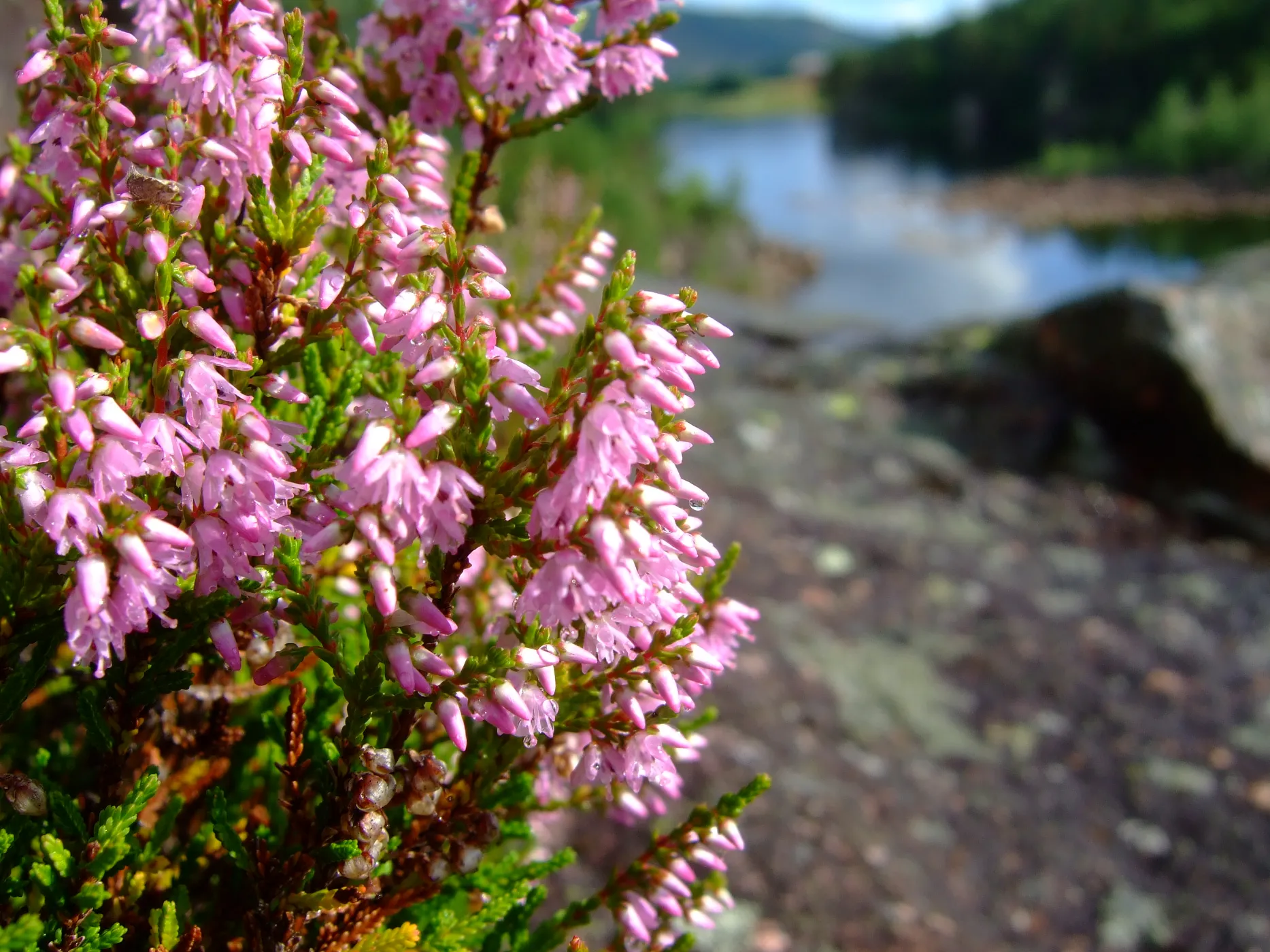
Heather: a natural indicator of acidic soil
Flowering common heather (Calluna vulgaris). This species is characteristic of acidic soils and can serve as a clear example of an indicator plant.
Acidic soils are often dominated by sorrel, horsetail, chickweed, heather, azalea, and rhododendron (Littlewood 2007). If these plants thrive while cultivated plants are suppressed, the soil is probably acidic.
Based on soil type and climate:
In humid regions (forest zone, high humidity), soils are naturally acidic due to leaching of bases (Weil 2017). In steppe and arid zones, by contrast, pH is more often neutral or alkaline, and liming is not required there (Troeh 1993).
Important note: Not every acidic soil needs liming. If you grow blueberries, rhododendrons, azaleas, hydrangeas, cranberries, or conifers, an acidic reaction (pH 4.5–5.5) is normal for them, and liming will cause harm (Weil 2017; Pavlis 2020).
Which Materials to Use
All lime materials work on the same principle: they contain carbonates, oxides, or hydroxides of calcium and/or magnesium, which neutralize hydrogen ions in the soil solution (Weil 2017). But different materials have their own characteristics.
Ground Limestone (Calcite)
What it is: ground natural limestone, with calcium carbonate (CaCO3) as the main component. The most common and economical material (Troeh 1993; Weil 2017).
When to choose it: when the test shows calcium deficiency but magnesium is normal.
Pros: gentle action, gradual, does not burn roots, available, stores well (Weil 2017).
Cons: acts slowly — it may take a year for the full effect (Troeh 1993).
Important: the finer the grind, the faster the action. Particles larger than 60 mesh (0.25 mm) react over years, so effectiveness depends on fineness of grind (Troeh 1993; Weil 2017).
Dolomitic Limestone (Dolomite Meal)
What it is: ground dolomite — calcium magnesium carbonate (CaMg(CO3)₂). Contains both calcium and magnesium (Weil 2017).
When to choose it: when the test shows magnesium deficiency simultaneously with an acidic reaction. It is also suitable for sandy soils, where magnesium leaches faster (Gershuny 1999; Littlewood 2007).
Pros: solves two problems at once — raises pH and enriches the soil with magnesium. Acts somewhat slower than calcite but more gently (Weil 2017).
Cons: not suitable if magnesium is already in excess in the soil (Troeh 1993).
Chalk
What it is: a soft, friable sedimentary material based on calcium carbonate. Essentially a type of limestone, but softer and more finely dispersed (Gershuny 1999).
When to choose it: a good alternative to ground limestone if it is available in the region. Acts similarly (Littlewood 2007).
Pros: often dissolves faster than hard limestone.
Cons: may be more expensive; availability depends on the region.
Ash
What it is: a product of burning wood or plant residues. Contains oxides of calcium, magnesium, and potassium, as well as phosphorus and trace elements (Littlewood 2007; Gershuny 1999).
When to choose it: as an additional nutrient source and a mild deacidifier on small plots. Especially useful on sandy and peaty soils (Littlewood 2007).
Pros: contains not only calcium but also potassium, phosphorus, and trace elements. Acts faster than limestone but more gently than lime (Gershuny 1999).
Cons: highly variable composition; may contain toxic impurities (heavy metals) when burning treated wood. Cannot be applied simultaneously with nitrogen fertilizers — nitrogen losses (Littlewood 2007; Troeh 1993). Rate: no more than 1 gallon per square yard; on sandy soils, half that (Troeh 1993).
Hydrated Lime (Calcium Hydroxide)
What it is: Ca(OH)₂, the product of slaking calcium oxide with water. Acts very quickly (Weil 2017; Troeh 1993).
When to choose it: only for rapid pH correction in emergency cases. Not recommended for regular use (Troeh 1993).
Pros: acts almost instantly.
Cons: caustic, dangerous if it gets on skin or respiratory tract, easy to overdose, can burn plants. Not recommended for organic farming (Weil 2017).
Other Materials
Marl — a natural mixture of calcium carbonate with clay and sand. Effectiveness is 40–70% of pure limestone (Troeh 1993).
Basic slag — a by-product of metallurgy, contains calcium and phosphorus. Effectiveness is 70–90% (Troeh 1993).
Waste-derived lime meal — from paper production, sugar factories, etc. Requires testing for toxic impurities (Troeh 1993).
Key Principle of Choice
Calcite — when only calcium is needed. Dolomite — when both calcium and magnesium are needed. Chalk — as an alternative to calcite. Ash — as a mild source of calcium and potassium on small areas. Hydrated lime — only in extreme cases.
In the next chapter, we will discuss how to calculate the dose — by pH and soil type.


LCD 4-in-1 Soil Tester
Check essential growing conditions with one compact tool. Measure soil pH, moisture, temperature and light intensity — ideal for gardens, potted plants and greenhouses.
- 4-in-1 measurement
- Easy-to-read LCD display
- Portable design
Affiliate link · For indicative measurements only.
3. How to Calculate the Dose
This is perhaps the most difficult part of the topic. Many gardeners make mistakes precisely here: they look at pH, pour “by eye,” and either get no effect or over-lime the soil for years to come. Let us break down how to approach the calculation correctly.
Main Principle: pH Is Only the Tip of the Iceberg

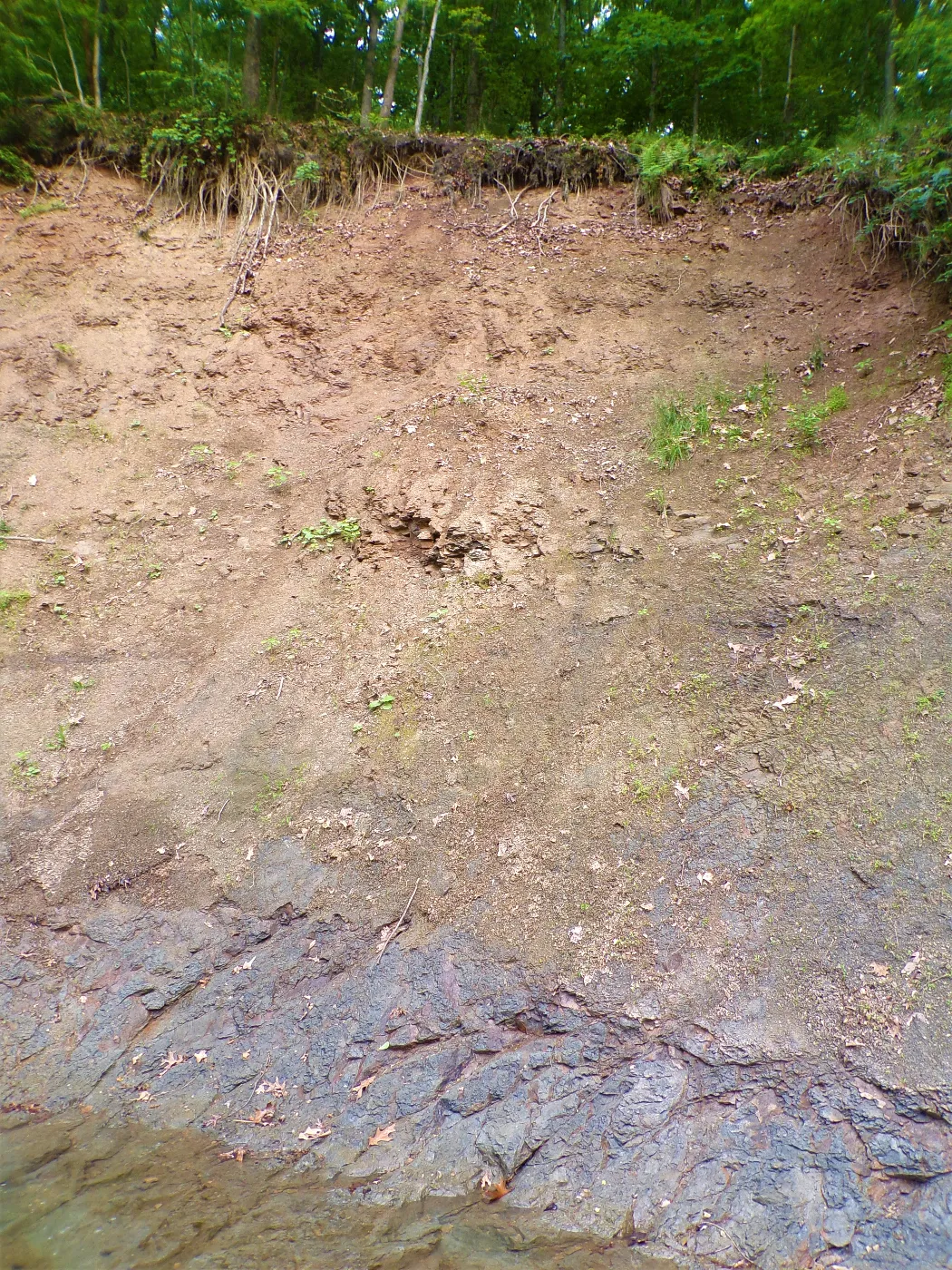
Soil profile of a slope with silt, loam, and clay.
Soil profile of an exposed hillslope demonstrating layers of silt, loam, and clay next to a creek. The photograph clearly shows the structure of the bank and the dense root system of plants in the upper soil layer.
The amount of lime needed to change pH depends not only on the current pH value but also on the buffering capacity of the soil (Weil 2017; Troeh 1993). Buffering capacity is the soil's resistance to pH change. The higher it is, the more lime is needed to shift pH by one unit.
What determines buffering capacity:
- Clay content. Clay soils are buffered more strongly than sandy soils (Troeh 1993; Weil 2017).
- Organic matter content. Humus has enormous buffering capacity (Weil 2017).
- Cation exchange capacity (CEC). The higher the CEC, the more lime is needed (Troeh 1993).
- Type of clay minerals. Montmorillonite buffers more strongly than kaolinite (Weil 2017).
That is why you cannot calculate the dose from pH alone. Two soils with the same pH 5.0 — sandy and clay — will require completely different amounts of lime. Clay soil may need 3–4 times more (Troeh 1993; Weil 2017).
Three Pools of Acidity: Why pH Is Deceptive
In any acidic soil, acidity is distributed among three “pools” (Weil 2017; Troeh 1993):
1. Active acidity — H+ ions in the soil solution. This is what a pH meter measures. The smallest part.
2. Exchangeable (salt-replaceable) acidity — H+ and Al3+ ions held on the surface of colloids. It can be hundreds of times greater than active acidity.
3. Reserve (residual) acidity — H+ and Al3+ ions tightly bound to organic matter and clays. It can be thousands of times greater than active acidity.
When you apply lime, it first neutralizes active acidity (pH rises quickly), but then exchangeable and reserve acidity gradually release new H+ ions, and pH falls again. That is why liming is not a one-day process but one of several seasons (Weil 2017).
Method 1: Laboratory Analysis with Buffer pH (Most Accurate)
The best way to calculate the dose is to send the soil to a laboratory and request buffer pH, not just ordinary pH (Weil 2017). Buffer pH shows how much acid is in the exchangeable and reserve pools.
How it works: the laboratory mixes the soil with a special buffer solution of known pH. The more the soil lowers the pH of this solution, the more lime will be required. From the buffer pH value, the laboratory calculates the recommended dose (Weil 2017; Troeh 1993).
Different laboratories use different buffer solutions: SMP (for soils with high CEC), Adams-Evans (for Ultisols and Oxisols with low CEC), and others (Weil 2017).
Important: buffer pH is not soil pH. For example, a report may state: water pH = 5.2, buffer pH = 7.63. This means the soil is very acidic, but buffering capacity is low, and relatively little lime will be needed (Weil 2017).
Method 2: Calculation Based on Exchangeable Aluminum
For highly weathered acidic soils (Ultisols, Oxisols), another approach is often used: calculate the lime dose needed to neutralize exchangeable aluminum (Weil 2017).
The formula is simple: if CEC = 10 cmol/kg and aluminum saturation = 50%, then 5 cmol/kg Al3+ must be neutralized. This requires 5 cmol/kg CaCO3 (Weil 2017).
Method 3: pH-Base Saturation (for Understanding the Process)
This method is used in textbooks to illustrate the process. It requires knowledge of CEC and the pH-base saturation curve (Weil 2017; Troeh 1993).
Example from Troeh (1993):
- CEC = 24 meq/100 g
- Current pH = 5.2 (base saturation = 70%)
- Target pH = 6.9 (base saturation = 95%)
- Difference = 25% of 24 = 6 meq/100 g
- 6 meq/100 g × 1000 = 6000 lb CaCO3 per acre-furrow-slice (Troeh 1993)
Note: the coefficient 1000 is a simplification. It works for a soil layer about 15–20 cm deep. For other depths, adjustment is needed (Troeh 1993).
Practical Guidelines for Gardeners
Most gardeners do not have access to a full laboratory analysis. Here are practical guidelines based on data from authoritative sources.
For a Small Plot (per 1 m2)
According to Littlewood (2007) and Gershuny (1999), approximate doses for raising pH by 1 unit:
| Soil type | Ground limestone | Dolomitic limestone |
|---|---|---|
| Sandy | 100–200 g/m2 | 100–200 g/m2 |
| Loamy | 200–300 g/m2 | 200–300 g/m2 |
| Clay | 300–400 g/m2 | 300–400 g/m2 |
Note: these doses are approximate. The exact dose depends on buffering capacity and target pH (Weil 2017).
For Large Areas (per 100 m2)
| Soil type | To raise by 0.5 pH | To raise by 1.0 pH |
|---|---|---|
| Sandy | 5–10 kg | 10–15 kg |
| Loamy | 10–15 kg | 20–30 kg |
| Clay | 15–20 kg | 30–40 kg |
Sources: Troeh (1993), Weil (2017), Littlewood (2007).
Calculation via ECCE (Effective Calcium Carbonate Equivalent)
If you buy lime, the packaging may indicate ECCE (effective calcium carbonate equivalent) — the percentage effectiveness compared with pure CaCO3 (Troeh 1993; Weil 2017).
Formula:
- You need to apply 10 kg CaCO3 per 100 m2.
- The ECCE of your lime = 70%.
- Actual dose = 10 / 0.70 = 14.3 kg per 100 m2.
ECCE depends on:
- Chemical composition (calcite = 100%, dolomite = 95–108%, hydrated lime = 134%).
- Fineness of grind (particles < 0.25 mm react quickly, > 1 mm — over years) (Troeh 1993).
The Rule “Better to Under-Correct”
Since an accurate calculation without a laboratory is difficult, follow the principle: apply no more than 50–70% of the calculated dose at one time (Weil 2017; Troeh 1993).
Example:
- Calculated dose = 10 kg per 100 m2.
- Apply 5–7 kg.
- Check pH a year later.
- If pH is still low, apply another 3–5 kg.
This is safer than applying 10 kg at once and over-liming the soil.
What to Do If You Cannot Get a Soil Test
If testing is unavailable, use indicator plants and soil type as a guide (Littlewood 2007):
- Horsetail, sorrel, chickweed, heather → the soil is acidic and probably needs liming.
- Sandy soil → minimal dose.
- Clay soil → maximum dose.
- Applying ash (1–2 cups per 1 m2) is a safe start for mild deacidification (Littlewood 2007).
Key Takeaway
An accurate calculation of the lime dose is possible only with data on the soil's buffering capacity. Without a test, use conservative doses, apply gradually, and check pH every year. Over-liming is more dangerous than a lack of lime.
In the next chapter, we will discuss when exactly to apply lime — by season and depending on soil cultivation.
4. When to Apply
Lime is not a fertilizer that gives a quick effect. It acts slowly, gradually neutralizing acidity, and requires time to “become incorporated” into the soil complex. That is why the question “when to apply” is no less important than the question “how much to apply.”
Main Principle: Autumn Is the Best Time
Autumn is the optimal season for liming (Littlewood 2007; Gershuny 1999). There are several reasons:
1. Time for reaction. Lime must interact with the soil. In autumn and winter, under the influence of moisture and freeze-thaw cycles, it gradually dissolves and neutralizes acidity. By spring, pH has already partially shifted in the right direction (Weil 2017; Troeh 1993).
2. Winter freezing. Frost action helps “work” lime into the soil and improve its contact with particles (Bubel 2024).
3. Does not interfere with plantings. If lime is applied in spring, it may not “have time” to act before plants need optimal pH. Autumn application solves this problem (Weil 2017).
4. Less risk of burns. Fresh lime in contact with roots can damage them. Over autumn and winter, it becomes milder and safer (Troeh 1993).
Important note: If the soil is strongly acidic (pH < 4.5), do not wait for autumn. Apply lime as soon as possible, even in spring or summer, but carefully and in a reduced dose (Troeh 1993).
Spring: If Autumn Was Missed
Spring liming is possible but less effective (Littlewood 2007; Weil 2017). If you apply lime in spring:
- Apply in advance. 2–4 weeks before sowing or planting, so the lime has time to partially react (Troeh 1993).
- Do not mix with seeds. Lime in contact with seeds can reduce germination (Weil 2017).
- Reduce the dose. Apply half the calculated dose, and the rest in autumn.
- Check pH before planting. If pH is still low, do not plant acid-sensitive crops — wait until the next season.
How to Apply: Surface or Incorporated

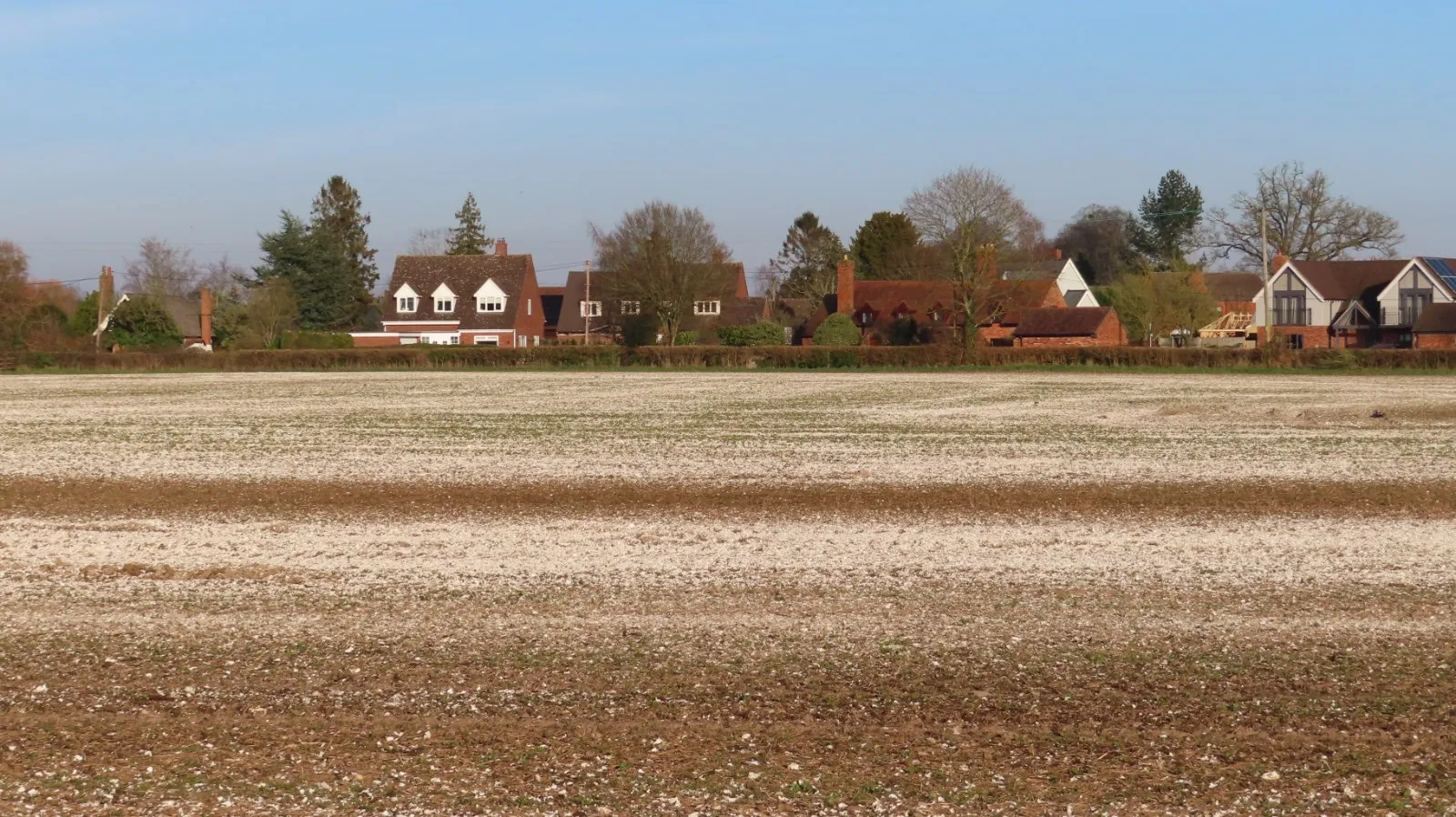
Liming of an agricultural field
Application of liming material to a cultivated agricultural field. Uniform distribution of the material over the soil surface is visible.
The method of application depends on how deeply you can work the soil.
Incorporated (for beds and vegetable gardens)
Lime migrates poorly downward through the profile. It remains where you applied it (Weil 2017; Troeh 1993). Therefore:
1. Spread lime evenly over the surface.
2. Dig the soil to a depth of 15–20 cm (a spade's depth).
3. Mix thoroughly.
If you apply only to the surface without digging, the effect will be slow — lime will work only in the top layer (Weil 2017). For clay soils with high buffering capacity, this is especially important (Troeh 1993).
Surface Application (for lawns, gardens, no-till)
For permanent plantings — lawns, fruit trees, berry patches, ornamental shrubs — digging is impossible (Weil 2017). In this case:
1. Spread lime over the surface.
2. Let rains and soil organisms “pull” it into the soil.
This works more slowly but is safer for roots (Weil 2017). Earthworms help move lime down the profile (Weil 2017; Troeh 1993).
For lawns: the best time is after aeration (spiking the turf). Lime will get into the holes and reach the root zone faster (Weil 2017).
For Fruit Trees
Apply lime over the crown projection — where the main roots are located. Do not pour lime right at the trunk — there are few roots there (Hill 2011). If the tree was planted recently, apply lime to the planting hole at planting (Weil 2017).
Compatibility with Fertilizers
Do not apply lime simultaneously with nitrogen fertilizers (Weil 2017; Littlewood 2007; Troeh 1993). Reason: lime raises pH, and ammonium forms of nitrogen (ammonium sulfate, urea, ammonium nitrate) at high pH turn into gaseous ammonia and volatilize. You simply lose nitrogen.
Rule: at least 2–4 weeks must pass between applying lime and nitrogen fertilizers (Littlewood 2007; Troeh 1993).
With organic fertilizers, lime is compatible, but also not simultaneously. Compost and manure are best applied in autumn, and lime in spring, or vice versa (Gershuny 1999).
Application Frequency
Liming is not a one-time event but a regular practice (Weil 2017; Troeh 1993). In humid regions (forest zone, high humidity), soils are constantly acidified:
- Rainwater contains carbonic acid (pH about 5.6) (Weil 2017).
- Decomposition of organic matter forms organic acids (Weil 2017).
- Nitrogen fertilizers acidify the soil (Weil 2017; Troeh 1993).
- Calcium and magnesium are removed with the harvest (Troeh 1993).
Typical schedule: repeat liming every 3–5 years (Weil 2017; Troeh 1993). In sandy soils — more often (every 2–3 years), in clay soils — less often (every 4–6 years) (Troeh 1993).
A sign that it is needed: pH has fallen below the target level again. Without a test, you will not know when this happened.
When NOT to Apply Lime
- On alkaline soils. If pH > 7.0, lime is not needed and is harmful (Weil 2017).
- Under acid-loving crops. Blueberries, rhododendrons, azaleas, cranberries, and conifers do not tolerate lime (Weil 2017; Pavlis 2020).
- On saline soils. Lime can worsen the problem (Weil 2017).
- Simultaneously with nitrogen fertilizers. Nitrogen losses (Troeh 1993; Littlewood 2007).
- On snow or frozen soil without mulch. If lime remains on the surface, meltwater can wash it away (Troeh 1993). However, on lawns and no-till this is acceptable if lime is applied regularly and in small doses (Weil 2017).
Key Takeaway
Autumn is the best time for liming. Apply by incorporation (if possible) or on the surface (for lawns and gardens). Do not mix with nitrogen fertilizers. Repeat every 3–5 years, checking pH.
In the next chapter, we will discuss the opposite process — acidification: when it is needed and what to use for it.

Solar Automatic Drip Irrigation Kit for Gardens
Automate watering for pots, gardens and small greenhouses. This solar-powered system features a timer to help schedule water delivery to your plants.
- Solar-powered
- 15 m irrigation hose
- Programmable watering
Affiliate link · Check included accessories.
5. Acidification: When It Is Needed and What to Use
Acidification is lowering soil pH. Unlike liming, which is required in most humid regions, acidification is needed less often — mainly on alkaline and carbonate soils, and for growing acid-loving crops. But here too there are subtleties: not all materials work the same, and some can harm the soil.
When Acidification Is Needed
Based on soil test results:
- pH above 7.0–7.5 for crops that prefer acidic or slightly acidic conditions (Weil 2017; Welbaum 2015).
- pH above 8.0 — the soil is alkaline, and many elements (iron, manganese, zinc, boron) become unavailable (Pavlis 2020; Weil 2017).
- Presence of free lime (carbonates) — visible by effervescence when treated with acid (Troeh 1993). Such soils have high buffering capacity, and acidifying them for the long term is very difficult.
Based on indicator plants:
Alkaline soils often support: gypsophila, poppy, lavender, thyme, rosemary, and many steppe and Mediterranean species (Littlewood 2007). If these plants thrive while blueberries, rhododendrons, or hydrangeas are suppressed, pH is probably high.
Based on soil type and climate:
- In arid and semi-arid regions (steppe, desert), soils are often alkaline due to low precipitation and carbonate accumulation (Weil 2017; Troeh 1993).
- In humid regions, acidification is usually not required — soils there are naturally acidic (Weil 2017).
- In the tropics, pH is often acidic, but there are exceptions — for example, soils on coral deposits (Weil 2017).
Which crops need acidification:

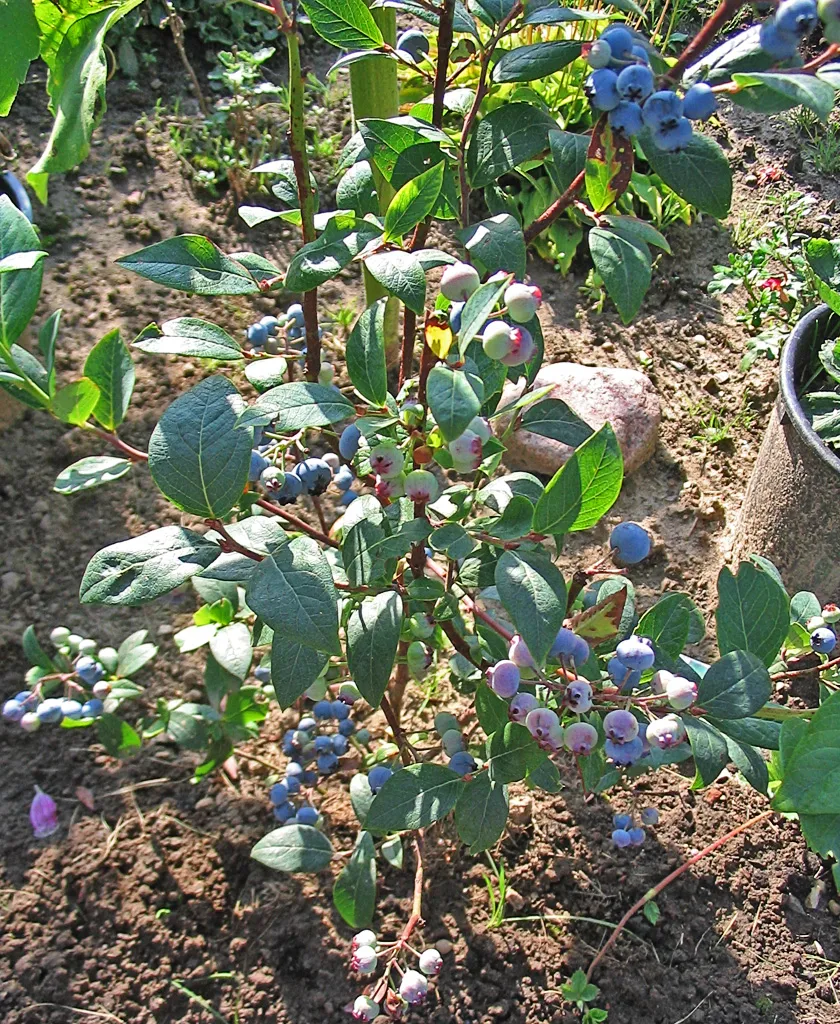
Highbush blueberry (Vaccinium corymbosum): an example of a fruit crop that requires acidic soil
Location: Leesylvania State Park, Woodbridge, Virginia, USA.
- Blueberries (pH 4.5–5.5) (Weil 2017).
- Rhododendrons, azaleas, camellias (pH 4.5–5.5) (Littlewood 2007).
- Hydrangeas (for blue flowers, pH < 5.5) (Weil 2017).
- Cranberries (pH 4.0–5.0) (Weil 2017).
- Conifers (many species prefer pH 5.0–6.0) (Weil 2017).
- Potatoes (pH 5.0–5.5 to prevent scab) (Troeh 1993).
- Tea (pH 4.5–5.5) (Weil 2017).
Important note: Acidification is a more complex and risky process than liming. If you over-lime the soil, you can block nutrition for years. If you over-acidify, you can also cause harm by causing aluminum and manganese toxicity (Weil 2017). Therefore, act especially carefully.
What to Acidify With: Overview of Materials
All acidifying materials fall into two groups: fast-acting (mineral acids, vinegar) and slow-acting (sulfur, peat, conifer litter, organic acids). The choice depends on how urgently pH needs to be changed and over what area.
Sulfur (Elemental)

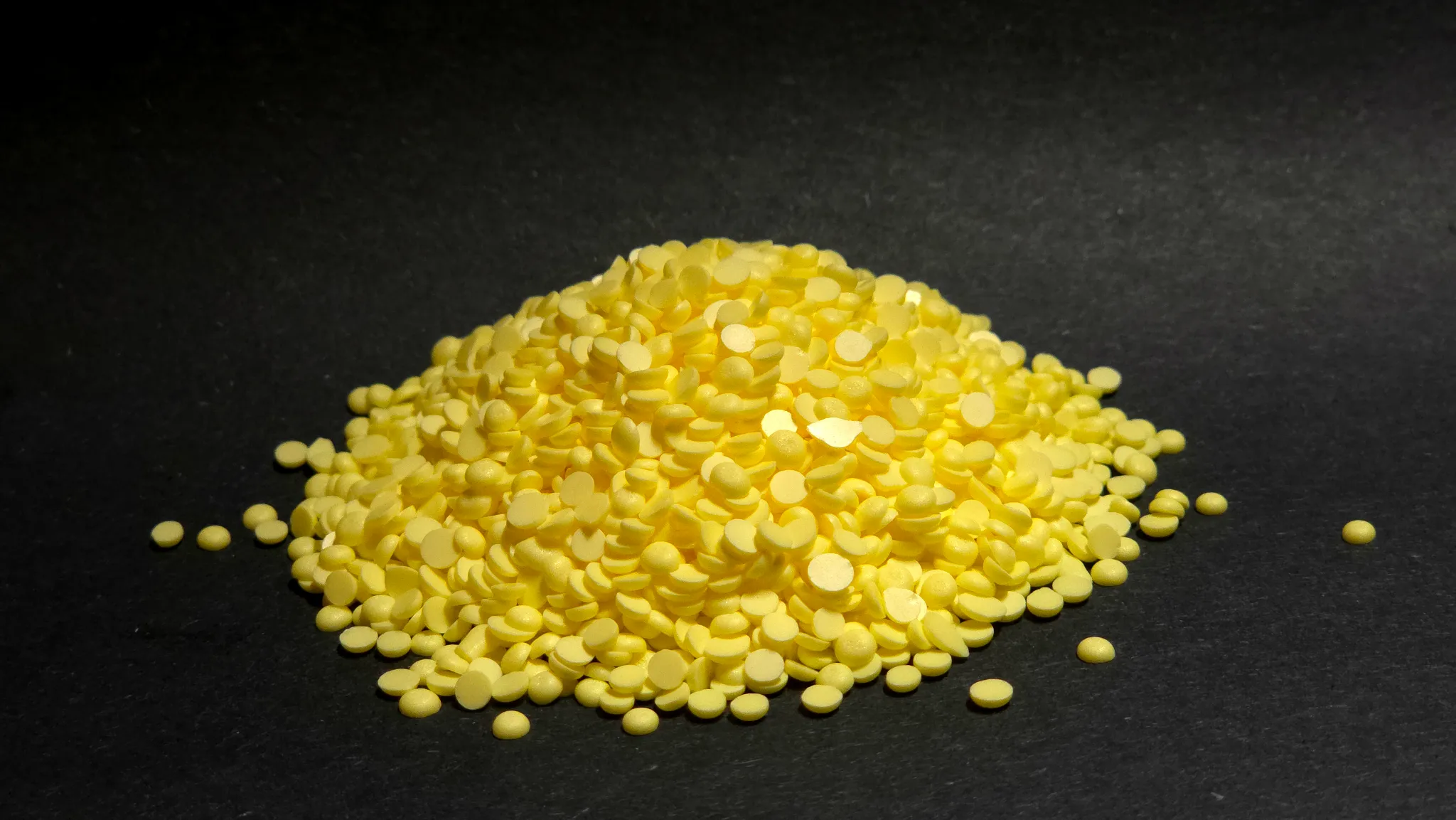
Elemental sulfur: a material for acidifying soil
Granules of elemental sulfur used to gradually lower soil pH. Microorganisms oxidize sulfur, resulting in compounds that promote acidification.
What it is: yellow powder or granules. The most effective and common material for acidification (Weil 2017; Troeh 1993).
How it works: soil microorganisms oxidize sulfur to sulfuric acid (H2SO4), which neutralizes carbonates and displaces bases from exchange positions (Weil 2017; Troeh 1993). Reaction:
2S + 3O2 + 2H2O → 2H2SO4
Speed of action: slow. Several months are required for sulfur to oxidize. In cold soil, the process goes even slower (Weil 2017; Troeh 1993). It is best to apply in autumn so that pH shifts by spring.
Doses: depend on buffering capacity and target pH. Approximately, to lower pH by 1 unit (Weil 2017; Troeh 1993):
- Sandy soil: 30–50 g/m2.
- Loamy soil: 50–100 g/m2.
- Clay soil: 100–150 g/m2.
Note: these are very approximate figures. The exact dose requires analysis. On carbonate soils, sulfur may be ineffective if there is too much carbonate — it neutralizes the acid faster than it forms (Weil 2017).
Pros: effective, relatively inexpensive, acts gradually, does not burn roots.
Cons: slow, does not work in cold soil, may be useless on carbonate soils.
Iron Sulfate (Ferrous Sulfate) and Aluminum Sulfate
What they are: mineral salts that form acid upon hydrolysis (Weil 2017; Troeh 1993).
How they work: FeSO4 + ¼O2 + 1½H2O → FeOOH + H2SO4. Aluminum sulfate works similarly (Weil 2017).
Speed of action: faster than sulfur, but still not instant. Several weeks are required.
Doses: lower than for sulfur, because these salts contain more acid equivalent per unit mass (Weil 2017). But they are more expensive and can be toxic if overdosed (Weil 2017).
Pros: faster than sulfur; iron sulfate additionally supplies iron (useful for chlorosis).
Cons: more expensive; risk of aluminum toxicity (for aluminum sulfate); can burn roots at high concentration (Weil 2017).
Important note: Aluminum sulfate is not recommended for food crops because of the risk of aluminum accumulation (Weil 2017). Use it only for ornamental acid-loving plants.
Peat (Acidic)
What it is: sphagnum peat has a pH of 3.5–4.5 (Gershuny 1999; Littlewood 2007).
How it works: peat is an organic material that is itself acidic. When added to soil, it gradually lowers pH, but the effect is not very strong or long-lasting (Littlewood 2007).
Speed of action: slow. Peat decomposes over years.
Doses: for a noticeable effect, you need to apply a lot — 10–20% of the soil volume (Pavlis 2020). This is expensive and often unjustified.
Pros: improves soil structure, adds organic matter, mildly acidifies.
Cons: expensive, weak effect, peat extraction harms the environment (Littlewood 2007; Pavlis 2020). It is not recommended to use peat only for acidification — it is better to choose another material.
Tip: peat can be used as a component of potting mixes for acid-loving container plants, but not for mass acidification of the garden (Pavlis 2020).
Conifer Litter (Pine Needles, Conifer Bark)
What it is: fallen needles, bark, and wood chips of coniferous species (Pavlis 2020).
How it works: fresh conifer litter has a pH of 3.5–4.5, but its acidity decreases as it decomposes. In addition, it contains resins and phenols that can suppress the growth of some plants (Pavlis 2020; Gershuny 1999).
Speed of action: very slow.
Doses: as mulch — a 5–10 cm layer. As a soil additive — ineffective.
Pros: available for free, improves structure, suppresses weeds, serves as mulch.
Cons: weak and short-lived acidification effect. Can contribute to fungal diseases (Pavlis 2020). Not recommended as the main method of acidification.
Important note: There is a widespread myth that conifer litter strongly acidifies soil. Studies show the effect is insignificant and short-lived (Pavlis 2020). Do not rely on it for serious pH change.
Vinegar (Table Vinegar, 5–9%)
What it is: diluted acetic acid.
How it works: vinegar is a weak acid. When added to soil, it is quickly neutralized by carbonates and exchangeable bases (Weil 2017). The effect is very short-lived.
Speed of action: instant, but very short.
Doses: for temporary acidification, you can water the soil with a vinegar solution (1 cup per 10 L of water). But this will have an effect for only a few days, no more (Pavlis 2020).
Pros: available, quick effect (for temporary pH shift in container crops).
Cons: does not work for long-term acidification, can burn roots at high concentration, kills soil microflora (Pavlis 2020).
Tip: vinegar can be used to quickly acidify water for watering acid-loving container plants (for example, blueberries in a container). But not for the garden.
Organic Acids (Citric, Oxalic)
What they are: food-grade acids that can be bought in a store.
How they work: similar to vinegar — a quick but short-lived effect.
Pros: available, safe for humans.
Cons: expensive, ineffective for large areas, short-lived effect.
Acidic Compost (from Conifer Litter, Oak Leaves, Peat)
What it is: compost made from acidic materials (conifer litter, oak leaves, peat, coffee grounds).
How it works: gradual acidification during decomposition.
Speed of action: very slow.
Pros: improves soil, safe, free.
Cons: weak effect, requires a lot of material.
Comparative Table of Materials
| Material | Speed | Effectiveness | Safety | Cost |
|---|---|---|---|---|
| Elemental sulfur | Slow (months) | High | Safe | Low |
| Iron sulfate | Medium (weeks) | Medium | Relatively safe | Medium |
| Aluminum sulfate | Medium | Medium | Toxic if overdosed | Medium |
| Peat | Slow (years) | Low | Safe | High |
| Conifer litter | Very slow | Very low | Safe | Free |
| Vinegar | Instant | Very short-lived | Can burn roots | Low |
| Organic acids | Instant | Short-lived | Safe | High |
| Acidic compost | Very slow | Low | Safe | Free |
Practical Recommendations
For the garden (large area):
- Use elemental sulfur. Apply in autumn, with incorporation, at a dose calculated from the analysis (Weil 2017; Troeh 1993).
- If the soil is carbonate (effervesces with acid), sulfur may not work. In this case, consider replacing the soil or growing in containers (Weil 2017).
For container plants:
- Use peat as a component of the potting mix (Pavlis 2020).
- For quick acidification of water — vinegar (1 tbsp per 1 L of water) (Pavlis 2020).
- Sulfur works poorly in pots because of the small volume and slow oxidation.
For the lawn:
- Usually not required. If pH is high, you can use iron sulfate (it also suppresses moss) (Weil 2017).
Mistakes in Acidification
1. Using vinegar for the garden. Short-lived effect, kills microflora, burns roots (Pavlis 2020).
2. Overdosing sulfur. Can lead to aluminum and manganese toxicity, as well as nutrient leaching (Weil 2017).
3. Trying to acidify carbonate soil. Sulfur will not work — carbonates neutralize the acid faster than it forms (Weil 2017; Troeh 1993).
4. Using peat as the main method. Expensive, weak, environmentally harmful (Pavlis 2020).
5. Applying sulfur and lime at the same time. They neutralize each other (Weil 2017).
Key Takeaway
Acidification is a more complex process than liming. The best material for the garden is elemental sulfur, but it acts slowly and requires time. For container plants, peat and vinegar are suitable. Conifer litter and acidic compost are weak acidifiers but useful as mulch and a source of organic matter. Better to under-acidify than to over-acidify.
In the next chapter, we will discuss typical mistakes in pH correction — and how to avoid them.
6. Mistakes: Over-Liming and Overdose
This chapter is about what happens when pH correction is done without analysis, “by eye,” or when too much material is applied at once. Mistakes in changing pH differ from ordinary fertilizer mistakes: their consequences do not disappear after a week. They can persist for years, and sometimes for decades.
Why pH Correction Mistakes Are So Dangerous
Lime and sulfur are not fertilizers. They are materials that change the chemical environment of the soil. They interact with clay minerals, organic matter, and the soil solution, triggering chains of reactions. If you make a mistake with a fertilizer dose, plants suffer for a season, but the soil recovers. If you make a mistake with a lime or sulfur dose, the consequences will be long-term (Weil 2017; Troeh 1993).
The main problem: pH is easy to change but hard to change back. If you over-lime the soil, its pH will remain at a high level for years because carbonates and exchangeable bases act as a buffer. The same is true for over-acidification: excess sulfur oxidizes gradually, and pH falls lower and lower, even after you stop applying the material (Weil 2017).
Over-Liming: What It Looks Like and Why It Is Dangerous
Over-liming is the most common mistake. It occurs when a gardener looks at the pH, sees “acidic soil,” and applies lime without considering buffering capacity, soil type, or the initial pH level.
What Happens with Excess Lime

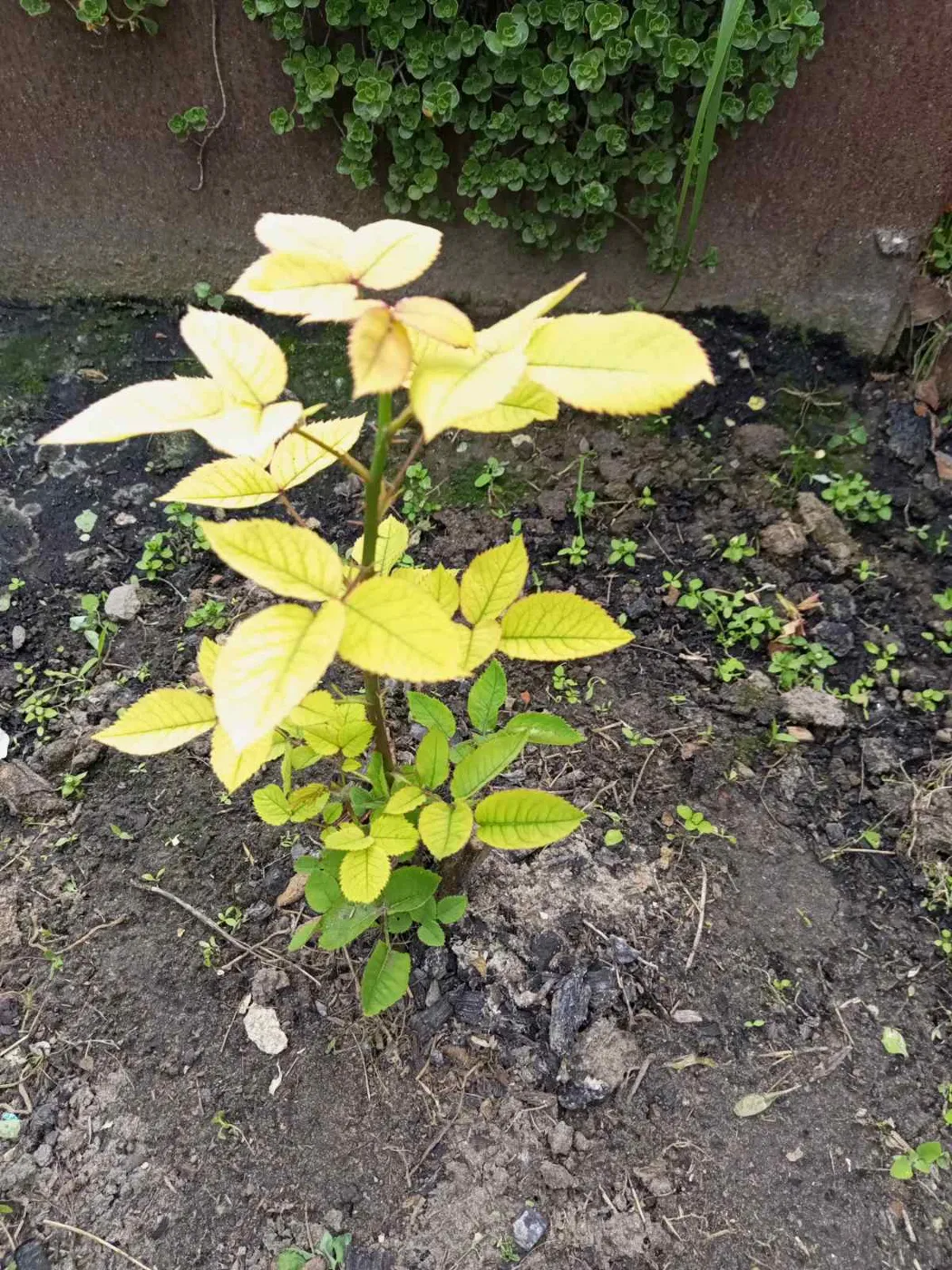
Iron deficiency (chlorosis) in a young rose bush
The image presents a young rose bush with clear signs of iron chlorosis. Since iron is low-mobility in the plant, its deficiency primarily manifests on young upper leaves, which turn yellow, while lower (old) leaves remain green. This is a common problem when growing roses on calcareous or waterlogged soils.
At pH above 7.0–7.5, nutrients begin to be blocked (Weil 2017; Troeh 1993):
- Iron (Fe). Becomes unavailable. Symptom: interveinal chlorosis on young leaves (Weil 2017; Welbaum 2015).
- Manganese (Mn). Also becomes unavailable. Symptoms resemble iron chlorosis but are often more diffuse (Welbaum 2015).
- Zinc (Zn). Unavailable at high pH. Symptom: small leaves, shortened internodes (Welbaum 2015).
- Copper (Cu). Unavailable. Symptom: chlorosis of young leaves, loss of turgor (Welbaum 2015).
- Boron (B). Unavailable. Symptom: death of growing points, hollow stems (Welbaum 2015).
- Phosphorus (P). Binds with calcium into insoluble phosphates (Pavlis 2020; Weil 2017).
- Potassium (K). Suppressed by excess calcium (Troeh 1993).
In addition, with excess lime, soil structure deteriorates: calcium can cause particles to stick together into dense aggregates, especially on clay soils (Troeh 1993). Nitrogen in ammonium form is lost as gas, because at high pH ammonium turns into ammonia (Weil 2017).
Who Is at Risk
Over-liming is especially likely in the following cases (Weil 2017; Troeh 1993):
1. Sandy and loamy sandy soils. They have low buffering capacity, so even a small amount of lime can sharply raise pH. It is easy to “overdo it” on such soils.
2. Soils with low organic matter content. Humus buffers pH, so organic-poor soils react more strongly to lime.
3. Fields with patchy soil. If a field has both clay and sandy patches, applying the same lime dose will lead to over-liming on the sandy patches (Troeh 1993).
4. Trying to raise pH above 7.0. For most crops, the optimal range is 5.5–7.0. Raising pH above 7.0 without a special need is not worthwhile (Troeh 1993; Weil 2017).
5. Using hydrated lime. It acts quickly and is easy to overdose (Weil 2017).
How to Fix Over-Liming
This is difficult. There is no quick way (Weil 2017; Troeh 1993).
- Applying sulfur. Sulfur acidifies the soil but acts slowly. On carbonate soils it may be useless — carbonates neutralize the acid faster than it forms (Weil 2017).
- Applying organic materials. Acidic peat, conifer litter, and acidic compost gradually lower pH, but the effect is weak (Pavlis 2020).
- Leaching. If the soil is well drained, heavy irrigation can leach out some carbonates, but this works only on sandy soils and requires a lot of water (Weil 2017).
- Soil replacement. A radical but sometimes the only way — remove the top layer and replace it with an acidic substrate (Weil 2017).
- Growing in containers. If the soil on the plot is over-limed, you can grow acid-loving plants in pots with a suitable substrate (Pavlis 2020).
Important note: Over-liming is not always “a lot of lime.” On sandy soil, even 100–200 g/m2 can raise pH above 7.0. On clay soil, the same dose will not give a noticeable effect (Troeh 1993).
Overdose of Acidifying Materials
Acidification is a rarer practice, but there is a risk here too.
Excess Sulfur
Sulfur is the most effective acidifier, but when overdosed it can cause harm (Weil 2017; Troeh 1993):
- Aluminum and manganese toxicity. At pH below 5.0, aluminum and manganese enter the soil solution and become toxic to roots (Weil 2017).
- Nutrient leaching. At low pH, calcium, magnesium, and potassium are leached from the upper horizons (Weil 2017).
- Suppression of microflora. Bacteria responsible for nitrogen mineralization work poorly at pH below 5.5 (Weil 2017; Pavlis 2020).
- Root damage. Fresh sulfur at high concentration can burn roots (Troeh 1993).
Sulfur acts slowly, and its effect accumulates. If you applied too much, pH will fall over several months, and it is impossible to stop this process (Weil 2017).
Excess Aluminum Sulfate
Aluminum sulfate acts faster than sulfur, but it is toxic to plants when overdosed. Aluminum is not a nutrient element; in high concentrations it damages roots and blocks the uptake of phosphorus and calcium (Weil 2017). Do not use aluminum sulfate on food crops.
Vinegar and Organic Acids
Vinegar and citric acid act instantly, but their effect is very short-lived. When overdosed, they can burn roots and kill soil microflora in the application zone (Pavlis 2020). This is not a way to acidify the garden — it is a way to temporarily change pH in a pot or a small volume of substrate.
Mistakes in Approach
Even if you have not over-limed or over-acidified the soil, there are mistakes that lead to incorrect results.
“Add Lime by pH”
This is the most common misconception. Many sources advise: “If pH is below 6.0, add such-and-such amount of lime.” But the dose depends not on pH but on buffering capacity (Weil 2017; Pavlis 2020).
Two soils with the same pH 5.0 — sandy and clay — will require different amounts of lime. Sandy soil may need only 100 g/m2, clay soil — 400 g/m2. If you use the same dose, you will over-lime the sandy soil and under-correct the clay soil (Troeh 1993).
Rule: without data on buffering capacity (buffer pH), an accurate calculation is impossible. If there is no analysis, apply the minimum dose and check the result.
Ignoring Soil Type
Sandy soils require less lime than clay soils (Troeh 1993). Clay soils require more, but the effect lasts longer. If you do not consider soil type, it is easy to make a mistake.
Applying Lime and Nitrogen Fertilizers at the Same Time
Lime raises pH. At high pH, ammonium nitrogen turns into gaseous ammonia and volatilizes (Weil 2017; Troeh 1993). You lose nitrogen and money. At least 2–4 weeks must pass between applying lime and nitrogen fertilizers (Littlewood 2007).
Applying Lime Under Acid-Loving Crops
Blueberries, rhododendrons, azaleas, cranberries, and conifers do not tolerate lime. If you apply lime under these plants, they will die (Weil 2017; Pavlis 2020). Always check crop requirements before liming.
Ignoring Application Depth
Lime does not migrate downward through the profile. If you apply it to the surface without digging, it works only in the top layer (Weil 2017). Roots located deeper remain in an acidic environment. For beds and vegetable gardens, lime must be incorporated (Troeh 1993).
Trying to Change pH “Forever”
pH is a dynamic indicator. Even if you change it, natural processes (leaching, organic matter decomposition, nitrogen fertilizers) will gradually return it to its original level (Weil 2017; Troeh 1993). Liming is not a one-time event but a regular practice.
How to Avoid Mistakes
Here are several practical rules that will help you avoid harming the soil (Weil 2017; Troeh 1993; Pavlis 2020):
1. Get a soil test. Without data on pH and buffering capacity, you are working blind.
2. Apply gradually. Do not apply the entire calculated dose at once. Divide it over 2–3 years.
3. Start small. If you have no analysis, apply the minimum dose (for example, 100 g/m2 of lime on sandy soil). Check pH a year later.
4. Consider soil type. Sandy — less, clay — more.
5. Do not mix with nitrogen fertilizers. Leave at least 2–4 weeks between applying lime and nitrogen.
6. Check crop requirements. Acid-loving plants do not tolerate lime.
7. Record what and when you applied. This will help track pH dynamics.
8. Remember: it is better to under-correct than over-correct. Plants will survive a lime shortage. They will not survive an excess.
Key Takeaway
Mistakes in pH correction are not just “an unlucky season.” They are long-term changes that are difficult to fix. Over-liming blocks nutrition for years. Over-acidification causes aluminum and manganese toxicity. The best way to avoid mistakes is to test, apply gradually, and start with small doses. Better to under-correct pH than to over-correct it.
In the next chapter, we will discuss how not to harm the soil during pH correction — practical steps and principles.

7-in-1 Wi-Fi Weather Station
Monitor local weather conditions with a wireless outdoor sensor. Track temperature, humidity, rainfall, wind speed and direction, and atmospheric pressure. Ideal for gardens, farms and greenhouses.
- Wireless outdoor sensor
- Solar-powered
- Wi-Fi connectivity
Affiliate link · Check regional compatibility.
7. How Not to Harm: Gradualness, pH Testing, Observation
This chapter is a practical guide on how to approach pH correction so as not to harm either the soil or the plants. There are no complex formulas or calculations here — only principles and a sequence of actions that will protect you from typical mistakes.
Principle One: Observe First, Then Act
Before applying anything, you need to understand what is happening in the soil. This is not as obvious as it seems.
What to observe:
- Plants. Chlorosis (yellowing) on young leaves at high pH is a sign of iron unavailability. Chlorosis on old leaves at low pH is a sign of magnesium unavailability or aluminum toxicity (Weil 2017; Welbaum 2015).
- Weeds. Horsetail, sorrel, and chickweed are indicators of acidic soil. Poppy, lavender, and thyme are indicators of alkaline soil (Littlewood 2007).
- Water. If water stands on the surface for a long time after rain, the soil is compacted — this can affect the effectiveness of lime (Pavlis 2020).
- Soil color. Dark soil is usually rich in organic matter and better buffered. Light, sandy soil is weakly buffered (Pavlis 2020).
Important: visual signs are only preliminary diagnostics. They do not replace a soil test.
Principle Two: A Soil Test Is the Foundation
Without testing pH and buffering capacity, any correction is guesswork (Weil 2017; Pavlis 2020).
What to order from the laboratory:
- Water pH (pHwater) — a basic indicator.
- Buffer pH (buffer pH) — shows buffering capacity.
- CEC (cation exchange capacity).
- Organic matter content.
- Calcium and magnesium content (to choose between calcite and dolomite).
How often to test:
- The first time — before starting correction.
- The second time — a year later, to see the dynamics.
- After that — every 2–3 years for vegetable beds, every 4–5 years for lawns and perennial plantings (Pavlis 2020; Weil 2017).
Note: if you cannot send a sample to a laboratory, use household pH meters or test strips. They are less accurate, but better than nothing (Pavlis 2020).
Principle Three: Gradualness
This is perhaps the most important principle. A sharp change in pH is stress for the soil ecosystem (Weil 2017; Troeh 1993).
Rule: do not apply the entire calculated dose at once. Divide it over 2–3 years.
Example:
- Calculated lime dose = 10 kg per 100 m2.
- Apply 4–5 kg in the first year.
- Check pH a year later.
- If pH is still low, apply another 3–4 kg.
- If pH is normal, stop.
Why this matters:
- Soil organisms adapt to changes gradually. A sharp pH shift can kill part of the microflora (Pavlis 2020).
- Plants also adapt to changes. A sharp pH change can cause temporary nutrient deficiency, even if the pH has become “correct” (Weil 2017).
- If you made a calculation error, gradual application gives you time to stop (Troeh 1993).
Exception: if pH is critically low (below 4.5) or critically high (above 8.5), you can apply more at once, but still carefully (Troeh 1993).
Principle Four: Consider Buffering Capacity
Buffering capacity is the soil's resistance to pH change. It depends on clay content, organic matter content, and the type of clay minerals (Weil 2017; Troeh 1993).
What this means in practice:
- Sandy soils with low buffering capacity change pH quickly. Even a small amount of lime can raise pH above 7.0 (Troeh 1993).
- Clay soils with high buffering capacity change pH slowly. They need more lime, but the effect lasts longer (Weil 2017).
Tip: on sandy soils, apply lime in smaller doses and more often. On clay soils — in larger doses and less often (Troeh 1993).
Principle Five: Do Not Mix Incompatible Materials
Some materials cannot be applied at the same time (Weil 2017; Troeh 1993; Littlewood 2007):
- Lime + nitrogen fertilizers. Nitrogen losses as ammonia. Leave at least 2–4 weeks between applications.
- Lime + fresh manure. Manure decomposes and releases acids that neutralize lime. It is better to apply them in different seasons.
- Sulfur + lime. They neutralize each other. Do not apply them at the same time.
- Ash + nitrogen fertilizers. Ash raises pH, and nitrogen is lost.
Rule: if you are unsure about compatibility, separate the applications in time. Lime in autumn, nitrogen in spring. Or vice versa.
Principle Six: Work with Organic Matter

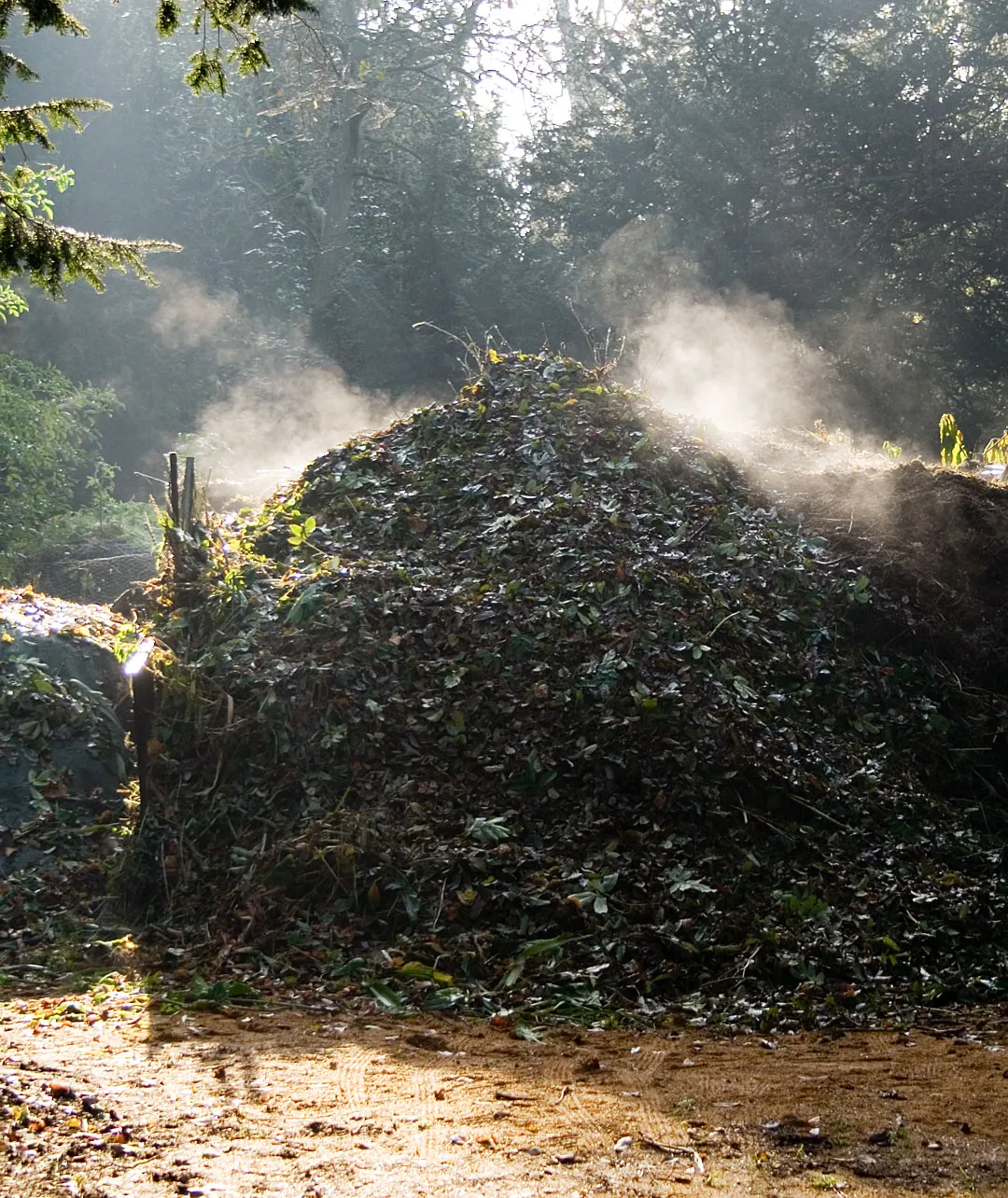
Compost heap on a frosty morning
Photograph of a large outdoor compost heap. The caption notes that the steam above the heap shows the exothermic activity of bacteria on a frosty morning.
Organic matter is a natural pH buffer (Weil 2017; Gershuny 1999). It softens sharp changes and creates a stable environment for soil organisms.
What this means in practice:
- Regular application of compost, manure, and mulch helps keep pH in the optimal range without sharp fluctuations (Gershuny 1999).
- Organic matter increases CEC, which improves nutrient retention (Weil 2017).
- On soils with high organic matter content, pH correction is needed less often (Pavlis 2020).
Tip: if you do not know where to start, start with organic matter. Compost and mulch will not harm, even if pH is not ideal.
Principle Seven: Check the Result
Any action needs to be checked. This is the only way to know whether you have achieved your goal (Pavlis 2020; Weil 2017).
How to check:
- With a pH meter or test strips — once a year.
- With a laboratory test — every 2–3 years.
- By plants — observe their condition.
What to do if the result is not what you expected:
- If pH has not changed, the dose may have been too small, or the buffering capacity higher than you thought.
- If pH has changed too much, stop applying and let the soil stabilize.
- If plants have gotten worse, check pH and other factors (drainage, compaction, pests).
Principle Eight: Consider the Region
What works in one climate may not work in another (Weil 2017; Troeh 1993).
Humid regions (forest zone, high humidity):
- Soils are naturally acidic.
- Liming is a regular practice.
- Acidification is rarely needed.
Arid and semi-arid regions (steppe, desert):
- Soils are often alkaline or neutral.
- Acidification may be needed for acid-loving crops.
- Liming is usually not needed.
Tropics:
- Soils are often acidic (weathered).
- Liming may be necessary for most crops.
- On carbonate soils (coral deposits), on the contrary, acidification may be needed.
Tip: find out what soils are typical for your region and what practices local gardeners use. This will help avoid mistakes.
Practical Algorithm: How Not to Harm
Here is a step-by-step plan to help you act safely (Weil 2017; Troeh 1993; Pavlis 2020):
1. Observe. Record how plants look, what weeds grow, and how the soil reacts to rain.
2. Get a soil test. At least pH and buffer pH.
3. Determine the goal. What pH do your crops need? (See the tables in Chapter 1.)
4. Choose the material. Lime, dolomite, sulfur, peat — depending on the task.
5. Calculate the dose. By buffer pH or by conservative guidelines.
6. Apply half. Not the entire dose at once.
7. Check a year later. pH and plant condition.
8. If necessary, add more. But no more than half of the initial dose.
9. Record. What, when, how much, what result.
10. Repeat the test. Every 2–3 years.
Key Takeaway
Not harming means acting gradually, with checks, and with respect for the soil ecosystem. pH can be changed, but it requires time. It is better to spend 2–3 years on gradual correction than to ruin the soil for a decade in one season.
In the next chapter, we will discuss regional aspects — how climate and soil type influence the pH correction strategy.
8. Regional Aspect: Climate and Soils Determine Strategy
Soil pH is not accidental. It is formed by climate, vegetation, and parent material over millennia. Therefore, the strategy for pH correction will differ in different regions of the world. There is no universal recipe “apply this much lime” that would work equally well in the Moscow region, Kansas, and the Amazon tropics.
Humid Regions (Forest Zone, High Humidity)

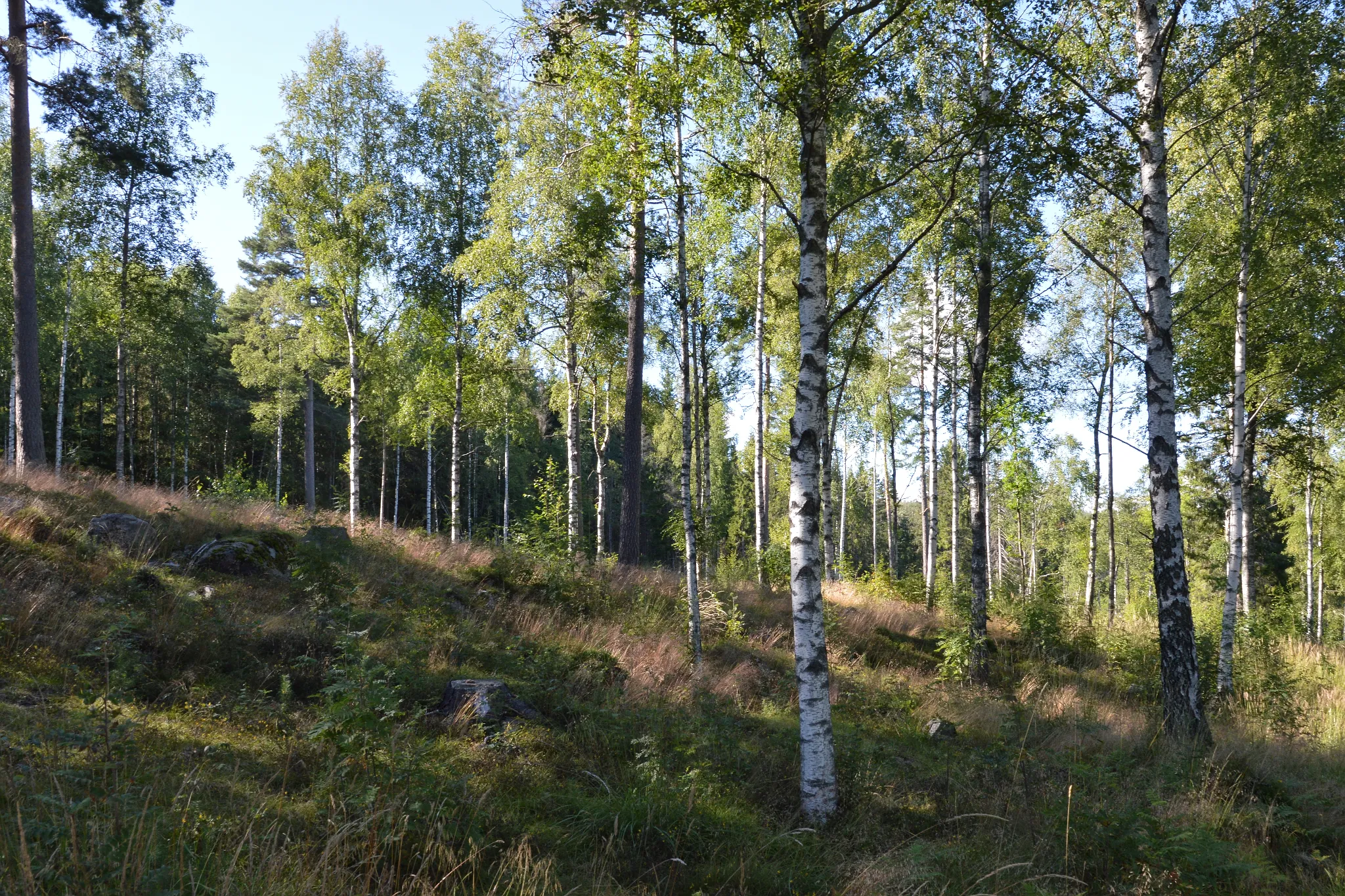
Forest landscape of a humid climate zone
Forest near Sognsvann Lake in Oslo. A typical example of a forest landscape in northern Europe, where the humid climate and precipitation promote leaching of bases and natural acidification of soils.
Where: Northern Europe, northern USA and Canada, most of central Russia, Primorye, mountain areas with high precipitation.
What happens to pH:
In these regions, precipitation exceeds evaporation. Water leaches the soil, washing out bases — calcium, magnesium, potassium, and sodium. Hydrogen and aluminum ions take their place. Soils are naturally acidic (Weil 2017; Troeh 1993). Typical pH values are 4.5–6.0. The more rain, the stronger the leaching and the more acidic the soil (Weil 2017).
Vegetation:
Coniferous and deciduous forests. Conifer litter additionally acidifies the soil through decomposition products (Pavlis 2020).
Strategy:
- Liming is a regular practice. Most vegetable and fruit crops need pH 6.0–7.0. Without lime, they will be nutrient-starved (Weil 2017; Littlewood 2007).
- Frequency: every 3–5 years for beds, every 5–7 years for lawns and perennial plantings (Troeh 1993).
- Materials: calcite or dolomite. On sandy soils — lower doses, on clay soils — higher (Troeh 1993).
- Acidification is rarely needed — only for acid-loving crops (blueberries, rhododendrons, conifers), and only if the soil is neutral or slightly alkaline (Weil 2017).
Typical mistakes in the humid zone:
- Ignoring liming. The soil is acidic, but the gardener thinks it will “grow by itself.” It will not — most vegetables at pH 4.5–5.0 yield half a crop (Weil 2017).
- Over-liming sandy patches. On sandy soil, it is easy to raise pH above 7.0 if the dose is not calculated (Troeh 1993).
Steppe and Arid Regions (Lack of Moisture)

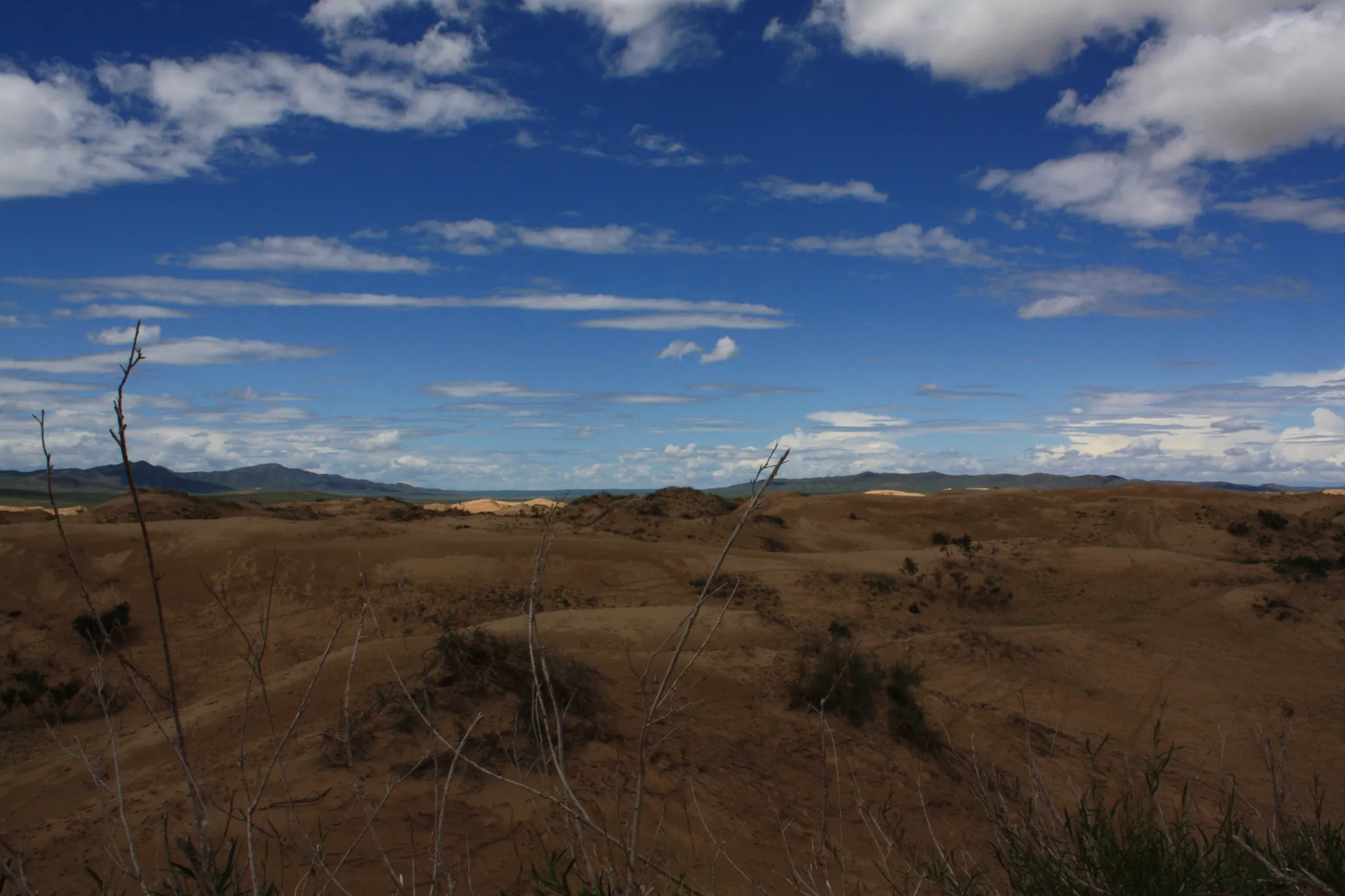
Steppe expanses of Mongolia
Open steppe landscape of central Mongolia. Insufficient precipitation and intense evaporation under such natural conditions promote the accumulation of soluble salts and bases in the upper soil layers.
Where: Central Asia, the Middle East, North Africa, southern Russia, the US Great Plains, Argentina, Australia.
What happens to pH:
There is little precipitation, and evaporation exceeds moisture input. Water does not leach bases but, on the contrary, raises them to the surface with capillary moisture. Calcium, magnesium, and sodium accumulate in the upper horizons. Soils are neutral or alkaline (Weil 2017; Troeh 1993). Typical pH values are 7.0–8.5, sometimes higher.
Vegetation:
Steppes, prairies, semi-deserts. Herbaceous vegetation, often with deep roots.
Strategy:
- Liming is usually not required. pH is already neutral or alkaline. Lime will only harm (Weil 2017).
- Acidification may be needed for acid-loving crops — blueberries, rhododendrons, hydrangeas, conifers (Weil 2017; Pavlis 2020).
- The main problem is not pH but salinity. Arid regions often accumulate soluble salts (NaCl, Na2SO4), which increase osmotic pressure and prevent plants from taking up water (Sparks 2003; Troeh 1993). In this case, leaching and drainage are needed, not acidification.
- Alkaline soils (pH > 8.0) require a special approach: application of sulfur, gypsum, and organic matter. But on carbonate soils, sulfur may not work (Weil 2017).
Typical mistakes in the arid zone:
- Applying lime “just in case.” This raises an already high pH and blocks nutrition (Weil 2017).
- Trying to acidify carbonate soil with sulfur. Carbonates neutralize the acid faster than it forms. The effect is zero, and the money is spent (Troeh 1993).
- Ignoring salinity. Sometimes a gardener thinks they have “alkaline soil” when in fact it is saline. The treatment is different (Sparks 2003).
Tropics and Subtropics

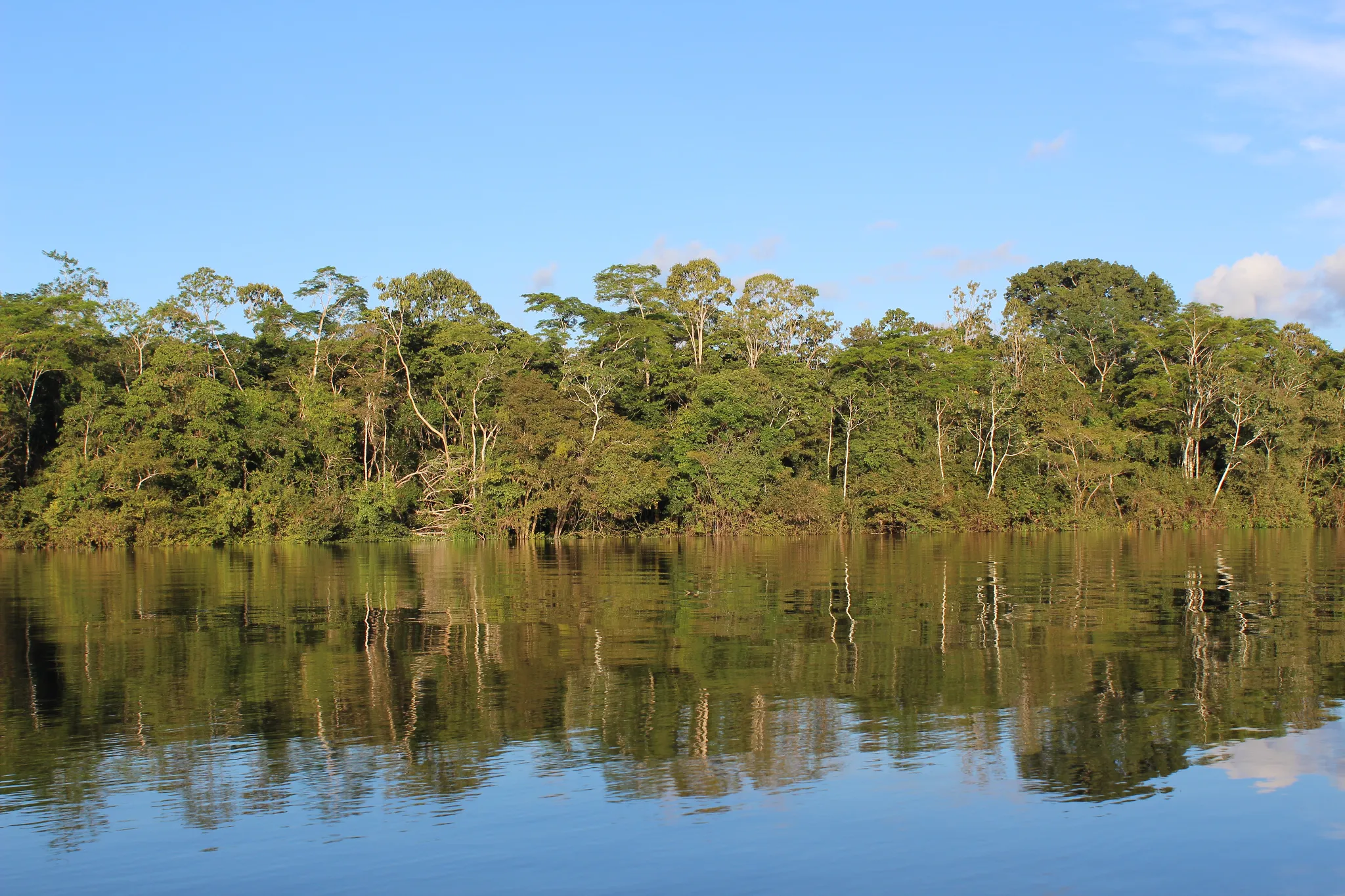
Amazon tropical rainforest
The precipitation-rich conditions of the tropics promote intense weathering and leaching of bases, so many soils of the region have a pronounced acidic reaction.
Where: Amazonia, Congo, Southeast Asia, Central America, northern Australia.
What happens to pH:
In a hot and humid climate, weathering is very fast. Rains are intense, and leaching is strong. Soils are often acidic, sometimes very acidic (pH 4.0–5.0). But there are exceptions (Weil 2017; Lambers 2019).
Features of tropical soils:
- High iron and aluminum content. Iron and aluminum oxides (goethite, gibbsite) dominate. Phosphorus binds with them and becomes unavailable (Weil 2017; Lambers 2019).
- Low organic matter content. Organic matter decomposes quickly, and humus does not accumulate (Weil 2017).
- Low CEC. Kaolinite-type clay minerals have low cation exchange capacity. Nutrients are easily leached (Weil 2017).
- Aluminum toxicity. At pH below 5.0, aluminum becomes toxic. This is the main problem of tropical agriculture (Weil 2017; Lambers 2019).
Strategy:
- Liming is often necessary for most crops. But doses must be careful (Weil 2017).
- The target pH is lower than in temperate latitudes. For many tropical crops, the optimum is 5.5–6.0, not 6.5–7.0. Liming to pH 6.5–7.0 can be harmful (Weil 2017).
- Organic matter is the key to success. Compost, mulch, and green manures help retain nutrients and soften aluminum toxicity (Gershuny 1999; Weil 2017).
- On carbonate soils (coral islands, limestone plateaus), pH may be high. There, on the contrary, acidification may be needed (Weil 2017).
Typical mistakes in the tropics:
- Liming to pH 7.0. This blocks iron, manganese, and zinc and makes the soil infertile (Weil 2017).
- Ignoring aluminum. If pH is below 5.0, roots do not grow, even if all nutrients are present (Lambers 2019).
- Using temperate lime doses. In the tropics, buffering capacity is often low, and doses should be lower (Weil 2017).
Mountain Regions


Panorama of the Alpine mountain landscape
Mountain regions are characterized by considerable soil heterogeneity: soils with a neutral or alkaline reaction form on limestone rocks, whereas acidic soils are more common on granites and sandstones.
Where: Alps, Caucasus, Himalayas, Andes, Rocky Mountains.
What happens to pH:
Depends on altitude, slope aspect, and parent material. On limestones — neutral or alkaline. On granites and sandstones — acidic. In the upper horizons, pH is often lower due to leaching and organic matter (Weil 2017).
Strategy:
- A soil test is especially important. Soil diversity over a small area is enormous. You cannot rely on an “average” pH (Weil 2017).
- Consider the slope. On slopes, water runs off and leaching increases. pH may be lower than on level ground (Troeh 1993).
- Erosion is the main problem. Liming on slopes must be done carefully to avoid runoff (Troeh 1993).
Coastal Regions
Where: sea and ocean coasts.
What happens to pH:
Sea salt (NaCl) and aerosols can salinize the soil. pH is often neutral or slightly alkaline. But if the soil is washed by rains, it may be acidic (Weil 2017).
Strategy:
- Check salinity. If the soil is saline, liming will not help. Leaching and drainage are needed (Sparks 2003).
- Consider the wind. Salt is carried by wind tens of kilometers inland (Weil 2017).
Universal Principles for Any Region
Despite the differences, there are several principles that work everywhere (Weil 2017; Troeh 1993; Pavlis 2020):
1. A soil test is the foundation. Without data on pH and buffering capacity, you do not know what to do.
2. Observe plants. They are the best indicators.
3. Organic matter is a universal solution. Compost and mulch help stabilize pH in any climate.
4. Gradualness. Sharp pH changes are harmful everywhere.
5. Better to under-correct than over-correct. This rule knows no geographical borders.
6. Consider water. Rain acidity, irrigation water hardness, and salinity all affect pH.
7. Record. What, when, how much, what result. In a few years, these records will become invaluable.
Key Takeaway
The region determines the initial pH and the strategy for its correction. In the humid zone, liming is needed. In the arid zone, caution with lime and possible acidification. In the tropics, liming with low doses and combating aluminum. But everywhere one principle works: observe, analyze, act gradually.

40W Full Spectrum LED Grow Light
Support healthy plant growth with full-spectrum LED lighting. Ideal for seedlings, indoor plants and small growing spaces. A practical solution for indoor gardening and year-round cultivation.
- Full-spectrum LED
- Energy-efficient design
- Indoor plant growing
Affiliate link · Check actual power and light coverage.
9. Summary: pH Can Be Changed, but Carefully and Gradually
We have covered a long path: from why to change pH at all to regional specifics. It is time to bring everything together — briefly, practically, and without unnecessary words.
Main Idea
Soil pH is not a sentence and not an accident. It is a manageable parameter. But it must be managed with respect for the soil ecosystem, with an understanding of the consequences, and with a willingness to wait. There are no quick solutions here. And that is good: quick solutions in soil almost always turn into long-term problems.
What to Remember
1. pH determines nutrient availability, not plant “health” directly.
A plant does not feel pH. It feels whether it has iron, phosphorus, and calcium. If pH is unsuitable, these elements are blocked, and the plant starves, even if fertilizers have been applied (Pavlis 2020; Weil 2017).
2. Most crops prefer pH 6.0–7.0.
But there are exceptions: blueberries, rhododendrons, and conifers like acidic soil. Always check crop requirements before applying anything (Weil 2017; Welbaum 2015).
3. Liming is for acidic soils. Acidification is for alkaline soils.
In humid regions, liming is more often needed. In arid regions — caution with lime and possible acidification. In the tropics — liming with low doses (Weil 2017; Troeh 1993).
4. The dose depends not on pH but on buffering capacity.
Without testing buffer pH, an accurate calculation is impossible. If there is no analysis, apply the minimum dose and check the result (Weil 2017; Troeh 1993).
5. Autumn is the best time for liming.
Lime must interact with the soil. Over autumn and winter, it has time to partially dissolve, and by spring pH shifts in the right direction (Littlewood 2007; Weil 2017).
6. Do not mix lime with nitrogen fertilizers.
Nitrogen losses as ammonia. Leave at least 2–4 weeks between applications (Troeh 1993; Littlewood 2007).
7. Better to under-correct than over-correct.
This is the golden rule. Plants will survive a lime shortage. An excess blocks nutrition for years (Weil 2017; Troeh 1993).
8. Organic matter is a universal helper.
Compost, mulch, and green manures stabilize pH, soften aluminum toxicity, increase CEC, and create a healthy soil environment. This works in any region (Gershuny 1999; Weil 2017).
9. Gradualness is the key to success.
Divide the dose over 2–3 years. Check pH every year. Record the results. It is boring, but it works (Pavlis 2020).
10. Observe plants.
They are the best indicators. Chlorosis, suppressed growth, death of growing points — all these are signals. But do not rush to conclusions: symptoms may be caused not only by pH (Weil 2017; Welbaum 2015).
Practical Algorithm for the Gardener
Here is a short sequence of actions that will help avoid harm (Weil 2017; Troeh 1993; Pavlis 2020):
1. Observe. Record how plants look, what weeds grow, and how water soaks into the soil.
2. Get a soil test. At least pH and buffer pH.
3. Determine the goal. What pH do your crops need?
4. Choose the material. Lime, dolomite, sulfur, peat — depending on the task.
5. Apply half the dose. Not all at once.
6. Check a year later. pH and plant condition.
7. If necessary, add more. But no more than half of the initial dose.
8. Record. What, when, how much, what result.
9. Repeat the test. Every 2–3 years.
10. Do not rush. pH changes slowly. This is normal.
What Not to Do
- Do not apply lime “just in case.” It is not a vitamin. It is a chemical reagent (Weil 2017).
- Do not try to change pH “forever.” It is a dynamic indicator. It will change under the influence of climate and practices (Troeh 1993).
- Do not ignore crop requirements. What is good for cabbage is deadly for blueberries (Pavlis 2020).
- Do not believe “universal” advice. “A cup of lime per square meter” is not a recipe but guesswork (Troeh 1993).
- Do not give up if the result is not immediate. pH is a marathon, not a sprint.
Final Word
pH is one of those parameters that seem complex but in practice come down to simple principles: observe, analyze, act gradually, check. If you follow this, you can create soil that will feed plants for years — without sharp swings, without toxicity, without erosion.
And remember: it is better to under-correct pH than to over-correct it. This rule will save you from most mistakes.
References
- (2014). ‘Soil’, in Agroecology. : CRC Press, 108-123. doi: 10.1201/b17881-13
- (2015). ‘Soil cultivation and fertility’, in Ingram, D.S., Vince-Prue, Daphne, Gregory, P.J. (ed.) Science and the Garden. The scientific basis of horticultural practice. West Sussex, UK: Royal Horticulture Society. Wiley Blackwell, pp. 86-101.
- Ahmed, Niaz, Masood, Sajid, Ahmad, Shakeel, Bashir, Safdar, Hussain, Sajjad, Hassan, Waseem, Khandekar, R.Islam, Hussain, Baqir, Ali, M.Arif (2019). ‘Soil Management for Better Crop Production and Sustainable Agriculture’, in Agronomic Crops. Singapore: Springer Singapore, 47-71. doi: 10.1007/978-981-32-9783-8_4
- Bubel, Nancy, Nick, Jean (2024). ‘Moving Plants Outdoors’, in The New Seed-Starters Handbook. : Rodale, .
- Capon, Brian (2022). ‘How Plants Function’, in Botany for Gardeners. An Introduction to the Science of Plants. Portland, Oregon: Timber Press, pp. 144-192.
- Chalker-Scott, Linda (2015). ‘What's Essential’, in How Plants Work. Portland, London: Timber Press, pp. 60-83.
- Chalker-Scott, Linda (2018). ‘Soil Analysis: What Makes Soil Great?’, in The Science of Gardening. Course Guidebook. Chantilly, Virginia: The Great Courses, pp. 25-36.
- Chalker-Scott, Linda (2018). ‘Soil Preparation and Protection’, in The Science of Gardening. Course Guidebook. Chantilly, Virginia: The Great Courses, pp. 73-80.
- Connor, D.J., Loomis, R.S., Cassman, K.G. (2011). ‘Soil resources’, in Crop Ecology. Productivity and Management in Agricultural Systems. Cambridge, UK: Cambridge University Press, pp. 159-194.
- Foth, H.D. (1990). ‘Soil Fertility Evaluation and Fertilizer Use’, in Fundamentals of Soil Science. New York: John Wiley & Sons, pp. 232-249.
- George, Eckhard, Horst, W.J., Neumann, Elke (2012). ‘Adaptation of Plants to Adverse Chemical Soil Conditions’, in Marschner's Mineral Nutrition of Higher Plants. : Elsevier, 409-472. doi: 10.1016/B978-0-12-384905-2.00017-0
- Gershuny, Grace, Smillie, Joe (1999). ‘Appendices’, in The Soul of Soil. A Soil-Building Guide for Master Gardeners and Farmers. Vermont: Chelsea Green Publishing, .
- Gershuny, Grace, Smillie, Joe (1999). ‘Soil Management Practices’, in The Soul of Soil. A Soil-Building Guide for Master Gardeners and Farmers. Vermont: Chelsea Green Publishing, .
- Gershuny, Grace, Smillie, Joe (1999). ‘Understanding the Soil Ecosystem’, in The Soul of Soil. A Soil-Building Guide for Master Gardeners and Farmers. Vermont: Chelsea Green Publishing, .
- Hill, Lewis, Perry, Leonard (2011). ‘Improving Your Soil’, in The Fruit Gardener’s Bible. North Adams, MA: Storey Publishing, pp. 212-232.
- Johnson, Noelle (2023). ‘Planting Basics for Dry Regions’, in Dry Climate Gardening. Beverly, MA: Cool Springs Press, .
- Lambers, Hans, Oliveira, R.S. (2019). ‘Mineral Nutrition’, in Plant Physiological Ecology. Cham: Springer International Publishing, 301-384. doi: 10.1007/978-3-030-29639-1_9
- Littlewood, Michael (2007). ‘The Ground’, in The organic gardener's handbook. Ramsbury, Wiltshire: The Crowood Press, pp. 59-102.
- Lowenfels, Jeff (2013). ‘Factors Influencing Nutrient Availability’, in Teaming with nutrients: The Organic Gardener's Guide to Optimizing Plant Nutrition. Portland, London, UK: Timber Press, pp. 179-193.
- Lowenfels, Jeff (2013). ‘The Importance of Soil Testing’, in Teaming with nutrients: The Organic Gardener's Guide to Optimizing Plant Nutrition. Portland, London, UK: Timber Press, pp. 166-178.
- Morgan, Sally (2021). ‘Building a healthy soil’, in The Healthy Vegetable Garden: A natural, chemical-free approach to soil, biodiversity and managing pests and diseases. Vermont, London, UK: Chelsea Green Publishing, .
- Pavlis, Robert (2020). ‘Solving Soil Problems’, in Soil Science for Gardeners. Working with Nature to Build Soil Health. Gabriola Island, BC, Canada: New Society Publishers, pp. 97-178.
- Pavlis, Robert (2020). ‘Understanding Soil’, in Soil Science for Gardeners. Working with Nature to Build Soil Health. Gabriola Island, BC, Canada: New Society Publishers, pp. 9-96.
- Pratt, M.M. (2005). ‘Looking After the Soil – the Balanced Approach’, in Practical Science for Gardeners. Portland, Oregon: Timber Press, pp. 61-80.
- Sparks, D.L. (2003). ‘The Chemistry of Saline and Sodic Soils’, in Environmental Soil Chemistry. California, USA: Academic Press, pp. 285-302.
- Troeh, F.R., Thompson, L.M. (1993). ‘Amending the Soil’, in Soil and Soil Fertility. New York, NY: Oxford University Press, pp. 149-170.
- Weil, R.R., Brady, N.C. (2017). ‘Soil Acidity’, in The Nature and Properties of Soils. Essex, UK: Pearson Education, pp. 392-437.
- Welbaum, G.E. (2015). ‘Fertilization and Mineral Nutrition Requirements for Growing Vegetables’, in Vegetable production and practices. Boston, MA: CABI, ch. 4.
- Вальков, В.Ф., Казеев, К.Ш., Колесников, С.И. (2004). ‘Состав и свойства почв [Soil composition and properties]’, in Почвоведение [Soil science]. Москва - Ростов-на-Дону: МарТ, pp. 9-170.
- Траннуа, Павел (2018). ‘Почва участка [Site soil]’, in Сад и огород в рисунках и комиксах: полная наглядная энциклопедия [The Garden and Vegetable Patch in Drawings and Comics: A Comprehensive Visual Encyclopedia]. Москва: Издательство «Э», pp. 16-22.
