
Water in Soil: How to Manage the Garden’s Main Resource
1. Water in soil: gravitational, capillary, and bound
Water in soil is not just moisture; it is a complex dynamic system. For a gardener, it is critically important to understand that water exists in soil in different forms, and far from all of it is available to plants. Imagine soil as a sponge with pores of different sizes. After rain or irrigation, water fills these pores, and depending on how strongly it is held by soil particles, it will behave differently (Weil & Brady, 2017).

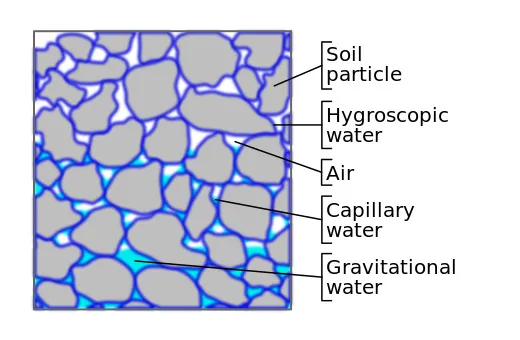
Forms of water in soil
Schematic representation of water in soil pores: gravitational, capillary, and bound water. The illustration shows differences in the nature of retention and availability of moisture to plants.
Three main categories of soil water can be distinguished by their mobility and availability to roots.
Gravitational water is water that fills large pores (macropores) and, under the force of gravity, freely percolates downward, leaving the root zone. This process is what we call drainage. Gravitational water appears immediately after heavy irrigation or rain. It is practically useless to plants because it leaves quickly. Moreover, its stagnation in the soil is harmful because it blocks oxygen access to roots (Mukha et al., 2003). Important note: On heavy clay soils, where pores are very small, gravitational water can remain for several days, creating a risk of waterlogging. On sandy soils, it leaves almost instantly.
Capillary water is the most valuable water for plants. It is held in medium and small pores (capillaries) by surface tension forces. This is the water that roots can absorb. Capillary water does not flow downward but remains in the soil, like water in a narrow tube, and can move in any direction—up, down, and sideways—although very slowly (Foth, 1990). When a plant absorbs water from the zone around a root, water from neighboring, wetter areas is pulled in through capillaries to replace it. This is the main mechanism of plant water supply between irrigations (Troeh & Thompson, 1993).
Bound water (or hygroscopic water) is the thinnest film of water that literally clings to the surface of soil particles under the action of powerful adsorption forces. This water is held so strongly that plant roots physically cannot pull it away. Bound water does not move in liquid form and is unavailable to plants. It remains in the soil even after the plant has wilted. In essence, it is a “dead reserve” of moisture (Mukha et al., 2003; Foth, 1990). Key fact: Some sources compare the forces holding bound water to the force required to lift water to a height of hundreds of meters—they are that great (Weil & Brady, 2017).
Practical takeaway for the gardener:
The goal of managing the water regime is to create and maintain an optimal amount of specifically capillary water in the soil. Gravitational water should drain freely (good drainage), and bound water is of no interest to us because it is unavailable anyway.
2. Available and unavailable water
Understanding which water is available to plants and which is not is the key to proper irrigation. As we have established, a plant can absorb only capillary water. However, not all capillary water is equally available. As the soil dries, water in the pores is held more and more strongly, and at some point roots can no longer extract it.
To describe this, scientists use two very important concepts: field capacity and permanent wilting point. These two states define the range within which water is available to plants (Weil & Brady, 2017).
Field capacity (FC) is the amount of water that soil can hold after all gravitational water has drained downward. Imagine: a heavy rain has fallen, the soil has become saturated with moisture, and after a day or two the excess water has gone. That state, when the soil is “saturated but not wet,” is field capacity. At this stage, all capillary pores are filled with water, and large pores (macropores) are filled with air. This is the ideal state for plant growth: there is plenty of water, and there is oxygen for roots (Foth, 1990; Troeh & Thompson, 1993).
Permanent wilting point (PWP) is the critical point at which a plant can no longer extract water from the soil. Water still remains in the finest pores and as films on particles, but the forces holding it exceed the forces roots can develop. The plant wilts, and if it is not watered, it dies. Even after irrigation, if the soil has been brought to PWP, the plant may not recover immediately and sometimes may not recover at all (Mukha et al., 2003). Important note: Permanent wilting point is not a fixed value for all plants. Some drought-resistant species can extract water at lower moisture content than moisture-loving species (Weil & Brady, 2017).
Available water is essentially the difference between field capacity and permanent wilting point. This is the “corridor” in which a plant can exist normally and receive moisture (Foth, 1990). Anything above field capacity is excess (gravitational water, which can lead to waterlogging). Anything below permanent wilting point is deficit (bound water, unavailable to plants).
What does this look like in practice?
Different soils hold different amounts of available water. This depends on their particle-size distribution and organic matter content (Troeh & Thompson, 1993).
- Sandy soils have large pores. They pass water quickly (low field capacity) and dry out quickly. They contain little available water, and plants require more frequent irrigation. However, the water that is present is not held very strongly, and plants can easily take it up.
- Clay soils have many small pores. They hold a lot of water (high field capacity), but a significant portion of this water is held so strongly that it becomes unavailable. The range of available water may not be as large as it seems. They need to be watered less often but in large volumes.
- Loamy and silty soils (loam, silt loam) are considered ideal for most plants. They combine sufficient water-holding capacity with good water availability. That is why gardeners strive so much for “loam.”
Key fact: It is estimated that in a typical loamy soil at a depth of 1 meter, about 200 mm of available water can be stored. This means that without rain and irrigation, plants can survive on these reserves for quite a long time, but not indefinitely (Weil & Brady, 2017).
Practical takeaway for the gardener:
You must not allow the soil to dry out to the permanent wilting point. On the other hand, there is no point in irrigating if the soil is already at field capacity—the water will simply go into drainage, carrying nutrients with it. The goal is to maintain soil moisture somewhere between FC and PWP, closer to field capacity. We will discuss how to do this in the following chapters.


LCD 4-in-1 Soil Tester
Check essential growing conditions with one compact tool. Measure soil pH, moisture, temperature and light intensity — ideal for gardens, potted plants and greenhouses.
- 4-in-1 measurement
- Easy-to-read LCD display
- Portable design
Affiliate link · For indicative measurements only.
3. Water-holding capacity: how much the soil holds
Water-holding capacity is the ability of soil to retain a certain amount of water. It is one of the key indicators determining how often you will have to water plants and how much water they can receive between irrigations. Understanding the water-holding capacity of your soil helps avoid both drying out and waterlogging (Mukha et al., 2003).
What determines water-holding capacity?
Water-holding capacity depends on two main factors: particle-size distribution (the ratio of sand, silt, and clay) and organic matter content (Foth, 1990; Troeh & Thompson, 1993).
Particle-size distribution is the foundation. Clay soils, consisting of the smallest particles, have an enormous total surface area. Water literally clings to these particles and fills countless micropores. Therefore, clay can hold very much water. However, as we already know, a significant part of this water is held so strongly that it becomes unavailable to plants (Weil & Brady, 2017).
Sandy soils, by contrast, consist of large particles with a small total surface area. Water does not linger in them—it quickly moves downward through large pores. Sand holds little water, but what remains is quite easily available to roots (Troeh & Thompson, 1993).
Organic matter is the second, no less important factor, and, what is especially valuable for the gardener, it is precisely the one we can actively influence. Humus and other organic components work like a sponge. They create additional pores, retain moisture, and make it more available to plants. Organic matter increases the water-holding capacity of both sandy and clay soils (Gershuny & Smillie, 1999; Morgan, 2021).
Key fact: Studies show that increasing organic matter content by just 1% can significantly increase the available water capacity of soil. For sandy soils this is especially important, because organic matter helps them retain water that would otherwise simply go deeper (Weil & Brady, 2017).
Types of water-holding capacity
Scientists distinguish several types of water-holding capacity, but for the practitioner the three most important are (Mukha et al., 2003; Foth, 1990):
- Full water-holding capacity (FWC) is the state when all soil pores are filled with water. This happens immediately after heavy rain or irrigation. In this state the soil is saturated, but there is no oxygen for roots. Prolonged stay in this state is destructive for most plants.
- Minimum (field) water-holding capacity (MC or FC in the English-language literature) is the amount of water that soil holds after gravitational water has drained. This is the “golden mean”: there is enough water, and air is present in large pores. This is the state we aim for when irrigating.
- Capillary water-holding capacity (CWC) is the amount of water held in capillary pores. This water is the most available to plants. It can rise from below from groundwater, providing plants with moisture even during a dry period.
How much water is in your soil?
Different soil types hold different amounts of available water. Here are approximate guidelines for a soil layer 1 meter thick (Weil & Brady, 2017):
- Sandy soil: about 100 mm of available water. This is not much, so such soils require frequent but moderate irrigation.
- Loamy soil (ideal): about 200 mm of available water. This is an optimal reserve that allows plants to survive short droughts.
- Clay soil: about 150–180 mm of available water. It seems that clay should hold more, but most of the water in it is bound and unavailable.
Practical takeaway for the gardener:
Knowing the water-holding capacity of your soil is the first step to competent irrigation. If you have sand, you will have to water more often and in small portions, possibly with the addition of organic matter to improve structure. If you have clay, water less often but abundantly, and be sure to monitor drainage so roots do not suffocate. And the main universal advice is to add compost and mulch. This is the best way to improve the water-holding capacity of any soil, whether sand or clay (Morgan, 2021; Pavlis, 2020).
4. Drainage: how water leaves
Drainage is not just “removing excess water.” It is a complex process on which it depends whether roots will have enough oxygen, whether they will rot, and whether the soil can function normally. Drainage is the ability of soil to pass water through itself and remove it from the root zone. Without effective drainage, even the most fertile soil becomes unsuitable for most crops (Pavlis, 2020).
Three stages of water movement
To understand how drainage works, we need to consider three successive stages of water movement in soil (Pavlis, 2020; Weil & Brady, 2017):

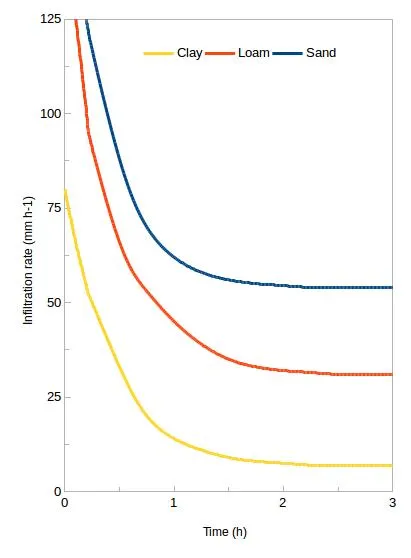
Rate of water infiltration in different soil types
Graph of changes in water infiltration rate in soils of different composition over time. It illustrates differences in permeability and moisture absorption dynamics. Yellow curve: clays; red curve: loam; blue curve: sand.
Infiltration is the absorption of water from the soil surface inward. Infiltration rate depends on surface condition: presence of a crust, compaction, mulch, and plant cover. If infiltration is low, water does not have time to soak in and accumulates on the surface or runs off as surface flow. This is a common problem on clay and compacted soils (Troeh & Thompson, 1993).
Percolation is the downward movement of water through the soil profile. After water has infiltrated, it must pass through soil horizons, filling pores and displacing air. Percolation rate depends on pore size and continuity, as well as on the presence of compacted layers or a plow pan (Foth, 1990). On sandy soils percolation is fast; on clay soils it is slow. If there is an impermeable layer in the profile, water is retained above it, creating a so-called “perched” water table (Weil & Brady, 2017).
Drainage proper (outflow) is the removal of gravitational water beyond the root zone. After the soil has reached field capacity, excess water must go deeper, toward groundwater, or be removed through a drainage pipe system. If this does not happen, the soil remains waterlogged, and roots suffer from lack of oxygen (Pavlis, 2020).
Factors affecting drainage
Drainage is affected by both natural and anthropogenic factors. Natural factors include particle-size distribution, soil structure, presence of compacted horizons, relief, and groundwater level. Anthropogenic factors include compaction from machinery and feet, improper cultivation, and lack of organic matter (Chalker-Scott, 2018).
Compaction is the main enemy of drainage. When soil is compressed, pores collapse, and water cannot pass through them. This is especially characteristic of clay soils. Walking on a wet bed, driving machinery, or even simply the absence of organic matter over time lead to the formation of a dense layer that water cannot penetrate (Pavlis, 2020).
Plow pan is a compacted layer at the depth of cultivation that forms after many years of plowing to the same depth. It impedes the movement of water and roots downward. It can only be destroyed mechanically, for example by deep loosening (Chalker-Scott, 2018).
High groundwater level is another problem. If water stands close to the surface, roots end up in the saturation zone, where there is no oxygen. In such cases, drainage ditches or pipes are required (Weil & Brady, 2017).
Signs of poor drainage
You can recognize that there are drainage problems by several signs (Pavlis, 2020; Chalker-Scott, 2018):
- Water stands on the surface after rain for more than several hours.
- The soil remains wet and cold for a long time in spring.
- Plants wilt despite wet soil (this is a sign of root rot).
- Roots are brown or black and have an unpleasant odor.
- Moss or blue-green algae appear on the soil surface.
- Plants grow poorly and turn yellow, although nutrition and irrigation are normal.
How to improve drainage
Improving drainage is not always about laying pipes. Often it is enough to change the approach to soil cultivation and add organic matter (Morgan, 2021; Chalker-Scott, 2018).
Adding organic matter is the most universal and effective method. Compost, humus, and leaf mold create additional pores, glue particles into aggregates, and improve structure. On clay soils organic matter loosens; on sandy soils it helps retain water while not preventing the outflow of excess (Gershuny & Smillie, 1999).
Mulching protects the surface from crusting and compaction, improves infiltration, and reduces evaporation. Mulch from organic materials gradually becomes incorporated into the soil, improving its structure (Lowenfels & Lewis, 2010).
Aeration—piercing the soil with a fork or special aerators—helps break up compacted layers and improve water and air entry. This is a temporary measure but useful on neglected plots.

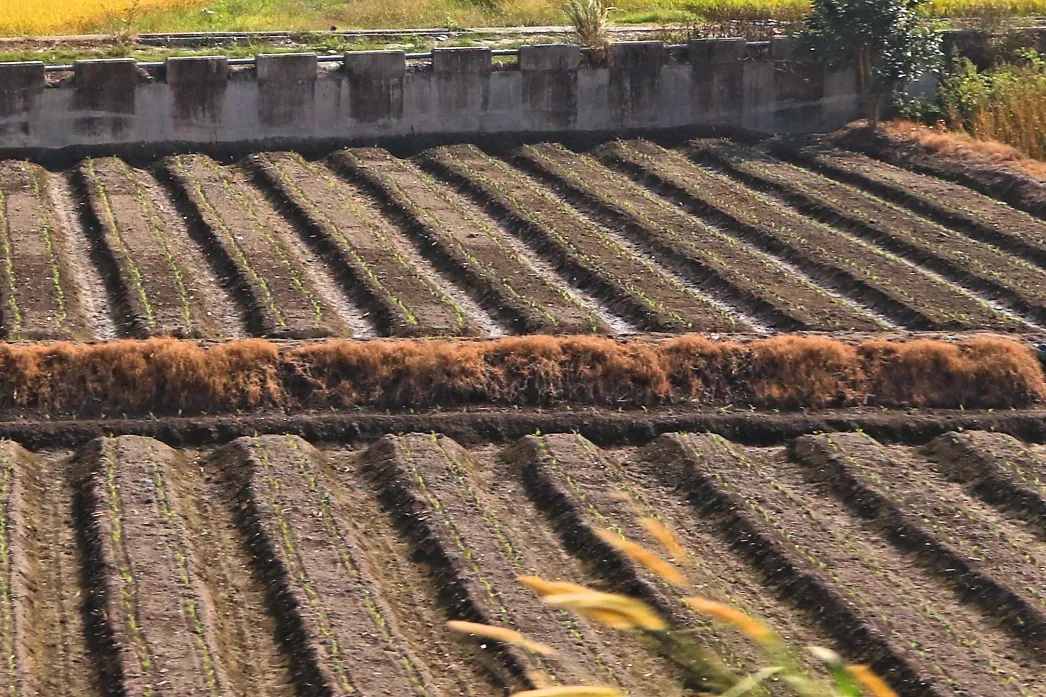
Raised beds for draining excess water
Agricultural plots with formed raised beds intended to reduce waterlogging and improve water drainage. Shooting location: Yunlin County, Taiwan.
Creating raised beds solves the drainage problem radically: you create a new soil layer with good structure that does not contact the problematic subsoil horizon. This is especially relevant for plots with high groundwater levels or heavy clay (Pavlis, 2020).
Drainage pipes (French drains, drainage wells) are a more complex and expensive solution, but sometimes they are indispensable. A system of perforated pipes laid at a slope removes water from the problem zone. This requires planning and often the involvement of specialists (Weil & Brady, 2017).
Key fact: Ideal drainage does not mean that water should leave instantly. The soil should have time to absorb water, retain it in available form, and remove excess. Complete drainage is just as harmful as waterlogging. The task is to create balance.
Practical takeaway for the gardener:
Check the drainage of your plot with a simple test: dig a hole 30–40 cm deep, fill it with water, and see how quickly the water leaves. If within an hour or two—drainage is good. If water stands for a day—there is a problem. Start by adding organic matter and mulch, avoid walking on wet soil, and if necessary create raised beds. Drainage is not a luxury but a necessity for healthy roots.

Solar Automatic Drip Irrigation Kit for Gardens
Automate watering for pots, gardens and small greenhouses. This solar-powered system features a timer to help schedule water delivery to your plants.
- Solar-powered
- 15 m irrigation hose
- Programmable watering
Affiliate link · Check included accessories.
5. Irrigation and precipitation: how water enters
Water enters the soil in two main ways: natural precipitation and artificial irrigation. Understanding exactly how water arrives helps organize irrigation properly and use rainwater efficiently. This is especially important in regions with unstable or insufficient moisture (Weil & Brady, 2017).
Precipitation: natural water input
Rain and snow are the main sources of moisture for plants in nature and in the garden. However, not all precipitation is equally useful. The effectiveness of rain depends on several factors (Troeh & Thompson, 1993; Weil & Brady, 2017):
Intensity. A downpour with a strong flow often does not have time to soak into the soil. Water runs over the surface, causing erosion and carrying away nutrients. Slow, steady rain is much more useful: it has time to seep deeper and replenish available moisture reserves.
Duration. A short rain may only wet the top layer, which will quickly dry out. A long rain wets the soil to a greater depth, creating a reserve for several weeks.
Soil condition. If the surface is compacted or covered with a crust, water will run off without soaking in. By contrast, loose, organic-rich soil with good structure absorbs water like a sponge (Pavlis, 2020).
Key fact: It is estimated that on average only about 30% of precipitation reaches the plant root zone. The rest is lost to evaporation, surface runoff, and filtration below the roots (Foth, 1990). That is why it is so important to improve soil structure and use mulch.
Snow is an important source of moisture in regions with cold winters. Slowly melting snow provides gradual, uniform water input into the soil in spring. However, if snow melts quickly, water may run off without replenishing reserves. Mulching and retaining plant residues help hold snow and slow its melting (Troeh & Thompson, 1993).
Irrigation: artificial water input
When precipitation is insufficient, irrigation comes to the rescue. However, here too there are rules and nuances (Pavlis, 2020; Chalker-Scott, 2018).
Amount of water. Plants need water in sufficient quantity, but not in excess. Overwatering is just as harmful as underwatering. As we already know, excess water displaces air from pores and leads to root rot. Therefore, it is important to water not according to a schedule but according to need, checking soil moisture (Chalker-Scott, 2018).
Depth of wetting. Surface irrigation stimulates the development of a surface root system, which will suffer at the slightest drought. Deep irrigation, by contrast, forces roots to grow deeper, where moisture lasts longer. This is especially important for perennial crops and trees (Weil & Brady, 2017).
Frequency. It is better to water less often but abundantly than often and little by little. This is because water must wet the root zone, not just moisten the surface. Frequent surface irrigation leads to moisture evaporating quickly while roots remain in the top layer, which dries out (Morgan, 2021).
Irrigation methods
Different irrigation methods have their advantages and disadvantages (Weil & Brady, 2017; Chalker-Scott, 2018; Johnson, 2025):
Sprinkler irrigation imitates natural rain. It is suitable for most crops but has a significant drawback: a large portion of water is lost to evaporation, especially in hot weather. In addition, sprinkling can contribute to the spread of diseases because it wets leaves.
Drip irrigation delivers water directly to plant roots through a system of tubes and emitters. This is the most efficient method in terms of water savings: evaporation losses are minimal, and water goes exactly where needed. Drip irrigation is ideal for arid regions and for crops sensitive to leaf wetness (Johnson, 2025).
Subsurface irrigation delivers water directly into the root zone through tubes laid underground. This is an even more efficient but also more expensive method. It eliminates evaporation losses and does not interfere with soil cultivation (Weil & Brady, 2017).
Surface irrigation (flooding) delivers water by gravity through furrows or flooding. This method is used for rice and some other crops, but it is extremely inefficient in terms of water use and can cause soil salinization (Weil & Brady, 2017).
Hose watering is the simplest but also the most labor-intensive method. It requires time and attention to distribute water evenly. It often leads to overwatering of some areas and underwatering of others.
Water quality
The quality of irrigation water matters. High salt content can lead to soil salinization, especially in arid regions. High sodium content degrades soil structure, making it dense and impermeable. If you use water from a well or irrigation system, it is worth testing its composition (Weil & Brady, 2017; Pavlis, 2020).
Key fact: Rainwater, as a rule, has a slightly acidic reaction (pH around 5.5–6.0) due to dissolved carbon dioxide. It also contains small amounts of nitrogen and other nutrients, which makes it especially useful for plants (Weil & Brady, 2017). Rainwater harvesting is an excellent way both to save water and to provide plants with quality moisture.
Practical takeaway for the gardener:
Do not rely only on rain and do not water “by eye.” Check soil moisture by hand or with a simple moisture meter. Water deeply and infrequently, preferably using drip irrigation or watering at the root. Harvest rainwater if possible. And remember: it is better to underwater than to overwater—excess water is more dangerous than a temporary drought.
6. Evaporation and transpiration
Water that enters the soil does not remain there forever. It is constantly lost in two main ways: evaporation from the soil surface and transpiration through plants. Understanding these processes helps the gardener reduce moisture losses and use every liter of water more efficiently (Weil & Brady, 2017).
Evaporation: losses from the soil surface
Evaporation is the transition of water from a liquid state to vapor and its loss to the atmosphere. This process occurs directly from the soil surface and does not require plant participation (Mukha et al., 2003).
The intensity of evaporation depends on several factors (Troeh & Thompson, 1993; Weil & Brady, 2017):
Temperature. The higher the air and soil temperature, the faster water evaporates. On a hot summer day, the soil surface can lose a significant amount of moisture within a few hours.
Air humidity. Evaporation proceeds faster in dry air than in humid air. In regions with low relative humidity, evaporation losses are especially large.
Wind. Air movement carries water vapor away from the soil surface, maintaining the moisture gradient and accelerating evaporation. Losses are higher in open, windy areas than in sheltered places.
Surface condition. Loose, moist soil evaporates more water than compacted soil or soil covered with mulch. Sunlight falling on bare soil heats it and increases evaporation.
Key fact: On average, over the growing season, 25 to 50% of precipitation or irrigation water can evaporate from the soil surface (Weil & Brady, 2017). This means that without mulch and other moisture-conservation measures, a significant part of the water is lost before reaching the roots.
Transpiration: losses through plants
Transpiration is the evaporation of water through plant leaves. Water is absorbed by roots, rises through xylem vessels, and exits through stomata—microscopic openings on the leaf surface (Capon, 2022; Zona, 2023).
Transpiration is not merely passive loss. It is a vitally important process that performs several functions (Capon, 2022; Weil & Brady, 2017):
Cooling. As water evaporates, it cools the leaves, protecting them from overheating in hot weather. This mechanism is analogous to sweating in animals.
Transport of nutrients. Water moving from roots to leaves carries dissolved mineral substances. Without transpiration, plant nutrition would be impossible.
Maintaining turgor. Water creates internal pressure in cells that maintains plant shape. When water is lacking, turgor drops, and the plant wilts.
The intensity of transpiration depends on the same factors as evaporation: temperature, air humidity, wind, and light. In addition, it is affected by the state of stomata. In hot, dry weather, stomata may close to reduce water loss, but this simultaneously reduces the intake of carbon dioxide needed for photosynthesis (Zona, 2023).
Key fact: A single large tree can transpire up to 400 liters of water per day (Pavlis, 2020). This is an impressive figure that shows how great the role of plants is in the water cycle.
Evapotranspiration: total losses
Scientists combine evaporation from the soil surface and plant transpiration into one concept—evapotranspiration. This is the total water consumption from a given area into the atmosphere. It is this value that is taken into account when calculating irrigation norms and designing irrigation systems (Weil & Brady, 2017; Foth, 1990).
Evapotranspiration depends on climate, vegetation type, plant development stage, and agricultural practices. In a hot and dry climate it can reach 5–10 mm per day, whereas in a cool and humid one it may not exceed 1–2 mm (Weil & Brady, 2017).
How to reduce water losses
Although it is impossible to completely stop evaporation and transpiration, losses can be substantially reduced (Morgan, 2021; Chalker-Scott, 2018):

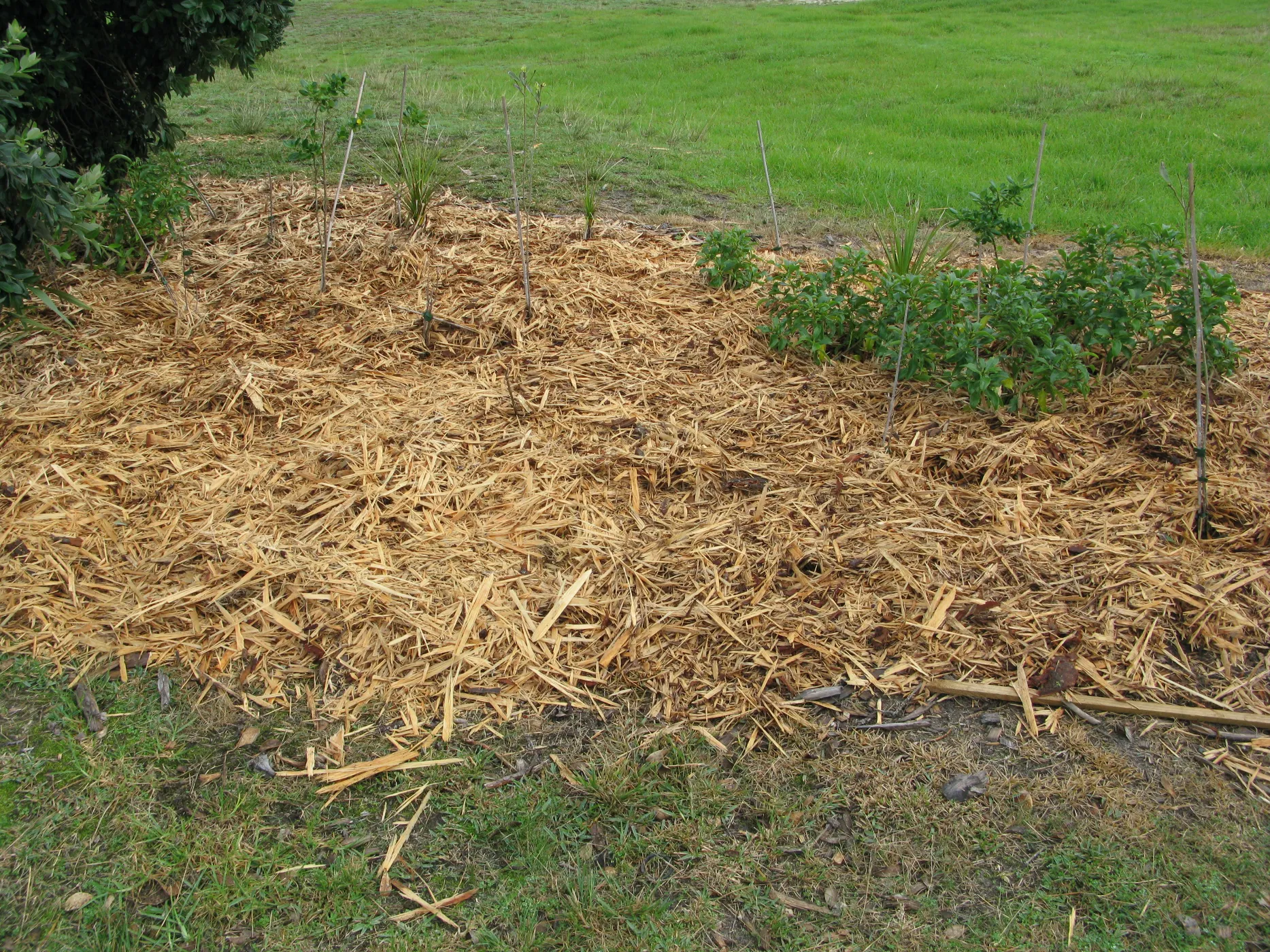
Mulch in New Zealand (Mulch in New Zealand)
Mulch used in New Zealand (Paillis en Nouvelle Zélande). The photo shows a layer of organic mulch (straw) on the soil surface.
Mulching is the most effective way to reduce evaporation from the soil surface. A 5–10 cm layer of organic materials (straw, compost, leaf mold, bark) creates a barrier between the soil and the atmosphere, slowing moisture loss. Studies show that mulch can reduce evaporation by 50–70% (Chalker-Scott, 2018).
Watering at the root—delivering water directly to the roots, bypassing the soil surface—reduces evaporation losses. Drip irrigation and subsurface irrigation are the most effective in this regard (Johnson, 2025).
Watering in the morning or evening—at this time the temperature is lower and humidity is higher, which reduces evaporation. Watering at noon in hot weather leads to significant losses.
Wind protection—hedges, strips of tall plants, and windbreaks reduce wind speed and decrease evaporation. However, it is important not to create stagnant air, which can contribute to disease development.
Reducing transpiration—in arid regions, antitranspirants are used: substances that form a film on leaves or cause stomata to close. This method is used mainly in nurseries and for transplanting plants, but it has not become widespread in home gardening because of cost and application complexity (Zona, 2023).
Key fact: Shading the soil with plants or mulch reduces surface temperature by several degrees, which directly reduces evaporation. In a hot climate, shading can be more effective than additional irrigation (Pavlis, 2020).
Practical takeaway for the gardener:
Water losses through evaporation and transpiration are inevitable, but they can be significantly reduced. Mulch the soil, water at the root, choose the right time for irrigation, and protect the plot from wind. Remember that every drop of water saved in the soil is water available to your plants.

7-in-1 Wi-Fi Weather Station
Monitor local weather conditions with a wireless outdoor sensor. Track temperature, humidity, rainfall, wind speed and direction, and atmospheric pressure. Ideal for gardens, farms and greenhouses.
- Wireless outdoor sensor
- Solar-powered
- Wi-Fi connectivity
Affiliate link · Check regional compatibility.
7. What happens when water is lacking
Water shortage is one of the most common stress factors for plants. Unlike animals, plants cannot move in search of moisture. They are forced either to adapt or to die. Understanding exactly how water deficit manifests and what happens inside the plant helps take timely measures and save the harvest (Weil & Brady, 2017).
External symptoms: how a plant signals thirst
The first thing a gardener notices is wilting. Leaves lose turgor, droop, and become limp. This happens because water is needed to maintain internal pressure in cells, which gives them firmness. When water is lacking, cells shrink, and the plant “goes limp” (Capon, 2022).
However, wilting is only the tip of the iceberg. Long before visible symptoms, serious physiological changes are launched inside the plant (Chalker-Scott, 2018).

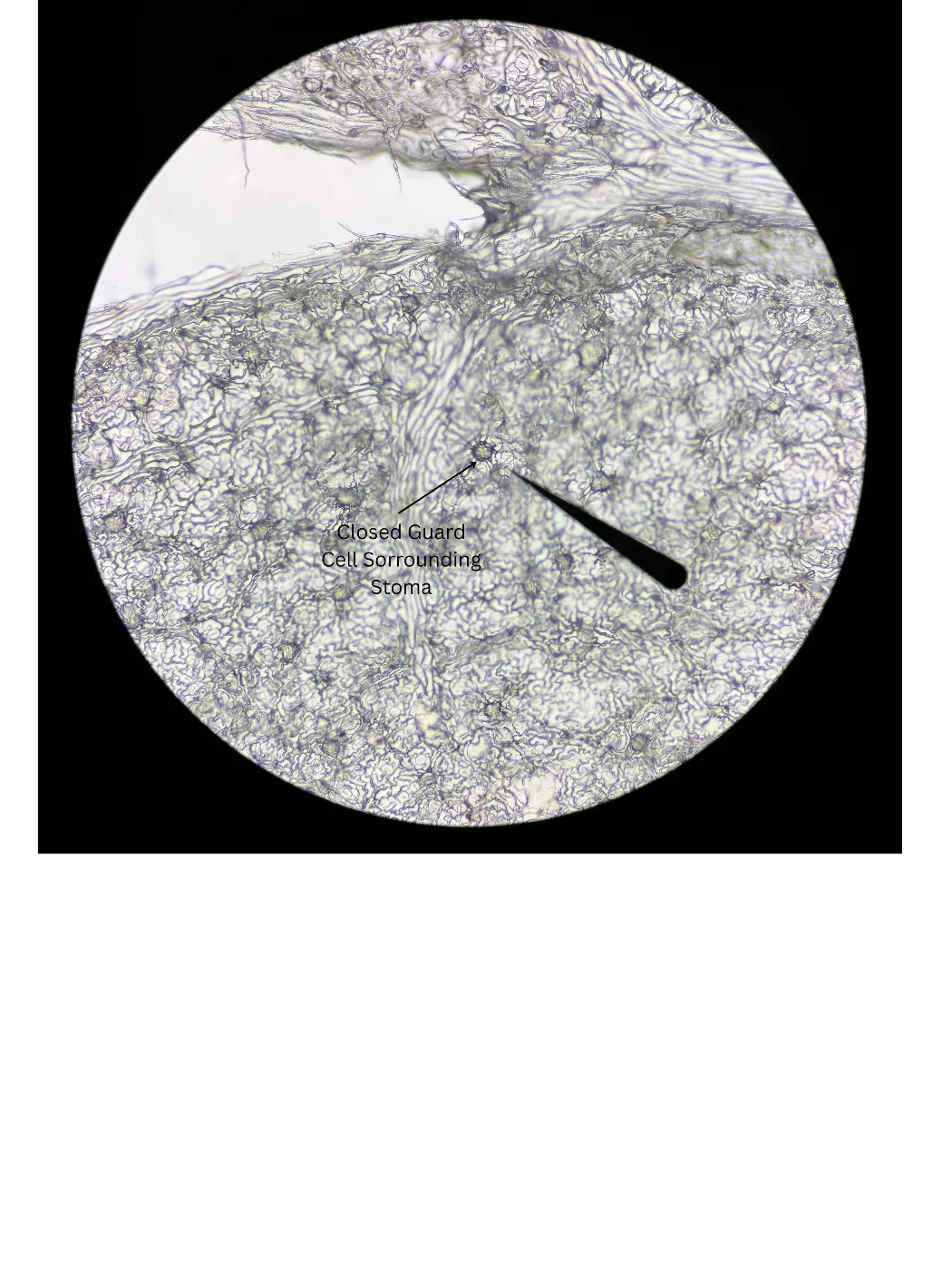
Closed stomata of common mugwort (Artemisia vulgaris)
Microscopic image of stomata and guard cells on the lower side of a common mugwort (Artemisia vulgaris) leaf. The image shows closed stomata, which is especially suitable for explaining the mechanism of limiting water loss.
Stomatal closure. The first reaction of a plant to water deficit is stomatal closure. These are microscopic openings on leaves through which gas exchange and water evaporation occur. By closing them, the plant tries to conserve moisture. But this has a side effect: the intake of carbon dioxide needed for photosynthesis stops, and the plant stops growing (Zona, 2023; Capon, 2022).
Growth slowdown. Even short-term water stress leads to a decrease in growth rate. The plant switches resources from growth to survival. Cells stop dividing and expanding, and new leaves and shoots do not form. If stress repeats, this leads to general suppression and reduced yield (Weil & Brady, 2017).
Color change. Leaves may turn yellow, brown, or acquire a bluish tint. This is associated with metabolic disruption and chlorophyll breakdown. In some crops, such as tomatoes, leaf curling may be observed when moisture is lacking (Pavlis, 2020).
Leaf and fruit drop. In critical situations, a plant may shed some leaves or young fruit to reduce the evaporation area and conserve water for survival. This is a protective mechanism, but it directly affects yield (Capon, 2022).
What happens inside the plant
At the cellular level, water deficit causes a number of serious disturbances (Troeh & Thompson, 1993; Weil & Brady, 2017):

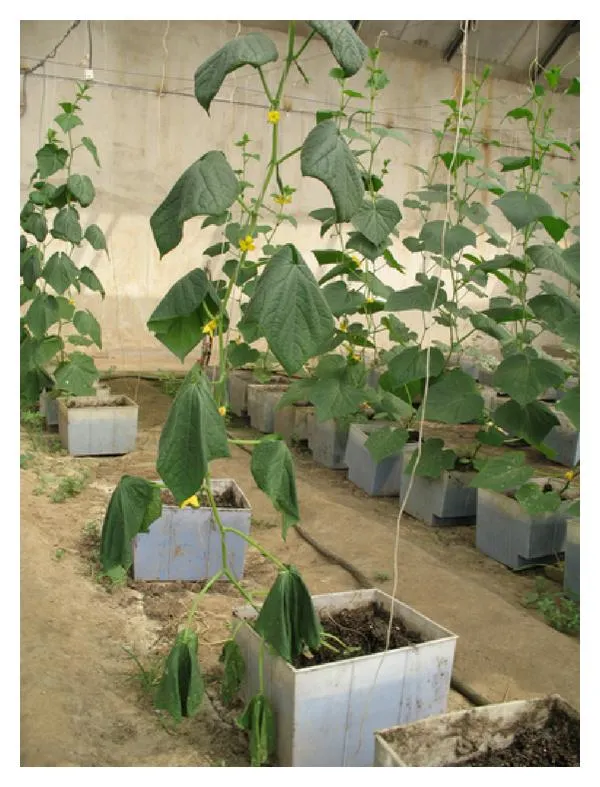
Wilting of cucumber plants in a greenhouse
The photograph captures cucumber plants grown under protected ground conditions in white containers. Plants in the foreground and on the left show severe wilting: the leaves have lost turgor and drooped. This may be caused both by a lack of moisture in the substrate and by damage to the plant vascular system by pathogens (e.g., Fusarium wilt).
Loss of turgor. As already mentioned, cells lose internal pressure. This leads to wilting and loss of shape.
Plasmolysis. With severe dehydration, the cell cytoplasm shrinks and pulls away from the cell wall. This process is called plasmolysis. If it goes too far, the cell dies. Plasmolysis is an irreversible state from which the plant can no longer recover (Capon, 2022).
Accumulation of abscisic acid. This is a stress hormone that signals water shortage. Abscisic acid causes stomatal closure and slows growth. It can also trigger leaf drop (Capon, 2022).
Disruption of photosynthesis. Due to stomatal closure, CO2 intake decreases, and photosynthesis slows. The plant cannot produce enough sugars for growth and development (Zona, 2023).
Increased salt concentration. When water evaporates from the soil, the concentration of salts in the soil solution rises. This makes it difficult for roots to absorb water, creating a so-called physiological water deficit, even if water is present in the soil (Pavlis, 2020).
Temporary and permanent wilting
It is important to distinguish two types of wilting (Mukha et al., 2003; Foth, 1990):
Temporary wilting is a reversible state. The plant loses turgor at midday heat but recovers by evening when temperature drops and humidity rises. This is a normal reaction that does not require immediate intervention.
Permanent wilting is a critical state. The plant does not recover even at night, when evaporation is minimal. This means that the soil has reached permanent wilting point and water has become unavailable. Without irrigation the plant will die. Even after irrigation it may not recover fully, because some cells have already been irreversibly damaged.
Key fact: Studies show that in many crops yield loss begins long before visible wilting symptoms appear. For example, in maize, yield losses can reach 40–50% if water stress occurs during flowering, even if the plants looked normal externally (Weil & Brady, 2017).
Physiological drought
Sometimes a plant suffers from water shortage even though the soil is not dry at all. This phenomenon is called physiological drought. It occurs when (Pavlis, 2020; Weil & Brady, 2017):
- High salt content in the soil solution reduces the ability of roots to absorb water. Osmosis works against the plant: water tends to leave the roots rather than enter them.
- Low temperature slows water uptake by roots, although transpiration may continue. This often happens in spring, when the soil is still cold but the air is already warm.
- Poor aeration (waterlogging) damages roots, and they lose the ability to absorb water.
Plant strategies: how they cope
Plants have developed different strategies for surviving under water shortage (Zona, 2023; Capon, 2022):
Drought avoidance. Some plants complete their life cycle quickly while water is available. These are ephemerals—annuals that germinate, flower, and produce seeds within a few weeks. Others enter a state of dormancy by shedding leaves (drought-deciduous plants).
Drought tolerance. Some plants are able to tolerate tissue dehydration without irreversible damage. They accumulate compatible osmolytes (e.g., proline) that protect cells. An example is “resurrection” plants, which can completely dry out and revive after rain (Zona, 2023).
Water conservation. Plants of arid regions often have small, thick, wax-covered leaves, deep roots, or storage tissues (succulents). These adaptations help them survive where others would die (Zona, 2023).
Practical takeaway for the gardener:
Do not allow permanent wilting. Water plants before they begin to wilt. Remember that even short-term water stress reduces yield. Use mulch to conserve moisture. Choose drought-resistant species for areas where irrigation is difficult. And remember: water shortage is not only “dry soil” but also physiological unavailability of moisture due to salinization or cold.
8. What happens when there is too much water
Excess water in the soil is just as dangerous as its shortage. Many gardeners, seeing a wilting plant, rush to water it, not understanding that the cause may be exactly the opposite. Waterlogging is one of the most common and insidious problems, which often remains unnoticed until plants begin to die (Pavlis, 2020).
The main problem: lack of oxygen
Plant roots, like all living cells, respire. They need oxygen for respiration—a process that provides energy for absorbing water and nutrients. In soil, oxygen is contained in pores not filled with water. When all pores are filled with water, oxygen is displaced, and roots begin to suffocate (Weil & Brady, 2017; Troeh & Thompson, 1993).
In such anaerobic (oxygen-free) conditions, roots cannot function normally. They stop absorbing water and nutrients, even if these are abundantly present in the soil. Moreover, in an anaerobic environment, putrefactive bacteria and fungi begin to develop, attacking weakened roots and causing them to rot (Pavlis, 2020).
Key fact: Oxygen in soil is consumed not only by roots but also by microorganisms decomposing organic matter. Therefore, in organic-rich soil under waterlogging, oxygen disappears especially quickly, and plants suffer more severely (Troeh & Thompson, 1993).
External symptoms: the paradox of waterlogging
The most insidious thing about excess water is that external symptoms often resemble water shortage. The plant wilts, leaves lose turgor, turn yellow, and may drop. This condition is called physiological drought: there is plenty of water in the soil, but roots cannot absorb it due to lack of oxygen (Pavlis, 2020; Weil & Brady, 2017).
Other signs of waterlogging (Chalker-Scott, 2018; Pavlis, 2020):
- Growth slowdown. The plant looks suppressed, does not produce new shoots, and leaves are small.
- Yellowing and browning of leaves. It begins with lower, older leaves and gradually spreads upward. This may resemble symptoms of nitrogen or other nutrient deficiency.
- Leaf and fruit drop. The plant sheds them in an attempt to reduce losses.
- Root rots. Roots become brown or black, soft, with an unpleasant odor. Healthy roots should be light and firm.
- Appearance of moss and algae on the soil surface—a sign of constant waterlogging.
- Fungal diseases. Waterlogged soil is an ideal environment for the development of many pathogens, such as Pythium, Phytophthora, and Rhizoctonia.
Effect on soil structure
Excess water destroys soil structure. Water breaks aggregates, leaches nutrients, and compacts the soil. Clay soils suffer especially: when waterlogged they become sticky and structureless, and when dry they become hard and cracked. This creates a vicious circle: the worse the structure, the worse the drainage, and the more water stagnates (Mukha et al., 2003; Foth, 1990).
Key fact: In waterlogged soil, substances toxic to plants can accumulate, for example ethyl alcohol, ammonia, and hydrogen sulfide, which are formed as a result of anaerobic decomposition of organic matter. These compounds additionally damage roots (Pavlis, 2020).
How to distinguish excess water from shortage
This is a key question for the gardener. Here is a simple algorithm (Pavlis, 2020; Chalker-Scott, 2018):
1. Check soil moisture. If the soil is wet and sticky and the plant wilts, it is waterlogging. If it is dry, it is shortage.
2. Assess drainage. Dig a hole 30 cm deep and fill it with water. If water does not leave within several hours, drainage is poor.
3. Inspect the roots. In a plant damaged by waterlogging, roots are dark, soft, and rotten.
4. Consider the weather. If there have been prolonged rains or you recently watered heavily, and the plant wilts, the cause is most likely excess.
What to do when there is excess water
Combating waterlogging is more difficult than drought, but it is possible (Morgan, 2021; Pavlis, 2020; Chalker-Scott, 2018):
- Improve drainage. Create raised beds, lay drainage pipes, add organic matter and sand (for clay) to the soil. On heavy soils, full site reconstruction is sometimes required.
- Stop irrigation. Let the soil dry out. Do not water until the top layer is dry to the touch.
- Mulch. Mulch protects against compaction and helps regulate moisture, but it does not save from already stagnant water. It must be used in combination with drainage.
- Do not walk on wet soil. This increases compaction and destruction of structure.
- Choose suitable plants. For areas with poor drainage, moisture-loving species that tolerate temporary waterlogging are suitable (for example, willows, purple loosestrife, hostas, some grasses).
- Use aeration. Piercing the soil with a fork or aerator improves air and water entry.
Key fact: Some plants are able to adapt to waterlogging by forming a special tissue—aerenchyma—which conducts oxygen from aboveground parts to the roots. This allows them to survive in waterlogged conditions. However, most garden crops do not have this ability (Zona, 2023).
Practical takeaway for the gardener:
Excess water is not just “a lot of moisture”; it is suffocation for roots. If a plant wilts and the soil is wet, do not rush to water. Check drainage and root condition. Remember that waterlogging often leads to irreversible damage faster than drought. It is better to underwater than to overwater—this principle is especially relevant for heavy clay soils and regions with abundant precipitation.
Now that we have examined the extremes—shortage and excess—it is logical to move on to how to improve the water regime as a whole.

40W Full Spectrum LED Grow Light
Support healthy plant growth with full-spectrum LED lighting. Ideal for seedlings, indoor plants and small growing spaces. A practical solution for indoor gardening and year-round cultivation.
- Full-spectrum LED
- Energy-efficient design
- Indoor plant growing
Affiliate link · Check actual power and light coverage.
9. How to improve the water regime: organic matter, mulch, drainage, drip irrigation
Managing the water regime is not a fight against nature but work with it. The goal is to create soil that absorbs water when there is plenty, retains it when there is little, and removes excess without creating stagnation. Four key tools help achieve this balance: organic matter, mulch, drainage, and efficient irrigation (Morgan, 2021; Chalker-Scott, 2018).
Organic matter: the foundation of the water regime
Organic matter is perhaps the most universal tool for the gardener. It improves the water regime of any soil, regardless of its type. Compost, humus, leaf mold, and well-rotted manure all work like a sponge, retaining water and making it available to plants (Gershuny & Smillie, 1999; Pavlis, 2020).
On sandy soils, organic matter fills large pores that would otherwise pass water like a sieve. It increases water-holding capacity and reduces irrigation frequency. On clay soils, organic matter, by contrast, loosens the dense structure, creates aggregates, and improves drainage. As a result, water does not stagnate, and air penetrates to the roots (Weil & Brady, 2017).
Key fact: Studies show that increasing organic matter content by 1% can increase the available water capacity of soil by 10–20%. For sandy soils this is especially important, because organic matter helps them retain water that would otherwise simply go deeper (Weil & Brady, 2017).
How to apply organic matter. The best time is autumn or early spring. Apply compost or humus in a 2–5 cm layer and lightly incorporate it into the topsoil (5–10 cm) without deep digging. For existing plantings, use compost as mulch, allowing earthworms and microorganisms to gradually incorporate it into the soil (Morgan, 2021).
Mulch: protecting the surface
Mulch is a layer of material laid on the soil surface. It performs several functions simultaneously (Lowenfels & Lewis, 2010; Chalker-Scott, 2018):
- Reduces evaporation. Mulch creates a physical barrier between the soil and the atmosphere, slowing moisture loss. Studies show that mulch can reduce evaporation by 50–70% (Chalker-Scott, 2018).
- Regulates temperature. In summer, mulch cools the soil, protecting roots from overheating. In winter, by contrast, it insulates it, reducing the risk of freezing.
- Suppresses weeds. Weeds compete with cultivated plants for water and nutrients. Mulch deprives them of light and space.
- Prevents erosion. Mulch protects the surface from the impact of raindrops, which destroy structure and cause runoff.
- Gradually improves the soil. Organic mulch decomposes, feeding soil life and increasing humus content.
Choosing mulch. Organic mulches (straw, hay, compost, leaf mold, bark, wood chips) gradually decompose and improve the soil. Inorganic mulches (gravel, stone) do not decompose but are well suited for arid regions and perennial plantings. In regions with high humidity and a risk of slugs, it is better to use compost or leaf mold rather than straw (Johnson, 2023; Robinson, 1999).
Key fact: A 5–10 cm layer of organic mulch not only conserves moisture but also creates an environment for the development of beneficial microorganisms and earthworms, which in turn improve soil structure and its ability to retain water (Lowenfels & Lewis, 2010).
Drainage: removing excess
Drainage is not just “pipes in the ground.” It is a set of measures aimed at preventing water from stagnating in the root zone. Good drainage is critically important for root health, especially on heavy clay soils and plots with high groundwater levels (Pavlis, 2020).
Improving structure. The simplest and most effective method is adding organic matter and mulch. They create pores through which water moves downward. Avoid walking on wet soil: compaction destroys pores and worsens drainage (Chalker-Scott, 2018).
Raised beds. Creating beds 20–30 cm high solves the drainage problem radically. You form a new soil layer with good structure that does not contact the problematic subsoil horizon. This is especially relevant for plots with high groundwater levels or heavy clay (Pavlis, 2020).
Drainage pipes. If the problem is serious, drainage pipes are installed (French drains). These are perforated pipes laid at a slope in a trench filled with gravel. They collect excess water and divert it to a drainage well or water body. This requires planning and often the involvement of specialists (Weil & Brady, 2017).
Key fact: Ideal drainage does not mean that water should leave instantly. The soil should have time to absorb water, retain it in available form, and remove excess. Complete drainage is just as harmful as waterlogging (Pavlis, 2020).
Drip irrigation: efficient delivery

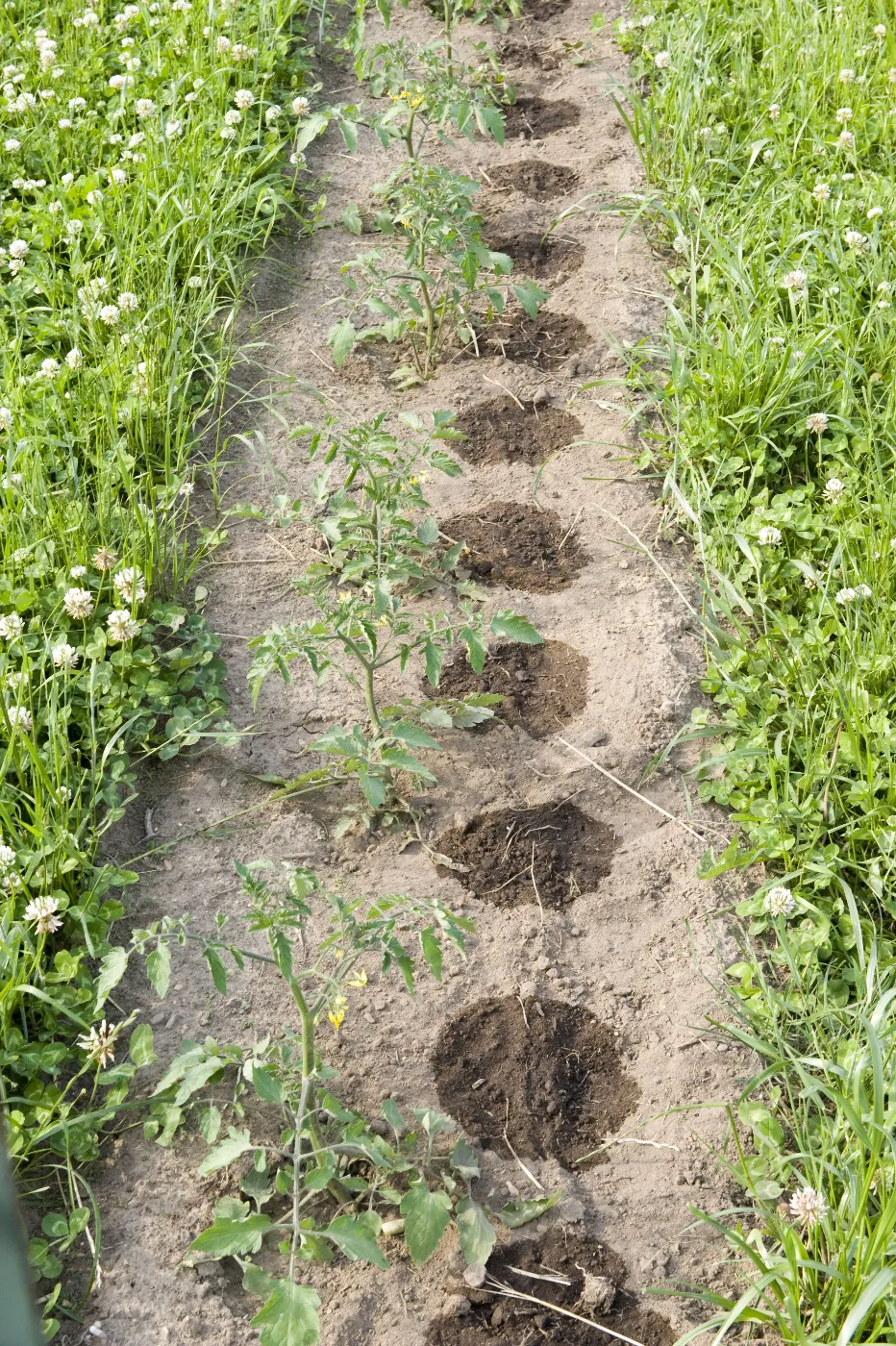
Subsurface drip irrigation: visualisation of soil moisture
A row of young tomatoes in open ground with clearly visible wet spots on dry sandy soil, formed by drippers buried at 30 cm spacing.
Drip irrigation is a system for delivering water directly to plant roots through tubes and emitters. This is the most efficient irrigation method in terms of water savings (Johnson, 2025; Weil & Brady, 2017).
Advantages of drip irrigation:
- Minimal evaporation losses. Water goes directly to the roots, bypassing the soil surface.
- Precise dosing. You can regulate the amount of water for each plant.
- Reduced disease risk. Leaves remain dry, which reduces the spread of fungal diseases.
- Water savings. Compared with sprinkling, drip irrigation saves 30–50% of water (Johnson, 2025).
How to set up drip irrigation. For small plots, you can use ready-made kits or assemble the system yourself. The main elements are: water source, filter, mainline, drip lines, and emitters. It is important to ensure that emitters do not become clogged (Johnson, 2025).
Key fact: Drip irrigation is especially effective in arid regions, where every drop of water counts. It is also ideal for container plants, greenhouses, and beds with dense planting (Johnson, 2025).
Integrated approach
The best result is achieved by combining all four methods. Organic matter improves structure and water-holding capacity. Mulch reduces evaporation and protects the soil. Drainage removes excess. Drip irrigation ensures efficient water delivery. Together they create a sustainable system that works with minimal gardener intervention (Morgan, 2021; Chalker-Scott, 2018).
Key fact: Healthy soils with high organic matter content and good structure are able to hold 2–3 times more available water than degraded soils. Investments in organic matter and mulch pay off through reduced irrigation costs and increased yields (Weil & Brady, 2017).
Practical takeaway for the gardener:
Start by adding organic matter and mulching. These are the simplest and most effective steps. If drainage is poor, create raised beds or install drainage pipes. For irrigation, use drip systems, especially in arid regions. And remember: the goal is not just to “water” but to create soil that manages water itself.
10. Regional aspect: in arid zones water is the main limiting factor; in humid zones, drainage is the problem
The soil water regime does not exist in a vacuum. The climate of a region determines what problems the gardener faces and which water-management strategies will be most effective. There are no universal recipes, but understanding regional characteristics helps choose the right approach (Weil & Brady, 2017).
Arid and semiarid zones: water as a scarce resource
In arid regions, where precipitation is significantly less than evaporation, water becomes the main limiting factor for plant growth. Here the gardener must maximize every liter of moisture that enters the soil (Johnson, 2023; Robinson, 1999).
Key strategies for arid zones:
Moisture conservation. Mulching is not just a recommendation but a necessity. A 5–10 cm layer of organic or inorganic materials (gravel, stone) reduces evaporation from the soil surface by 50–70%. In desert conditions, where surface temperatures can reach 60 °C, mulch is the only way to retain moisture in the root zone (Johnson, 2023; Chalker-Scott, 2018).
Organic matter. Applying compost and humus improves the water-holding capacity even of sandy soils. Organic matter acts as a sponge, retaining water and making it available to plants. However, it is important not to overdo it: in arid zones, excess organic matter can lead to salinization, because salts accumulate in the soil when there is insufficient leaching (Pavlis, 2020; Johnson, 2025).
Drip irrigation. This is the most efficient irrigation method in arid regions. Water is delivered directly to the roots, bypassing the surface, which eliminates evaporation losses. Drip irrigation saves 30–50% of water compared with sprinkling and allows maintaining optimal moisture in the root zone (Johnson, 2025).
Plant selection. In arid zones, preference is given to drought-resistant species—succulents, xerophytes, plants with deep root systems. Native species adapted to local conditions require less irrigation and tolerate drought better. Introduced plants from humid regions, as a rule, do not survive without intensive irrigation (Zona, 2023; Robinson, 1999).
Rainwater harvesting. In regions with rare but intense rains, collecting and storing rainwater is an important strategy. Water is collected from roofs, stored in cisterns, and used for irrigation during dry periods. This reduces the load on the municipal water system and provides plants with quality moisture (Johnson, 2025).
Key fact: In arid zones, evaporation losses from the soil surface can reach 50% of total precipitation. Mulching and shading the soil with plants reduce these losses to 10–20% (Weil & Brady, 2017).
Humid zones: drainage as a priority
In humid regions, where precipitation exceeds evaporation, the problem is the opposite: excess water and the associated lack of oxygen. Here the main task is not to conserve moisture but to remove its excess (Pavlis, 2020; Weil & Brady, 2017).
Key strategies for humid zones:
Drainage. Good drainage is the foundation of root health. On heavy clay soils that retain water, it is necessary to create raised beds, lay drainage pipes, or improve soil structure by adding organic matter and sand. Stagnant water leads to root rot and plant death (Pavlis, 2020).
Organic matter. In humid zones, organic matter plays a dual role: it improves soil structure by creating pores for removing excess water, and at the same time increases water-holding capacity, retaining moisture during dry periods. Compost and humus are a universal solution for improving drainage and water retention (Morgan, 2021; Gershuny & Smillie, 1999).
Mulch. Unlike arid zones, where mulch conserves moisture, in humid zones it protects the surface from compaction and erosion and also regulates temperature. However, it is important not to create a thick layer of mulch on waterlogged soils, as this can slow evaporation and worsen the problem (Lowenfels & Lewis, 2010).
Plant selection. For areas with poor drainage, moisture-loving species that tolerate temporary waterlogging are suitable: willows, purple loosestrife, hostas, some grasses. On well-drained areas, a wider range of crops can be grown (Zona, 2023).
Soil structure. Avoid walking on wet soil—this destroys structure and increases compaction. Use permanent paths so as not to compact the beds. Regular addition of organic matter and mulch gradually improves structure and drainage (Chalker-Scott, 2018).
Key fact: In humid zones, nutrient losses due to leaching can be significant, especially on sandy soils. Organic matter retains nutrients, preventing their washout, and gradually releases them to plants (Weil & Brady, 2017).
Transitional zones: balance between extremes
In regions with a temperate climate, where precipitation and evaporation are approximately equal, the gardener faces both problems at different times of the year. In summer there may be drought, and in spring and autumn waterlogging. Here it is important to be flexible: mulch during dry periods and ensure drainage during wet ones. Universal principles—organic matter, mulch, and proper irrigation—work everywhere, but their proportion changes depending on the season and weather (Weil & Brady, 2017; Mukha et al., 2003).
Key fact: Climate change makes weather patterns less predictable. Even in traditionally humid regions, droughts are becoming more frequent, and in arid regions, extreme downpours are becoming more frequent. This makes water-regime management even more important and requires adaptive strategies (Weil & Brady, 2017).
Practical takeaway for the gardener:
Determine which zone your region belongs to and choose priorities. In arid zones—conserving every drop, mulch, drip irrigation, drought-resistant plants. In humid zones—drainage, raised beds, moisture-loving crops. In transitional zones—flexibility and observation. And remember: healthy soils with high organic matter content and good structure work in any climate.
11. Conclusion: water must be available but must not stagnate
Water in soil is a dynamic system, not a static reservoir. It is in constant motion: it enters with precipitation and irrigation, is retained in pores, absorbed by roots, evaporates from the surface, and is transpired through leaves. Managing this movement is the art and science of the gardener (Weil & Brady, 2017).
The main principle
A plant cannot take up water if there is too little or too much of it. This is the key idea that runs through the entire article. Water shortage leads to wilting, growth slowdown, and reduced yield. Excess water displaces oxygen from pores, causing root rot and physiological drought. The gardener’s task is to maintain balance: water must be available but must not stagnate (Pavlis, 2020; Chalker-Scott, 2018).
What we have learned
Water in soil exists in three forms: gravitational, capillary, and bound. Only capillary water is available to plants. Gravitational water must leave; bound water is unavailable (Mukha et al., 2003; Foth, 1990).
Available water lies in the range between field capacity and permanent wilting point. Different soils hold different amounts of available water. Loams are ideal; sands and clays require management (Weil & Brady, 2017; Troeh & Thompson, 1993).
Water-holding capacity depends on particle-size distribution and organic matter. Organic matter is a universal improver that increases the water-holding capacity of any soil (Gershuny & Smillie, 1999).
Drainage is the ability of soil to pass and remove excess water. Poor drainage is destructive to roots. Drainage is improved by organic matter, raised beds, and drainage pipes (Pavlis, 2020).
Irrigation and precipitation are sources of water. Efficient irrigation is deep, infrequent, and at the root. Drip irrigation is the most economical method (Johnson, 2025; Chalker-Scott, 2018).
Evaporation and transpiration are pathways of water loss. Mulch, shading, wind protection, and proper timing of irrigation reduce losses (Morgan, 2021; Lowenfels & Lewis, 2010).
Water shortage causes wilting, stomatal closure, slowed photosynthesis, and yield loss. Permanent wilting is irreversible (Capon, 2022; Zona, 2023).
Excess water displaces oxygen, causes root rot, physiological drought, and nutrient loss. Symptoms may resemble water shortage (Pavlis, 2020; Weil & Brady, 2017).
Improving the water regime is achieved through a set of measures: organic matter, mulch, drainage, and drip irrigation. These methods work together, reinforcing each other (Morgan, 2021; Chalker-Scott, 2018).
Regional characteristics determine priorities. In arid zones—moisture conservation; in humid zones—drainage; in transitional zones—flexibility (Johnson, 2023; Robinson, 1999; Pavlis, 2020).
Universal principles for any region
Despite differences in climate and soils, there are principles that work everywhere (Morgan, 2021; Chalker-Scott, 2018; Gershuny & Smillie, 1999):
1. Add organic matter. Compost, humus, and leaf mold are the best investment in the soil’s water regime. They improve structure, water-holding capacity, and drainage.
2. Mulch. A 5–10 cm layer of mulch reduces evaporation, regulates temperature, suppresses weeds, and gradually feeds the soil.
3. Irrigate correctly. Deeply, infrequently, at the root. Check soil moisture before watering. It is better to underwater than to overwater.
4. Do not compact the soil. Walking on wet soil destroys structure. Use paths and raised beds.
5. Observe. Every plot is unique. What works for your neighbor may not work for you. Look at the plants, check the soil, and adapt methods.
6. Choose appropriate plants. Drought-resistant for dry places, moisture-loving for wet ones. A plant suited to the conditions requires less care.
Key fact: Soils with high organic matter content and good structure are able to hold 2–3 times more available water than degraded soils. Healthy soils are also better drained and less susceptible to erosion. Investments in organic matter and mulch are investments in the water security of your garden (Weil & Brady, 2017).
Final word
Water is life. But life is possible only when water is in the right balance. Too little—drought. Too much—suffocation. The gardener’s task is to create soil that works like a sponge: absorbs when there is plenty of water, retains when there is little, and releases it to plants as needed (Pavlis, 2020; Morgan, 2021).
This does not require complex technologies or huge expenses. Organic matter, mulch, proper irrigation, and attention to drainage are tools available to everyone. Start small: add compost, mulch the beds, check drainage. Over time, the soil will thank you with healthy plants, abundant harvests, and resilience to weather whims.
Water must be available but must not stagnate. This is a simple principle, but its implementation requires understanding, observation, and consistency. And then your garden will become not just a place for growing plants but a resilient ecosystem capable of thriving in any conditions (Weil & Brady, 2017; Chalker-Scott, 2018).
References
- (2015). ‘Soil cultivation and fertility’, in Ingram, D.S., Vince-Prue, Daphne, Gregory, P.J. (ed.) Science and the Garden. The scientific basis of horticultural practice. West Sussex, UK: Royal Horticulture Society. Wiley Blackwell, pp. 86-101.
- (2015). ‘Summary’, in Ingram, D.S., Vince-Prue, Daphne, Gregory, P.J. (ed.) Science and the Garden. The scientific basis of horticultural practice. West Sussex, UK: Royal Horticulture Society. Wiley Blackwell, pp. 75-85.
- Capon, Brian (2022). ‘How Plants Function’, in Botany for Gardeners. An Introduction to the Science of Plants. Portland, Oregon: Timber Press, pp. 144-192.
- Chalker-Scott, Linda (2018). ‘Soil Preparation and Protection’, in The Science of Gardening. Course Guidebook. Chantilly, Virginia: The Great Courses, pp. 73-80.
- Eash, N.S., Sauer, T.J., O'Dell, D., Odoi, Evah (2016). ‘Soil Water’, in Soil Science Simplified. New Jersey: Wiley Blackwell, ch. 6.
- Foth, H.D. (1990). ‘Soil Water’, in Fundamentals of Soil Science. New York: John Wiley & Sons, pp. 54-72.
- Gershuny, Grace, Smillie, Joe (1999). ‘Observing and Evaluating Your Soil’, in The Soul of Soil. A Soil-Building Guide for Master Gardeners and Farmers. Vermont: Chelsea Green Publishing, .
- Gershuny, Grace, Smillie, Joe (1999). ‘Soil Management Practices’, in The Soul of Soil. A Soil-Building Guide for Master Gardeners and Farmers. Vermont: Chelsea Green Publishing, .
- Gershuny, Grace, Smillie, Joe (1999). ‘Understanding the Soil Ecosystem’, in The Soul of Soil. A Soil-Building Guide for Master Gardeners and Farmers. Vermont: Chelsea Green Publishing, .
- Johnson, Noelle (2023). ‘Planting Basics for Dry Regions’, in Dry Climate Gardening. Beverly, MA: Cool Springs Press, .
- Johnson, Noelle (2025). ‘Building Drought-Resistant Soil’, in The Water-Smart Garden. Beverly, MA: Cool Springs Press, .
- Lowenfels, Jeff, Lewis, Wayne (2010). ‘Mulch’, in Teaming with Microbes. The Organic Gardener’s Guide to the Soil Food Web. Portland, Oregon: Timber Press, .
- Morgan, Sally (2021). ‘Building a healthy soil’, in The Healthy Vegetable Garden: A natural, chemical-free approach to soil, biodiversity and managing pests and diseases. Vermont, London, UK: Chelsea Green Publishing, .
- Pavlis, Robert (2020). ‘Solving Soil Problems’, in Soil Science for Gardeners. Working with Nature to Build Soil Health. Gabriola Island, BC, Canada: New Society Publishers, pp. 97-178.
- Pavlis, Robert (2020). ‘Understanding Soil’, in Soil Science for Gardeners. Working with Nature to Build Soil Health. Gabriola Island, BC, Canada: New Society Publishers, pp. 9-96.
- Peter, Robinson (1999). ‘Improving Soil and Surfaces’, in Water-wise gardening. New York, NY: DK Publishing, pp. 17-28.
- Pratt, M.M. (2005). ‘Looking After the Soil – the Balanced Approach’, in Practical Science for Gardeners. Portland, Oregon: Timber Press, pp. 61-80.
- Troeh, F.R., Thompson, L.M. (1993). ‘Physical Properties of Soils’, in Soil and Soil Fertility. New York, NY: Oxford University Press, pp. 37-64.
- Troeh, F.R., Thompson, L.M. (1993). ‘Soil’, in Soil and Soil Fertility. New York, NY: Oxford University Press, pp. 1-14.
- Weil, R.R., Brady, N.C. (2017). ‘The Soils Around Us’, in The Nature and Properties of Soils. Essex, UK: Pearson Education, pp. 19-50.
- Zona, Scott (2026). ‘What a Plant Needs: Water’, in A Gardener's Guide to Botany. Beverly, MA: Cool Springs Press, .
- Муха, В.Д., Картамышев, Н.И., Муха, Д.В. (2003). ‘Водный режим и его регулирование [Water Regime and Its Regulation]’, in Агропочвоведение [Agropedology]. Москва: КолосС, pp. 115-134.
