
Soil Types and Properties
1. What a Soil Type Is and Why It Matters
Soil is not just "dirt under your feet." It is a complex, living, dynamic system that serves as home to billions of microorganisms, plant roots, worms, and insects (Gliessman, 2015). A great deal depends on what kind of soil you have: which crops will grow, how often you will have to water, whether you need to apply fertilizers, and how to cultivate the plot.
Soil type is a characteristic determined by the ratio of three main mineral particles: sand, silt, and clay (Pavlis, 2020). This ratio determines key properties: the ability to retain water and nutrients, the rate of warming, air permeability, and ease of cultivation (Troeh & Thompson, 1993).
Why is this important for a gardener? Because knowing your soil type allows you to predict in advance what problems will arise and how to solve them. For example, sandy soil dries out quickly and requires frequent watering, while clay soil warms up slowly in spring and can waterlog roots (Nonnecke, 1989). Loamy soil is considered the best for most crops, but even it can be improved (Bubel, 2024).
It is important to understand: there are no "bad" soils. There are soils that require different approaches. Even poor sandy or heavy clay soil, with proper care, can produce excellent harvests (Gershuny & Smillie, 1999). The main thing is to know its characteristics and work with them, not against them.
Note. According to the Soil Science Society of America, soil is "unconsolidated mineral or organic material on the surface of the earth that serves as a natural medium for the growth of land plants" (Eash et al., 2016). This definition emphasizes two key functions of soil: it is both a habitat for roots and a source of water and nutrients.
Soil type forms under the influence of climate, parent material, relief, vegetation, and time (Foth, 1990). Different soil types predominate in different regions of the world: podzolic soils in the taiga zone, chernozems in the steppes, laterites in the tropics, and saline soils in arid zones (Naumov, 2016; Mukha et al., 2003). Therefore, there are no universal recommendations — it is important to take local conditions into account.
In the following sections, we will examine the main soil types, their properties, and how they affect crop selection and care practices.
2. Sandy Soil

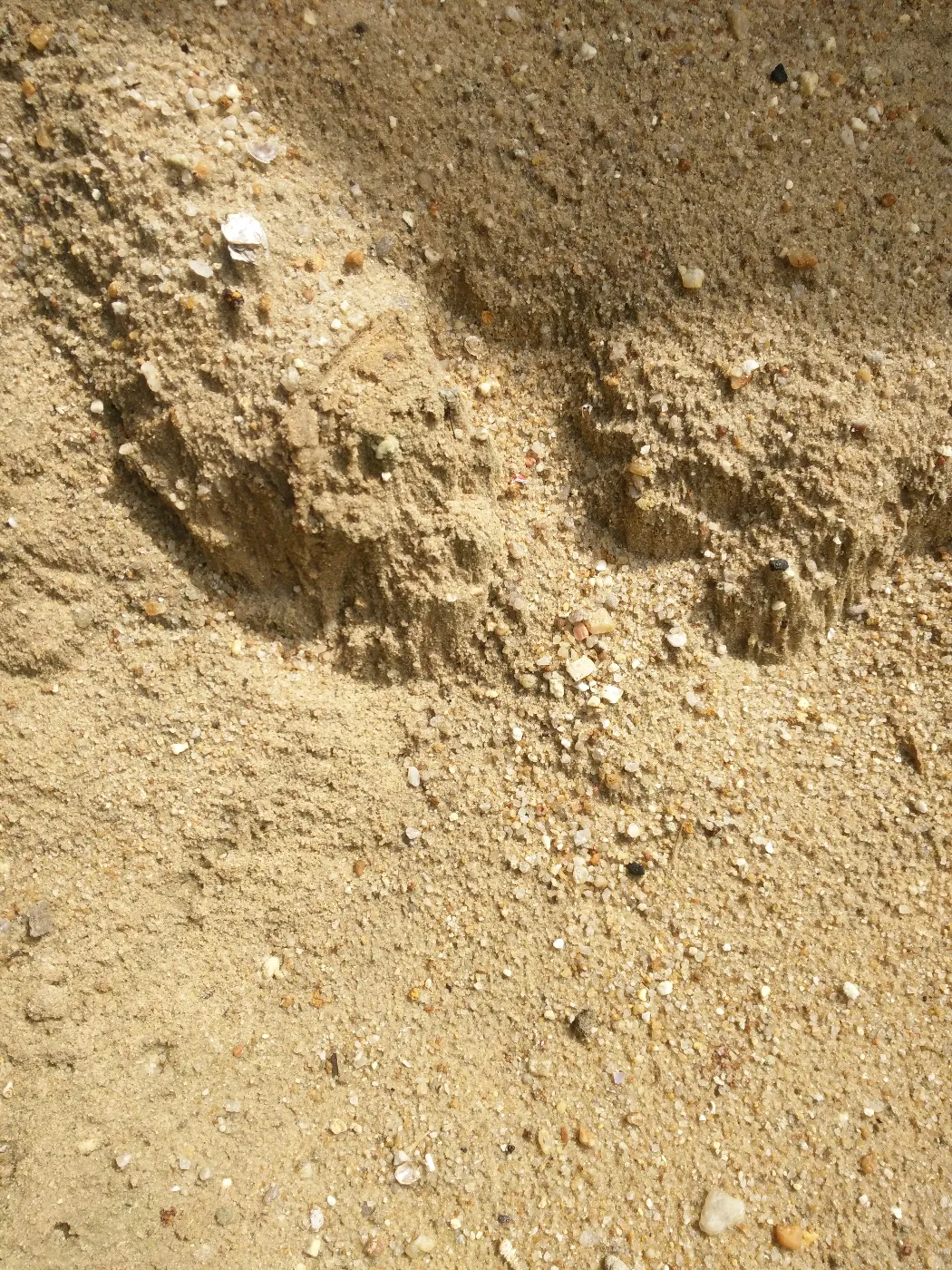
Sandy soil surface
A close-up of a sandy soil sample. The original caption gives a translation into Yoruba — "Iyanrin ile" (where Iyanrin means sand and ile means earth/soil).
Sandy soil is soil in which particles ranging from 0.05 to 2 mm predominate (Troeh & Thompson, 1993). It is easily recognizable: when rubbed between the fingers, it feels distinctly gritty, that is, sandy, with a crunch. If you try to roll a ball from moist soil, it crumbles, and a ribbon cannot be formed (Pavlis, 2020).
Key Properties
- Dries out quickly. Large particles and the large gaps between them do not retain water. Moisture rapidly moves downward under gravity, and evaporation from the surface is more active than on clay soils (Brady & Weil, 2008).
- Warms up quickly. In spring, sandy soils warm up earlier than clay and loamy soils, which allows earlier sowing and planting of heat-loving crops (Nonnecke, 1989).
- Poor in nutrients. Sand particles have almost no electrical charge and do not retain nutrient cations. Nutrients are easily washed out by rain and irrigation (Gershuny & Smillie, 1999).
- Good air permeability. Roots and soil organisms receive enough oxygen, which is favorable for root respiration (Gliessman, 2015).
- Ease of cultivation. Sandy soil is easy to dig and loosen; it does not form hard clods (Pavlis, 2020).
Pros and Cons for the Gardener
Pros:
- Early warming allows for early harvests.
- Good drainage prevents waterlogging and root rot.
- Easy to cultivate, requires little physical effort.
Cons:
- Requires frequent watering, especially during dry periods.
- Nutrients are quickly leached, so regular fertilizing is needed.
- In hot climates, plants may suffer from lack of moisture even with frequent watering.
Note. According to USDA data, sandy soils usually contain less than 10% clay and more than 70% sand. They are classified as "sandy" or "loamy sand" depending on the ratio of fractions (Shukla, 2023).
How to Improve Sandy Soil
The main tool is organic matter. Compost, humus, well-rotted manure, cut grass, leaf litter — all of these increase the water-holding capacity and nutrient value of the soil (Bubel, 2024). Organic matter acts like a sponge: it retains water and nutrients in the root zone.
- Apply 5–10 cm of compost or humus annually, incorporating it into the top layer (Water-Smart Garden, 2025).
- Mulch plantings with straw, cut grass, or leaves — this reduces evaporation and gradually enriches the soil.
- Use green manures (cover crops): mustard, phacelia, clover. Their roots improve structure, and the green mass, when incorporated, adds organic matter (Littlewood, 2007).
- To retain moisture, you can add bentonite clay or zeolite, but this requires caution and localized application.
Suitable Crops
On sandy soils, crops that like drainage and cannot tolerate waterlogging grow well:
- Root crops: carrots, radishes, beets, potatoes (Nonnecke, 1989).
- Melons and gourds: watermelons, melons, pumpkins.
- Berry crops: strawberries, raspberries, blackberries (with regular watering).
- Drought-tolerant herbs and flowers: lavender, sage, thyme, stonecrops.
Moisture-loving crops tolerate sandy soil poorly: cabbage, cucumbers, celery, as well as plants with shallow root systems that dry out quickly.
Regional Features
Sandy soils are widespread in regions with sandy deposits of glacial, fluvial, or aeolian origin. In Russia, these are, for example, the Meshchera Lowland and pine forests on sandy river terraces (Naumov, 2016). In the world — large areas in the Sahara, Australia, and coastal areas. In such zones, it is especially important to accumulate organic matter and use mulch.
Brief Summary
Sandy soil is warm and light but poor and dry. It requires constant attention to watering and nutrition. With sufficient application of organic matter and mulching, it becomes an excellent medium for many crops, especially root crops and drought-tolerant plants. The main thing is not to leave it bare and to regularly "feed" it with organic matter.


LCD 4-in-1 Soil Tester
Check essential growing conditions with one compact tool. Measure soil pH, moisture, temperature and light intensity — ideal for gardens, potted plants and greenhouses.
- 4-in-1 measurement
- Easy-to-read LCD display
- Portable design
Affiliate link · For indicative measurements only.
3. Clay Soil

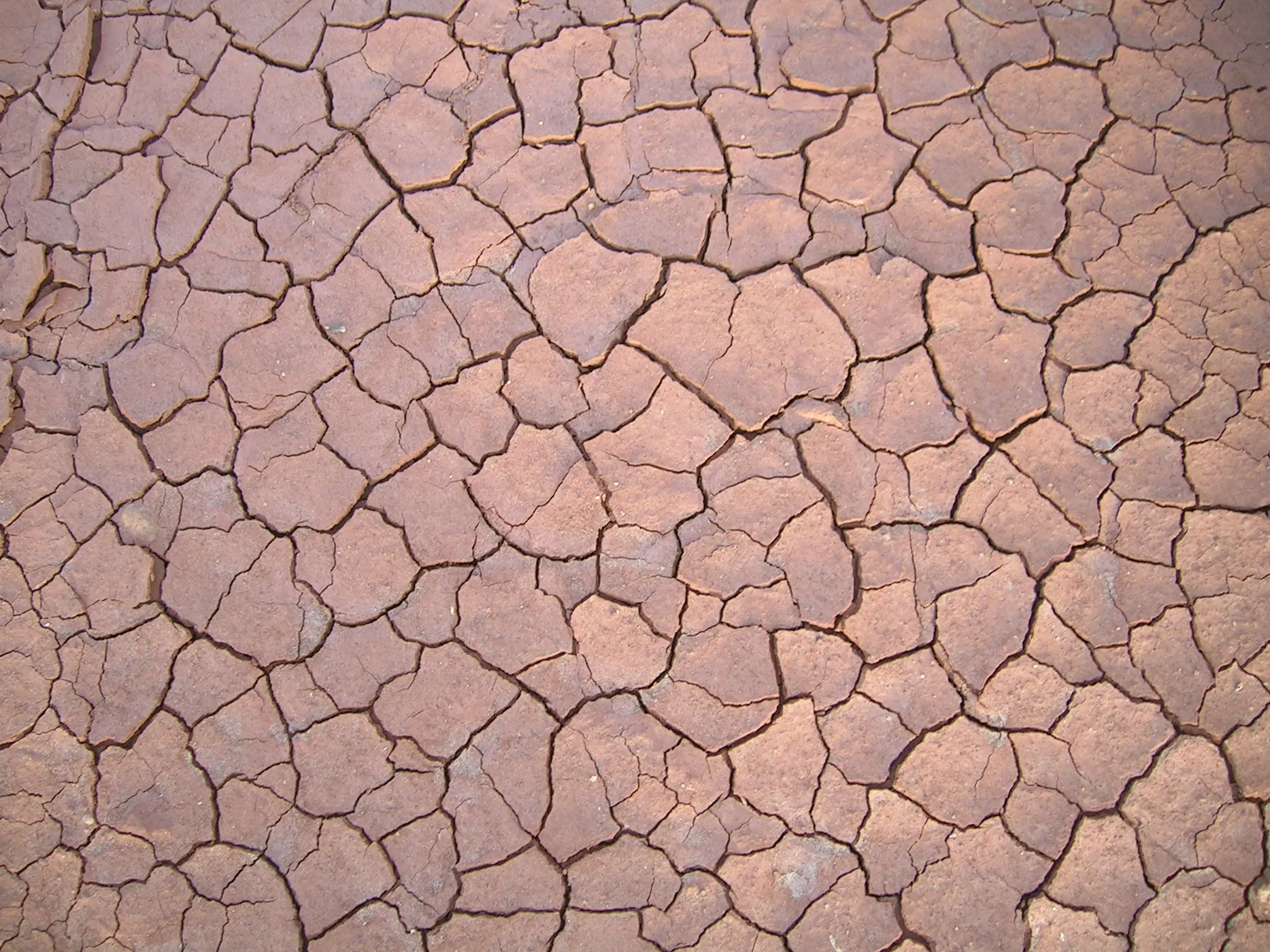
Cracks on the surface of dried clayey soil
Surface of dried-out clay at the bottom of a drying water body. It clearly demonstrates the cracking of heavy soil upon loss of moisture and the characteristic behavior of clayey substrate. Location: India.
Clay soil is the opposite of sandy soil. It is dominated by the finest particles, less than 0.002 mm in size (Troeh & Thompson, 1993). These particles are flat, like tiny plates that fit tightly against each other (Pavlis, 2020). If you squeeze moist clay soil in your hand, it molds easily, and you can roll a long ribbon or "sausage" from it (Chalker-Scott, 2018).
Key Properties
- Heavy and dense. Fine particles pack very tightly, leaving little space for air. When wet, clay is sticky and viscous; when dry, it is hard as stone and cracks (Brady & Weil, 2008).
- Warms up slowly. Due to its high water-holding capacity, clay remains cold for a long time in spring. Water has a high heat capacity, so much more solar energy is needed to warm such soil (Troeh & Thompson, 1993).
- Passes water slowly. The pores between clay particles are very small. Water is retained in them by surface tension forces and hardly moves under gravity. After rain, clay can remain wet for several days (Water-Smart Garden, 2025).
- Rich in nutrients. Clay particles carry a negative electrical charge and retain nutrient cations — calcium, magnesium, potassium, ammonium (Gershuny & Smillie, 1999). This is why clay soils are often very fertile.
- Poor air permeability. Roots and soil organisms lack oxygen, especially when wet. This slows the decomposition of organic matter and can suppress plants (Gliessman, 2015).
Pros and Cons for the Gardener
Pros:
- High natural fertility: clay retains nutrients and releases them to plants gradually.
- Good water-holding capacity: during dry periods, clay soil stays moist longer than sandy soil.
- With proper cultivation and application of organic matter, it becomes very productive.
Cons:
- Difficult to cultivate: digging and loosening it is hard, especially when wet.
- Warms up slowly in spring, which delays sowing and planting.
- Prone to compaction: walking and machinery compress particles, depriving roots of air.
- When wet, it can waterlog roots, causing them to rot.
- When drying, it forms a hard crust that is difficult to break.
Note. According to USDA data, clay soils contain more than 40% clay. They are classified as "clay," "heavy loam," and "medium loam" depending on the ratio of fractions (Shukla, 2023). People call such soils "heavy" — not because they weigh more, but because they require more effort to cultivate (Troeh & Thompson, 1993).
How to Improve Clay Soil
The main enemy of clay is lack of structure. The gardener's task is to create a crumb structure in which there are pores for air and water between aggregates. The best way is organic matter.
- Apply compost, humus, well-rotted manure, leaf mold. Organic matter glues clay particles into crumbs and improves structure (Bubel, 2024).
- Do not add sand to clay in large quantities! A mixture of sand and clay when wet turns into "concrete" (Water-Smart Garden, 2025). A small amount of sand will not help, and a large amount will ruin the soil.
- Mulch plantings. Mulch protects the surface from raindrop impact, prevents crust formation, and gradually improves structure (Littlewood, 2007).
- Use green manures with deep roots: lupine, sweet clover, oilseed radish. Their roots loosen the soil, and the green mass, when incorporated, adds organic matter.
- Do not cultivate clay when wet. This is the main rule. If the soil sticks to the spade, it is better to wait. Cultivating wet clay destroys structure and creates dense clods (Bubel, 2024).
- Autumn digging while leaving large clods for the winter helps: frost and thaws loosen the clay naturally (Nonnecke, 1989).
Suitable Crops
On clay soils, crops with powerful root systems and high nutrient requirements grow well:
- Cabbage, broccoli, cauliflower, Brussels sprouts.
- Peas, beans, broad beans.
- Potatoes (provided loosening and sufficient drainage).
- Beets, chard, spinach.
- Apple, pear, plum, cherry trees — fruit trees like clay soils with good drainage.
Crops that require light, loose soil tolerate clay poorly: carrots (they will be crooked), parsnip, radish, as well as plants prone to root rot.
Regional Features
Clay soils are widespread in regions with clay parent material or in places where clay deposits accumulated by water. In Russia, these are, for example, many areas of the Non-Black Earth region, the Moscow region, as well as areas with heavy loams in the Central region (Naumov, 2016). In the world — large areas in the Amazon basin, Eastern Europe, and the prairies of North America (Mukha et al., 2003).
Note. In regions with a hot and dry climate, clay soils crack when drying, forming deep fissures. This is characteristic of swelling soils (vertisols), which contain a lot of montmorillonite — a clay mineral that swells strongly when moistened (Shukla, 2023).
Brief Summary
Clay soil is heavy and cold but very fertile. It requires patience and organic matter. The main thing is not to work with it when wet, to regularly apply compost, and to mulch. With the right approach, it becomes one of the most productive soils for gardens and vegetable plots. If left unattended, it can turn into a dense, lifeless substrate where plants suffer from lack of air and waterlogging.
4. Loamy Soil
Loamy soil is the golden mean among all types. In it, sand, silt, and clay are present in approximately equal proportions, creating optimal conditions for most garden and vegetable crops (Troeh & Thompson, 1993). This is the soil that agronomists call "ideal" (Pavlis, 2020).
Key Properties
- Balanced composition. Ideal loam contains approximately 40% sand, 40% silt, and 20% clay (Pavlis, 2020). Sand provides drainage and air permeability, clay and silt retain water and nutrients, and organic matter glues everything into stable aggregates (Chalker-Scott, 2018).
- Good drainage. Water does not stagnate but also does not drain instantly as on sand. Roots receive enough moisture and oxygen at the same time (Brady & Weil, 2008).
- Moderate water-holding capacity. Loam retains moisture in a form available to plants. During dry periods, it stays moist longer than sandy soil but does not turn into a swamp like clay (Water-Smart Garden, 2025).
- Nutrient content. Clay and organic particles retain nutrient cations — calcium, magnesium, potassium, ammonium — and gradually release them to roots (Gershuny & Smillie, 1999).
- Ease of cultivation. Loam does not stick to the spade like clay and does not crumble like sand. It forms soft, friable crumbs that are easy to loosen (Pavlis, 2020).
- Rapid warming. In spring, loam warms up quite early, allowing sowing to begin at optimal times (Nonnecke, 1989).
Why Loam Is Considered the Best
Loamy soil combines the advantages of sandy and clay soils while minimizing their disadvantages:
| Property | Sandy | Clay | Loamy |
|---|---|---|---|
| Drainage | Excellent | Poor | Good |
| Water-holding capacity | Low | High | Optimal |
| Nutrient content | Low | High | High |
| Air permeability | Excellent | Poor | Good |
| Spring warming | Early | Late | Medium |
| Cultivation | Easy | Difficult | Moderate |
Note. According to USDA data, loamy soils contain from 7 to 27% clay, from 28 to 50% silt, and less than 52% sand. Within this category, light, medium, and heavy loams are distinguished (Shukla, 2023). Heavy loam is closer to clay, light loam to sand, but all of them remain favorable for most crops.
How to Maintain Loam in Good Condition
Loamy soil is not a given but the result of proper management. Even ideal loam can be ruined by improper cultivation. Here are the basic rules:
- Regularly apply organic matter. Compost, humus, leaf mold — 2–5 cm annually. Organic matter maintains crumb structure and feeds soil life (Bubel, 2024).
- Mulch. Mulch protects the surface from erosion, conserves moisture, and gradually improves structure (Littlewood, 2007).
- Do not dig unnecessarily. Deep digging destroys structure and burns up organic matter. It is better to loosen the top layer (Chalker-Scott, 2018).
- Practice crop rotation. Different crops affect the soil differently. Alternating legumes, root crops, leafy crops, and fruit crops maintains nutrient balance (Nonnecke, 1989).
- Do not walk on the beds unnecessarily. Compaction destroys structure, especially when wet. Use permanent paths (Pavlis, 2020).
- Maintain pH in the optimal range. For most crops, this is 6.0–7.0. Loam usually has a neutral or slightly acidic reaction, but liming or applying sulfur may be needed (Chalker-Scott, 2018).
Suitable Crops
Almost everything grows well on loamy soil:
- Vegetables: tomatoes, cucumbers, peppers, cabbage, carrots, beets, onions, lettuce, spinach.
- Berries: strawberries, raspberries, currants, gooseberries.
- Fruit trees: apple, pear, plum, cherry.
- Flowers: roses, peonies, daylilies, annuals.
- Lawn grasses.
The only exception is plants that require specific conditions: acidic soil (blueberries, rhododendrons) or very poor soil (some wild plants). But even for them, suitable conditions can be created using containers or localized pH adjustment.
Note. In regions with high precipitation, loam may be leached and have an acidic reaction. In arid regions, it may be alkaline and contain carbonates. Therefore, it is important to check pH and adjust it if necessary (Naumov, 2016).
Regional Features
Loamy soils are widespread in the temperate zone. In Russia, these are, for example, gray forest soils, sod-podzolic loams, and many chernozems (Mukha et al., 2003). In the world — large areas in Europe, North America, and China. It was on such soils that agriculture historically developed.
Note. Chernozem is a special type of loamy soil with a high humus content (up to 10–15%). It is considered the most fertile in the world. Chernozems are widespread in the steppes of Russia, Ukraine, Kazakhstan, and North America (Naumov, 2016).
Brief Summary
Loamy soil is the best for most garden and vegetable crops. It combines good drainage with sufficient water-holding capacity, is rich in nutrients, and is easy to cultivate. But even it needs support: apply organic matter, mulch, avoid compaction, and practice crop rotation. If the loam is "tired" or depleted, several years of regular compost application will restore its fertility.

Solar Automatic Drip Irrigation Kit for Gardens
Automate watering for pots, gardens and small greenhouses. This solar-powered system features a timer to help schedule water delivery to your plants.
- Solar-powered
- 15 m irrigation hose
- Programmable watering
Affiliate link · Check included accessories.
5. Peaty Soil

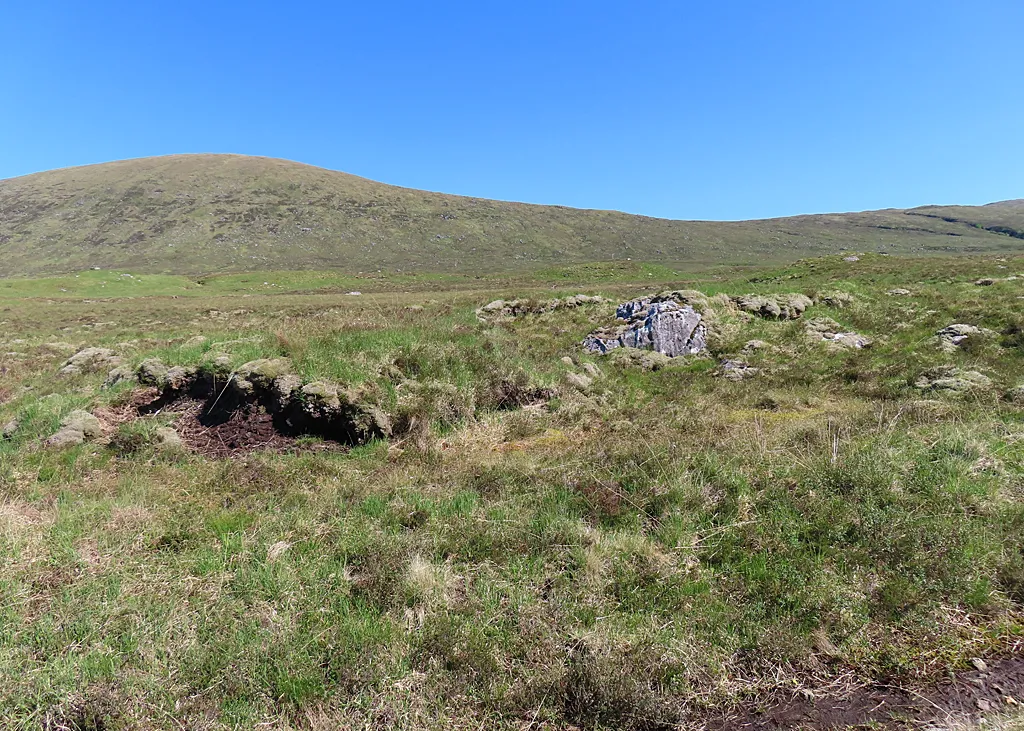
Peatlands of Scotland
Natural landscape of waterlogged upland terrain with peatlands. It illustrates the conditions under which organic remains accumulate and peat soils form. Location: Lismore and Appin, Argyll and Bute, Scotland, United Kingdom.
Peaty soil is soil dominated by organic matter rather than mineral particles. It forms under conditions of constant waterlogging and lack of oxygen, which is why plant residues do not decompose completely but accumulate as peat (Pavlis, 2020). Externally, such soil is usually dark, almost black, loose, and very light. When squeezed in the hand, it springs back and releases moisture, and after drying, it becomes light and can easily ignite (Gershuny & Smillie, 1999).
Key Properties
- Very high organic matter content. Peaty soils contain more than 20% organic matter, often 50–80% or more (Eash et al., 2016). This makes them unlike all mineral soils.
- High water-holding capacity. Peat can hold 10–20 times its own weight in water (Littlewood, 2007). However, this water is not always available to plants: peat holds it too strongly.
- Acidic reaction. Most peaty soils have a pH from 3.5 to 5.0 (Pavlis, 2020). Raised bog peat (sphagnum) is the most acidic; lowland peat is less acidic and more nutritious.
- Poor in mineral elements. Peat is low in potassium, phosphorus, calcium, and trace elements. Nutrients are present but are "locked up" in organic matter and are released very slowly (Brady & Weil, 2008).
- Poor thermal conductivity. Peat warms up slowly in spring and remains cold for a long time. This delays plant growth (Nonnecke, 1989).
- Loose and light. Peaty soil is easy to cultivate, but it shrinks greatly when drying and may lose volume (Gershuny & Smillie, 1999).
Pros and Cons for the Gardener
Pros:
- High water-holding capacity: during dry periods, peat stays moist longer.
- Ease of cultivation: requires little physical effort.
- Good air permeability: roots receive enough oxygen.
- Suitable for crops that like acidic soil and moisture.
Cons:
- Poor in mineral elements: without fertilizing, plants starve.
- Acidic reaction: most vegetable crops grow poorly at pH below 5.5.
- Slow warming in spring: delays sowing and planting.
- Fire risk: dried peat easily ignites.
- Subsidence: over time, peat decomposes and subsides, which can expose roots (Water-Smart Garden, 2025).
Note. Peaty soils are divided into two main types: raised (oligotrophic) and lowland (eutrophic). Raised bogs form on elevated areas and are fed only by atmospheric precipitation, so they are very acidic and poor. Lowland bogs form in depressions and receive nutrients from groundwater, so they are less acidic and more fertile (Naumov, 2016).
How to Improve Peaty Soil
The main task is to reduce acidity and add mineral components. Peat itself is not soil in the full sense but an organic mass that needs to be "diluted" and enriched.
- Liming. Applying dolomite flour or lime raises pH to the optimal level (6.0–7.0). Doses depend on the initial acidity: usually 2–5 kg per 10 m2 (Littlewood, 2007).
- Adding sand and clay. Peat is too loose and wet. Sand (for drainage) and clay (for retaining nutrients) improve structure. Ratio: for 1 part peat — 1 part sand and 0.5 part clay (Bubel, 2024).
- Applying mineral fertilizers. Peat is poor in potassium, phosphorus, and trace elements. Regularly apply complex fertilizers or ash (Gershuny & Smillie, 1999).
- Drainage. If peaty soil is located in an area with a high groundwater level, drainage ditches or raised beds are necessary. Otherwise, roots will suffocate from excess water.
- Mulching. Mulch made of compost or humus gradually enriches peat with mineral substances and improves structure (Water-Smart Garden, 2025).
Note. Do not try to "dig over" peaty soil deeply. This destroys its structure and leads to rapid subsidence. It is better to gradually improve the top layer by applying additives superficially (Chalker-Scott, 2018).
Suitable Crops
On peaty soils, plants that like acidic environments and moisture grow well:
- Berry crops: blueberries, cranberries, lingonberries, bilberries.
- Ornamentals: rhododendrons, azaleas, heathers, hydrangeas.
- Vegetables after improvement: cabbage, carrots, beets, onions, lettuce (provided liming and fertilizer application).
- Herbs: sorrel, lovage, mint.
Poorly on peat without improvement: tomatoes, cucumbers, peppers, eggplants, and most fruit trees (they prefer loam).
Regional Features
Peaty soils are widespread in the taiga and tundra zones, in waterlogged lowlands, and on the sites of former bogs. In Russia, these are, for example, the Meshchera Lowland, Polesie, Western Siberia, and many areas of the Non-Black Earth region (Mukha et al., 2003). In the world — large areas in Canada, Finland, Ireland, and Indonesia. In such regions, peat is often extracted as fuel and for garden substrates, but worked-out peat bogs remain at extraction sites and require reclamation (Naumov, 2016).
Note. Drained peaty soils mineralize rapidly when misused: organic matter decomposes, the soil subsides, and after a few decades it may turn into a barren mineral substrate. Therefore, peaty soils require especially careful management (Gershuny & Smillie, 1999).
Brief Summary
Peaty soil is rich in organic matter but poor in minerals and acidic. It requires liming, addition of sand and clay, regular fertilizing, and drainage. Without improvement, only acid-loving crops grow on it. With the right approach, a peat bog becomes a fertile and moisture-retentive soil, but one must remember the risk of fires and subsidence. It is best to use peaty soils for blueberries, cranberries, rhododendrons, and other plants that like acidic and moist environments.
6. Calcareous Soil

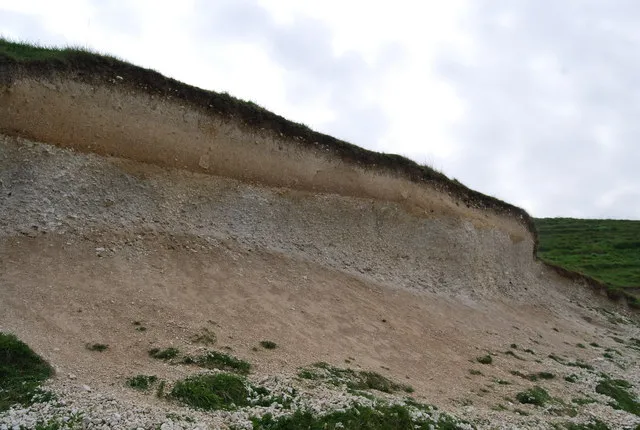
Soil profile on chalk bedrock
Soil section on a chalk base. The dark humus upper horizon, a lighter leached layer, and the underlying rock are clearly visible. The author identifies the soil as Rendzina. Location: Seven Sisters Country Park, East Sussex, England, United Kingdom.
Calcareous soil is soil that contains a significant amount of calcium carbonate (CaCO3) or magnesium carbonate (MgCO3). It forms on limestones, chalk, dolomites, and other carbonate rocks. The main distinguishing feature is an alkaline reaction: pH is usually above 7.5 and sometimes reaches 8.5 or more (Pavlis, 2020). Externally, such soil is often light, grayish-white or yellowish, and often stony. When vinegar or a weak acid is added, it "fizzes" — this is a simple field test for the presence of carbonates (Chalker-Scott, 2018).
Key Properties
- Alkaline reaction. High carbonate content maintains pH in the range of 7.5–8.5. This makes many nutrients unavailable to plants (Brady & Weil, 2008).
- Poor in available elements. At high pH, iron, manganese, zinc, copper, and boron become insoluble. Phosphorus is also bound by calcium and becomes poorly available. Plants may suffer from chlorosis even if these elements are present in the soil (Pavlis, 2020).
- Often stony and shallow. Calcareous soils often have a thin layer of humus, beneath which dense carbonate rock begins immediately. Roots have difficulty penetrating deeper (Littlewood, 2007).
- Good drainage but rapid moisture loss. Limestone is fissured, and water drains quickly. During dry periods, such soils dry out severely (Water-Smart Garden, 2025).
- Structure can vary. If the top layer contains organic matter, the structure may be crumbly. But calcareous soils are often pulverized or, conversely, compacted (Naumov, 2016).
- High buffering capacity. Carbonates strongly resist changes in pH. Shifting the reaction toward acidic is very difficult and expensive (Chalker-Scott, 2018).
Pros and Cons for the Gardener
Pros:
- Good drainage: water does not stagnate, and roots do not rot.
- Rapid warming in spring: calcareous soils are warmer than clay soils.
- Suitable for calciphilous plants that love lime.
Cons:
- Alkaline reaction blocks the availability of iron, manganese, zinc, and phosphorus.
- Often poor in organic matter and nitrogen.
- May be stony and shallow, which complicates planting.
- Require regular application of organic matter and special fertilizers.
- Poorly suited for acid-loving crops.
Note. Do not confuse calcareous soil with liming. Liming is the application of lime to acidic soil to raise pH. Calcareous soil is soil that already contains a lot of lime and has an alkaline reaction. These are opposite situations (Pavlis, 2020).
How to Improve Calcareous Soil
The main task is to lower pH and increase the availability of nutrients. It is impossible to completely remove carbonates, but you can create favorable conditions for most crops.
- Applying organic matter. Compost, humus, leaf mold, peat (acidic) — all of these gradually acidify the soil and improve structure. Organic matter also chelates trace elements, making them more available (Littlewood, 2007).
- Mulching with acidic materials. Conifer litter, bark, wood chips, oak leaves — gradually acidify the top layer (Water-Smart Garden, 2025).
- Applying sulfur. Elemental sulfur is oxidized by bacteria to sulfuric acid and lowers pH. Doses: 100–200 g per 10 m2 for loam, less for sand. The effect is slow but lasting (Chalker-Scott, 2018).
- Ammonium sulfate or iron sulfate. These fertilizers acidify the soil and simultaneously supply nitrogen or iron. But do not overdo it: an excess can be harmful (Pavlis, 2020).
- Chelated fertilizers. Iron, manganese, and zinc in chelated form (EDDHA, DTPA) remain available even at high pH. This is the best way to combat chlorosis (Pavlis, 2020).
- Drainage and loosening. If the soil is stony, it is useful to add sand and compost to improve structure and give roots more space.
- Choosing the right crops. Instead of fighting pH, it is sometimes easier to select plants that love lime.
Suitable Crops
On calcareous soils, calciphiles grow well — plants that prefer an alkaline environment:
- Vegetables: cabbage, broccoli, cauliflower, beets, spinach, onions, garlic, asparagus.
- Fruit: apple, pear, plum, cherry, apricot, grapes.
- Berries: currants, gooseberries (but not blueberries or cranberries).
- Flowers: lavender, sage, thyme, roses, peonies, clematis, carnations.
- Trees: oak, beech, ash, maple.
Poorly on lime: blueberries, cranberries, rhododendrons, azaleas, heathers, hydrangeas (except those that change color), magnolias, as well as potatoes (may suffer from scab) and tomatoes (often suffer from iron deficiency).
Regional Features
Calcareous soils are widespread in regions with carbonate rocks. In Russia, these are, for example, sod-carbonate soils on limestones and chalk, found in the Central region, the Volga region, the Urals, and Ciscaucasia (Naumov, 2016). In the world — large areas in the Mediterranean, the Balkans, England (Chalk), France (Champagne, Burgundy), the USA (Texas, Kansas), and China. In such regions, gardeners often encounter chlorosis and are forced to use chelated fertilizers.
Note. In arid zones, calcareous soils are often combined with salinization. High salt and carbonate content makes such soils especially difficult for agriculture. Leaching, drainage, and application of organic matter are required (Mukha et al., 2003).
Brief Summary
Calcareous soil is alkaline, often stony, and poor in available trace elements. It requires regular application of organic matter, mulching with acidic materials, and the use of chelated fertilizers. It is impossible to completely change the pH, but you can select crops that love lime or create local conditions for acid-loving plants. The main thing is not to ignore the characteristics of such soil, otherwise plants will suffer from chlorosis and nutrient deficiency.

7-in-1 Wi-Fi Weather Station
Monitor local weather conditions with a wireless outdoor sensor. Track temperature, humidity, rainfall, wind speed and direction, and atmospheric pressure. Ideal for gardens, farms and greenhouses.
- Wireless outdoor sensor
- Solar-powered
- Wi-Fi connectivity
Affiliate link · Check regional compatibility.
7. Stony Soil

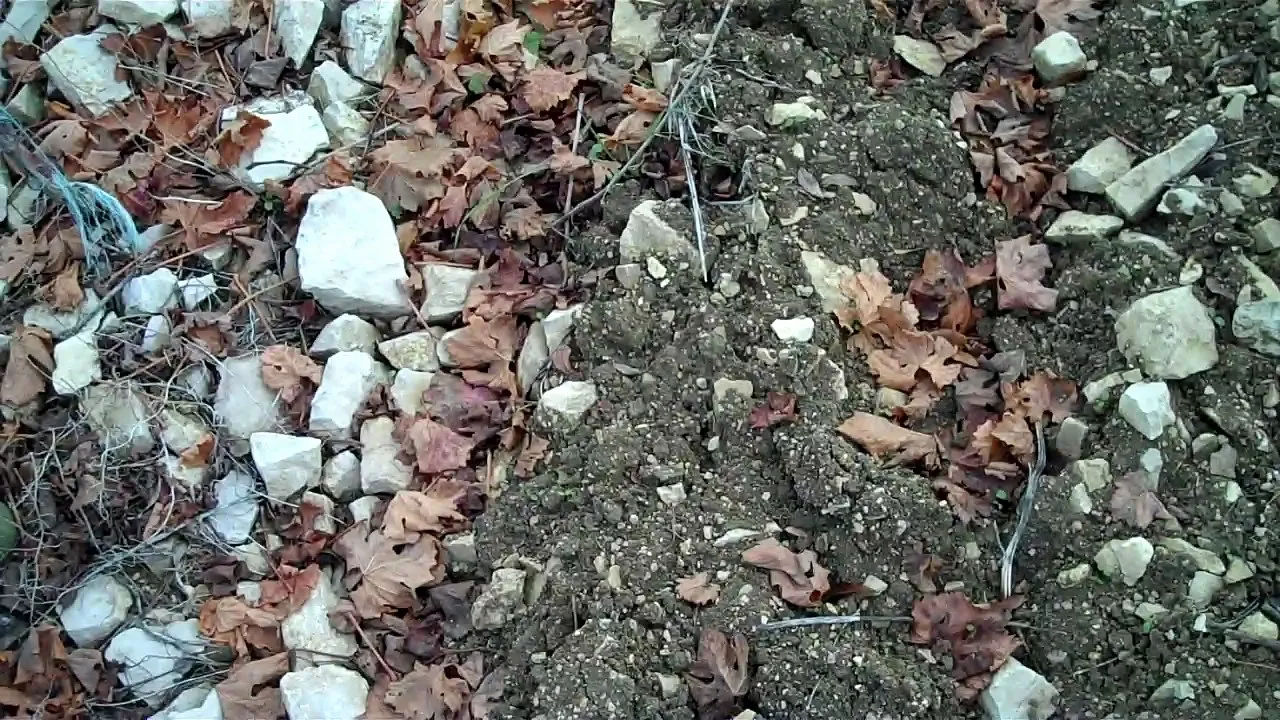
Vineyard on stony soil
Grapevines grow on stony ground in the Cabardès wine region. Stones are clearly visible on the surface and emphasize the coarse-clastic composition of the soil. The crop shown is the cultivated grape (Vitis vinifera L.). Location: Cabardès wine area, Languedoc region, France.
Stony soil is soil in which a significant proportion of the volume is occupied by rock fragments larger than 2 mm: stones, crushed stone, gravel, pebbles (Troeh & Thompson, 1993). Such soils often form on slopes, in mountainous areas, at rock outcrops, or in zones where glaciers and water left coarse debris (Valkov et al., 2004). If the soil contains many small stones, it is called "grity"; if large ones, "stony" or "gravelly."
Key Properties
- Small volume of fine earth. The fertile layer consisting of sand, silt, and clay occupies a small part of the volume. The bulk is made up of stones, which do not retain water or nutrients (Troeh & Thompson, 1993).
- Rapid drainage. Water drains freely through the large gaps between stones. During dry periods, stony soil dries out very quickly (Water-Smart Garden, 2025).
- Good aeration. Roots and soil organisms receive enough oxygen. Waterlogging almost never occurs unless there is a dense clay layer under the stones.
- Rapid warming. Stones heat up in the sun and release heat to the soil. In spring, such areas warm up earlier than level clay or peaty soils (Valkov et al., 2004).
- Poor in nutrients. Nutrients are washed out of the fine earth and are not retained by stones. There is usually little humus, unless it has accumulated in cracks and pockets between stones (Gershuny & Smillie, 1999).
- Difficulty of cultivation. Digging, loosening, and planting on stony soil is hard. Stones interfere with roots, the spade, and the hoe. Root crops grow crooked if they encounter obstacles (Pavlis, 2020).
- Heterogeneity. Stony soil is extremely heterogeneous: areas with deep fine earth may be next to areas where rock comes to the surface. This creates a "mosaic" of conditions even on a small plot (Valkov et al., 2004).
Pros and Cons for the Gardener
Pros:
- Rapid warming in spring: sowing and planting can begin earlier.
- Good drainage: roots do not rot from waterlogging.
- Suitable for plants that like warmth and drainage: grapes, lavender, thyme, stonecrops, and many Mediterranean crops.
- Stones on the surface create a microclimate: they heat up during the day and release heat at night, smoothing out temperature fluctuations.
- On slopes, stony soil is less prone to erosion than clay or sandy soil (Naumov, 2016).
Cons:
- Small volume of fertile layer: plants have little space for roots.
- Rapid moisture loss: frequent watering is required.
- Poor nutrition: regular fertilizing is needed.
- Difficulty of cultivation: stones interfere with planting and care.
- Root crops become deformed if they run into stones.
- Impossible to cultivate deeply without special equipment.
Note. Grapes on stony soils give higher yields and better berry quality than on clay or loam. Stones promote drainage, warming, and sugar accumulation. That is why the world's best vineyards are located on stony soils — in Bordeaux, Champagne, the Rhône Valley, and Tuscany (Valkov et al., 2004).
How to Improve Stony Soil
It is impossible and unnecessary to completely remove stones from a large plot. It is much more effective to work with what is there, creating local conditions for plants.
- Choosing a planting site. Find pockets with the most fine earth. If stones lie in a thin layer over clay or loam, they can be carefully removed from the future bed and used for drainage or paths.
- Applying organic matter. Compost, humus, and leaf mold fill the gaps between stones and retain moisture and nutrients. Apply 5–10 cm of organic matter annually; it will gradually penetrate the cracks and improve the soil (Bubel, 2024).
- Mulching. Mulch made of straw, cut grass, or leaves reduces evaporation and gradually enriches the soil. Stones under mulch stay moist longer (Water-Smart Garden, 2025).
- Raised beds. If stones lie densely and the soil cannot be cultivated, create raised beds from imported loam and compost. A height of 20–30 cm is sufficient for most vegetables.
- Containers and pots. For demanding crops or on very stony plots, use containers with a good soil mix. This allows you to fully control the conditions.
- Green manures. Deep-rooted plants — lupine, sweet clover, oilseed radish — loosen the soil and add organic matter. Their roots penetrate into cracks between stones.
- Watering. Stony soil dries quickly, so regular watering is necessary. It is better to water less often but more abundantly so that water reaches the roots.
- Do not try to dig everything over. Deep digging of stony soil is hard work with minimal results. It is better to improve local areas for each bed or tree.
Note. On stony soils, drip irrigation and subsurface irrigation are especially effective. They deliver water directly to the roots, bypassing surface evaporation. This saves water and reduces plant stress (Water-Smart Garden, 2025).
Suitable Crops
On stony soils, plants that like drainage, warmth, and are not afraid of poverty grow well:
- Grapes (the world's best wines come from stony soils).
- Lavender, thyme, rosemary, sage, oregano.
- Stonecrops, houseleeks, saxifrages, carnations.
- Trees and shrubs: pine, juniper, cotoneaster, barberry.
- Berries: blackberries, raspberries (with sufficient watering).
- Vegetables after creating raised beds: tomatoes, peppers, eggplants, zucchini.
Poorly on stony soil: root crops (carrots, beets, radishes) — they become deformed; moisture-loving crops (cabbage, cucumbers, celery) — they suffer from rapid moisture loss; large fruit trees with deep root systems — they lack sufficient fine earth volume.
Regional Features
Stony soils are widespread in mountainous areas, on slopes, in foothills, and at rock outcrops. In Russia, these are the Caucasus, Urals, Altai, Sayans, Crimea, and Carpathians (Naumov, 2016). In the world — the Alps, Apennines, Pyrenees, Andes, Rocky Mountains, and Himalayas. In such regions, gardeners often use slope terracing, raised beds, and container growing.
Note. In mountainous areas, stony soils are often combined with steep slopes and erosion. Terracing is an ancient method of farming on such plots. Terraces retain water and soil and allow crops to be grown even on very steep slopes (Mukha et al., 2003).
Brief Summary
Stony soil is difficult for agriculture but not hopeless. It warms up quickly, is well drained, and is suitable for many heat-loving and drought-resistant crops. The main strategies are: creating raised beds, applying organic matter, mulching, drip irrigation, and choosing the right plants. It is impossible to completely remove stones, but you can create local fertile areas that will produce good harvests. On stony soils, the principle is especially clear: "there are no bad soils — there are soils that require different approaches."
8. Soil Properties
Soil type is a convenient starting point, but for practical decisions it is important to understand the properties that determine how soil behaves on your plot. Two plots with the same type may behave differently due to structure, drainage, or pH. Let us consider the key properties that a gardener can assess and change.
Texture

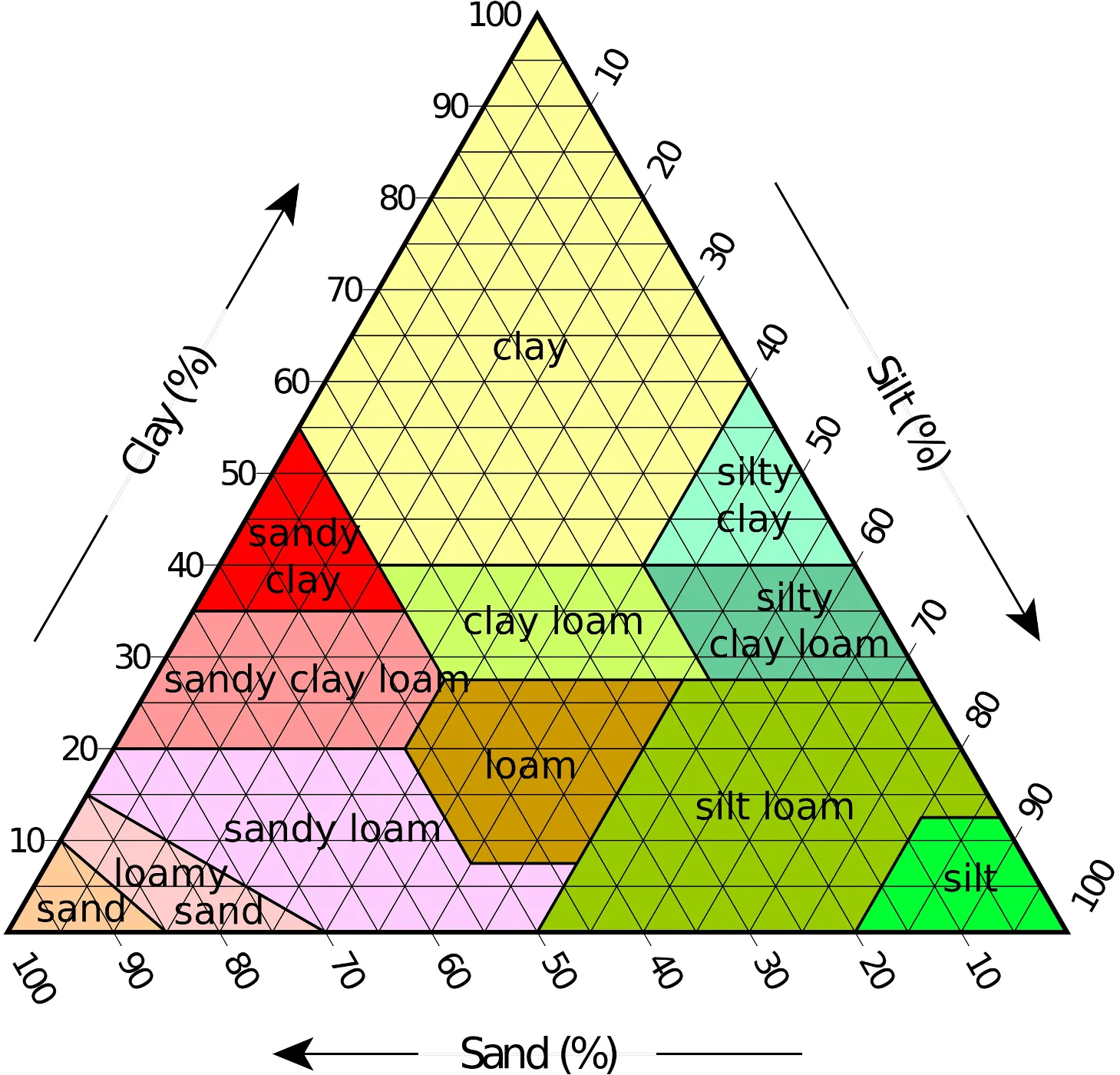
Soil texture triangle
Diagram for classifying soils by the proportions of sand, silt, and clay. It clearly shows how changes in the proportions of mineral particles determine the soil texture class.
Texture is the ratio of sand, silt, and clay in the soil (Troeh & Thompson, 1993). It is determined by particle size: sand (0.05–2 mm), silt (0.002–0.05 mm), clay (less than 0.002 mm) (Shukla, 2023). Texture is a property that is almost impossible to change on the scale of an entire plot. You can add sand to clay or clay to sand, but this requires huge volumes, and the effect is often the opposite (Water-Smart Garden, 2025). Therefore, it is better to accept texture as a given and work with it rather than against it.
Note. A simple field test for texture: take a handful of moist soil and try to roll it into a ribbon. Sandy soil does not form a ribbon, loam gives a short ribbon, and clay gives a long and strong one (Chalker-Scott, 2018).
Structure
Structure is the way soil particles are glued together into aggregates (crumbs). If texture is "what it is made of," then structure is "how it is arranged" (Troeh & Thompson, 1993). Good structure means that the soil consists of soft, friable crumbs with pores for air and water between them. Poor structure is a dense mass, dust, or large hard clods.
Structure can be improved — unlike texture. Organic matter, plant roots, earthworms, and microorganisms create and maintain crumb structure (Gershuny & Smillie, 1999). That is why compost application and mulching are so effective: they do not change texture but radically improve structure (Shukla, 2023).
Drainage
Drainage is the ability of soil to pass water. Good drainage means that after rain, water goes down without stagnating. Poor drainage leads to waterlogging, water stagnation, and root rot (Water-Smart Garden, 2025).
Drainage depends on texture and structure. Sandy soils drain quickly, clay soils slowly. But even clay with good structure drains better than clay without structure. If drainage is poor due to a dense layer beneath the topsoil, a drainage ditch or raised beds may be needed (Bubel, 2024).
Water-Holding Capacity
Water-holding capacity is the ability of soil to retain water. It is determined by the number of small pores and the presence of organic matter (Brady & Weil, 2008). Clay soils hold more water than sandy soils, but not all of this water is available to plants: some is held too strongly (Troeh & Thompson, 1993).
Organic matter dramatically increases water-holding capacity. Compost acts like a sponge: it absorbs water and gradually releases it to the roots. Therefore, adding organic matter is beneficial for both sandy and clay soils: in sandy soils it retains water, in clay soils it improves structure and moisture availability (Water-Smart Garden, 2025).
Air Permeability
Roots and soil organisms breathe oxygen. If the soil is dense and waterlogged, there is not enough oxygen, and the roots suffocate (Gliessman, 2015). Air permeability depends on the number of large pores and their connectivity.
Sandy soils are usually well aerated, clay soils poorly. But structure is again more important than texture: clay with crumb structure has enough pores for air, while sand compacted by machinery can become almost airless (Brady & Weil, 2008).
Fertility
Fertility is the ability of soil to provide plants with nutrients in an available form (Gershuny & Smillie, 1999). It depends on:
- the content of organic matter and humus;
- the reserve of mineral elements (nitrogen, phosphorus, potassium, calcium, magnesium, trace elements);
- the ability to retain these elements (cation exchange capacity);
- the activity of soil microorganisms that convert elements into available forms (Pavlis, 2020).
Clay and loamy soils are usually more fertile than sandy soils because they retain nutrients better. But fertility can be increased on any soil by regularly adding organic matter and supporting soil life (Gershuny & Smillie, 1999).
pH (Acidity)
pH is a measure of soil acidity or alkalinity on a scale from 0 to 14. A value of 7 is neutral, below 7 is acidic, above 7 is alkaline (Pavlis, 2020). Most garden crops prefer the range of 6.0–7.0 (Chalker-Scott, 2018).
pH affects the availability of nutrients. At low pH, phosphorus, calcium, and magnesium are blocked; at high pH, iron, manganese, zinc, copper, and boron (Pavlis, 2020). Therefore, it is important to know the pH of your soil and adjust it if necessary. Acidic soils are limed, alkaline soils are acidified with sulfur or organic matter (Troeh & Thompson, 1993).
Note. pH is measured in a water extract or a salt extract (KCl). The second method gives more accurate values for acidic soils (Valkov et al., 2004). Home test kits usually use a water extract, which gives approximate but useful results.
Summary Table of Properties
| Property | What it determines | Can it be changed |
|---|---|---|
| Texture | Ratio of sand, silt, clay | Practically no |
| Structure | The way particles are arranged into aggregates | Yes, with organic matter and cultivation |
| Drainage | Rate of water drainage | Partially, with structure and drainage |
| Water-holding capacity | Ability to retain water | Yes, with organic matter |
| Air permeability | Oxygen availability for roots | Yes, with structure |
| Fertility | Nutrient supply | Yes, with organic matter and fertilizers |
| pH | Acidity/alkalinity | Yes, with lime or sulfur |

40W Full Spectrum LED Grow Light
Support healthy plant growth with full-spectrum LED lighting. Ideal for seedlings, indoor plants and small growing spaces. A practical solution for indoor gardening and year-round cultivation.
- Full-spectrum LED
- Energy-efficient design
- Indoor plant growing
Affiliate link · Check actual power and light coverage.
9. How Soil Type Affects Crop Selection and Practices
Understanding soil type allows you to make the right decisions: what to plant, how to water, whether to apply lime or sulfur, and whether to make raised beds. Here are practical conclusions for each type.
Sandy Soil
What to plant: root crops (carrots, radishes, beets, potatoes), melons and gourds (watermelons, melons, pumpkins), drought-tolerant herbs and flowers (lavender, thyme, stonecrops), berries (strawberries, raspberries with watering).
What to avoid: moisture-loving crops (cabbage, cucumbers, celery) without frequent watering and organic matter application.
Practices:
- Apply compost and humus annually (5–10 cm).
- Mulch plantings to conserve moisture.
- Use green manures to accumulate organic matter.
- Water frequently but in small portions, or use drip irrigation.
- Do not leave the soil bare: wind and sun quickly dry it out.
Clay Soil
What to plant: cabbage, broccoli, peas, beans, beets, spinach, fruit trees (apple, pear, plum, cherry).
What to avoid: carrots and other root crops (they become deformed), plants prone to root rot.
Practices:
- Apply plenty of organic matter (compost, humus, leaf mold).
- Do not add sand in large quantities — this makes the soil worse.
- Mulch to protect against crusting and erosion.
- Do not cultivate when wet.
- Autumn digging while leaving clods for the winter helps loosen the clay.
- Create raised beds for crops requiring good drainage.
Loamy Soil
What to plant: almost everything — vegetables, berries, fruit trees, flowers, lawn.
What to avoid: nothing, except plants requiring specific conditions (acidic or very poor soil).
Practices:
- Maintain structure with organic fertilizers (2–5 cm of compost annually).
- Mulch to conserve moisture and protect structure.
- Practice crop rotation.
- Do not compact the soil: use permanent paths.
- Check pH and adjust if necessary.
Peaty Soil
What to plant: blueberries, cranberries, lingonberries, rhododendrons, azaleas, heathers, hydrangeas. After liming and applying mineral fertilizers — cabbage, carrots, beets, onions, lettuce. @ln-latin[]
What to avoid: tomatoes, cucumbers, peppers, eggplants, fruit trees (without serious improvement).
Practices:
- Lime to raise pH (2–5 kg of dolomite flour per 10 m2).
- Add sand and clay to improve structure.
- Apply mineral fertilizers (peat is poor in potassium and phosphorus).
- Provide drainage if groundwater is close.
- Mulch with compost for gradual enrichment.
- Do not dig deeply — peat subsides.
Calcareous Soil
What to plant: cabbage, broccoli, beets, spinach, onions, garlic, asparagus, apple, pear, plum, cherry, grapes, lavender, roses, peonies.
What to avoid: blueberries, cranberries, rhododendrons, azaleas, heathers, hydrangeas, magnolias, potatoes (scab), tomatoes (chlorosis).
Practices:
- Apply organic matter to acidify and improve structure.
- Mulch with acidic materials (conifer litter, bark, oak leaves).
- Use chelated fertilizers (iron, manganese, zinc) to combat chlorosis.
- Apply sulfur to gradually lower pH.
- Choose calciphilous crops if you do not want to fight pH.
Stony Soil
What to plant: grapes, lavender, thyme, rosemary, sage, stonecrops, houseleeks, pine, juniper, blackberries. After creating raised beds — tomatoes, peppers, zucchini.
What to avoid: root crops (they become deformed), moisture-loving crops, large fruit trees without raised beds.
Practices:
- Create raised beds from imported loam and compost.
- Add organic matter into pockets between stones.
- Mulch to conserve moisture.
- Use drip irrigation.
- Choose pockets with the most fine earth.
- Do not try to dig everything over — improve locally.
Universal Principles
Regardless of soil type, there are several universal rules that work everywhere:
1. Organic matter is the key to success. Compost, humus, and mulch improve any soil: they make sandy soil more water-retentive, clay soil looser, peaty soil more nutritious, and calcareous soil more acidic (Bubel, 2024).
2. Do not leave the soil bare. Mulch or green manures protect against erosion, overheating, drying out, and nutrient leaching (Littlewood, 2007).
3. Support soil life. Earthworms, microorganisms, and fungi are your helpers. The more diverse the soil biota, the healthier the soil (Gershuny & Smillie, 1999).
4. Check pH and adjust if necessary. Acidic soils are limed, alkaline soils are acidified. But do not overdo it: drastic changes are harmful (Chalker-Scott, 2018).
5. Practice crop rotation. Different crops affect the soil differently. Alternating legumes, root crops, leafy crops, and fruit crops maintains nutrient balance and reduces disease accumulation (Nonnecke, 1989).
6. Do not compact the soil. Walking and machinery compress particles, depriving roots of air. Use permanent paths and do not work on beds when wet (Pavlis, 2020).
7. Observe and adapt. Every plot is unique. What works for your neighbor may not work for you. Observe, experiment, keep records (Bubel, 2024).
Note. Different soil types predominate in different regions of the world, and this determines traditional farming systems. In the taiga zone — podzolic soils requiring liming and organic matter. In the steppes — chernozems, the most fertile in the world. In the tropics — laterites, poor and acidic, requiring special methods. In arid zones — saline soils requiring leaching and drainage (Naumov, 2016; Mukha et al., 2003).
10. Regional Aspect: Why Soils Differ in Different Zones
Soil type is not random. It forms under the influence of climate, vegetation, relief, parent material, and time (Foth, 1990). That is why different soils predominate in different regions of the world — and a gardener who moves from one zone to another often encounters completely unfamiliar conditions.
Soil-Forming Factors
Climate is the main factor. Temperature and precipitation determine the rate of weathering, decomposition of organic matter, and leaching of nutrients (Brady & Weil, 2008). In a cold climate, organic matter decomposes slowly, so peat and coarse humus accumulate. In a hot and humid climate, organic matter decomposes quickly, and nutrients are leached — soils become poor but deeply weathered (Gliessman, 2015).
Vegetation also matters. Under forests, acidic soils with a thin humus horizon form because forest litter decomposes to form organic acids. Under steppes, where grasses with powerful root systems predominate, dark, humus-rich soils form — chernozems (Mukha et al., 2003).
Relief determines drainage. On slopes, water runs off, soils are washed away, and remain shallow. In lowlands, water stagnates, and waterlogged and peaty soils form (Naumov, 2016).
Major Soil Zones of the World

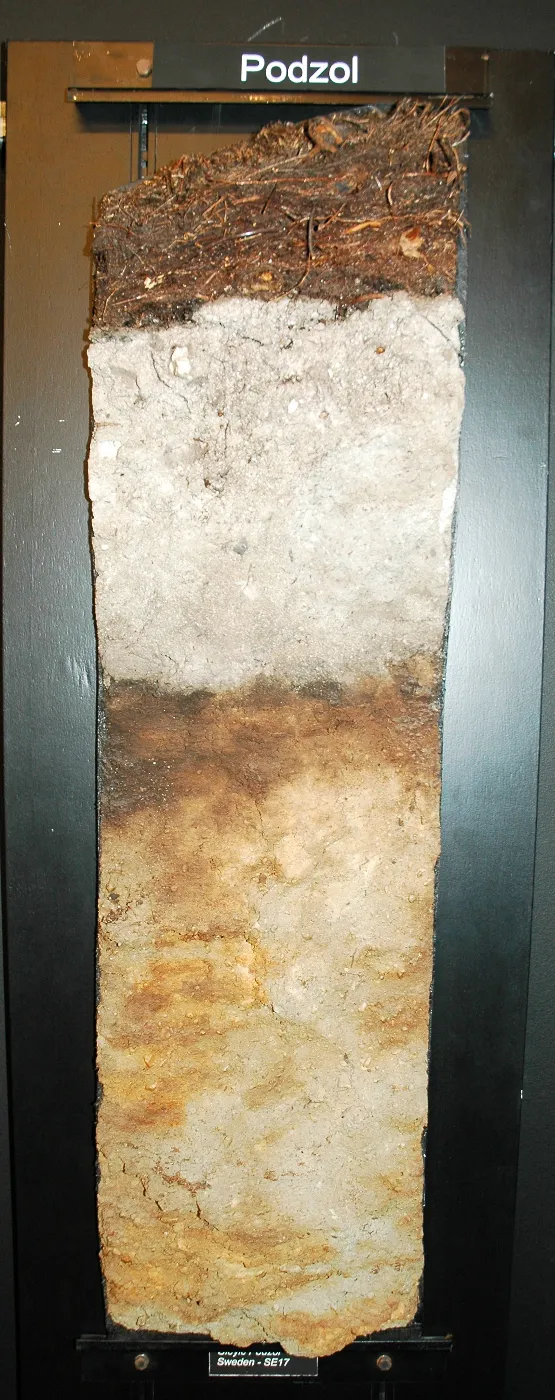
Soil profile: Podzol
Soil profile of Podzol type. At the bottom of the display, the sample location is indicated: Sweden (Sweden - SE17). Podzols are characterized by a sharply expressed bleached (eluvial) horizon from which organic and mineral substances have been leached.
Taiga and coniferous forests (boreal zone). Podzolic and soddy-podzolic soils predominate here. They are acidic, nutrient-poor, with a thin humus horizon and a light leached layer beneath it (Naumov, 2016). In Russia, these are vast areas of Siberia and the north of the European part. Globally, they occur in Canada, Scandinavia, and the northern United States. For gardening, such soils require liming, application of organic matter, and mineral fertilizers (Mukha et al., 2003).
Broadleaf forests. Gray and brown forest soils form here. They are less acidic than podzolic soils and more fertile. In Russia, this includes the Central region and the Volga region. Globally, they occur in Western Europe, the eastern United States, and China. These are among the best soils for gardening after chernozems (Naumov, 2016).

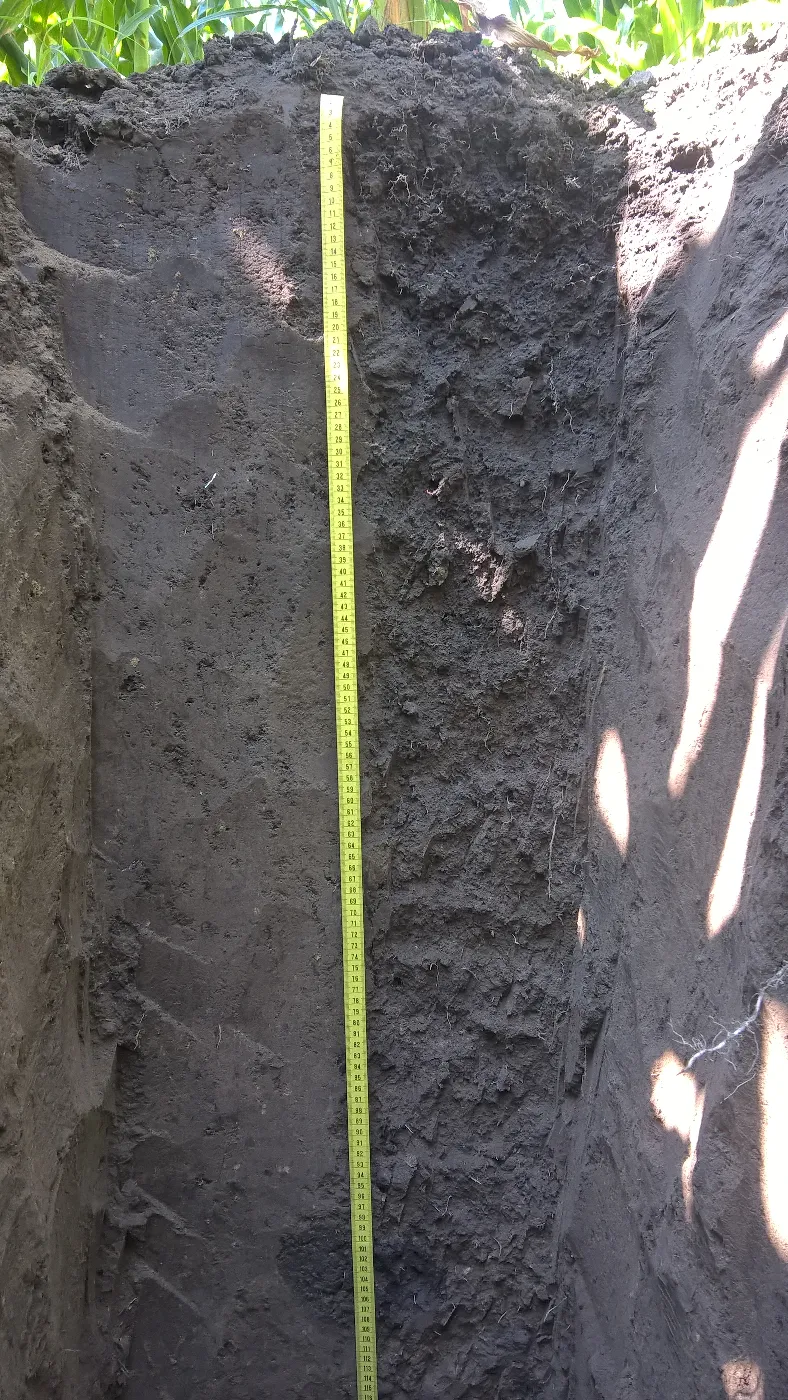
Profile of a typical chernozem
Soil profile of a typical chernozem (Calcic Voronic Chernozem). The original caption gives exactly this soil name.
Steppes and forest-steppes. Chernozems dominate here—the most fertile soils in the world. They contain 6–15% humus, have a thick dark horizon, a neutral reaction, and excellent structure (Mukha et al., 2003). In Russia, they occur in the Central Chernozem region, the Volga region, and Western Siberia. Globally, they occur in Ukraine, Kazakhstan, the North American prairies, and Argentina. Almost everything grows well on chernozems (Naumov, 2016).
Semi-deserts and deserts (arid zone). Sierozems, chestnut, and saline soils form here. They are often alkaline, poor in organic matter, and may contain salts. In Russia, they occur in the Lower Volga region and the Caspian region. Globally, they occur in North Africa, the Middle East, Central Asia, the southwestern United States, and Australia. For farming, they require irrigation, leaching, and drainage (Naumov, 2016; Mukha et al., 2003).

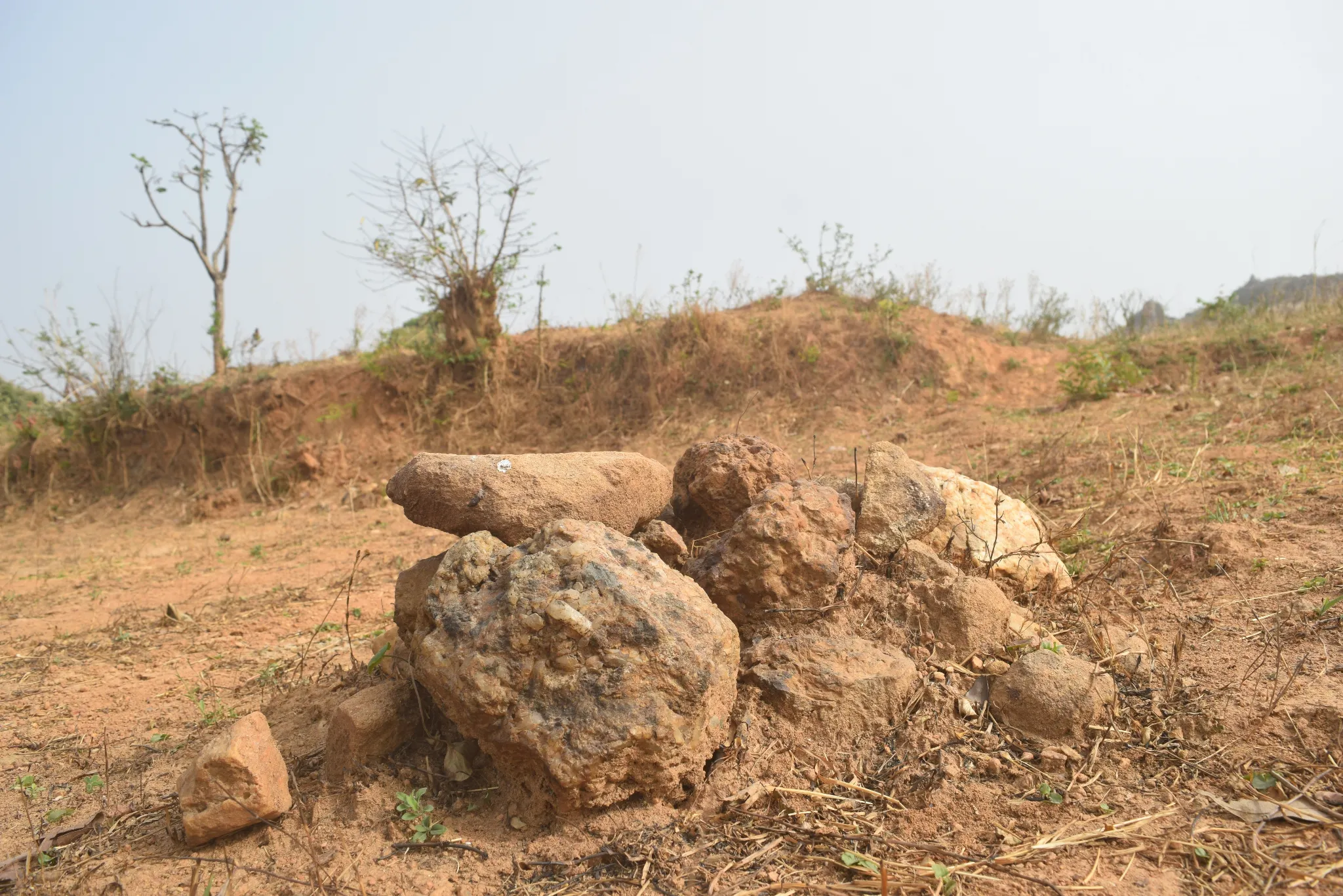
Lateritic soil of tropical regions (Nigeria)
Sample of lateritic soil characteristic of areas with intense chemical weathering. Red-brown lateritic materials are rich in iron and aluminum oxides.
Humid subtropics and tropics. Red soils, yellow soils, and laterites (ferralitic soils) predominate here. They are acidic, nutrient-poor, and high in iron and aluminum oxides. Nutrients are quickly leached, and phosphorus is bound into unavailable forms (Gliessman, 2015). Globally, they occur in Amazonia, Central Africa, and Southeast Asia. For farming, they require constant application of organic matter and mineral fertilizers (Mukha et al., 2003).
Mountain areas. Soils here are diverse and depend on altitude. Stony and gravelly soils with a shallow profile are common in mountains. In Russia, this includes the Caucasus, the Urals, and the Altai. Globally, it includes the Alps, the Andes, and the Himalayas. For gardening, terracing and raised beds are used (Naumov, 2016).
Why This Matters for a Gardener
Knowing which zone your plot is in allows you to predict in advance:
- Soil acidity. In taiga and humid tropics, it is acidic; in steppes, neutral; in deserts, alkaline.
- Fertility. Chernozems are the richest; podzolic soils and laterites are poor.
- Drainage. In lowlands and on clayey parent material, drainage is poor; on sands and slopes, it is good.
- Necessary improvements. Liming, application of organic matter, drainage, and leaching of salts.
Note. Different regions of the world are dominated by different soil types, and this determines traditional farming systems. In the taiga zone, there are podzolic soils requiring liming and organic matter. In the steppes, there are chernozems, the most fertile in the world. In the tropics, there are laterites—poor and acidic, requiring special methods. In arid zones, there are saline soils requiring leaching and drainage (Naumov, 2016; Mukha et al., 2003).
Local Features Matter More Than Zonal Ones
It is important to understand: zonal soil is only the background. On a specific plot, the soil may differ greatly from the “zonal” soil because of relief, parent material, and land-use history. For example, in the taiga zone, a slope may have loam, while a lowland may have peat. In the steppe zone, sands may have sandy soil, and clays may have clayey soil. Therefore, you should always assess the soil on your own plot, rather than relying only on a map (Pavlis, 2020).
Note. The most reliable way to learn the soil on your plot is to carry out simple field tests (ribbon test, jar of water, vinegar) and, if possible, submit samples to a laboratory for analysis of pH, organic matter, and nutrients (Chalker-Scott, 2018).
11. Summary: Knowing the Soil Type Lets You Predict What Will Grow
Soil is not just a substrate. It is a living system that determines which plants will feel good and which will not. Soil type is the starting point for understanding its possibilities and limitations.
Key idea: there are no “bad” soils. There are soils that require different approaches. Sandy soil is warm and light, but poor and dry. Clayey soil is heavy and cold, but rich. Peaty soil is moist and organic, but acidic and poor in minerals. Calcareous soil is alkaline and stony, but suitable for calciphiles. Stony soil is difficult, but suitable for heat-loving crops.
Knowing the soil type, you can:
- Predict what will grow. Root vegetables and melons and gourds grow well on sandy soil; cabbage and fruit crops on clayey soil; blueberries and rhododendrons on peaty soil; grapes and lavender on calcareous soil.
- Choose the right practices. Organic matter, mulch, drainage, liming, and watering all depend on the soil type.
- Avoid mistakes. Do not add sand to clay, do not plant blueberries on lime, and do not leave sandy soil bare.
- Improve the soil purposefully. Adding compost, green manures, crop rotation, and maintaining pH are universal tools that work on any soil.
Main principle: work with the soil, not against it. Observe, experiment, and keep records. Every plot is unique, and the best way to learn it is through practice. Start with simple tests, add organic matter, mulch, and the soil will respond with healthy plants and a good harvest.
Note. Sustainable soil management is not a one-time event but an ongoing process. Soil is a renewable but vulnerable resource. It forms over centuries and can be destroyed in a few years of misuse. Caring for soil is an investment in the future of the garden, the vegetable plot, and the planet as a whole (Gershuny & Smillie, 1999; Gliessman, 2015).
References
- (2014). ‘Soil’, in Agroecology. : CRC Press, 108-123. doi: 10.1201/b17881-13
- (2015). ‘Summary’, in Ingram, D.S., Vince-Prue, Daphne, Gregory, P.J. (ed.) Science and the Garden. The scientific basis of horticultural practice. West Sussex, UK: Royal Horticulture Society. Wiley Blackwell, pp. 75-85.
- Bubel, Nancy, Nick, Jean (2024). ‘Moving Plants Outdoors’, in The New Seed-Starters Handbook. : Rodale, .
- Capon, Brian (2022). ‘How Plants Function’, in Botany for Gardeners. An Introduction to the Science of Plants. Portland, Oregon: Timber Press, pp. 144-192.
- Chalker-Scott, Linda (2018). ‘Soil Analysis: What Makes Soil Great?’, in The Science of Gardening. Course Guidebook. Chantilly, Virginia: The Great Courses, pp. 25-36.
- Chalker-Scott, Linda (2018). ‘Soil Preparation and Protection’, in The Science of Gardening. Course Guidebook. Chantilly, Virginia: The Great Courses, pp. 73-80.
- Connor, D.J., Loomis, R.S., Cassman, K.G. (2011). ‘Soil resources’, in Crop Ecology. Productivity and Management in Agricultural Systems. Cambridge, UK: Cambridge University Press, pp. 159-194.
- Eash, N.S., Sauer, T.J., O'Dell, D., Odoi, Evah (2016). ‘Introduction to Soil’, in Soil Science Simplified. New Jersey: Wiley Blackwell, ch. 1.
- Foth, H.D. (1990). ‘Soil as a Natural Body’, in Fundamentals of Soil Science. New York: John Wiley & Sons, pp. 11-21.
- George, Eckhard, Horst, W.J., Neumann, Elke (2012). ‘Adaptation of Plants to Adverse Chemical Soil Conditions’, in Marschner's Mineral Nutrition of Higher Plants. : Elsevier, 409-472. doi: 10.1016/B978-0-12-384905-2.00017-0
- Gershuny, Grace, Smillie, Joe (1999). ‘Observing and Evaluating Your Soil’, in The Soul of Soil. A Soil-Building Guide for Master Gardeners and Farmers. Vermont: Chelsea Green Publishing, .
- Gershuny, Grace, Smillie, Joe (1999). ‘Understanding the Soil Ecosystem’, in The Soul of Soil. A Soil-Building Guide for Master Gardeners and Farmers. Vermont: Chelsea Green Publishing, .
- Hill, Lewis, Perry, Leonard (2011). ‘Improving Your Soil’, in The Fruit Gardener’s Bible. North Adams, MA: Storey Publishing, pp. 212-232.
- Johnson, Noelle (2023). ‘Planting Basics for Dry Regions’, in Dry Climate Gardening. Beverly, MA: Cool Springs Press, .
- Johnson, Noelle (2025). ‘Building Drought-Resistant Soil’, in The Water-Smart Garden. Beverly, MA: Cool Springs Press, .
- Koumanov, K.S., Long, L.E. (2017). ‘Site preparation and orchard infrastructure.’, in Cherries: botany, production and uses. Wallingford: CABI, 223-243. doi: 10.1079/9781780648378.0223
- Littlewood, Michael (2007). ‘The Basics’, in The organic gardener's handbook. Ramsbury, Wiltshire: The Crowood Press, pp. 15-22.
- Littlewood, Michael (2007). ‘The Ground’, in The organic gardener's handbook. Ramsbury, Wiltshire: The Crowood Press, pp. 59-102.
- Lowenfels, Jeff, Lewis, Wayne (2010). ‘Classic Soil Science’, in Teaming with Microbes. The Organic Gardener’s Guide to the Soil Food Web. Portland, Oregon: Timber Press, .
- Mayer, Dale (2011). ‘How to Start Companion Planting’, in The complete guide to companion planting: everything you need to know to make your garden successful. Ocala, Florida: Atlantic Publishing Group, pp. 45-68.
- Morgan, Sally (2021). ‘Building a healthy soil’, in The Healthy Vegetable Garden: A natural, chemical-free approach to soil, biodiversity and managing pests and diseases. Vermont, London, UK: Chelsea Green Publishing, .
- Nonnecke, Libner (1989). ‘Soils’, in Vegetable production. New York, USA: Van Nostrand Reinhold, pp. 44-65.
- Pavlis, Robert (2020). ‘Understanding Soil’, in Soil Science for Gardeners. Working with Nature to Build Soil Health. Gabriola Island, BC, Canada: New Society Publishers, pp. 9-96.
- Pessarakli, Mohammad, Szabolcs, I. (2019). ‘Soil Salinity and Sodicity as Particular Plant/Crop Stress Factors’, in Handbook of Plant and Crop Stress, Fourth Edition. Fourth edition. | Boca Raton, FL : CRC Press, Taylor & Francis Group, 2019.: CRC Press, 3-21. doi: 10.1201/9781351104609-1
- Pratt, M.M. (2005). ‘Looking After the Soil – the Balanced Approach’, in Practical Science for Gardeners. Portland, Oregon: Timber Press, pp. 61-80.
- Sharma, Akhilesh, Rana, Chanchal, Singh, Saurabh, Katoch, Viveka (2016). ‘Soil Salinity: Causes, Effects, and Management in Cucurbits’, in Pessarakli, Mohammad (ed.) Handbook of Cucurbits. Growth,Cultural Practices, and Physiology. New York, NY: CRC Press, pp. 419-440.
- Shukla, M.K. (2023). ‘Characteristics of Soils of the Vadose Zone’, in Soil Physics. An Introduction. Boca Raton, FL: CRC Press, pp. 23-54.
- Troeh, F.R., Thompson, L.M. (1993). ‘Physical Properties of Soils’, in Soil and Soil Fertility. New York, NY: Oxford University Press, pp. 37-64.
- Walliser, Jessica (2020). ‘Soil Preparation & Conditioning’, in Plant Partners. North Adams, MA: Storey Publishing, pp. 27-48.
- Zona, Scott (2026). ‘What a Plant Needs: Nutrients’, in A Gardener's Guide to Botany. Beverly, MA: Cool Springs Press, .
- Вальков, В.Ф., Казеев, К.Ш., Колесников, С.И. (2004). ‘Состав и свойства почв [Soil composition and properties]’, in Почвоведение [Soil science]. Москва - Ростов-на-Дону: МарТ, pp. 9-170.
- Муха, В.Д., Картамышев, Н.И., Муха, Д.В. (2003). ‘Почва как многофазная полидисперсная система [Soil as a Multiphase Polydisperse System]’, in Агропочвоведение [Agropedology]. Москва: КолосС, pp. 29-40.
- Наумов, В.Д. (2016). ‘География полярного пояса. Особенности почвообразования [Geography of the polar belt. Soil Formation Features]’, in География почв (почвы России) [Soil geography (soils of Russia)]. Москва: Проспект, pp. 10.
- Траннуа, Павел (2018). ‘Почва участка [Site soil]’, in Сад и огород в рисунках и комиксах: полная наглядная энциклопедия [The Garden and Vegetable Patch in Drawings and Comics: A Comprehensive Visual Encyclopedia]. Москва: Издательство «Э», pp. 16-22.
