
Soil Structure: The Invisible Skeleton of Fertility
1. What Structure Is: How Particles Are Glued into Aggregates
When we take a handful of good garden soil, we rarely think that we are holding an incredibly complex architectural construction. Meanwhile, soil is not simply “sand, clay, and a little humus” mixed in arbitrary proportions. It is a system in which tiny mineral particles are connected to one another in a special way into small clumps—aggregates. It is the character of these connections that is called soil structure (Weil, 2017).
Particles and Aggregates: Two Levels of Organization

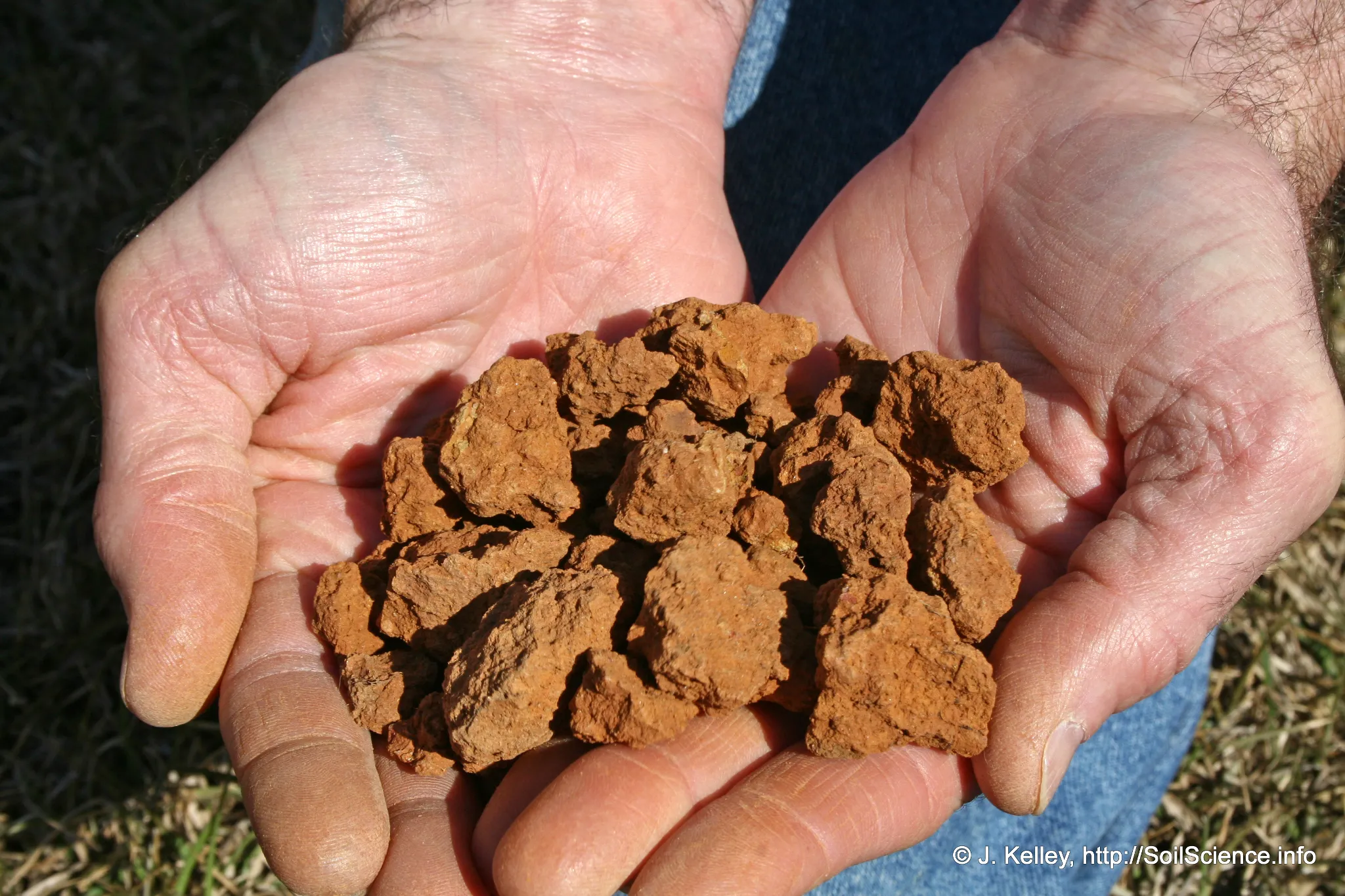
Soil aggregates (peds) from sand, silt, clay, and organic matter
The photo shows soil material. Sand, silt, clay, and organic substances bind together to form soil structure. Individual structural units are called peds (aggregates).
Soil consists of particles of different sizes. Sand consists of large particles (from 2.0 to 0.05 mm), which can be seen with the naked eye and felt as grains. Silt (0.05–0.002 mm) feels like flour. Clay (less than 0.002 mm) consists of the smallest particles, which cannot be seen without a microscope; when wet, they are sticky and plastic (Weil, 2017; Troeh & Thompson, 1993).
But in nature, these particles rarely exist separately. Under the influence of many factors, they stick together into larger formations—aggregates, or peds. Soil structure is precisely how particles are combined into such aggregates (Ghezzehei, 2012).
Imagine a brick wall. The bricks are mineral particles. But by themselves they do not form a wall. A mortar is needed to bind them. In soil, the role of such mortar is played by various “glues”—organic and mineral substances, as well as living organisms (Pavlis, 2020).
Hierarchy of Aggregates: From Microscopic to Visible

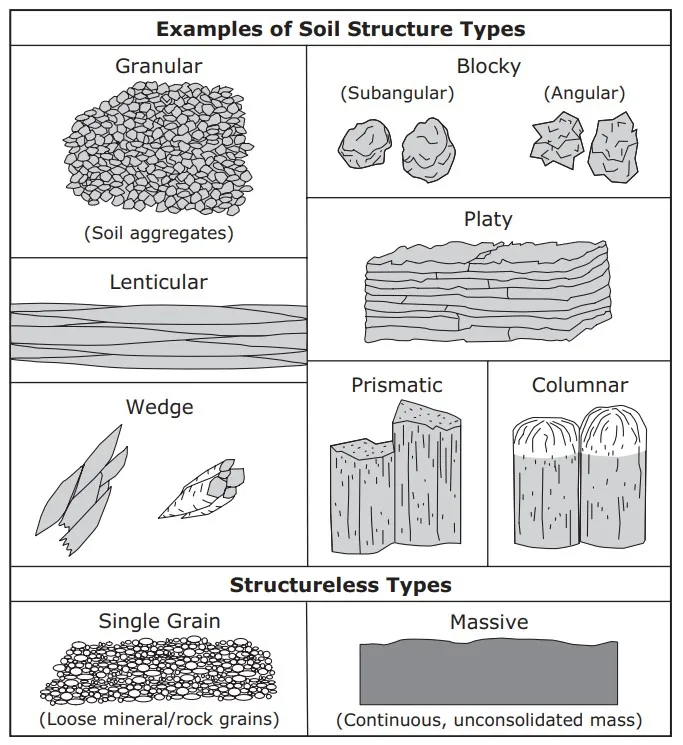
Main types of soil structure
Schematic representation of the main types of soil structure: granular, blocky, platy, prismatic, columnar, and massive. The illustration allows comparison of the shape and arrangement of soil aggregates.
Modern science describes soil structure as a hierarchical system. This means that aggregates of different sizes are formed sequentially, like nesting dolls: small particles combine into slightly larger ones, those into even larger ones, and so on (Tisdall & Oades, 1982, cited in Ghezzehei, 2012; Shukla, 2023).
Here is what this hierarchy looks like in simplified form:
1. Clay domains (less than 2 µm)—the smallest clay plates, connected by electrostatic forces.
2. Clusters (2–20 µm)—clay domains glued to silt particles.
3. Microaggregates (20–250 µm)—clusters connected by resistant organic substances and metal oxides.
4. Macroaggregates (more than 250 µm)—microaggregates bound by fungal hyphae, roots, and less resistant organic compounds.
This hierarchy is important for understanding why some aggregates are stronger than others. Microaggregates bound by humus and iron and aluminum oxides are very stable. Macroaggregates, which are held together by fungal threads and root exudates, break down more easily—but they also recover faster (Ghezzehei, 2012; Shukla, 2023).
What Glues Particles Together: “Glue” for Soil
There are several types of “glue” in soil, and each plays its own role (Ghezzehei, 2012; Weil, 2017; Pavlis, 2020):
Organic matter. This is the main “universal glue.” Humus—stable organic matter—coats mineral particles and binds them. In addition, bacteria and fungi release mucous substances (polysaccharides), which act as instant glue. In the words of Robert Pavlis (2020), these are the “life juices” of soil.
Glomalin. This is a special protein released by mycorrhizal fungi. It works as a super-strong glue, coating fungal threads and binding soil particles into stable aggregates. Glomalin is so effective that it persists in soil for decades, holding carbon and creating structure (Lowenfels & Lewis, 2010; Pavlis, 2020).
Calcium and other cations. Calcium ions (Ca2+) act as “bridges” between negatively charged clay particles and organic molecules. This is why gypsum and lime have long been used to improve the structure of heavy clay soils (Troeh & Thompson, 1993; Ghezzehei, 2012).
Iron and aluminum oxides. In tropical and highly weathered soils, these minerals act as cement, creating very strong aggregates. However, in large quantities they can turn soil into something like brick—laterite (Weil, 2017).
Roots and fungal threads. Living roots, growing through the soil, compress the particles around them, and after dying they leave channels that become the basis for new aggregates. Fungal hyphae (threads) physically entangle particles, binding them (Ghezzehei, 2012; Lowenfels & Lewis, 2010).
Earthworms. They swallow soil and organic matter, digest them, and excrete them as coprolites—small pellets that are highly resistant to breakdown. It is estimated that earthworms process the topsoil of the temperate zone in about 4 years (Ghezzehei, 2012; Lowenfels & Lewis, 2010).
Note from an authoritative source. The textbook “The Nature and Properties of Soils” (Weil, 2017) emphasizes: “Soil aggregates form when primary particles are glued together by organic and inorganic substances. This process takes time, but it is precisely what creates the very ‘crumbly’ structure that gardeners value most.”
Why This Matters
Soil structure is not an abstract scientific concept. It determines whether water will infiltrate the soil or run off the surface, whether roots can penetrate deeply or will suffocate in dense ground, whether nutrients will be available to plants or will be washed away with water. Without good structure, neither water, nor air, nor nutrition works as it should (Gliessman, 2015; Connor et al., 2011).
In the next section, we will look in more detail at what good structure looks like and why crumbly, porous soil is the ideal to strive for.
2. Good Structure: Crumbly and Porous
When gardeners talk about “good soil,” they usually mean something quite definite: the soil is crumbly, soft, easily lets water and air through, and plant roots go into it without effort. This is the visual manifestation of good structure. But what exactly makes it that way?
Crumb Structure: The Ideal for Plants
For most crops, the best structure is considered to be crumb, or granular, structure. In this case, the soil breaks apart into rounded crumbs approximately 1 to 10 mm in size—like breadcrumbs or buckwheat grains (Troeh & Thompson, 1993; Weil, 2017). Each such crumb is an aggregate with its own pores inside, and between the crumbs there are larger voids.
Agronomists call such structure granular. It is characteristic of the upper humus horizons of virgin steppe soils—chernozems—as well as of well-cultivated garden soils (Mukha et al., 2003; Troeh & Thompson, 1993).
Why is this the ideal? Because crumb structure creates dual porosity: small pores inside the crumbs retain water and nutrients, while large gaps between the crumbs provide drainage and aeration. As a result, the soil is simultaneously water-retentive and air-permeable—a rare combination that is difficult to achieve in dense or silty soils (Weil, 2017; Ghezzehei, 2012).
Note from the textbook “Soils and Soil Fertility” (Troeh & Thompson, 1993): “Granular structure is the most desirable for plant growth because of the openness between peds. Water can be held within the granules, and at the same time air can circulate between them.”
Porosity: Why Voids Matter More Than They Seem
Good structure is not only crumbs, but also pores between and within them. Pores are the space where roots and microorganisms live, where water and air circulate. Without pores, soil turns into a dead substrate incapable of supporting life (Weil, 2017; Ingram et al., 2015).
Specialists divide pores by size and function (Ingram et al., 2015; Shukla, 2023):
Transmission pores (macropores), more than 50 µm. These are the “highways” of soil. Water quickly moves downward through them after rain or irrigation, and air enters through them as well. Macropores are earthworm burrows, root cracks, and the space between large aggregates. If macropores make up less than 10% of soil volume, drainage becomes a problem (Ingram et al., 2015).
Storage pores (mesopores), 0.2–50 µm. These are the “storehouses” of water. They hold moisture available to plants. If storage pores make up less than 15% of volume, plants may suffer from drought even with regular watering (Ingram et al., 2015).
Residual pores (micropores), less than 0.2 µm. In these pores, water is held so strongly that roots cannot extract it. This is the “dead reserve” of moisture. If micropores are too numerous (more than 20% of volume), the soil becomes viscous and heavy to cultivate (Ingram et al., 2015).
In ideal soil, all three types of pores are present in reasonable proportions. This is what ensures drainage, water retention, and aeration at the same time (Weil, 2017).
Why Crumbs Do Not Fall Apart: Aggregate Stability
Good structure is not only the presence of crumbs, but also their stability. If crumbs fall apart from the first rain or a light touch, the structure does not fulfill its functions. Stable aggregates retain their shape when moistened, do not slake, and do not turn into mud (Ghezzehei, 2012; Troeh & Thompson, 1993).
Scientists use the term water stability—the ability of aggregates to resist the destructive action of water. Good soil contains many water-stable aggregates. Poor soil crumbles into dust or turns into a solid mass when wetted (Ghezzehei, 2012).
What makes aggregates stable? As we said in the first section, it is humus, glomalin, calcium, and metal oxides. But there is another important factor—the age of aggregates. Young crumbs, just glued by bacterial slime, break down quickly. Old, “mature” aggregates that have repeatedly gone through cycles of wetting and drying become much stronger (Ghezzehei, 2012; Tisdall & Oades, 1982, cited in Shukla, 2023).
Note from the “Handbook of Soil Sciences” (Ghezzehei, 2012): “Microaggregates bound by humus and oxides are very stable. Macroaggregates bound by fungal hyphae and root exudates break down more easily—but they also recover faster.”
Signs of Good Structure: How to Recognize It
Experienced gardeners determine good structure “by eye and by touch.” Here are several characteristic signs (Littlewood, 2007; Gershuny & Smillie, 1999):
The soil breaks into crumbs. If you take a handful of slightly moist earth and squeeze it, it will break into rounded crumbs rather than dust or hard clods. The crumbs crumble easily between the fingers but do not fall apart into powder (Troeh & Thompson, 1993).
Roots penetrate freely. If you dig up a plant, you can see that the roots are branched, go deep and sideways, and are not flattened or bent after encountering a dense layer (Littlewood, 2007).
Water is absorbed quickly. After rain or watering, no puddles remain on the surface. Water enters the soil rather than running down the slope (Littlewood, 2007).
Soil does not stick to the shovel. Well-structured soil easily falls away from the tool, does not form “pancakes,” and does not cling in clumps (Gershuny & Smillie, 1999).
A fresh, “earthy” smell. The healthy smell of soil is the result of the activity of actinomycetes and other microorganisms. It indicates active biological life (Pavlis, 2020; Lowenfels & Lewis, 2010).
Many earthworms. Worms are an indicator of good structure. They feed on organic matter and create stable coprolites. If, when digging, you find 10–15 adult worms per square foot, this is an excellent indicator (Pavlis, 2020; Littlewood, 2007).
Density and Porosity: Quantitative Benchmarks
For those who like precision, here are some figures. Optimal density of the arable horizon for most crops is about 1.0–1.3 g/cm³. At densities above 1.5 g/cm³, roots begin to experience serious difficulties, and at 1.6–1.7 g/cm³, root growth practically stops (Mukha et al., 2003; Troeh & Thompson, 1993).
Total porosity of good soil is about 50% of volume. Of this, approximately half is pores filled with air and half is pores with water (Weil, 2017).
Aeration porosity (the volume of pores available for air) should be at least 15%. If this indicator is lower, roots suffocate, and microbes switch to anaerobic respiration, releasing toxic substances (Mukha et al., 2003; Ingram et al., 2015).
What This Means in Practice
Good structure is not a luxury but a necessary condition for healthy plant growth. It provides:
- Rapid drainage—water does not stagnate, and roots do not rot.
- Sufficient water retention—moisture is preserved in mesopores and is available to plants.
- Aeration—oxygen reaches roots and microorganisms.
- Ease of cultivation—soil can be dug, loosened, and planted without excessive effort.
- Erosion resistance—crumbs are not washed away by rain or carried away by wind.
- Active biological life—microbes, fungi, and worms find a home and food (Gliessman, 2015; Gershuny & Smillie, 1999).
In the next section, we will look at poor structure—silty, dense, cloddy—and why it is dangerous for the garden and vegetable plot.


LCD 4-in-1 Soil Tester
Check essential growing conditions with one compact tool. Measure soil pH, moisture, temperature and light intensity — ideal for gardens, potted plants and greenhouses.
- 4-in-1 measurement
- Easy-to-read LCD display
- Portable design
Affiliate link · For indicative measurements only.
3. Poor Structure: Silty, Dense, Cloddy
If good structure is crumbly, porous soil that breaks into rounded crumbs, then poor structure looks completely different. It can manifest in different ways: as dust, as a solid dense mass, as hard clods, or as horizontal plates. In all cases, the result is the same: the soil stops performing its functions—retaining water, letting air through, and giving roots space to grow (Weil, 2017; Ghezzehei, 2012).
Silty Structure: Soil That “Flows”

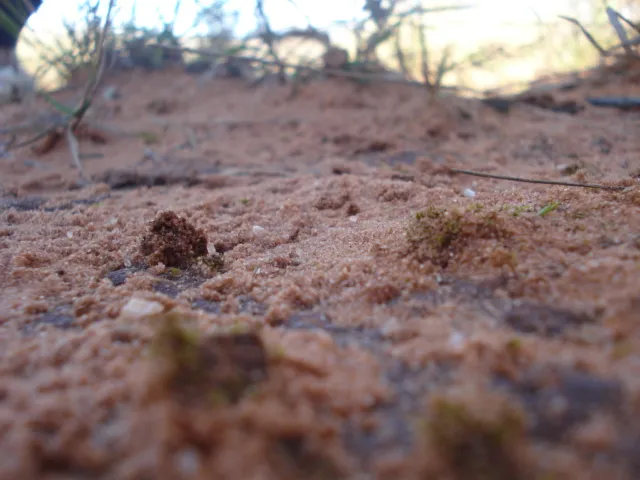
Formation of surface soil crust after rain
On the surface of sandy soil after intense precipitation, a thin layer of settled fine particles formed. The photograph shows the accumulation of silty material involved in the formation of a surface crust. Location: municipality of São Francisco de Assis, Rio Grande do Sul, Brazil.
Silty structure is a condition in which aggregates are destroyed into individual small particles. The soil becomes similar to dust or flour. It feels soft, but as soon as it is wetted, it turns into mud, and after drying—into a hard crust (Pavlis, 2020; Troeh & Thompson, 1993).
Silty structure is especially characteristic of soils with a high content of silt and fine sand. Such particles easily separate from one another, do not form stable crumbs, and are easily transported by water and wind. After rain, the surface of such soil slakes—small particles fill the pores, and water stops infiltrating. A crust forms—a thin but very dense layer that lets through neither water nor air (Pavlis, 2020; Nonnecke, 1989).
Note from “Soil Science for Gardeners” (Pavlis, 2020): “A crust forms when rain or irrigation destroys surface aggregates. Small particles fill the pores and, as they dry, create a hard layer. Seeds cannot break through such a crust, and water cannot infiltrate.”
Crust is not just an aesthetic problem. It blocks air supply to roots, hinders emergence, increases surface runoff and erosion. Small-seeded crops suffer especially from crust—carrots, onions, parsley, lettuce (Nonnecke, 1989; Pavlis, 2020).
Dense (Massive) Structure: Soil Without Pores

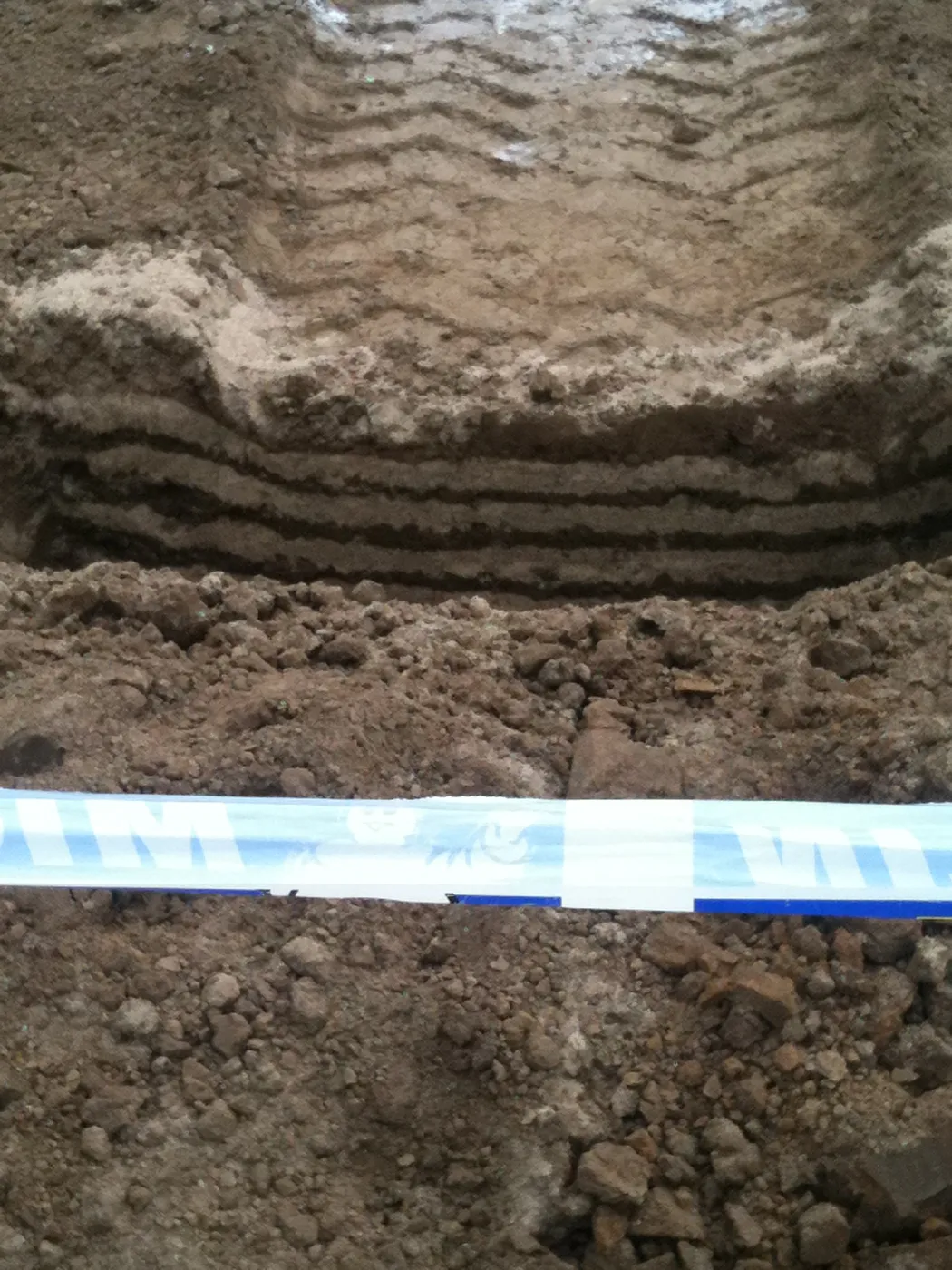
Soil profile after compaction by machinery
Soil cross-section with alternating layers of sand and loess, demonstrating the consequences of machinery passage.
Dense, or massive, structure is the opposite of crumb structure. The soil is a solid mass without noticeable pores and gaps. Many clay horizons have such structure, especially illuvial (clay accumulation) horizons, as well as heavily compacted soils (Mukha et al., 2003; Troeh & Thompson, 1993).
In English-language literature, such structure is called massive. In this state, the soil does not break into aggregates—it breaks into large blocks with smooth or conchoidal surfaces. A shovel enters such soil with difficulty, and plant roots cannot overcome it (Weil, 2017; Troeh & Thompson, 1993).
Massive structure is the result of compaction. Compaction arises under the action of:
- heavy machinery and repeated passage over the same place;
- tillage when the soil is wet, when it is most vulnerable;
- livestock grazing on wet land;
- natural settling under gravity in the absence of organic matter (Mukha et al., 2003; Ghezzehei, 2012).
The plow pan is especially dangerous—a compacted layer at the depth of cultivation. It forms with many years of plowing to the same depth. The plow pan prevents roots from penetrating deeper, retains water, and creates waterlogging above itself. Plants suffer from drought, although moisture is present—but it cannot go deeper and cannot rise back (Pavlis, 2020; Chalker-Scott, 2018).
Note from “Agrosoil Science” (Mukha et al., 2003): “Massive composition is usually characteristic of solonetzic horizons or gleyed masses, almost free of visible pores. Such composition greatly reduces the agronomic value of soils.”
Cloddy Structure: Soil That Does Not Crumble
Cloddy structure is when soil breaks not into crumbs but into large irregular lumps. Clods can range from several centimeters to tens of centimeters in size. They are dense, heavy, and difficult to break by hand. During cultivation, such clods do not crumble but only move (Mukha et al., 2003; Troeh & Thompson, 1993).
Cloddy structure forms for several reasons:
- Cultivating soil that is too dry. If you dig over-dried clay soil, it breaks into hard pieces.
- Cultivating soil that is too wet. If you dig wet clay, it turns into a sticky mass that hardens into clods as it dries.
- Loss of organic matter. Without humus, which glues particles into crumbs, soil loses the ability to form aggregates.
- Solonetzization. Excess sodium destroys aggregates and leads to the formation of dense clods (Mukha et al., 2003; Ghezzehei, 2012).
Cloddy structure is a sign of degradation. It makes cultivation difficult, worsens emergence, and restricts root growth. Gardeners often call such earth “heavy” or “stony,” although there may be no stones in it (Troeh & Thompson, 1993; Littlewood, 2007).
Platy Structure: Compaction in the Horizontal Plane
Platy structure is when soil aggregates have the form of horizontal plates or tiles. They easily separate from one another horizontally but not vertically. Such structure often forms on the surface of compacted soils, as well as in lower horizons where water moves along layers (Shukla, 2023; Troeh & Thompson, 1993).
Platy structure is a sign of vertical compaction. It is characteristic of soils that are often walked or driven on, pastures with overgrazing, and areas where heavy machinery passed over wet ground. In the garden, platy structure can form on paths and in places where pots or boxes constantly stand (Shukla, 2023; Ghezzehei, 2012).
With platy structure, water does not penetrate deeper—it is retained on the surface or runs off. Roots cannot break through horizontal plates. Air also does not penetrate into lower layers (Shukla, 2023).
What All Types of Poor Structure Have in Common
Despite external differences, silty, dense, cloddy, and platy structure have common features (Pavlis, 2020; Weil, 2017; Ghezzehei, 2012):
Few pores, especially large ones. Transmission pores (macropores) become less than 10% of volume—and water stops infiltrating. Storage pores may also be insufficient—and plants suffer from drought. Residual pores, on the contrary, become more numerous—and the soil becomes viscous and heavy (Ingram et al., 2015).
Density is increased. If the optimal density for most crops is 1.0–1.3 g/cm³, then with poor structure it rises to 1.4–1.6 g/cm³ and higher. At densities above 1.5 g/cm³, roots begin to experience serious difficulties, and at 1.6–1.7 g/cm³, root growth practically stops (Mukha et al., 2003; Troeh & Thompson, 1993).
Water permeability is reduced. Water either stagnates on the surface or runs down the slope without penetrating deeper. This leads to erosion, drought, and loss of nutrients (Pavlis, 2020).
Aeration is disrupted. Oxygen does not penetrate into lower layers, and carbon dioxide does not escape. Roots suffocate, microbes switch to anaerobic respiration, releasing toxic substances—methane, hydrogen sulfide, organic acids (Weil, 2017; Mukha et al., 2003).
Biological activity is suppressed. In dense, silty, or cloddy soil there are fewer worms, fewer fungal threads, fewer bacteria. Biological life fades (Pavlis, 2020; Littlewood, 2007).
How to Recognize Poor Structure: Practical Signs
Here are several characteristic signs that a gardener can notice without special instruments (Littlewood, 2007; Gershuny & Smillie, 1999; Pavlis, 2020):
Water stands on the surface after rain. If puddles do not disappear within an hour or two, it means water cannot penetrate the soil. This is a sign of crust, compaction, or platy structure (Pavlis, 2020).
Soil sticks to the shovel. If, when digging, earth clings to the tool in clumps, forms “pancakes,” and does not fall away, this is a sign of destroyed structure. Good soil easily shakes off the shovel (Gershuny & Smillie, 1999).
Roots grow sideways rather than downward. If, when digging up a plant, you see that roots bend, flatten, or spread horizontally at a certain depth, it means there is a compacted layer or plow pan there (Pavlis, 2020; Littlewood, 2007).
The surface becomes covered with crust. After rain or watering, the soil surface dries into a hard crust that cracks or peels off. Seeds cannot break through, and water does not infiltrate (Nonnecke, 1989).
Few earthworms. If, when digging, you find fewer than 5–10 worms per square foot, this is an alarming signal. In good soil there should be 10–15 or more (Pavlis, 2020; Littlewood, 2007).
Unpleasant smell. Healthy soil smells fresh and “earthy.” Poor soil may smell damp, rotten, or of hydrogen sulfide. This is a sign of anaerobic processes (Littlewood, 2007; Gershuny & Smillie, 1999).
Soil is dusty during cultivation. If digging or loosening raises a cloud of dust, it means aggregates have been destroyed into individual particles. Such soil is easily washed away by wind and water (Pavlis, 2020).
Note from “The Organic Gardener's Handbook” (Littlewood, 2007): “Poor structure: plants root poorly, unpleasant smell, water stands in planting holes or on the surface, soil is sticky or in hard clods, or very dry, compacted layer in the upper horizon, few worms, the surface layer slakes when moistened and dries into a crust.”
Why This Matters for the Gardener
Poor structure is not just “inconvenient to dig.” It is a serious limitation for plant growth. In soil with poor structure:
- Water does not reach the roots—plants suffer from drought even with regular watering.
- Air does not penetrate deeper—roots suffocate, microbes work in anaerobic mode, releasing toxins.
- Nutrients are unavailable—they cannot dissolve and move to the roots.
- Roots cannot grow—they hit dense layers and do not find resources.
- Plants weaken—they become vulnerable to diseases and pests (Gliessman, 2015; Connor et al., 2011).
That is why it is so important to understand what destroys structure and how to restore it. This is discussed in the following sections.
4. Why Structure Matters: Water, Air, Roots, Microbes
Soil structure is not just a “convenience” for the gardener but a fundamental condition for plant life. Without good structure, neither water, nor air, nor nutrients work as they should. In this section, we will examine four key aspects: how structure affects water, air, roots, and soil microbes.
Water: Infiltration, Retention, Drainage
Soil structure determines what happens to water after rain or irrigation. In well-structured soil, water quickly penetrates downward through macropores, fills mesopores, and is retained there in a form available to plants. In poor structure, water either stagnates on the surface or runs off without having time to infiltrate (Weil, 2017; Ingram et al., 2015).
Infiltration. The rate at which water enters the soil directly depends on the presence of large pores. In soil with crumb structure, macropores form a network of channels through which water moves downward almost instantly. In soil with destroyed structure—silty, dense, or covered with crust—water cannot penetrate inside and remains on the surface (Pavlis, 2020; Ghezzehei, 2012).
The crust is especially dangerous—a thin dense layer on the surface that forms after rain or irrigation on silty soil. Crust blocks infiltration, and water runs down the slope, causing erosion and loss of nutrients (Pavlis, 2020; Nonnecke, 1989).
Water retention. In soil with good structure, water is preserved in mesopores—medium-sized voids. These pores hold moisture strongly enough that it does not move downward under gravity, but weakly enough that roots can extract it. If structure is destroyed, water either drains quickly (in sandy soils) or is held too strongly (in clayey soils), becoming unavailable to plants (Ingram et al., 2015; Weil, 2017).
Note from “Science and the Garden” (Ingram et al., 2015): “If storage pores make up less than 15% of volume, water availability for plants becomes limited. If residual pores (micropores) occupy more than 20%, the soil becomes viscous and difficult to cultivate.”
Drainage. Good structure provides drainage—the ability of water to move downward without stagnating. Stagnant water is dangerous because roots suffocate and microbes switch to anaerobic respiration, releasing toxic substances. In dense, massive soil, drainage is disrupted, and even a small rain can lead to waterlogging (Mukha et al., 2003; Pavlis, 2020).
Water availability. Not all water in soil is available to plants. Some of it is held so strongly that roots cannot extract it (residual moisture). Another part—gravitational water—drains too quickly. Only water in mesopores is in the “zone of availability.” The better the structure, the greater the proportion of available moisture (Weil, 2017; Ingram et al., 2015).
Air: Respiration of Roots and Microbes
Plant roots and soil microorganisms breathe—they consume oxygen and release carbon dioxide. Without a constant inflow of oxygen and outflow of carbon dioxide, life in the soil fades. Soil structure determines how this gas exchange occurs (Weil, 2017; Lowenfels & Lewis, 2010).
Aeration. Air enters the soil through macropores that are not filled with water. In well-structured soil, after drainage, macropores fill with air, and oxygen reaches roots and microbes. In dense or waterlogged soil, macropores are filled with water, and air cannot penetrate deeper (Weil, 2017; Ingram et al., 2015).
Composition of soil air. In soil with good structure, oxygen content is about 18–20%, and carbon dioxide up to 1%. In poorly aerated soil, oxygen drops to 5–10% and below, and carbon dioxide accumulates to toxic levels. This suppresses roots and microbes (Weil, 2017; Mukha et al., 2003).
Anaerobic conditions. When oxygen is insufficient, microbes switch to anaerobic respiration. This process is accompanied by the release of methane, hydrogen sulfide, organic acids, and other toxic substances. The soil acquires an unpleasant smell, and plant roots are damaged or die (Lowenfels & Lewis, 2010; Pavlis, 2020).
Note from “Teaming with Microbes” (Lowenfels & Lewis, 2010): “Anaerobic bacteria produce alcohols and other substances that kill root cells. The smell of rot, rotten eggs, vinegar—all these are signs of anaerobic conditions.”
Relationship with water. Water and air in soil are antagonists. The more water in the pores, the less air. The optimal ratio is approximately equal proportions of water and air in the total pore volume. Good structure ensures exactly such a balance (Weil, 2017; Mukha et al., 2003).
Roots: Penetration, Growth, Respiration
Roots are the “pumps” and “anchors” of plants. They obtain water and nutrients, hold the plant in the soil, and interact with microbes. Soil structure determines how successfully roots cope with these tasks (Weil, 2017; Connor et al., 2011).
Penetration. In well-structured soil, roots easily pass between aggregates, following macropores and cracks. In dense, massive soil, roots cannot overcome mechanical resistance and remain in the upper layer. This limits access to water and nutrients that may be deeper (Pavlis, 2020; Troeh & Thompson, 1993).
Studies show that at soil density above 1.5 g/cm³, root growth of many crops slows, and at 1.6–1.7 g/cm³ it practically stops. Root crops are especially sensitive to compaction—carrots, beets, radishes (Mukha et al., 2003; Troeh & Thompson, 1993).
Branching and growth. In loose, crumbly soil, roots form a dense branched network. They explore a larger volume of soil, finding water and nutrients in different horizons. In dense soil, roots grow sideways without going deeper, and their total length and mass are smaller (Pavlis, 2020; Weil, 2017).
Root respiration. Roots breathe—they consume oxygen and release carbon dioxide. For this they need a constant supply of air. In soil with good structure, air penetrates through macropores, and roots receive enough oxygen. In waterlogged or dense soil, roots suffocate, their growth slows, and tissues are damaged (Weil, 2017; Lowenfels & Lewis, 2010).
Interaction with microbes. Roots release sugars, amino acids, and other substances into the soil that attract beneficial microbes. In well-structured soil, these exudates spread through pores, creating a zone of active interaction—the rhizosphere. In dense soil, exudates cannot move, and beneficial connections do not form (Pavlis, 2020; Lowenfels & Lewis, 2010).
Microbes: Home, Food, Oxygen

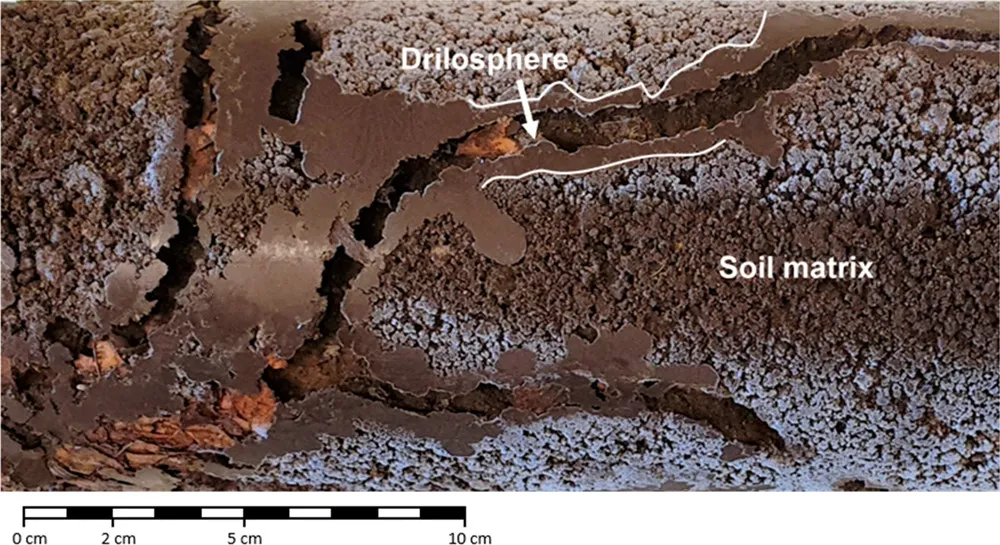
Earthworm burrows in a soil monolith (drilosphere)
The image shows a cross-section of a soil monolith penetrated by earthworm burrows. White lines mark the boundaries of the drilosphere (the zone of earthworm influence) and the soil matrix, demonstrating changes in soil texture due to earthworm excretions (castings) during their life activity.
Soil is home to billions of microorganisms: bacteria, fungi, protozoa, nematodes. They decompose organic matter, convert nutrients into available forms, suppress pathogens, and create structure. But for active work they need certain conditions—and soil structure plays a key role here (Lowenfels & Lewis, 2010; Pavlis, 2020).
Pores as dwellings. Microbes live in pores of different sizes. Bacteria occupy micropores (less than 2 µm), where they are protected from predators and can be held by water. Fungi grow in larger pores (3–5 µm), and protozoa and nematodes in even larger ones (10–100 µm). If structure is destroyed, pores disappear, and microbes lose their home (Ghezzehei, 2012; Lowenfels & Lewis, 2010).
Oxygen for respiration. Most beneficial microbes are aerobes, meaning they breathe oxygen. In well-structured soil, air penetrates into pores, and microbes are active. In dense or waterlogged soil, oxygen is insufficient, and beneficial aerobes are replaced by anaerobes that release toxins (Lowenfels & Lewis, 2010; Pavlis, 2020).
Food and movement. Organic matter and root exudates move through pores together with water. Microbes can also move along water films in pores. In dense soil, movement is limited, and microbes cannot reach food (Pavlis, 2020; Ghezzehei, 2012).
Creating structure. Microbes not only depend on structure—they create it. Bacteria release slimes that glue particles. Fungi entangle particles with hyphae. Glomalin, released by mycorrhizal fungi, works as a super-strong glue. Earthworms process soil and organic matter, creating stable coprolites. All this is the result of soil life activity (Lowenfels & Lewis, 2010; Ghezzehei, 2012).
Note from “Soil Science for Gardeners” (Pavlis, 2020): “Soil contains more biodiversity in the top foot than anywhere else on Earth. Microbes are the driving force of the ecosystem, and soil structure is their home.”
Interconnection of All Factors
Water, air, roots, and microbes do not exist separately from one another. They are connected in a single system, and soil structure is the foundation that allows the system to work (Gliessman, 2015; Connor et al., 2011).
- Water is necessary for dissolving nutrients and moving them to roots. But if water stagnates, it displaces air, and roots suffocate.
- Air is needed by roots and microbes for respiration. But if the soil is too loose and dry, water is not retained, and plants suffer from drought.
- Roots obtain water and nutrients, but for this they need pores through which they can grow and oxygen for respiration.
- Microbes decompose organic matter and make nutrients available, but for this they need water, air, and a home—pores.
Good structure ensures a balance of all these factors. Poor structure disrupts the balance, and the system stops working effectively (Weil, 2017; Pavlis, 2020).
What This Means in Practice
A gardener who cares about soil structure receives many benefits (Gliessman, 2015; Gershuny & Smillie, 1999):
- Fewer waterings. Good structure retains moisture, and plants suffer less from drought.
- Fewer fertilizers. Nutrients are not washed away but retained in available form.
- Better growth. Roots penetrate deeper, find more resources, and plants become stronger.
- Fewer diseases. Beneficial microbes are active and suppress pathogens.
- Easier cultivation. Soil can be dug, loosened, and planted without excessive effort.
Conversely, poor structure leads to constant problems: puddles after rain, surface crusts, weak plants, frequent diseases, the need for constant watering and fertilizing (Pavlis, 2020; Littlewood, 2007).
In the next section, we will examine what destroys soil structure—which gardener actions and natural factors lead to its degradation.

Solar Automatic Drip Irrigation Kit for Gardens
Automate watering for pots, gardens and small greenhouses. This solar-powered system features a timer to help schedule water delivery to your plants.
- Solar-powered
- 15 m irrigation hose
- Programmable watering
Affiliate link · Check included accessories.
5. What Destroys Structure: Digging, Rain, Machinery, Monoculture, Chemicals
Soil structure is a fragile equilibrium that is easy to disrupt. Aggregates that took years to create can be destroyed in a single season by improper cultivation, heavy machinery, or chemicals. In this section, we will examine the main “enemies” of structure—both natural and human-related.
Digging and Intensive Cultivation
Digging is one of the most common methods of soil cultivation in gardens and vegetable plots. And one of the most destructive to structure.
When we dig soil, we destroy aggregates. Crumbs that have been glued together for years are broken into individual particles. Macroaggregates suffer especially—those bound by fungal threads and root exudates. They are destroyed first, and their recovery takes the most time (Ghezzehei, 2012; Pavlis, 2020).
Digging also destroys fungal networks. Mycorrhizal fungi, which entangle roots and glue particles into aggregates, are very sensitive to mechanical disturbance. After digging, their networks are torn apart, and the soil loses one of its main “glues” (Chalker-Scott, 2015; Walliser, 2020).
Note from “How Plants Work” (Chalker-Scott, 2015): “Loosening destroys the natural structure of the soil along with the roots of plants and animals that get in the way. Roots damaged during loosening require energy and resources to recover, and when their protective outer tissues are torn, they become vulnerable to diseases and pests.”
In addition, digging accelerates the decomposition of organic matter. When soil is turned over, organic matter ends up on the surface where there is more oxygen. Microbes begin to actively decompose it, and humus reserves are quickly depleted. And it is humus that is the main “glue” for aggregates (Troeh & Thompson, 1993; Mukha et al., 2003).
The plow pan is another consequence of regular digging. If you dig to the same depth, a compacted layer forms at that level, preventing roots and water from penetrating. The plow pan can persist for years even after cultivation stops (Pavlis, 2020; Chalker-Scott, 2018).
Note from “Soil Science for Gardeners” (Pavlis, 2020): “The plow pan is a compacted layer at the depth of cultivation. It forms with many years of plowing to the same depth. The plow pan prevents roots from penetrating deeper, retains water, and creates waterlogging above itself.”
Finally, digging kills earthworms. Worms are “living plows” that create stable coprolites and lay channels for water and air. When digging, they are cut by the shovel, and their population declines (Lowenfels & Lewis, 2010).
The Impact of Rain and Irrigation
Rain is a natural factor that can destroy structure. Raindrops fall on the soil surface with force that breaks aggregates into small particles. These particles fill the pores, and crust forms (Pavlis, 2020; Ghezzehei, 2012).
Heavy showers with large drops are especially dangerous. A drop 5 mm in diameter falls at about 20 miles per hour and has enough energy to destroy surface aggregates. Small drizzle drops (less than 0.5 mm) fall more slowly and are less destructive (Hasanuzzaman, 2019).
Irrigation can also destroy structure. If you water with large volumes of water under pressure, drops break aggregates just like rain. Irrigation on slopes and on soils with low organic matter content is especially dangerous (Hasanuzzaman, 2019; Nonnecke, 1989).
Note from “Vegetable Production” (Nonnecke, 1989): “The wider the nozzle spread, the larger the drops and usually the higher they are installed above the plants. Any exposed soil surface reacts to the impact of drops from an irrigation system. If the soil has only been moderately cultivated, it very quickly deflocculates and loses aggregate structure, causing crust formation and slaking.”
Protection from raindrop impact is mulch or plant cover. If the soil surface is covered, drops do not reach the aggregates, and structure is preserved (Chalker-Scott, 2018; Pavlis, 2020).
Compaction by Machinery and Feet
Heavy machinery—tractors, trucks, even garden wheelbarrows—creates pressure on the soil that compacts it. Compaction destroys macropores, and the soil loses the ability to absorb water and let air through (Pavlis, 2020; Mukha et al., 2003).
Compaction of wet soil is especially dangerous. When soil is wet, its particles easily shift and come closer together under pressure. After drying, such soil becomes hard as stone. That is why experienced gardeners try not to walk on beds and not to cultivate soil in a wet state (Pavlis, 2020; Nonnecke, 1989).
Walking on beds is compaction that gardeners often underestimate. Every step creates pressure that destroys pores. If beds are walked on regularly, the upper layer becomes compacted, and water stops infiltrating. Raised beds solve this problem: they are not walked on, and structure is preserved (Pavlis, 2020; Littlewood, 2007).
Note from “Agrosoil Science” (Mukha et al., 2003): “Soil compaction has a significant effect on the accumulation of water and food and on the ratio of water and air in the soil. With soil compaction, the proportion of solid phase and the proportion occupied by unavailable moisture increase. At a density of 1.5–1.6, available moisture accounts for only 5–10% of soil volume.”
The plow pan is also a result of compaction, but not from wheels, but from the pressure of a plow or shovel at the same depth. It restricts root growth and water movement (Chalker-Scott, 2018; Pavlis, 2020).
Monoculture and Loss of Biodiversity
Monoculture—growing one crop in the same place year after year—gradually destroys soil structure. This happens for several reasons (Gliessman, 2015; Connor et al., 2011).
Uniformity of root systems. Different plants have different root systems: some go deep, others spread wide, others form a dense fibrous network. Under monoculture, the soil is explored by roots of only one type, and diverse channels and pores do not form in it. Structure becomes uniform and less stable (Gliessman, 2015).
Depletion of organic matter. Monoculture is often accompanied by nutrient removal and removal of plant residues. The soil does not receive enough organic matter to maintain humus, and aggregates lose their “glue” (Pavlis, 2020; Gershuny & Smillie, 1999).
Reduced biological activity. Plant diversity supports microbial diversity. Under monoculture, the microbial community becomes impoverished, and the soil loses the ability to self-regulate. Fewer fungi—less glomalin. Fewer bacteria—less slime. Structure is destroyed (Pavlis, 2020; Lowenfels & Lewis, 2010).
Note from “Gaia's Garden” (Hemenway, 2009): “Soil is a living system. Plant diversity supports the diversity of soil life. When we grow one crop in one place, we impoverish this life and destroy structure.”
Crop rotation is a proven way to avoid these problems. Alternating crops with different root systems and different nutrient requirements helps maintain structure and biological activity (Gliessman, 2015; Gershuny & Smillie, 1999).
Chemical Impacts
Chemicals—fertilizers, pesticides, fungicides, herbicides—can destroy soil structure even when applied with good intentions.
Synthetic fertilizers. Phosphate fertilizers are especially dangerous. High doses of phosphorus suppress mycorrhizal fungi—the very ones that release glomalin and glue aggregates. Without mycorrhiza, soil loses the ability to form stable structure (Chalker-Scott, 2015; Lowenfels & Lewis, 2010).
In addition, synthetic fertilizers are salts. High salt concentrations destroy aggregates and worsen structure. Potassium chloride and ammoniacal forms of nitrogen are especially dangerous (Pavlis, 2020).
Note from “Teaming with Microbes” (Lowenfels & Lewis, 2010): “Adding too much fertilizer, especially fertilizer containing phosphate, is certainly the most harmful garden practice from the point of view of mycorrhizal health. When nutrients are abundant, plants depend less on mycorrhizal connections. Mycorrhizal fungi retreat into the shadows, remaining inactive until more favorable conditions return.”
Fungicides. These substances are designed to kill fungi. But mycorrhizal fungi are also fungi. Fungicides kill them, and the soil loses glomalin. Without glomalin, aggregates break down (Chalker-Scott, 2015, 2018).
Pesticides and herbicides. They destroy not only pests and weeds but also beneficial soil organisms. Earthworms, which create structure, die from many pesticides. Microbes that glue particles also suffer. The soil loses its “builders” (Chalker-Scott, 2018; Pavlis, 2020).
Excess salts. Applying large doses of fertilizers, especially sodium and potassium, leads to salt accumulation. Sodium destroys aggregates by dispersing clay particles. The soil slakes, loses pores, and turns into a dense mass (Mukha et al., 2003; Pavlis, 2020).
Note from “The Nature and Properties of Soils” (Weil, 2017): “Sodium-saturated clays collapse into dense (‘massive’) structures upon drying and disperse as soils upon wetting.”
How These Factors Interact
Destruction of structure is often a cumulative process. One factor reinforces another (Pavlis, 2020; Gliessman, 2015):
- Digging + rain. After digging, the soil surface is bare, and raindrop impacts destroy aggregates, forming crust.
- Compaction + loss of organic matter. Compacted soil passes air less well, microbes work more slowly, organic matter does not decompose fully, and humus decreases.
- Monoculture + chemicals. Monoculture depletes the soil, while fertilizers and pesticides kill microbes that could restore structure.
- Lack of mulch + heat. Bare soil overheats, organic matter mineralizes quickly, and aggregates break down.
That is why it is so important to understand how these factors work and to try to minimize their impact. This is discussed in the next section: what restores structure.
6. What Restores It: Organic Matter, Mulch, Roots, Worms, Green Manures, Minimal Tillage
Soil structure is a renewable resource. Even heavily degraded soil can be restored if conditions are created for the work of natural “builders”—microorganisms, roots, and earthworms. Restoration takes time, but it is worth it: good structure is the foundation of fertility that will serve for years.
In this section, we will examine six main tools for restoring structure: organic matter, mulch, living roots, earthworms, green manures, and minimal tillage.
Organic Matter: The Main “Glue” for Aggregates
Organic matter is the foundation of structure. Without it, particles do not stick together into crumbs, and soil turns into dust or a dense mass. Organic matter performs several functions (Pavlis, 2020; Weil, 2017):
Gluing particles. Humus—stable organic matter—coats mineral particles and binds them into aggregates. Bacteria and fungi release mucous substances (polysaccharides) that work as instant glue. Mycorrhizal fungi release glomalin—a “superglue” that persists in soil for decades (Lowenfels & Lewis, 2010; Ghezzehei, 2012).
Food for microbes. Organic matter is food for bacteria, fungi, protozoa, and nematodes. The more organic matter, the more active soil life, and the more “glue” is released. Microbes are living factories for producing structure (Pavlis, 2020; Lowenfels & Lewis, 2010).
Improving physical properties. Organic matter increases water capacity and porosity. In sandy soil, it fills large voids and retains water. In clayey soil, it loosens the dense mass, creating pores (Gershuny & Smillie, 1999; Pavlis, 2020).
Note from “The Soul of Soil” (Gershuny & Smillie, 1999): “Humus can hold the equivalent of 80–90% of its weight in water, so soil rich in humus is more resistant to drought. Humus is light and loose, allows air to circulate easily, and makes soil easy to cultivate. The sticky gums released by microbes during humus formation bind soil particles into the desired crumb structure.”
How to apply organic matter. There are several ways (Pavlis, 2020; Littlewood, 2007):
- Compost. Apply 2–5 cm of compost to the soil surface annually. Do not bury it—let worms and microbes process it themselves.
- Manure. Well-rotted manure is an excellent source of organic matter and nutrients. Apply in autumn so it has time to decompose by spring.
- Leaf mold. Fallen leaves are a free source of organic matter. Collect them in piles, let them rot for a year or two, and you will get excellent material for mulch and compost.
- Plant residues. Do not throw away tops, cut grass, or weeds without seeds. All of this is organic matter that can return to the soil.
Mulch: Protection and Nutrition

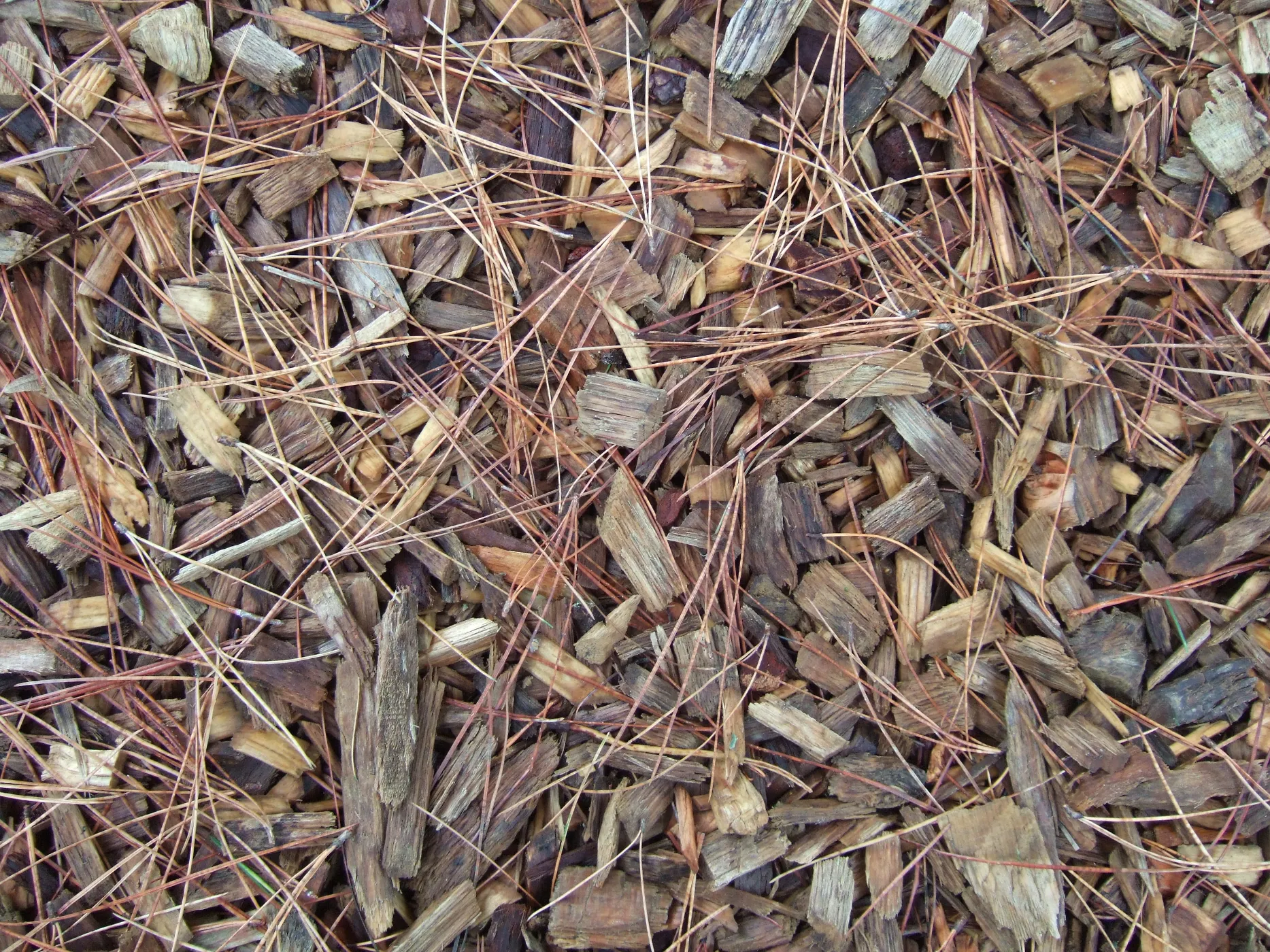
Wood chip mulch at Wisley (Wood chip mulch at Wisley)
Wood chip mulch protecting the soil in the garden of the Royal Horticultural Society (Royal Horticultural Society) at Wisley (Wisley), Surrey (Surrey). It is used to improve and protect the soil.
Mulch is a layer of organic material on the soil surface. It performs two key functions for structure (Chalker-Scott, 2018; Pavlis, 2020):
Protection from raindrop impact. Mulch takes the impact of drops, preventing them from destroying aggregates. Under mulch, soil remains loose and porous even after heavy showers. Without mulch, the surface slakes and becomes covered with crust (Pavlis, 2020; Nonnecke, 1989).
Food for soil life. Mulch gradually decomposes, and organic matter enters the soil. Worms and microbes process it, creating humus and gluing particles. Mulch is the “food” you put on the surface, and soil life itself carries it deeper (Chalker-Scott, 2018; Lowenfels & Lewis, 2010).
Types of mulch. Organic mulches are best for restoring structure (Chalker-Scott, 2018; Pavlis, 2020):
- Wood chips (arborist mulch). Decomposes well, feeds fungi, creates stable structure. Layer 5–10 cm.
- Straw. Decomposes quickly, feeds bacteria. Layer 10–15 cm.
- Compost. Nutritious but disappears quickly. Layer 2–5 cm.
- Leaf mold. Excellent material for mulching. Layer 5–10 cm.
- Cut grass. In a thin layer (2–3 cm), otherwise it rots.
Note from “The Science of Gardening” (Chalker-Scott, 2018): “Organic mulch will gradually be incorporated into the soil at a sustainable rate, so that soil organic matter will be constantly maintained at an ideal level. Use coarse, chunky mulch—it lets water and air through better.”
What to avoid. Do not use plastic film, geotextile, or gravel as permanent mulch. They do not feed the soil, do not let air through, and do not promote restoration of structure. Geotextile is especially harmful: it becomes clogged with particles, stops letting water and air through, and the soil beneath it degrades (Chalker-Scott, 2015, 2018; Pavlis, 2020).
Living Roots: Pumps and Builders
Living roots are a powerful tool for restoring structure. They do what no shovel can do: penetrate dense layers, create channels, and release substances that glue particles (Gliessman, 2015; Pavlis, 2020).
Penetration and loosening. Roots grow through dense layers, pushing particles apart and creating channels. After death, these channels remain, fill with air and organic matter, and new roots, water, and air rush into them (Pavlis, 2020; Weil, 2017).
Release of “glue.” Roots release sugars, amino acids, organic acids, and mucilage into the soil. These substances glue particles and feed microbes, which in turn release even more “glue.” Around the roots, a zone of active structure formation forms—the rhizosphere (Pavlis, 2020; Lowenfels & Lewis, 2010).
Maintaining mycorrhiza. Living roots are home to mycorrhizal fungi. Fungi entangle roots, release glomalin, and glue particles into stable aggregates. Without living roots, mycorrhiza does not work, and structure loses one of its main “glues” (Lowenfels & Lewis, 2010; Walliser, 2020).
Practical conclusion. Keep the soil planted for as long as possible. Do not leave it bare. After harvest, sow green manures, mulch, and plant catch crops. Living roots are a free “tool” for restoring structure (Pavlis, 2020; Gliessman, 2015).
Note from “Gaia's Garden” (Hemenway, 2009): “Soil is a living system. Plant diversity supports the diversity of soil life. When we grow one crop in one place, we impoverish this life and destroy structure.”
Earthworms: Living Plows
Earthworms are perhaps the most effective “builders” of structure. They do several things at once (Lowenfels & Lewis, 2010; Gershuny & Smillie, 1999):
Lay channels. Worms dig burrows that become macropores. Water moves downward through these burrows, and air penetrates to the roots. Worm burrows persist for years, even after the worm dies (Lowenfels & Lewis, 2010).

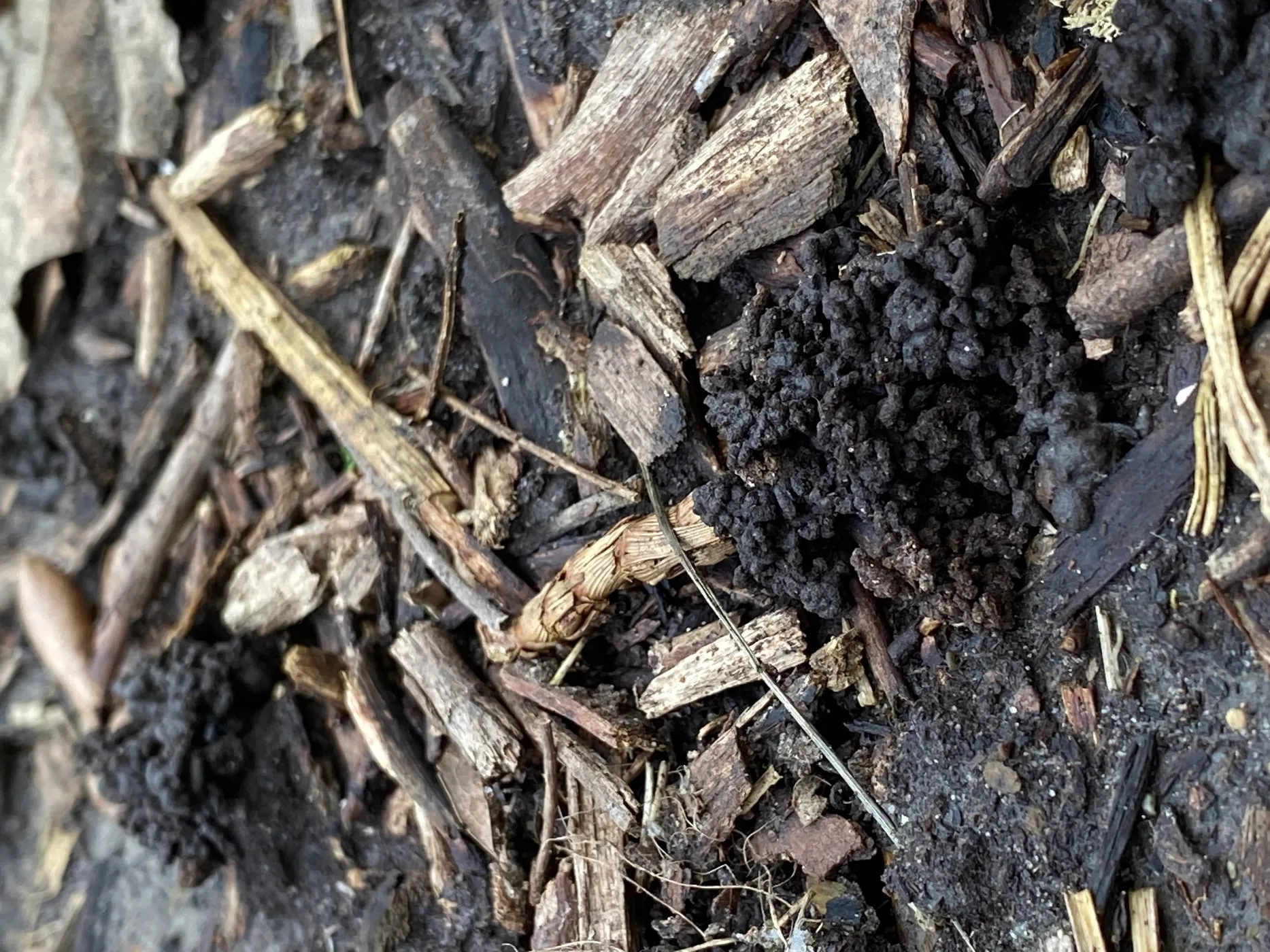
Piles of vermicompost (worm castings) on the soil surface
Close-up of organic fertilizer — earthworm castings left on the soil surface in a garden. Vermicompost is a valuable nutrient that improves soil structure and increases its fertility.
Create coprolites. Worms swallow soil and organic matter, digest them, and excrete them as coprolites—small pellets that are highly resistant to breakdown. Coprolites are ready-made aggregates that do not crumble from rain (Lowenfels & Lewis, 2010; Ghezzehei, 2012).
Enrich the soil. Coprolites contain 5–10 times more available nutrients than the surrounding soil. They are also rich in organic matter and microbes. Worms literally “make” the fertile layer (Lowenfels & Lewis, 2010; Gershuny & Smillie, 1999).
Accelerate decomposition. Worms shred plant residues, mix them with soil and microbes. Decomposition proceeds faster, and organic matter more quickly turns into humus—the main “glue” of structure (Lowenfels & Lewis, 2010).
Note from “Teaming with Microbes” (Lowenfels & Lewis, 2010): “Earthworms are the most recognizable of all animals in the soil food web and, as it turns out, some of the most important for gardening. They can move 18 tons of soil per year in search of food. Their coprolites are 50% richer in organic matter than soil that has not passed through a worm.”
How to attract worms. Worms like organic matter, moisture, and no digging. Mulch the soil, add compost, do not dig unnecessarily—and worms will come on their own. If there are no worms, you can buy them from special nurseries, but it is better to create conditions for them to multiply naturally (Pavlis, 2020; Littlewood, 2007).
What to avoid. Do not use pesticides or synthetic fertilizers—they kill worms. Do not dig—digging cuts worms and destroys their burrows. Do not leave the soil bare—worms feed on organic matter on the surface (Lowenfels & Lewis, 2010; Chalker-Scott, 2018).
Green Manures: Green Fertilizers

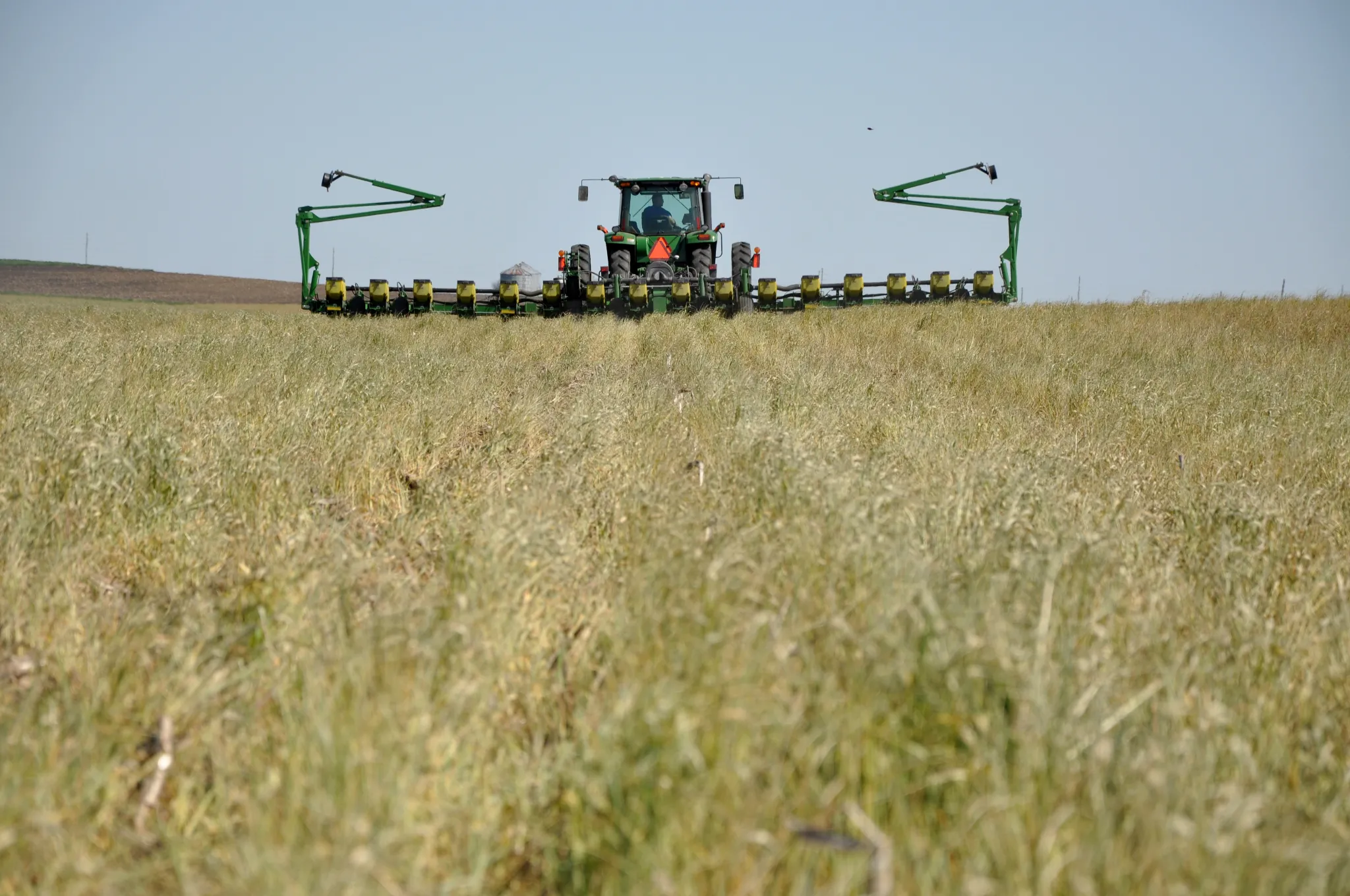
Cover crop for preserving soil structure
A farmer sows soybeans using no-till technology into the residues of a cover crop, winter rye. Plant residues protect the soil surface, and preserving living roots helps maintain porosity and biological activity. Location: north-central Iowa, USA.
Green manures are plants grown not for harvest but to improve the soil. They perform several functions for restoring structure (Walliser, 2020; Pavlis, 2020):
Different root systems. Different green manures have different roots: some deep, some shallow, some fibrous. Alternating green manures with different root systems creates a diversity of pores and channels, as in nature (Walliser, 2020; Gliessman, 2015).
Organic matter. Green manures grow a large biomass that can be incorporated into the soil or left on the surface as mulch. This organic matter feeds microbes and creates “glue” for aggregates (Pavlis, 2020; Littlewood, 2007).
Soil protection. Green manures cover the soil surface, protecting it from raindrop impact, overheating, and erosion. Under the cover of green manures, structure is preserved and restored (Walliser, 2020; Pavlis, 2020).
Food for microbes. Roots of green manures release sugars and other substances that feed microbes. Mycorrhizal fungi form connections with roots, and glomalin accumulates in the soil (Walliser, 2020; Lowenfels & Lewis, 2010).
Loosening dense layers. Some green manures, such as daikon radish, form powerful root crops that penetrate dense layers and loosen them. After these plants die, channels filled with organic matter remain in the soil (Walliser, 2020; Pavlis, 2020).
Note from “Plant Partners” (Walliser, 2020): “Forage radish is not the radish you will find in a salad mix. These long, pointed radishes are valued for their ability to provide biodrainage—a process that uses cover crops to break up compacted soil in order to improve water filtration and gas exchange. Thanks to its long, thick roots, forage radish reduces compaction and serves as an excellent ‘living rotary cultivator.’”
How to use green manures. Sow them after harvest or in gaps between crops. Do not leave the soil bare—green manures should grow whenever there are no main crops. When green manures have grown, cut them and leave them on the surface as mulch or incorporate them into the topsoil (Pavlis, 2020; Walliser, 2020).
Minimal Tillage: Do No Harm
All previous methods work only if we stop destroying structure. Minimal tillage is a principle, not just a method. It means: do not dig unnecessarily, do not turn the soil over, do not destroy aggregates (Pavlis, 2020; Chalker-Scott, 2018).
Why this matters. Every time we dig, we destroy what took years to create. Aggregates, fungal networks, worm burrows, root channels—all this is destroyed by the shovel or plow. After digging, the soil starts from scratch, and its restoration takes months or years (Pavlis, 2020; Ghezzehei, 2012).
What to do instead of digging. There are several alternatives (Pavlis, 2020; Chalker-Scott, 2018):
- Mulching. Instead of digging, simply put organic matter on the surface. Worms and microbes will process it and incorporate it into the soil.
- Green manures. Instead of digging, sow green manures. Their roots will loosen the soil, and the biomass will become mulch.
- Spot loosening. If you need to plant a plant, dig only a hole, not the entire bed. Do not turn the soil over, only push it apart.
- Fork instead of shovel. If you need to loosen the soil, use a fork rather than a shovel. A fork pushes particles apart without turning over the layer.
- Raised beds. Raised beds allow you not to walk on the soil and not to compact it. You work with the bed without stepping on it.
Note from “The Science of Gardening” (Chalker-Scott, 2018): “Modern research in no-till farming shows that this approach should also be used for vegetable gardens. Instead of plowing—which brings weed seeds to the surface and causes erosion and compaction—you can use coarse organic mulch to suppress weeds and prepare the soil for planting.”
What to do if the soil is already compacted. If compaction is severe, mechanical loosening is used. But this must be done carefully and only once, to break up the dense layer. After that—mulch, green manures, worms, minimal tillage. Nature will do the rest (Pavlis, 2020; Chalker-Scott, 2018).
How These Methods Work Together
Restoring structure is not a single action but a system. Here is how it works (Pavlis, 2020; Gliessman, 2015):
1. Stop destroying. Stop digging, do not walk on beds, do not use chemicals.
2. Add organic matter. Compost, manure, leaf mold—on the surface.
3. Cover the soil. Mulch or green manures—always, at any time of year.
4. Keep roots in the soil. Green manures, catch crops, perennials—so that roots work all year round.
5. Attract worms. Worms will come on their own if there is organic matter, moisture, and no digging.
6. Give it time. Structure is not restored in one season. On sandy soils it is faster, on clayey soils slower. But every year will be better.
Note from “The Soul of Soil” (Gershuny & Smillie, 1999): “Soil is a living system. The goal of ecological soil management is to create favorable conditions for life in the soil. Soil can be improved to become better for growing plants, but this is not a question of health in the sense in which animals can be healthy or sick.”
In the next section, we will examine how to check soil structure—simple tests that will help assess the condition of your soil and understand whether it needs improvement.

7-in-1 Wi-Fi Weather Station
Monitor local weather conditions with a wireless outdoor sensor. Track temperature, humidity, rainfall, wind speed and direction, and atmospheric pressure. Ideal for gardens, farms and greenhouses.
- Wireless outdoor sensor
- Solar-powered
- Wi-Fi connectivity
Affiliate link · Check regional compatibility.
7. How to Check Structure: Aggregate in Water, Shovel, Visual Assessment
Before changing anything, it is useful to assess the current state of the soil. The good news is that this does not require a laboratory or complex instruments. A few simple tests that can be done right in the garden will provide enough information to understand what condition the structure is in and whether it needs improvement.
Visual Assessment: What to Look At
The simplest way is to look carefully at the soil and assess its appearance. Here are several signs worth paying attention to (Littlewood, 2007; Gershuny & Smillie, 1999):
Surface after rain. If water infiltrates quickly and puddles do not remain, this is a good sign. If water stands on the surface for hours or runs down the slope, structure is disrupted. Crust on the surface after drying is a sign of destroyed aggregates (Pavlis, 2020; Nonnecke, 1989).
Color. Dark, almost black or dark brown soil is usually rich in organic matter and has good structure. Light, gray, or yellowish soil is often poor in organic matter and has poor structure (Weil, 2017; Troeh & Thompson, 1993).
Crumbs on the surface. If, with light loosening, the soil breaks into rounded crumbs, this is a good sign. If it crumbles into dust or breaks into hard clods, structure is disrupted (Troeh & Thompson, 1993; Mukha et al., 2003).
Indicator plants. Some plants indicate the condition of the soil. For example, chickweed and wood sorrel often grow on dense, acidic soils with poor structure. Couch grass and bindweed—on compacted soils. But nettle and orache prefer loose, organic-rich soils (Gershuny & Smillie, 1999; Littlewood, 2007).
Note from “The Soul of Soil” (Gershuny & Smillie, 1999): “Couch grass indicates a compacted surface or crust. Chickweed—wet, poorly drained soil. Nettle—cultivated, rich soil. Observe weeds: they will tell you more about the condition of the soil than any instrument.”
A hole 30–40 cm deep. Dig a small hole and look at the cross-section. Good soil has crumb structure throughout the profile, roots penetrate it in different directions, and worm burrows are visible. Poor soil is dense, with sharp horizontal layers, and roots bend or are absent (Gershuny & Smillie, 1999; Littlewood, 2007).
The Aggregate-in-Water Test: Checking Aggregate Stability
This simple test shows how resistant aggregates are to destruction by water. This is exactly how soil scientists check structure—using the so-called “water stability test” (Pavlis, 2020; Ghezzehei, 2012).
What you need. Take a clod of dry soil the size of a walnut or golf ball. Prepare a transparent jar or glass of water. The water should be at room temperature (Pavlis, 2020).
How to conduct it. Carefully lower the clod into the water. Do not throw it, do not stir—just let it sit. Observe for 1–5 minutes (Pavlis, 2020; Shukla, 2023).
How to read the result (Pavlis, 2020; Shukla, 2023):
- The clod remains intact—excellent structure. Aggregates are stable, glued by humus, glomalin, or calcium. Rating: 1 (very stable).
- The clod softens slightly but does not fall apart—good structure. Aggregates are sufficiently stable. Rating: 2.
- The clod breaks into several large pieces—average structure. Aggregates are partially destroyed. Rating: 3.
- The clod quickly breaks into small particles—poor structure. Aggregates are destroyed; there is no “glue.” Rating: 4.
- The clod instantly turns into a cloud of turbidity—very poor structure. Soil is dispersed; particles are not glued. Rating: 5.
Note from “Soil Science for Gardeners” (Pavlis, 2020): “The aggregate stability test, also called the Emerson slaking test, is used to assess the quality of structure. Drop a clod of soil into water and observe. A stable aggregate will remain intact. A poorly formed aggregate will fall apart.”
What the result means. If the clod falls apart quickly, it means the soil has little humus, glomalin, or calcium. Such soil needs organic matter and protection from raindrop impact. If the clod remains intact, structure is good, and it needs to be maintained (Pavlis, 2020; Ghezzehei, 2012).
Clarification. For a more accurate assessment, a set of sieves can be used to perform so-called “wet sieving.” But for a gardener, a simple jar test is sufficient (Shukla, 2023; Ghezzehei, 2012).
The Shovel and “Sausage” Test: Assessing Texture and Structure
This test helps assess both texture (the ratio of sand, silt, and clay) and structure (how these particles are glued). It is described in many gardening guides (Troeh & Thompson, 1993; Gershuny & Smillie, 1999; Ingram et al., 2015).
What you need. Take a handful of moist soil (not wet, not dry—like a squeezed sponge). Remove stones, roots, and worms (Gershuny & Smillie, 1999).
Step 1: Roll a ball. Squeeze the soil in your fist. If it does not hold its shape and crumbles, it is sandy soil. If it holds its shape but breaks easily, it is loam. If it rolls into a dense ball, it is clayey soil (Troeh & Thompson, 1993; Ingram et al., 2015).
Step 2: Make a “sausage.” Place the ball on your palm and roll it into a cylinder (“sausage”) 5–10 cm long. Then try to bend it into a ring (Troeh & Thompson, 1993; Gershuny & Smillie, 1999).
- The ring does not form; the “sausage” breaks—sandy soil or sandy loam.
- The ring forms but with cracks—loam.
- The ring forms smoothly, without cracks—clayey soil.
Step 3: Assess “by feel.” Rub a little soil between your fingers (Gershuny & Smillie, 1999; Ingram et al., 2015):
- Sand—individual grains are felt; the soil is rough.
- Silt—resembles flour, smooth but not sticky.
- Clay—sticky, plastic, resembles modeling clay.
Step 4: Assess structure. Look at the “sausage” and the ball. If they break into crumbs, structure is good. If they form a solid dense mass, structure is poor. If they crumble into dust, structure is destroyed (Troeh & Thompson, 1993; Ghezzehei, 2012).
Note from “Soils and Soil Fertility” (Troeh & Thompson, 1993): “Wet clay soil easily molds into a long, strong ‘sausage’ or ‘wire.’ Clay loam will form a ‘sausage,’ but not as long and strong. Some loams can be molded into short ‘sausages,’ while others cannot.”
What the result means. If the soil forms a long “sausage” and ring, it contains a lot of clay. Such soil is potentially fertile but may be dense and poorly drained. If the “sausage” does not form, the soil is sandy—it is well drained but poor in nutrients and moisture (Troeh & Thompson, 1993; Ingram et al., 2015).
Important. This test assesses texture (the ratio of particles), not structure (how these particles are glued). But it gives an idea of the soil’s potential: clayey soils can have good structure if they contain enough organic matter, while sandy soils need organic matter to retain moisture (Gershuny & Smillie, 1999; Pavlis, 2020).
The Wire Test: Assessing Compaction
This test helps assess how compacted the soil is. It is described in guides for gardeners and farmers (Pavlis, 2020; Gershuny & Smillie, 1999).
What you need. Take a sturdy metal wire (for example, from a clothes hanger or garden stake). Length—about 40–50 cm (Pavlis, 2020).
How to conduct it. Push the wire vertically into the soil until it bends or stops. Measure the depth to which it entered (Pavlis, 2020; Gershuny & Smillie, 1999).
How to read the result (Pavlis, 2020; Gershuny & Smillie, 1999):
- The wire enters 30 cm and deeper—good structure, no compaction.
- The wire enters 15–30 cm—moderate compaction, there is work to do.
- The wire enters less than 15 cm—severe compaction, restoration measures are needed.
- The wire bends at the same depth—a plow pan or dense layer is likely.
What the result means. If the wire enters easily and deeply, structure is good. If it hits a dense layer, it means there is compaction or a plow pan there. This limits root growth and water movement (Pavlis, 2020; Chalker-Scott, 2018).
Additional test. You can also use a shovel: if it enters the soil easily and without effort, structure is good. If you have to put your full weight on the shovel, the soil is compacted (Littlewood, 2007; Gershuny & Smillie, 1999).
Counting Earthworms: An Indicator of Soil Health
Worms are living indicators of structure. The more worms, the more active soil life and the better the structure (Pavlis, 2020; Lowenfels & Lewis, 2010).
How to conduct it. Dig a hole 20×20×10 cm. Spread the soil on a light-colored tray or newspaper. Loosen it by hand and count all worms—adults and juveniles (Pavlis, 2020; Gershuny & Smillie, 1999).
How to read the result (Pavlis, 2020; Gershuny & Smillie, 1999):
- 10–15 adult worms—excellent indicator. Soil is healthy, structure is good.
- 5–10 worms—satisfactory. There is work to do.
- Fewer than 5 worms—alarming signal. Soil is poor in organic matter or compacted.
- No worms—serious problem. Urgent restoration measures are needed.
Best time. Late spring or early autumn, when the soil is moist and warm. In heat or cold, worms go deeper, and they are difficult to find (Pavlis, 2020; Gershuny & Smillie, 1999).
Note from “The Soul of Soil” (Gershuny & Smillie, 1999): “Assessing the earthworm population is a valuable barometer of soil biological activity and the overall health of the system. Measure an area of 30×30 cm and dig to a depth of 15 cm, placing everything in a bucket. You should find at least ten earthworms in that amount of good, healthy soil.”
Water Permeability Test: How Quickly Water Leaves
This test shows how well water infiltrates the soil. It is described in guides for gardeners and farmers (Pavlis, 2020; Gershuny & Smillie, 1999).
How to conduct it. Dig a hole 30 cm deep and 30 cm wide. Fill it with water to the brim. Let the water completely drain. Then fill it again and time how long it takes for the water to leave (Pavlis, 2020; Gershuny & Smillie, 1999).
How to read the result (Pavlis, 2020; Gershuny & Smillie, 1999):
- Water leaves in 2–4 hours—excellent structure. Drainage and infiltration are normal.
- Water leaves in 4–8 hours—satisfactory. There are minor problems.
- Water leaves in more than 8 hours—poor structure. Compaction, crust, or a high groundwater level.
- Water leaves in less than 1 hour—soil is too sandy; water is not retained.
What the result means. If water leaves quickly, structure is good. If water stands, it means there is a dense layer, crust, or compaction. This limits water access to roots and can cause waterlogging (Pavlis, 2020; Gershuny & Smillie, 1999).
Comprehensive Assessment: Summary Table
Here is a brief summary of all tests and their results (Pavlis, 2020; Gershuny & Smillie, 1999; Littlewood, 2007; Troeh & Thompson, 1993):
| Test | Good result | Poor result |
|---|---|---|
| Visual | Dark, crumbly, water infiltrates | Light, silty, water stands |
| Clod in water | Remains intact 5+ minutes | Falls apart within 1 minute |
| “Sausage” | Forms but breaks into crumbs | Solid dense mass or dust |
| Wire | Enters 30+ cm | Enters less than 15 cm |
| Worms | 10–15 per 20×20×10 cm | Fewer than 5 |
| Water in hole | Leaves in 2–4 hours | Leaves in more than 8 hours |
What to Do with the Results
If the tests show good structure—maintain it. Mulch, sow green manures, do not dig unnecessarily, return organic matter (Pavlis, 2020; Chalker-Scott, 2018).
If structure is disrupted—do not despair. Restoration is possible. Start with mulch and green manures. Stop digging. Attract worms. In a year or two you will see improvement (Pavlis, 2020; Gershuny & Smillie, 1999).
Note from “The Organic Gardener's Handbook” (Littlewood, 2007): “Good structure: roots penetrate deeply, sweet earthy smell, water does not remain in the hole after rain, soil digs relatively easily, no hard ‘shell’ in the upper layer, many worm burrows, the upper layers are crumbly and loose both when wet and when dry.”
In the next section, we will examine regional aspects—how soil structure behaves in different climatic zones and on different soil types.
8. Regional Aspect: Clayey, Sandy, Tropical Soils
Soil structure is a universal concept, but its behavior varies greatly depending on climate and soil type. What works in the temperate zone may not work in the tropics or in an arid region. In this section, we will examine how structure forms, breaks down, and is restored under different conditions.
Clayey Soils: Structure Breaks Down Faster
Clayey soils are soils with a high content of particles smaller than 0.002 mm. They have an enormous specific surface area and a high ability to retain water and nutrients. But they also have a downside: clayey soils are very vulnerable to structure destruction (Weil, 2017; Troeh & Thompson, 1993).
Why clay breaks down faster. Clay particles are plate-shaped and negatively charged. When there is a lot of sodium in the soil or when it is subjected to mechanical impact in a wet state, clay plates come closer together and stick into a solid mass. Pores disappear, and the soil turns into a dense, almost waterproof layer (Mukha et al., 2003; Ghezzehei, 2012).
The problem of swelling and shrinkage. Many clay minerals (especially montmorillonite) have the property of swelling when moistened and shrinking when dried. When swelling, volume can increase by 30–150%. This creates enormous pressure that destroys aggregates and compacts the soil. When drying, deep cracks form that tear plant roots (Mukha et al., 2003; Shukla, 2023).
Note from “Agrosoil Science” (Mukha et al., 2003): “Swelling is closely related to the composition of clay minerals in the soil. Minerals of the montmorillonite group with an expanding crystal lattice have the greatest swelling capacity, while minerals of the kaolinite group have the least. When soils are saturated with monovalent bases (especially sodium), swelling reaches 120–150%.”
What to do. Clayey soils need a special approach (Pavlis, 2020; Gershuny & Smillie, 1999):
- Do not dig when wet. This is the main rule. Wet clay turns into a sticky mass that hardens into clods as it dries.
- Apply organic matter. Compost, manure, leaf mold—all of this loosens clay, creates pores, and feeds microbes.
- Mulch. Mulch protects the surface from raindrop impact and drying out.
- Use gypsum. Calcium from gypsum replaces sodium on clay particles, promoting aggregate formation. But gypsum is effective only on solonetzic soils (Pavlis, 2020; Weil, 2017).
- Sow green manures. Roots of green manures penetrate dense clay, creating channels. After the roots die, pores filled with organic matter remain.
Good news. Clayey soils are potentially very fertile. They retain nutrients and water better than sandy soils. If their structure is improved, they become among the most productive (Troeh & Thompson, 1993; Weil, 2017).
Sandy Soils: Structure Is Harder to Restore
Sandy soils consist of large particles (0.05–2.0 mm) that do not stick to one another. They have little specific surface area and retain water and nutrients poorly. Structure in sandy soils forms more slowly and is restored with more difficulty than in clayey soils (Troeh & Thompson, 1993; Pavlis, 2020).
Why sand does not hold structure. Sand particles are too large to be held together by electrostatic forces. They do not form aggregates without “glue”—organic matter or oxides. If there is little organic matter, sand remains loose, like on a beach. Water passes through it instantly, carrying nutrients away (Troeh & Thompson, 1993; Weil, 2017).
The problem of rapid organic matter decomposition. In sandy soils, organic matter decomposes faster than in clayey soils because there is more oxygen and better aeration. Microbes work more actively, and humus does not accumulate. To maintain structure, organic matter must be added constantly (Pavlis, 2020; Gershuny & Smillie, 1999).
Note from “The Soul of Soil” (Gershuny & Smillie, 1999): “Sandy soils, as a rule, are easy to cultivate and well drained, but have a poor ability to retain nutrients and moisture. Their very high aeration means that organic matter decomposes too quickly, and little stable humus is formed.”
What to do. Sandy soils need constant addition of organic matter (Pavlis, 2020; Littlewood, 2007):
- Compost and manure. Apply large amounts—sand “eats” organic matter quickly.
- Mulch. A layer of 10–15 cm to protect the surface and feed microbes.
- Green manures. Plants with powerful roots, such as rye or lupine, will add organic matter and bind the sand.
- Clay. Adding clay can improve the structure of sand, but it requires large quantities and thorough mixing (Pavlis, 2020).
- Biochar. Charcoal added to sandy soil retains water and nutrients, creating something like structure (Chalker-Scott, 2018).
Good news. Sandy soils are easy to cultivate, warm up quickly in spring, and are well drained. If organic matter is added, they become excellent for many crops (Troeh & Thompson, 1993; Nonnecke, 1989).
Tropical Soils: Heavy Rains Destroy Structure
In the tropics, soil structure undergoes special challenges. High temperatures, abundant precipitation, and intense weathering create conditions that do not exist in the temperate zone (Weil, 2017; Gliessman, 2015).
Heavy rains and erosion. Tropical rains are not drizzle but downpours with large drops that fall with enormous force. The impact of drops destroys aggregates on the surface, and small particles fill the pores. Crust forms, water does not infiltrate, and erosion begins. In one downpour, a layer of soil that took years to form can be washed away (Weil, 2017; Hasanuzzaman, 2019).
Rapid decomposition of organic matter. In a warm and humid climate, microbes work all year round. Organic matter decomposes 3–5 times faster than in the temperate zone. Humus does not accumulate, and the soil loses its “glue” for aggregates (Weil, 2017; Gliessman, 2015).
Lateritization. In humid tropics with alternating wet and dry seasons, lateritization occurs—a process in which iron and aluminum oxides accumulate and cement the soil. When dried, such soil turns into a hard, brick-like mass—laterite. Restoring structure after lateritization is practically impossible (Valkov et al., 2004; Weil, 2017).
Note from “Soil Science” (Valkov et al., 2004): “Ferrallitic soils predominate in the tropics. As a result of lateritic soil formation, various soils form—from red soils and yellow soils to typical ferrallitic soils of humid tropics. These soils often have low fertility and are prone to rapid degradation when used improperly.”
What to do. In the tropics, the following are especially important (Gliessman, 2015; Weil, 2017):
- Permanent plant cover. Do not leave the soil bare for a single day. Mulch, green manures, cover crops—anything that protects the surface.
- Minimal tillage. Do not dig. Every intervention destroys structure that is already fragile.
- Agroforestry. Trees create shade, protect from raindrop impact, their roots hold the soil, and leaf litter feeds microbes (Gliessman, 2015; Gershuny & Smillie, 1999).
- Organic matter. Apply compost and mulch constantly because organic matter decomposes quickly.
- Terracing. On slopes, terraces prevent erosion and conserve water (Gershuny & Smillie, 1999).
Good news. Tropical soils can be very productive if managed properly. Natural tropical ecosystems are among the most productive on Earth. The secret is to maintain a constant cycle of organic matter and not leave the soil bare (Gliessman, 2015; Weil, 2017).
Arid and Semi-Arid Soils: Salts and Crusts
In arid and semi-arid regions, soil structure suffers from other problems. Low precipitation, high evaporation, and salt accumulation all affect structure (Weil, 2017; Gershuny & Smillie, 1999).
Salinization. In arid regions, water rises through capillaries and evaporates, leaving salts on the surface. Sodium destroys aggregates by dispersing clay particles. The soil slakes, loses pores, and becomes covered with a white salt crust (Weil, 2017; Mukha et al., 2003).
Crust formation. Rain in arid regions often falls rarely but intensely. The impact of drops destroys surface aggregates, and crust forms. Water does not infiltrate, and plants suffer from drought even after rain (Pavlis, 2020; Nonnecke, 1989).
Low organic matter content. In deserts and semi-deserts, vegetation is sparse, and there is little organic matter in the soil. Without organic matter, structure does not form. The soil remains silty or dense (Weil, 2017; Gershuny & Smillie, 1999).
Note from “The Soul of Soil” (Gershuny & Smillie, 1999): “In arid regions, soils are usually rich in minerals and very productive under irrigation. However, improper irrigation can lead to salinization. Water rises to the surface through capillaries and evaporates, leaving salts. This is one of the main problems of irrigated agriculture in arid zones.”
What to do. In arid regions, the following are especially important (Pavlis, 2020; Gershuny & Smillie, 1999):
- Mulch. A thick layer of mulch protects from evaporation and raindrop impact.
- Organic matter. Compost and manure improve structure and retain water.
- Drainage. Good drainage prevents salt accumulation.
- Leaching. Periodically wash the soil with large amounts of water to flush salts deeper (Pavlis, 2020).
- Salt-tolerant plants. If salinization is severe, plant crops that tolerate salts (Hasanuzzaman, 2019).
Temperate Zone: Balance and Stability
In the temperate zone, conditions for structure are most favorable. Moderate temperatures, sufficient moisture, and seasonal cycles of freezing-thawing and wetting-drying promote the formation and restoration of aggregates (Weil, 2017; Troeh & Thompson, 1993).
Freeze-thaw cycles. In winter, water in pores freezes, expands, and pushes particles apart. In spring, the ice melts, and the soil becomes looser. This process is called frost heaving and helps form structure (Troeh & Thompson, 1993; Mukha et al., 2003).
Wetting-drying cycles. In summer, the soil periodically becomes wet and dries. When drying, clay particles come closer together and stick, forming aggregates. When moistened, they swell but do not break down if organic matter is present (Ghezzehei, 2012; Shukla, 2023).
Organic matter accumulates. In the temperate zone, organic matter decomposes more slowly than in the tropics and faster than in the tundra. This creates a balance: enough organic matter for structure, but not too much to cause waterlogging (Weil, 2017; Gershuny & Smillie, 1999).
What to do. In the temperate zone, it is enough to follow general principles: mulch, organic matter, minimal tillage, green manures, worms. Nature itself will help restore structure (Pavlis, 2020; Littlewood, 2007).
Summary Table: Regional Features
| Region | Main problems | What to do |
|---|---|---|
| Clayey soils | Swelling, compaction, clods | Organic matter, mulch, gypsum, do not dig when wet |
| Sandy soils | Rapid organic matter decomposition, looseness | Lots of organic matter, mulch, green manures, biochar |
| Tropics | Heavy rains, erosion, lateritization, rapid decomposition | Permanent cover, agroforestry, mulch |
| Arid regions | Salinization, crusts, little organic matter | Mulch, organic matter, drainage, leaching |
| Temperate zone | Seasonal cycles, compaction | Mulch, organic matter, minimal tillage |
Universal Principles
Despite regional differences, there are several principles that work everywhere (Pavlis, 2020; Gershuny & Smillie, 1999; Gliessman, 2015):
1. Do not leave the soil bare. Mulch or plants—always.
2. Add organic matter. Compost, manure, leaf mold—everywhere and always.
3. Do not dig unnecessarily. Minimal tillage preserves structure.
4. Keep roots in the soil. Green manures, cover crops, perennials.
5. Attract worms. They work for free and effectively.
6. Give it time. Structure is not restored in one season. On sandy soils it is faster, on clayey soils slower. But every year will be better.
Note from “Agroecology” (Gliessman, 2015): “Sustainable soil management requires understanding local conditions. What works in one region may not work in another. But the principles remain the same: protect the soil, feed it with organic matter, and do not disturb its structure unnecessarily.”
In the next and final section, we will summarize and once again emphasize the main idea: structure is the “skeleton” of soil, without which neither water, nor air, nor nutrition works.

40W Full Spectrum LED Grow Light
Support healthy plant growth with full-spectrum LED lighting. Ideal for seedlings, indoor plants and small growing spaces. A practical solution for indoor gardening and year-round cultivation.
- Full-spectrum LED
- Energy-efficient design
- Indoor plant growing
Affiliate link · Check actual power and light coverage.
9. Conclusion: Structure Is the “Skeleton” of Soil
We have traveled from microscopic clay domains to regional features, from the clod-in-water test to the role of earthworms. It is time to bring everything together and formulate the main point.
Structure Is the Architecture of Fertility
Soil is not just a mixture of mineral particles, water, and air. It is a living, breathing, structured system in which every particle occupies its place, and the voids between them are not an “absence of material” but a vitally important space (Weil, 2017; Ghezzehei, 2012).
Soil structure is its skeleton. Without a skeleton, a body cannot stand. Without structure, soil cannot:
- retain water and give it to roots;
- let air through to roots and microbes;
- accumulate and process organic matter;
- resist erosion and compaction;
- support the life of billions of microorganisms (Gliessman, 2015; Pavlis, 2020).
It is structure that turns “just earth” into fertile soil. You can add as much fertilizer as you like, but if structure is destroyed, nutrients will not reach the roots. You can water every day, but if water does not infiltrate, plants will suffer from drought (Connor et al., 2011; Pavlis, 2020).
Three Main Conclusions
First: structure matters more than it seems. Gardeners often assess soil by color, texture, or nutrient content. But it is structure that determines how all other parameters work. Good structure is not a “bonus” but a foundation (Weil, 2017; Gershuny & Smillie, 1999).
Second: structure is created by life. Aggregates do not form by themselves. They are glued by humus, glomalin, root exudates, and bacterial slimes. They are created by worms, fungi, and roots. Soil is a living system, and its structure is a product of that life (Lowenfels & Lewis, 2010; Ghezzehei, 2012).
Third: structure can be restored. Even heavily degraded soil can be brought back to life. It takes time, patience, and the right actions, but it is possible. Nature strives for equilibrium—we only need to help it (Pavlis, 2020; Gliessman, 2015).
Note from “The Soul of Soil” (Gershuny & Smillie, 1999): “Soil is a living system. The main goal of ecological soil management is to create favorable conditions for life in the soil. Soil can be improved to become better for growing plants, but this is not a question of health in the sense in which animals can be healthy or sick.”
What to Do: A Brief Guide
If you want to preserve or restore soil structure, here are several simple steps (Pavlis, 2020; Chalker-Scott, 2018; Gliessman, 2015):
1. Stop destroying. Do not dig unnecessarily. Do not walk on beds. Do not use chemicals unless necessary.
2. Add organic matter. Compost, manure, leaf mold—on the surface, regularly.
3. Mulch. Always, at any time of year. Mulch protects and feeds.
4. Keep roots in the soil. Green manures, cover crops, perennials.
5. Attract worms. They will come on their own if there is organic matter, moisture, and no digging.
6. Observe and test. The clod-in-water test, worm counts, visual assessment—simple tools that will help you understand what is happening.
7. Give it time. Structure is not restored in one season. But every year will be better.
Regional Perspective
Different regions—different challenges. Clayey soils break down faster; sandy soils are harder to restore. Tropical downpours wash away structure; arid regions suffer from salts and crusts. But the principles are the same everywhere: protection, organic matter, minimal intervention, living roots (Weil, 2017; Gliessman, 2015; Pavlis, 2020).
Final Thought
Soil is not “dirt underfoot.” It is a living, breathing, structured world that feeds us. Structure is its skeleton. If we care about structure, we care about fertility. If we destroy structure, we destroy the very foundation of life on Earth.
Note from “The Nature and Properties of Soils” (Weil, 2017): “Earth—our only home in the universe—is unique because of the living systems supported by its air, water, and soil resources. Among the millions of life forms on our planet, one species, the human species, has become so dominant that the quality of these resources now depends on whether this species can learn to show a completely new level of care.”
May your soil be crumbly, porous, and alive. May it contain worms, fungi, and billions of bacteria. May it retain water, let air through, and feed your plants. And may every season bring improvement.
Structure is the skeleton of soil. Take care of it—and it will repay you with a harvest.
References
- (2014). ‘Soil’, in Agroecology. : CRC Press, 108-123. doi: 10.1201/b17881-13
- (2015). ‘Summary’, in Ingram, D.S., Vince-Prue, Daphne, Gregory, P.J. (ed.) Science and the Garden. The scientific basis of horticultural practice. West Sussex, UK: Royal Horticulture Society. Wiley Blackwell, pp. 75-85.
- Ahmed, Niaz, Masood, Sajid, Ahmad, Shakeel, Bashir, Safdar, Hussain, Sajjad, Hassan, Waseem, Khandekar, R.Islam, Hussain, Baqir, Ali, M.Arif (2019). ‘Soil Management for Better Crop Production and Sustainable Agriculture’, in Agronomic Crops. Singapore: Springer Singapore, 47-71. doi: 10.1007/978-981-32-9783-8_4
- Bubel, Nancy, Nick, Jean (2024). ‘Moving Plants Outdoors’, in The New Seed-Starters Handbook. : Rodale, .
- Chalker-Scott, Linda (2015). ‘The Underground Railroad’, in How Plants Work. Portland, London: Timber Press, pp. 38-59.
- Chalker-Scott, Linda (2018). ‘Living Soils: Bacteria and Fungi’, in The Science of Gardening. Course Guidebook. Chantilly, Virginia: The Great Courses, pp. 37-45.
- Chalker-Scott, Linda (2018). ‘Soil Preparation and Protection’, in The Science of Gardening. Course Guidebook. Chantilly, Virginia: The Great Courses, pp. 73-80.
- Chalker-Scott, Linda (2018). ‘The Truth about Mulch’, in The Science of Gardening. Course Guidebook. Chantilly, Virginia: The Great Courses, pp. 81-89.
- Connor, D.J., Loomis, R.S., Cassman, K.G. (2011). ‘Soil resources’, in Crop Ecology. Productivity and Management in Agricultural Systems. Cambridge, UK: Cambridge University Press, pp. 159-194.
- Gershuny, Grace, Smillie, Joe (1999). ‘Observing and Evaluating Your Soil’, in The Soul of Soil. A Soil-Building Guide for Master Gardeners and Farmers. Vermont: Chelsea Green Publishing, .
- Gershuny, Grace, Smillie, Joe (1999). ‘Soil Management Practices’, in The Soul of Soil. A Soil-Building Guide for Master Gardeners and Farmers. Vermont: Chelsea Green Publishing, .
- Gershuny, Grace, Smillie, Joe (1999). ‘Understanding the Soil Ecosystem’, in The Soul of Soil. A Soil-Building Guide for Master Gardeners and Farmers. Vermont: Chelsea Green Publishing, .
- Ghezzehei, T.A. (2012). ‘Soil Structure’, in Huang, P.Ming, Li, Yuncong, Sumner, M.E. (ed.) Handbook of Soil Sciences Properties and Processes. Boca Raton, FL: CRC Press, pp. 2-1:2-17.
- Hemenway, Toby (2009). ‘Bringing the Soil to Life’, in Gaia's Garden. A Guide To Home-Scale Permaculture. : Chelsea Green Publishing, .
- Johnson, Noelle (2023). ‘Planting Basics for Dry Regions’, in Dry Climate Gardening. Beverly, MA: Cool Springs Press, .
- Johnson, Noelle (2025). ‘Building Drought-Resistant Soil’, in The Water-Smart Garden. Beverly, MA: Cool Springs Press, .
- Littlewood, Michael (2007). ‘The Ground’, in The organic gardener's handbook. Ramsbury, Wiltshire: The Crowood Press, pp. 59-102.
- Lowenfels, Jeff, Lewis, Wayne (2010). ‘Classic Soil Science’, in Teaming with Microbes. The Organic Gardener’s Guide to the Soil Food Web. Portland, Oregon: Timber Press, .
- Lowenfels, Jeff, Lewis, Wayne (2010). ‘Earthworms’, in Teaming with Microbes. The Organic Gardener’s Guide to the Soil Food Web. Portland, Oregon: Timber Press, .
- Lowenfels, Jeff, Lewis, Wayne (2010). ‘Mycorrhizal Fungi’, in Teaming with Microbes. The Organic Gardener’s Guide to the Soil Food Web. Portland, Oregon: Timber Press, .
- Morgan, Sally (2021). ‘Building a healthy soil’, in The Healthy Vegetable Garden: A natural, chemical-free approach to soil, biodiversity and managing pests and diseases. Vermont, London, UK: Chelsea Green Publishing, .
- Nonnecke, Libner (1989). ‘Soils’, in Vegetable production. New York, USA: Van Nostrand Reinhold, pp. 44-65.
- Pavlis, Robert (2020). ‘Solving Soil Problems’, in Soil Science for Gardeners. Working with Nature to Build Soil Health. Gabriola Island, BC, Canada: New Society Publishers, pp. 97-178.
- Pavlis, Robert (2020). ‘Understanding Soil’, in Soil Science for Gardeners. Working with Nature to Build Soil Health. Gabriola Island, BC, Canada: New Society Publishers, pp. 9-96.
- Pratt, M.M. (2005). ‘Looking After the Soil – the Balanced Approach’, in Practical Science for Gardeners. Portland, Oregon: Timber Press, pp. 61-80.
- Shukla, M.K. (2023). ‘Characteristics of Soils of the Vadose Zone’, in Soil Physics. An Introduction. Boca Raton, FL: CRC Press, pp. 23-54.
- Troeh, F.R., Thompson, L.M. (1993). ‘Physical Properties of Soils’, in Soil and Soil Fertility. New York, NY: Oxford University Press, pp. 37-64.
- Walliser, Jessica (2020). ‘Soil Preparation & Conditioning’, in Plant Partners. North Adams, MA: Storey Publishing, pp. 27-48.
- Weil, R.R., Brady, N.C. (2017). ‘The Soils Around Us’, in The Nature and Properties of Soils. Essex, UK: Pearson Education, pp. 19-50.
- Вальков, В.Ф., Казеев, К.Ш., Колесников, С.И. (2004). ‘Состав и свойства почв [Soil composition and properties]’, in Почвоведение [Soil science]. Москва - Ростов-на-Дону: МарТ, pp. 9-170.
- Муха, В.Д., Картамышев, Н.И., Муха, Д.В. (2003). ‘Почва как многофазная полидисперсная система [Soil as a Multiphase Polydisperse System]’, in Агропочвоведение [Agropedology]. Москва: КолосС, pp. 29-40.
- Траннуа, Павел (2018). ‘Почва участка [Site soil]’, in Сад и огород в рисунках и комиксах: полная наглядная энциклопедия [The Garden and Vegetable Patch in Drawings and Comics: A Comprehensive Visual Encyclopedia]. Москва: Издательство «Э», pp. 16-22.
